SEC ends Biden-era probe into tokenized equity platform Ondo Finance

cointelegraphPubblicato 2025-12-08Pubblicato ultima volta 2025-12-08

Introduzione

The US Securities and Exchange Commission (SEC) has closed its investigation into Ondo Finance, a tokenization platform, without filing any charges. The probe, initiated in 2023 under former Chair Gary Gensler, examined whether Ondo’s tokenization of real-world assets complied with federal securities laws and if its ONDO token constituted a security. Ondo described the decision as part of a broader shift in US policy toward real-world asset tokenization, signaling a new chapter where tokenized securities may become integral to US capital markets. The company emphasized its early and large-scale focus on tokenizing publicly listed equities, which attracted regulatory scrutiny. While many US-based tokenization platforms currently serve overseas markets—particularly in Europe—due to regulatory constraints, the resolution of the SEC investigation raises questions about whether firms like Ondo may begin offering services to US clients. The news follows recent regulatory approvals for Ondo and competitor Securitize to operate in Europe.

The US Securities and Exchange Commission has officially dropped its investigation into the New York-based tokenization platform Ondo Finance, which it initiated in 2023.

Ondo Finance has received formal notice that a confidential, multi-year SEC investigation into the platform has been closed without any charges, the company announced on Monday.

“The probe examined whether Ondo’s tokenization of certain real-world assets complied with federal securities laws as well as whether the ONDO token was a security,” the statement said.

The SEC’s decision to end the investigation reflects a broader shift in the US policy regarding real-world asset (RWA) tokenization, bringing it on the authority’s formal agenda, Ondo noted.

A new chapter of tokenization in the US

According to a report by Crypto in America, the SEC initially opened the probe in October 2023 under former SEC Chair Gary Gensler, who was known for his stringent stance toward the crypto industry.

However, since Paul Atkins took over as SEC chair, the agency has closed a number of crypto-related cases involving major companies, including Coinbase, Ripple and Kraken.

“When the inquiry began in 2024, the US regulatory environment for digital assets was defined by caution, confusion, and occasionally overbroad enforcement actions,” Ondo Finance said in its blog post.
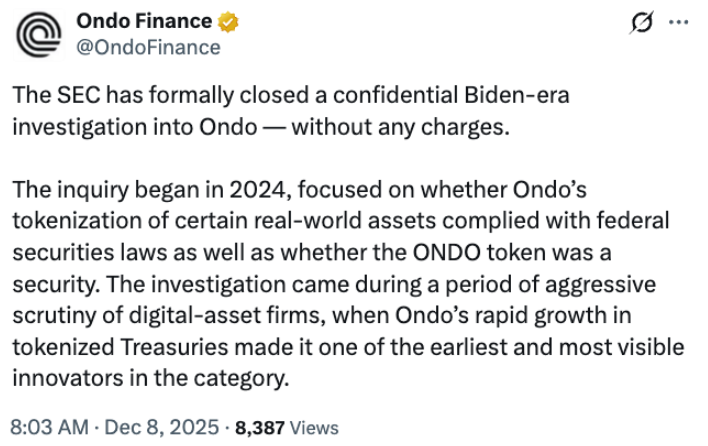
Source: Ondo Finance

Against that backdrop, Ondo was “one of the only firms focused on tokenizing publicly listed equities at scale,” it said, adding: “Being early, and being successful, came with scrutiny.”

According to Ondo, the resolution of the SEC inquiry marks the end of one chapter for Ondo and the beginning of another, where tokenized securities become a “core part of the US capital markets.”

“The future of global finance, including U.S. capital markets, will be onchain and Ondo will help lead that transition,” Ondo said.

Most US tokenization platforms serve overseas markets

The news comes as most tokenization platforms offer tokenized equity products primarily to customers outside the US, including firms such as Kraken-owned Backed, the issuer of xStocks.

While these platforms tokenize major US-listed stocks and exchange-traded funds (ETFs), many of the offerings are aimed at clients located overseas, particularly in Europe.

“The reality is that users in the US already have relatively seamless access to traditional equities such as stocks and ETFs through well-established brokerage platforms,” Alchemy Pay chief marketing officer Ailona Tsik told Cointelegraph in June.

Following the SEC probe’s resolution, it remains to be seen whether RWA platforms like Ondo will begin offering services to US-based clients.

Related: WisdomTree brings options income strategy onchain with new tokenized fund

The news came shortly after Ondo Global Markets received regulatory approval to offer tokenized stocks to European investors in November.

Securitize, a rival US tokenization platform, also obtained regulatory approval to operate as both an Investment Firm and a Trading & Settlement System (TSS) in the EU on Nov. 26. According to the company, the approval positioned it as one of the first operators for regulated digital securities infrastructure in both the US and EU.

Magazine: When privacy and AML laws conflict: Crypto projects’ impossible choice


Crypto di tendenza

Letture associate

RIP: Atlas, Which Lived Only 292 Days

On August 9, 2026, OpenAI discontinued its standalone AI browser, Atlas, just 292 days after its launch on October 21, 2025. Initially positioned as a challenger to Chrome and the broader AI browser ecosystem, Atlas aimed to fundamentally redesign how users interact with browsers by deeply integrating ChatGPT. Its features included an AI-powered address bar, a sidebar for webpage analysis, Browser Memories for context retention, and an Agent Mode to automate multi-step tasks like shopping and research. Despite building on Chromium with a custom OWL (OpenAI Web Layer) framework, OpenAI struggled with the immense complexity of maintaining a full-fledged browser. The team spent significant time addressing basic functionalities—password managers, extensions, input methods—that mainstream browsers already handled seamlessly. Atlas's core AI agent capabilities also faced issues with reliability, speed, and security vulnerabilities like prompt injection. Furthermore, Atlas was limited to Apple Silicon Macs, failing to release promised Windows, iOS, and Android versions. This, coupled with the high switching cost for users entrenched in Chrome or Edge's ecosystems, hindered its adoption. By mid-2026, updates slowed, and OpenAI announced its shutdown, opting to integrate Atlas's AI explorations into the ChatGPT desktop app and browser extensions instead. The article contrasts two AI browser development paths: standalone products like Atlas, Perplexity's Comet, and Dia, which redesign the browser around AI but face user migration barriers; and the approach of incumbents like Chrome and Edge, which add AI features atop existing, widely-used platforms. The key question remains whether users need a completely new "AI browser" or simply AI capabilities within their current browser. While Atlas's experiment ended, the broader trend of AI integration into browsing continues.

marsbit24 min fa

RIP: Atlas, Which Lived Only 292 Days

marsbit24 min fa

Bitcoin's "Anti-Spam" Update Failed, Lasting Less Than a Day

A Bitcoin update proposal aimed at curbing spam by temporarily banning non-financial data from being stored on the network, BIP-110, has failed decisively. After months of debate, developers attempted to launch a separate blockchain, which collapsed within a day. The failure stemmed from a critical lack of miner support, with less than 1% signaling approval for the update. The vast majority of miners chose to continue mining the main Bitcoin blockchain without providing explanations. Despite this, the initiative's developers proceeded to launch an alternative blockchain—a hard fork of Bitcoin—on August 8. This meant a small subset of miners stopped mining Bitcoin to support the new chain with BIP-110 changes. However, the new network inherited Bitcoin's mining difficulty. With only a tiny fraction of the total computational power, block times stretched to roughly 7 hours instead of the standard 10 minutes, rendering the network practically non-functional. Michael Saylor, founder of major corporate Bitcoin holder MicroStrategy and a vocal opponent of BIP-110, commented: "Bitcoin worked exactly as designed. The BIP-110 fork occurred, and network participants were free to choose which chain to follow. As a result, about 99.85% of the network's hash power remained with Bitcoin." The event had no significant impact on Bitcoin's price, which traded in a narrow range between approximately $64.5k and $65.5k from August 7 through August 10.

cryptonews.ru30 min fa

Bitcoin's "Anti-Spam" Update Failed, Lasting Less Than a Day

cryptonews.ru30 min fa

Trading

Spot

Articoli Popolari

Come comprare ONDO

Benvenuto in HTX.com! Abbiamo reso l'acquisto di OndoFinance (ONDO) semplice e conveniente. Segui la nostra guida passo passo per intraprendere il tuo viaggio nel mondo delle criptovalute.Step 1: Crea il tuo Account HTXUsa la tua email o numero di telefono per registrarti il tuo account gratuito su HTX. Vivi un'esperienza facile e sblocca tutte le funzionalità,Crea il mio accountStep 2: Vai in Acquista crypto e seleziona il tuo metodo di pagamentoCarta di credito/debito: utilizza la tua Visa o Mastercard per acquistare immediatamente OndoFinanceONDO.Bilancio: Usa i fondi dal bilancio del tuo account HTX per fare trading senza problemi.Terze parti: abbiamo aggiunto metodi di pagamento molto utilizzati come Google Pay e Apple Pay per maggiore comodità.P2P: Fai trading direttamente con altri utenti HTX.Over-the-Counter (OTC): Offriamo servizi su misura e tassi di cambio competitivi per i trader.Step 3: Conserva OndoFinance (ONDO)Dopo aver acquistato OndoFinance (ONDO), conserva nel tuo account HTX. In alternativa, puoi inviare tramite trasferimento blockchain o scambiare per altre criptovalute.Step 4: Scambia OndoFinance (ONDO)Scambia facilmente OndoFinance (ONDO) nel mercato spot di HTX. Accedi al tuo account, seleziona la tua coppia di trading, esegui le tue operazioni e monitora in tempo reale. Offriamo un'esperienza user-friendly sia per chi ha appena iniziato che per i trader più esperti.

440 Totale visualizzazioniPubblicato il 2024.12.12Aggiornato il 2026.06.02

Come comprare ONDO

Discussioni

Benvenuto nella Community HTX. Qui puoi rimanere informato sugli ultimi sviluppi della piattaforma e accedere ad approfondimenti esperti sul mercato. Le opinioni degli utenti sul prezzo di ONDO ONDO sono presentate come di seguito.

活动图片