SEC Drops Case, CZ Pardoned, Justin Sun Settles: Trump's Crypto Business Gains Momentum

marsbitPubblicato 2026-03-09Pubblicato ultima volta 2026-03-09

Introduzione

On March 5, Justin Sun reached a $10 million settlement with the SEC to resolve a civil fraud lawsuit, without admitting wrongdoing. This follows a broader trend of regulatory easing under the Trump administration, including the dismissal of the SEC’s case against Binance and the presidential pardon of its founder, CZ. A Reuters analysis reveals that Trump-affiliated crypto ventures, particularly World Liberty Financial’s token and the USD1 stablecoin, have significantly benefited from this regulatory pullback. Trump’s businesses reportedly earned $802 million from crypto in the first half of 2025. USD1, now the sixth-largest stablecoin with $4.4 billion in circulation, has become a key revenue generator. The article highlights a feedback loop: reduced regulatory friction boosts market activity, from which Trump-linked tokenomics directly profit through structured revenue-sharing and distribution advantages. This has raised concerns over potential conflicts of interest, even without evidence of direct coordination. While the broader U.S. crypto market benefits secondarily, the most concentrated gains flow to Trump’s ecosystem.

Author: CryptoSlate

Compiled by: Deep Tide TechFlow

Deep Tide Insight: This article goes beyond simply reporting Justin Sun's settlement with the SEC, placing this $10 million resolution within a broader policy context—since President Trump took office, the SEC's enforcement pressure on crypto giants has systematically receded, with the primary beneficiary being Trump's own token and stablecoin projects. Using quantifiable data ($802 million in revenue, $4.4 billion USD1 circulation), the article outlines the transmission mechanism between policy and private gain, making it essential reading for anyone tracking the direction of U.S. crypto regulation.

Full Text:

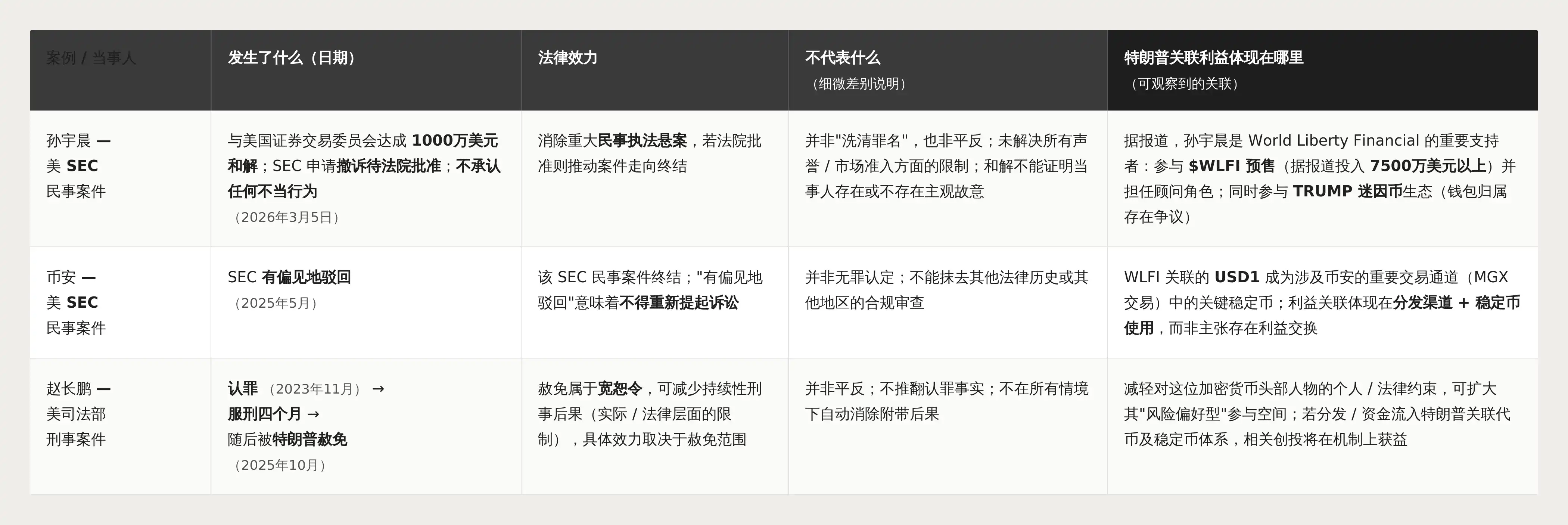
On March 5th, Justin Sun reached a $10 million settlement with the SEC, resolving a civil fraud lawsuit. The case accused him of profiting $31 million through wash trading-like operations and undisclosed celebrity promotions.

The settlement, which requires court approval and does not include any admission of wrongdoing, will lead to the dismissal of the case.

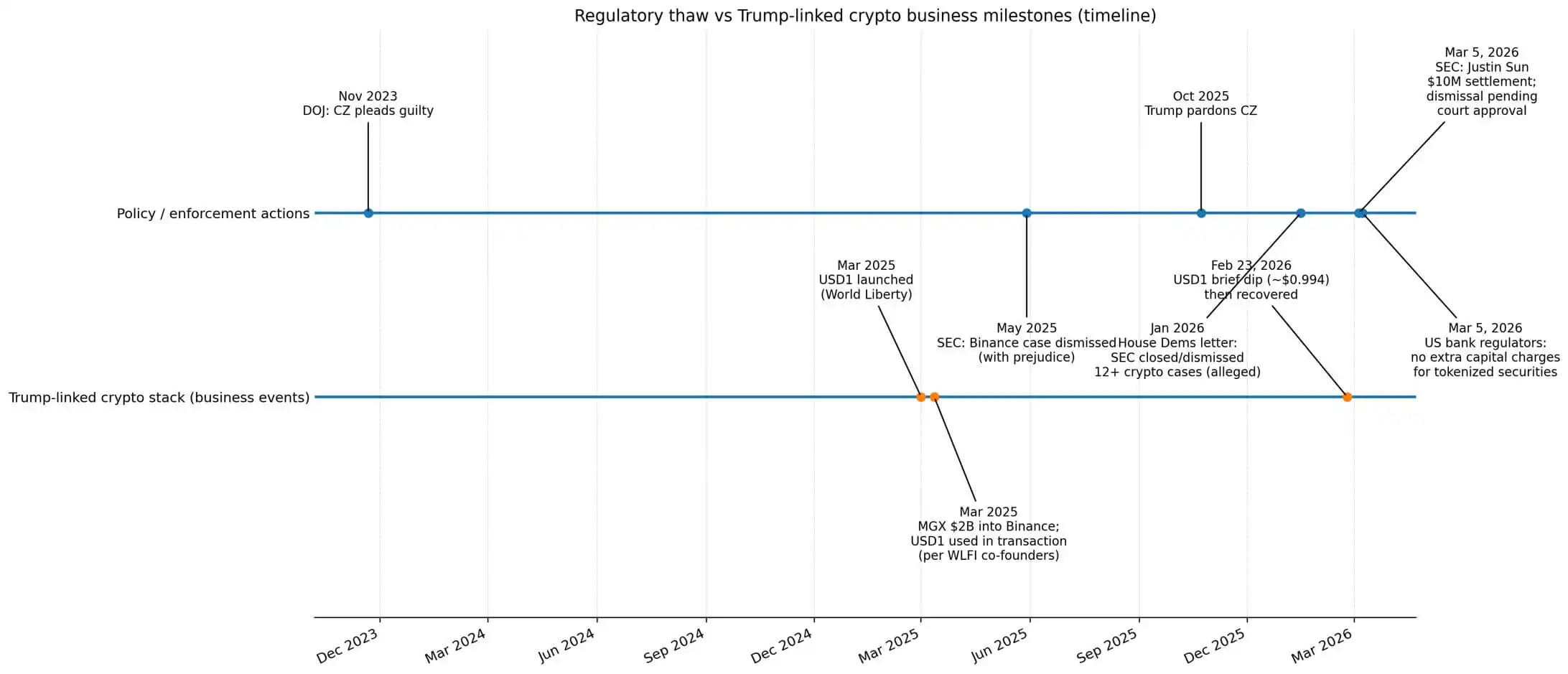
On the same day, U.S. banking regulators announced that banks holding tokenized securities would not face additional capital requirements compared to traditional securities. This technology-neutral classification represents another brick removed from the wall of crypto regulation.

Sun's settlement coincides with the one-year anniversary of the regulatory pullback under the Trump administration.

In May 2025, the SEC's civil lawsuit against Binance was dismissed with prejudice (cannot be refiled). In October 2025, Trump pardoned Binance founder Changpeng Zhao (CZ)—who had pleaded guilty in November 2023 to charges of anti-money laundering violations and operating an unlicensed money transmitting business, paid billions in fines, and served a four-month sentence.

In January 2026, Democratic members of the House Financial Services Committee sent a joint letter noting that the SEC had dismissed or terminated at least twelve crypto-related cases since January 2025.

The beneficiaries are not just the broader U.S. crypto market. Trump's own crypto network has quietly positioned itself to capture disproportionate private gains from the distribution channels and business relationships controlled by these entrepreneurs.
Presidential Proximity Tokenomics

In less than a year, two globally renowned crypto entrepreneurs have been freed from major U.S. legal constraints.

Sun's settlement ends the civil fraud case but is not a finding of innocence. Binance's SEC civil case was dismissed with prejudice. CZ's pardon is an act of judicial clemency, not an overturning of the facts to which he pleaded guilty.

Simultaneously, crypto projects linked to the Trump family have become direct beneficiaries of the crypto market's renewed activity.

Reuters estimated that the Trump Organization generated $802 million from crypto operations in the first half of 2025 alone, far surpassing other business lines, with the token economics of World Liberty Financial constituting the largest share.

World Liberty's charter stipulates that 75% of token sale revenue, after operational expenses, flows to Trump family entities. The stablecoin component USD1, launched in March 2025, added another revenue stream through collateral reserve earnings, which Reuters estimated could generate tens of millions annually at scale.

Justin Sun became one of the most visible buyers of World Liberty tokens, investing at least $75 million into the WLFI token pre-sale and joining as an advisor.

He also participated in the TRUMP Memecoin ecosystem, with reports linking a "SUN" wallet and HTX-related activity to significant holdings, though specific ownership remains disputed.

Binance's connection to the Trump crypto ecosystem is linked through another channel: Abu Dhabi-backed MGX invested $2 billion in Binance in March 2025, the largest institutional-level transaction in crypto history.

A World Liberty co-founder confirmed that USD1 was used in this MGX-Binance transaction.

Reports found that when the total circulating supply of USD1 was only about $2.1 billion, a single wallet held approximately $2 billion USD1, highlighting how a single conduit dominated early supply.

By February 2026, according to Artemis data, USD1 had grown to become the sixth-largest stablecoin, with a circulation of approximately $4.4 billion.

On February 23rd, USD1 briefly dipped to around $0.994, which World Liberty attributed to a "coordinated attack" on its X account, before the peg was restored.

The high concentration of early USD1 supply in the MGX-Binance channel, followed by growth, created a distribution advantage that World Liberty's revenue structure could directly monetize.
The Feedback Loop from Policy to Profit

This business design means: The ebb in enforcement and gradual guidance from regulators are lowering friction.

Reduced friction leads to increased activity, and increased activity enables the token and stablecoin economies linked to Trump to monetize.

Trump becomes the largest private beneficiary of these outcomes without needing to personally orchestrate regulatory results. This overlap is mechanical: as legal pressure eases on players who control distribution channels—like Binance's exchange listing power or Sun's investment capacity—the projects that capture this re-energized activity benefit, and World Liberty's token and stablecoin structures are恰好 positioned at these key junctures.

Stablecoins have evolved from niche crypto infrastructure to macro-level collateral. A February 2026 Bank for International Settlements working paper found that a two standard deviation net inflow into dollar stablecoins could depress three-month Treasury yields by about 2.5 to 3.5 basis points, rising to 5 to 8 basis points during periods of Treasury scarcity.

Stablecoin growth now generates measurable demand for safe assets, embedding these tools into interest rate and Treasury pipelines.

A European Central Bank working paper documented a "deposit substitution mechanism": the proliferation of stablecoins reduces retail deposits, limiting bank intermediation activity.

Eurozone evidence provides a rigorous analytical framework for U.S. banks' opposition to stablecoin interest-bearing functions. This directly corresponds to the current U.S. legislative impasse. The Clarity Act is stalled again, primarily due to bank opposition to stablecoin interest (fearing accelerated deposit outflows) and ongoing disputes over ethics and anti-money laundering provisions related to Trump-linked projects.

According to DeFiLlama data, the total stablecoin market cap is approximately $313 billion, with 3.7% growth over 30 days. Even without new legislation, the U.S. is functionally lowering the operating costs for crypto businesses, and Trump's crypto ecosystem has positioned itself as the "toll booth" for distribution growth.

Second-Order Beneficiaries and Structural Constraints

The first-order private beneficiaries are Trump's crypto network. The second-order public beneficiaries are the broader U.S. crypto market—lower enforcement risk premiums, faster product launches, more U.S.-facing projects.

This distinction is important because it separates correlation from causation without ignoring the observable flow of benefits. Settlements are not findings of innocence, dismissals are with prejudice, pardons are clemency, not an overturning of pleaded facts.

Even if a direct link between enforcement outcomes and private business ties cannot be proven, the distribution and revenue outcomes are visible and quantifiable.

SEC Chairman Paul Atkins stated in February 2026, following previous White House-led staff reductions, that the agency was re-hiring. He responded to accusations that the SEC's dismissal of crypto cases was politically motivated, noting many decisions predated his tenure.

The thaw extends beyond individuals. U.S. regulators now favor "exemptive relief" for tokenized security experiments, while the UK favors sandbox mechanisms—a divergence creating cross-border friction, even as U.S. policy overall leans permissive.

The next constraint may not be legal, but legislative and political.

Banks see stablecoins as a deposit substitution threat. Ethics clauses in proposed legislation could structurally limit the scale of Trump-linked projects, even as the market grows; or they could land weakly, allowing faster expansion.

Entrepreneurs who gained civil clearance or criminal pardons still face reputational and market access constraints if future enforcement agencies take a harder line.

Regulatory pressure could re-emerge as policy risk rather than pure legal risk.

Why This Matters

The concentration of benefits flowing to Trump's crypto projects raises conflict-of-interest questions,无需 requiring proof of a quid pro quo.

Revenue sharing, stablecoin reserve earnings, and distribution touchpoints are all documented in public filings and reports. Policy shifts—reduced enforcement, gradual guidance, civil dismissals, and pardons—reduce friction.

The private capture of this reduced friction is most apparent in projects where tokenomics and stablecoin growth translate directly into President-linked income.

Trump did not need to be the primary beneficiary of the regulatory pullback for the beneficiary to be observable.

As Trump-era regulators relieve legal pressure on crypto figureheads, the clearest private upside accrues to Trump's own token and stablecoin system, with the wider U.S. market as the second-order beneficiary. This pattern holds regardless of motive, and the numbers make it清晰可辨.


Domande pertinenti

QWhat was the outcome of the legal case between Justin Sun and the SEC, and what were the allegations?

AJustin Sun reached a $10 million settlement with the SEC to resolve a civil fraud lawsuit. The case alleged that he profited $31 million through wash trading-like operations and undisclosed celebrity promotions. The settlement, which requires court approval, does not include any admission of wrongdoing, and the case is set to be dismissed.

QHow has the regulatory environment for cryptocurrency in the U.S. changed under the Trump administration, according to the article?

AUnder the Trump administration, there has been a systematic retreat in SEC enforcement pressure on crypto giants. This includes the dismissal of the SEC's civil lawsuit against Binance in May 2025, the pardon of Binance founder CZ in October 2025, and the dismissal or termination of at least a dozen crypto-related cases since January 2025, as noted in a Democratic lawmakers' letter.

QWhat are the key financial figures mentioned for Trump's associated crypto projects, World Liberty Financial and USD1?

AThe Trump Organization generated $802 million from crypto businesses in the first half of 2025, largely from World Liberty Financial's token economics. Its stablecoin, USD1, had a circulating supply of approximately $4.4 billion by February 2026, making it the sixth-largest stablecoin. A single wallet was reported to hold around $2 billion of the early USD1 supply.

QHow does the article describe the connection between policy changes and private profit for Trump's crypto network?

AThe article describes a 'feedback loop' where reduced regulatory friction and enforcement retreat lead to increased crypto market activity. This activity directly benefits Trump's associated token and stablecoin projects, which are positioned to capture revenue through their economic structures. The projects mechanically benefit from the renewed activity of key players like Binance and Justin Sun, whose legal pressures have been lifted.

QWhat are some of the potential future challenges or constraints mentioned for the crypto industry and Trump's projects specifically?

AFuture constraints are predicted to be legislative and political rather than purely legal. Banks view stablecoins as a threat to deposits and oppose their interest-bearing功能. Proposed legislation could impose structural limits on Trump-associated projects through ethics and anti-money laundering clauses. Even cleared entrepreneurs could face reputational and market access constraints if future administrations adopt a tougher enforcement stance.

Letture associate

Gensyn AI: Don't Let AI Repeat the Mistakes of the Internet

In recent months, the rapid growth of the AI industry has attracted significant talent from the crypto sector. A persistent question among researchers intersecting both fields is whether blockchain can become a foundational part of AI infrastructure. While many previous AI and Crypto projects focused on application layers (like AI Agents, on-chain reasoning, data markets, and compute rentals), few achieved viable commercial models. Gensyn differentiates itself by targeting the most critical and expensive layer of AI: model training. Gensyn aims to organize globally distributed GPU resources into an open AI training network. Developers can submit training tasks, nodes provide computational power, and the network verifies results while distributing incentives. The core issue addressed is not decentralization for its own sake, but the increasing centralization of compute power among tech giants. In the era of large models, access to GPUs (like the H100) has become a decisive bottleneck, dictating the pace of AI development. Major AI companies are heavily dependent on large cloud providers for compute resources. Gensyn's approach is significant for several reasons: 1) It operates at the core infrastructure layer (model training), the most resource-intensive and technically demanding part of the AI value chain. 2) It proposes a more open, collaborative model for compute, potentially increasing resource utilization by dynamically pooling idle GPUs, similar to early cloud computing logic. 3) Its technical moat lies in solving complex challenges like verifying training results, ensuring node honesty, and maintaining reliability in a distributed environment—making it more of a deep-tech infrastructure company. 4) It targets a validated, high-growth market with genuine demand, rather than pursuing blockchain integration without purpose. Ultimately, the boundaries between Crypto and AI are blurring. AI requires global resource coordination, incentive mechanisms, and collaborative systems—areas where crypto-native solutions excel. Gensyn represents a step toward making advanced training capabilities more accessible and collaborative, moving beyond a niche controlled by a few giants. If successful, it could evolve into a fundamental piece of AI infrastructure, where the most enduring value in the AI era is often created.

marsbit11 h fa

Gensyn AI: Don't Let AI Repeat the Mistakes of the Internet

marsbit11 h fa

Why is China's AI Developing So Fast? The Answer Lies Inside the Labs

A US researcher's visit to China's top AI labs reveals distinct cultural and organizational factors driving China's rapid AI development. While talent, data, and compute are similar to the West, Chinese labs excel through a pragmatic, execution-focused culture: less emphasis on individual stardom and conceptual debate, and more on teamwork, engineering optimization, and mastering the full tech stack. A key advantage is the integration of young students and researchers who approach model-building with fresh perspectives and low ego, prioritizing collective progress over personal credit. This contrasts with the US culture of self-promotion and "star scientist" narratives. Chinese labs also exhibit a strong "build, don't buy" mentality, preferring to develop core capabilities—like data pipelines and environments—in-house rather than relying on external services. The ecosystem feels more collaborative than tribal, with mutual respect among labs. While government support exists, its scale is unclear, and technical decisions appear driven by labs, not state mandates. Chinese companies across sectors, from platforms to consumer tech, are building their own foundational models to control their tech destiny, reflecting a broader cultural drive for technological sovereignty. Demand for AI is emerging, with spending patterns potentially mirroring cloud infrastructure more than traditional SaaS. Despite challenges like a less mature data industry and GPU shortages, Chinese labs are propelled by vast talent, rapid iteration, and deep integration with the open-source community. The competition is evolving beyond a pure model race into a contest of organizational execution, developer ecosystems, and industrial pragmatism.

marsbit13 h fa

Why is China's AI Developing So Fast? The Answer Lies Inside the Labs

marsbit13 h fa

3 Years, 5 Times: The Rebirth of a Century-Old Glass Factory

Corning, a 175-year-old glass company, is experiencing a dramatic revival as a key player in AI infrastructure, driven by surging demand for high-performance optical fiber in data centers. AI data centers require vastly more fiber than traditional ones—5 to 10 times as much per rack—to handle high-speed data transmission between GPUs. This structural demand shift, coupled with supply constraints from the lengthy expansion cycle for fiber preforms, has created a significant supply-demand gap. Nvidia has invested in Corning, along with Lumentum and Coherent, in a $4.5 billion total commitment to secure the optical supply chain for AI. Corning's competitive edge lies in its expertise in producing ultra-low-loss, high-density, and bend-resistant specialty fiber, which is critical for 800G+ and future 1.6T data rates. Its deep involvement in co-packaged optics (CPO) with partners like Nvidia further solidifies its position. While not the largest fiber manufacturer globally, Corning's revenue from enterprise/data center clients now exceeds 40% of its optical communications sales, and it has secured multi-year supply agreements with major hyperscalers including Meta and Nvidia. Financially, Corning's optical communications revenue has surged, doubling from $1.3 billion in 2023 to over $3 billion in 2025. Its stock price has risen nearly 6-fold since late 2023. Key future catalysts include the rollout of Nvidia's CPO products and the scale of undisclosed customer agreements. However, risks include high current valuations and potential disruption from next-generation technologies like hollow-core fiber. The company's long-term bet on light over electricity, maintained even through the telecom bubble crash, is now being validated by the AI boom.

marsbit13 h fa

3 Years, 5 Times: The Rebirth of a Century-Old Glass Factory

marsbit13 h fa

Trading

Spot
Futures

Articoli Popolari

Come comprare SUN

Benvenuto in HTX.com! Abbiamo reso l'acquisto di SUN (SUN) semplice e conveniente. Segui la nostra guida passo passo per intraprendere il tuo viaggio nel mondo delle criptovalute.Step 1: Crea il tuo Account HTXUsa la tua email o numero di telefono per registrarti il tuo account gratuito su HTX. Vivi un'esperienza facile e sblocca tutte le funzionalità,Crea il mio accountStep 2: Vai in Acquista crypto e seleziona il tuo metodo di pagamentoCarta di credito/debito: utilizza la tua Visa o Mastercard per acquistare immediatamente SUNSUN.Bilancio: Usa i fondi dal bilancio del tuo account HTX per fare trading senza problemi.Terze parti: abbiamo aggiunto metodi di pagamento molto utilizzati come Google Pay e Apple Pay per maggiore comodità.P2P: Fai trading direttamente con altri utenti HTX.Over-the-Counter (OTC): Offriamo servizi su misura e tassi di cambio competitivi per i trader.Step 3: Conserva SUN (SUN)Dopo aver acquistato SUN (SUN), conserva nel tuo account HTX. In alternativa, puoi inviare tramite trasferimento blockchain o scambiare per altre criptovalute.Step 4: Scambia SUN (SUN)Scambia facilmente SUN (SUN) nel mercato spot di HTX. Accedi al tuo account, seleziona la tua coppia di trading, esegui le tue operazioni e monitora in tempo reale. Offriamo un'esperienza user-friendly sia per chi ha appena iniziato che per i trader più esperti.

839 Totale visualizzazioniPubblicato il 2024.12.12Aggiornato il 2025.03.21

Come comprare SUN

Discussioni

Benvenuto nella Community HTX. Qui puoi rimanere informato sugli ultimi sviluppi della piattaforma e accedere ad approfondimenti esperti sul mercato. Le opinioni degli utenti sul prezzo di SUN SUN sono presentate come di seguito.

活动图片