SEC confirms years-long director bans for former Alameda, FTX executives

cointelegraphPubblicato 2025-12-19Pubblicato ultima volta 2025-12-19

Introduzione

The U.S. Securities and Exchange Commission (SEC) has obtained final consent judgments against former Alameda Research CEO Caroline Ellison and former FTX executives Gary Wang and Nishad Singh. They are barred from holding company leadership roles for eight to 10 years due to their involvement in misusing FTX investor funds from 2019 to 2022. Ellison received a 10-year ban, while Wang and Singh each accepted eight-year bans. All three are also subject to five-year conduct-based injunctions. The SEC alleged that, with Ellison's knowledge, FTX co-founder Sam Bankman-Fried and the other executives exempted Alameda from risk measures and provided it with an unlimited line of credit using FTX customer funds. Ellison, who testified against Bankman-Fried, was sentenced to two years in prison and is scheduled for early release on February 20. Wang and Singh also cooperated with authorities and received time-served sentences. Bankman-Fried was sentenced to 25 years for his central role in the exchange’s collapse.

Former Alameda Research CEO Caroline Ellison and former FTX executives Gary Wang and Nishad Singh will be barred from assuming company leadership roles for eight to 10 years following a court judgment.

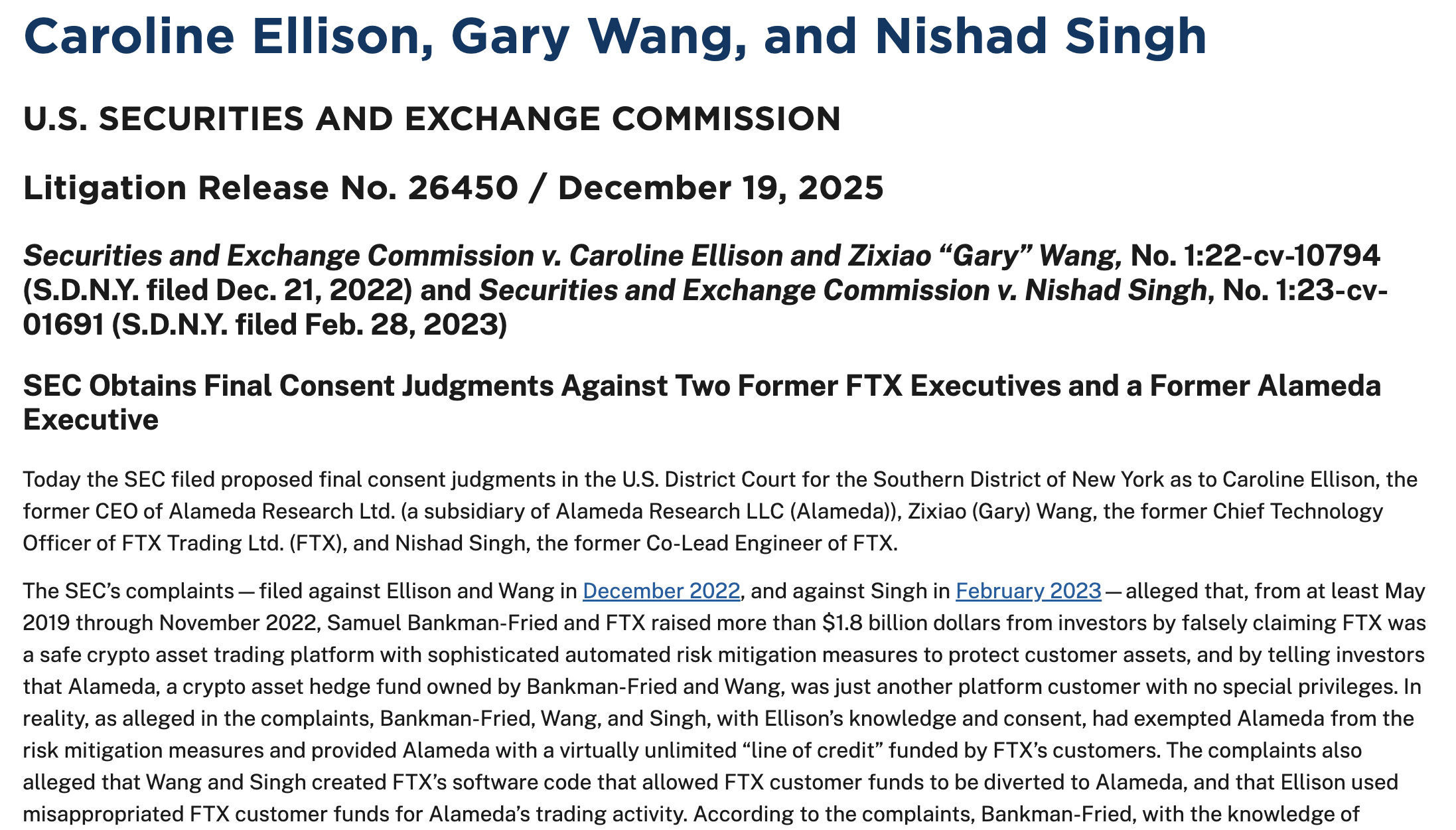
In a Friday notice, the US Securities and Exchange Commission said that it had obtained final consent judgments against Ellison, Wang and Singh for their roles in the misuse of investor funds at FTX from 2019 to 2022.

The former Alameda CEO consented to a 10-year officer-and-director bar, while Wang and Singh consented to eight-year officer-and-director bars each. All three are also subject to five-year ”conduct-based injunctions,” according to the SEC.

“In reality, as alleged in the complaints, [Sam] Bankman-Fried, Wang, and Singh, with Ellison’s knowledge and consent, had exempted Alameda from the risk mitigation measures and provided Alameda with a virtually unlimited ‘line of credit’ funded by FTX’s customers,” said the SEC. “The complaints also alleged that Wang and Singh created FTX’s software code that allowed FTX customer funds to be diverted to Alameda, and that Ellison used misappropriated FTX customer funds for Alameda’s trading activity.”
Source: SEC

Former FTX CEO Sam “SBF” Bankman-Fried received a 25-year sentence for his role in the exchange’s collapse. He is awaiting the results of an appeal in the US Court of Appeals for the Second Circuit, where a hearing was held on Nov. 4.

Related: Caroline Ellison blames Sam Bankman-Fried for misuse of FTX user funds at trial

Ellison was sentenced to two years as part of a plea deal in which she testified against Bankman-Fried. Wang and Singh testified against SBF at his criminal trial and were sentenced to time served in 2024.

Ellison will soon be released from custody

The former Alameda CEO, who largely stayed out of the public spotlight between FTX’s collapse and her testimony at SBF’s trial in October 2023, was recently transferred from prison to a Residential Reentry Management field office in New York City.

According to the Federal Bureau of Prisons, she is scheduled to be released on Feb. 20, about nine months before the end of her two-year sentence. The timing suggested she may have been eligible for good-conduct credits to reduce her prison time.

Magazine: When privacy and AML laws conflict: Crypto projects’ impossible choice

Domande pertinenti

QWhat are the specific officer-and-director bar durations for Caroline Ellison, Gary Wang, and Nishad Singh as ordered by the SEC?

ACaroline Ellison consented to a 10-year officer-and-director bar, while Gary Wang and Nishad Singh each consented to an 8-year officer-and-director bar.

QAccording to the SEC, what was the primary allegation against Sam Bankman-Fried, Gary Wang, and Nishad Singh regarding Alameda Research?

AThe SEC alleged that Sam Bankman-Fried, Gary Wang, and Nishad Singh, with Caroline Ellison's knowledge and consent, exempted Alameda from risk mitigation measures and provided it with a virtually unlimited 'line of credit' funded by FTX's customers.

QWhat was the role of Gary Wang and Nishad Singh in the misuse of FTX customer funds as stated in the complaints?

AThe complaints alleged that Gary Wang and Nishad Singh created FTX's software code that allowed FTX customer funds to be diverted to Alameda.

QWhat is the current status of Sam Bankman-Fried's legal case as mentioned in the article?

ASam Bankman-Fried received a 25-year sentence and is awaiting the results of an appeal in the US Court of Appeals for the Second Circuit, where a hearing was held on November 4.

QWhen is Caroline Ellison scheduled to be released from custody and what is the reason for her early release?

ACaroline Ellison is scheduled to be released on February 20, about nine months before the end of her two-year sentence, likely due to being eligible for good-conduct credits to reduce her prison time.

Letture associate

Why Did Zhipu Surge Nearly 30% in a Single Day?

"Global AI Model Unicorn" Zhipu's stock surged nearly 30% in a single day, reaching a new market cap high. The catalyst was the launch of its GLM-5.1-highspeed API, boasting a generation speed of **400 tokens per second**, setting a new global benchmark. This speed, roughly 3-5 times faster than industry leaders like OpenAI's GPT-4o and Anthropic's Claude, is achieved **without compromising the full-scale model's capabilities**. In the era of AI Agents requiring dozens of self-calls, such latency reduction is critical, transforming speed from a system metric into a determinant of intelligence limits. The breakthrough stems from a three-layer technical overhaul: 1. **TileRT Inference Engine**: Compiles the entire model into a continuous, always-on computation pipeline using "Warp Specialization," minimizing GPU idle time by having different processor groups handle data loading, computation, and communication in parallel. 2. **Heterogeneous Parallelism for MLA**: To efficiently run the GLM-5.1 model using the MLA attention mechanism, TileRT employs a heterogeneous strategy. One GPU handles sparse indexing/routing, while the others perform dense computation, optimizing for MLA's unique workflow. 3. **ZCube Network Architecture**: Replaces the standard Spine-Leaf (ROFT) network topology with a flat, dual-group interconnect. This design creates a single optimal path between any two GPUs, eliminating network congestion at scale and reducing latency. The business impact is significant: a 15% increase in cluster throughput (free extra capacity), a 40.6% reduction in tail latency (improved stability), and a one-third cut in networking hardware costs. Long-term, this innovation challenges the dominance of NVIDIA's integrated hardware-software stack (GPU+NVLink+InfiniBand), potentially benefiting manufacturers of high-density Leaf switches and optical modules while lowering the software barrier for domestic AI chips like Huawei's Ascend. The innovation proves that more can be achieved with the same compute, reshaping the infrastructure beyond just GPUs.

marsbit1 h fa

Why Did Zhipu Surge Nearly 30% in a Single Day?

marsbit1 h fa

Bidding Farewell to the 'Gray Gambling Game'! Polymarket Charges into the Compliance Track—How Will This Impact the Entire Crypto Industry?

From Gray to Regulated: How Polymarket’s Compliance Journey Reshapes Crypto The evolution of Polymarket, a decentralized prediction market platform, illustrates a critical trend in crypto: innovative, high-value sectors ultimately integrate into regulatory frameworks. Founded in 2020, Polymarket quickly gained traction by leveraging low-cost Layer 2 blockchain technology for event-based trading, notably during the 2024 US presidential election where its markets outperformed traditional polls. However, its "build first, comply later" approach led to a 2022 CFTC enforcement action, resulting in a $1.4 million fine and a ban from the US market. A pivotal shift occurred in 2025 under a new US administration. Polymarket strategically acquired CFTC-licensed derivatives exchange QCX for $112 million, securing a regulated pathway back into the US. This move coincided with a regulatory reversal, as the CFTC withdrew a prior proposal to ban political event contracts. The platform’s successful "regulatory acquisition" strategy, avoiding a lengthy independent licensing process, highlights a viable compliance path for crypto-native projects. Its journey from regulatory target to a CFTC-recognized entity—bolstered by a major data partnership and investment from Intercontinental Exchange (ICE)—signals the maturation of prediction markets from a "crypto novelty" into acknowledged financial infrastructure. The story underscores that genuine utility provides negotiating power with regulators and that embracing compliance does not necessarily mean sacrificing core technological advantages.

marsbit1 h fa

Bidding Farewell to the 'Gray Gambling Game'! Polymarket Charges into the Compliance Track—How Will This Impact the Entire Crypto Industry?

marsbit1 h fa

Trading

Spot
Futures
活动图片