SEC Chairman confirms U.S. crypto bill nears finish line: Details

ambcryptoPubblicato 2026-01-20Pubblicato ultima volta 2026-01-20

Introduzione

The long-standing tension between Washington and the crypto industry is easing as SEC Chairman Paul Atkins confirms the Digital Asset Market Clarity Act of 2025 is ready for presidential review. The SEC and CFTC are now cooperating to align regulations, ending years of conflict. The bill clearly divides oversight: the CFTC will regulate decentralized digital commodities like Bitcoin, while the SEC handles investment-style tokens. A "maturity clause" allows tokens to transition from SEC to CFTC oversight once their networks become sufficiently decentralized. This regulatory clarity could unlock institutional adoption and real-world asset tokenization, potentially ending crypto’s regulatory winter and fostering innovation. Despite recent market pressures, the bill represents a significant step toward legal certainty.

The long-standing tension between Washington and the crypto industry is beginning to ease.

Recently, SEC Chairman Paul Atkins confirmed that the Digital Asset Market Clarity Act of 2025 is ready to be presented to the U. S. President.

More importantly, he revealed that the SEC and the CFTC are no longer fighting over control and are instead working together to align their rules.

Why hasn’t the crypto market reacted?

However, this comes at a time when crypto prices are under pressure.

As per data from CoinMarketCap, the total market value has fallen to $3.08 trillion, at press time, down by 1.92% in the past 24 hours. However, this drop is mainly because of Donald Trump’s tariff shock.

This sudden shift in global economies raised fears about tighter global liquidity, pushing investors away from riskier assets like Bitcoin [BTC] and altcoins.

The fight is over

That being said, for years, crypto projects were stuck between the SEC and the CFTC, unsure which rules applied to them. However, this new bill is different as it clearly divides responsibility.

Once passed, the CFTC would oversee digital commodities, such as Bitcoin and other decentralized assets. Meanwhile, the SEC would regulate investment-style tokens, especially during early fundraising stages.

Additionally, the bill is also designed to introduce a key idea called the “maturity clause.”

Once a blockchain network becomes decentralized and stable enough, its token could move out of SEC oversight and fall under the CFTC instead.

This could stop the endless cycle of enforcement actions that have hurt crypto innovation in the U.S.

More than trading

Needless to say, this bill isn’t just about crypto exchanges. It also lays the groundwork for tokenizing real-world assets.

With clear legal rules, things like bonds, funds, and stablecoins could be issued and traded on blockchains. This makes it easier for traditional finance firms to move on-chain.

Remarking on Atkins’s remarks, an X user said,

“If market structure is finally being clarified, that’s a big unlock. Clear rules don’t slow innovation, they let real infrastructure scale.”

Echoing similar sentiments, another X user added,

“Things are about to get parabolic.”

What changed?

Under former SEC Chair Gary Gensler, the crypto industry often navigated a regulatory tightrope. With President Trump back in office, however, the tone in Washington has shifted.

While Gensler’s departure has clearly opened the door to greater cooperation, the path to full regulatory clarity remains uneven.

As Bitwise CEO Hunter Horsley recently noted, while progress is being made, significant clarity gaps remain.

Still, regardless of what lies ahead, this reform has been overdue for years, and it now finally appears within reach.

Ergo, one X user responded best to Atkins’s remarks when he said,

“This is huge clarity has been missing for years.”


Final Thoughts

  • Regulatory alignment between the SEC and CFTC ends years of jurisdictional uncertainty and enforcement-first policy.
  • If lawmakers bridge the remaining gaps, 2026 could mark the end of crypto’s regulatory winter and the start of institutional spring.


Domande pertinenti

QWhat is the name of the crypto bill that is nearing the finish line, as confirmed by the SEC Chairman?

AThe Digital Asset Market Clarity Act of 2025.

QAccording to the article, which two regulatory bodies have stopped fighting and are now working together to align their rules?

AThe SEC (Securities and Exchange Commission) and the CFTC (Commodity Futures Trading Commission).

QHow does the new bill propose to divide regulatory oversight between the SEC and CFTC?

AThe CFTC would oversee digital commodities like Bitcoin, while the SEC would regulate investment-style tokens, especially during early fundraising stages.

QWhat is the 'maturity clause' introduced in the bill?

AIt is a clause that allows a token to move out of SEC oversight and fall under the CFTC once its blockchain network becomes decentralized and stable enough.

QWhat event, unrelated to the bill, does the article cite as the main reason for the recent drop in crypto market value?

ADonald Trump's tariff shock, which raised fears about tighter global liquidity.

Letture associate

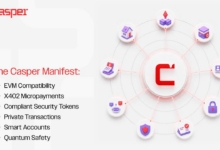
Casper Network Publishes the Casper Manifest, a Multi-Year Roadmap to Power Regulated Real-World Assets and the Machine Economy

The Casper Association has published "The Casper Manifest," a multi-year technical roadmap for Casper Network. Introduced at the Digital Finance Forum in Bermuda, the roadmap outlines nine coordinated initiatives designed to position the layer-1 blockchain as the infrastructure for regulated real-world asset (RWA) tokenization and the machine-to-machine economy. Key initiatives focus on: 1. **Developer Access:** Adding full Ethereum Virtual Machine (EVM) compatibility alongside its existing WebAssembly (Wasm) execution layer. 2. **User Experience:** Implementing gasless transactions, batch operations, and smart accounts with biometric authentication. 3. **Institutional Compliance & Privacy:** Building compliant security tokens aligned with the ERC-3643 standard and a multi-phase roadmap for confidential transactions with built-in audit tools. 4. **Machine Economy:** Implementing the X402 open payment standard to enable AI agents and machines to make autonomous, programmatic micropayments. 5. **Token Infrastructure:** Creating a Native Token Registry to give all tokens protocol-level status with fixed, predictable costs. 6. **Quantum Safety:** Developing hybrid accounts with both classical and quantum-resistant keys. The first initiative, X402 micropayments, is expected within weeks. Subsequent releases through 2026 and 2027 will include EVM compatibility, compliant security tokens, the Native Token Registry, gasless transactions, and quantum-safe features. The goal is to create a blockchain that is frictionless for users, trusted by institutions, and native for machines.

TheNewsCrypto1 h fa

Casper Network Publishes the Casper Manifest, a Multi-Year Roadmap to Power Regulated Real-World Assets and the Machine Economy

TheNewsCrypto1 h fa

TechFlow Intelligence: Trump-Linked Companies Transfer $12 Million in Assets Before China Visit, 'The Big Short' Protagonist Warns of Stock Market Bubble Again

The article reports multiple developments across tech, crypto, and finance. In AI, Mozilla used AI for large-scale code review, Google confirmed hackers used AI to find zero-day exploits, and OpenAI deployed GPT-5.5 to find errors in math benchmarks. A court ruled Anthropic's scanning and destroying books for AI training as fair use, while its Claude platform launched on AWS. Google's new video model 'Omni' was leaked. In crypto/Web3, Trump-linked companies transferred $12M in crypto assets before a China visit. BlackRock chose Ethereum for tokenized funds, and a hacker stole $174k via a malicious NFT that tricked an AI. Jack Dorsey's first tweet NFT plummeted from $2.9M to under $5. In chips/hardware, TSMC approved an additional $20B for its Arizona plant. Apple's Tim Cook and Elon Musk will accompany Trump to China, while Nvidia's Jensen Huang is notably absent. For markets, Michael Burry warned of parabolic stock rises and suggested near-total sell-offs, with online discussions comparing current sentiment to the 1999 bubble. Other notes include WTI oil surpassing $100, a 20% price hike for Beijing-Shanghai high-speed rail, and new products like Unitree's $26.9k humanoid robot. The underlying theme suggests AI is becoming infrastructure, creating pressure on old systems while a new order is not yet ready, leaving investors anxious.

marsbit1 h fa

TechFlow Intelligence: Trump-Linked Companies Transfer $12 Million in Assets Before China Visit, 'The Big Short' Protagonist Warns of Stock Market Bubble Again

marsbit1 h fa

Trading

Spot
Futures
活动图片