Scaramucci predicts ‘exponential opportunity’ for crypto at LONGITUDE

cointelegraphPubblicato 2025-12-12Pubblicato ultima volta 2025-12-12

Introduzione

At the LONGITUDE event, Anthony Scaramucci and other industry leaders expressed strong optimism for cryptocurrency in 2026, citing institutional investment and clearer regulations as key drivers. Scaramucci emphasized the potential for blockchain to reduce the $4 trillion spent globally on transaction verification in TradFi, with protocols like Ethereum and Solana offering major efficiency gains. Kristin Smith highlighted regulatory progress in the U.S. and globally, though she noted that trading regulations remain a barrier. Eli Ben-Sasson discussed the rising demand for privacy protocols like Zcash, noting that enterprises seek tailored privacy solutions. Security was also a focus, with Phemex CEO Federico Variola and Ledger's Ian Rodgers addressing risks from social engineering attacks, exemplified by the $1.6B Bybit hack. The event underscored a collective push toward safer, more regulated, and efficient crypto adoption.

Institutional investment and clear-cut regulations are laying the foundation for a strong start to 2026 for the wider cryptocurrency industry.

Industry titans including Anthony Scaramucci, Kristin Smith, Eli Ben-Sasson, Ian Rodgers, Reeve Collins and Joseph Chalom delivered optimistic outlooks for the new year after a year of positive change, particularly in the United States.

Cointelegraph’s latest LONGITUDE event, powered by Phemex, featured alpha-rich panels focused on Solana’s growth, surging interest in privacy protocols and lessons learned from security incidents in 2025.
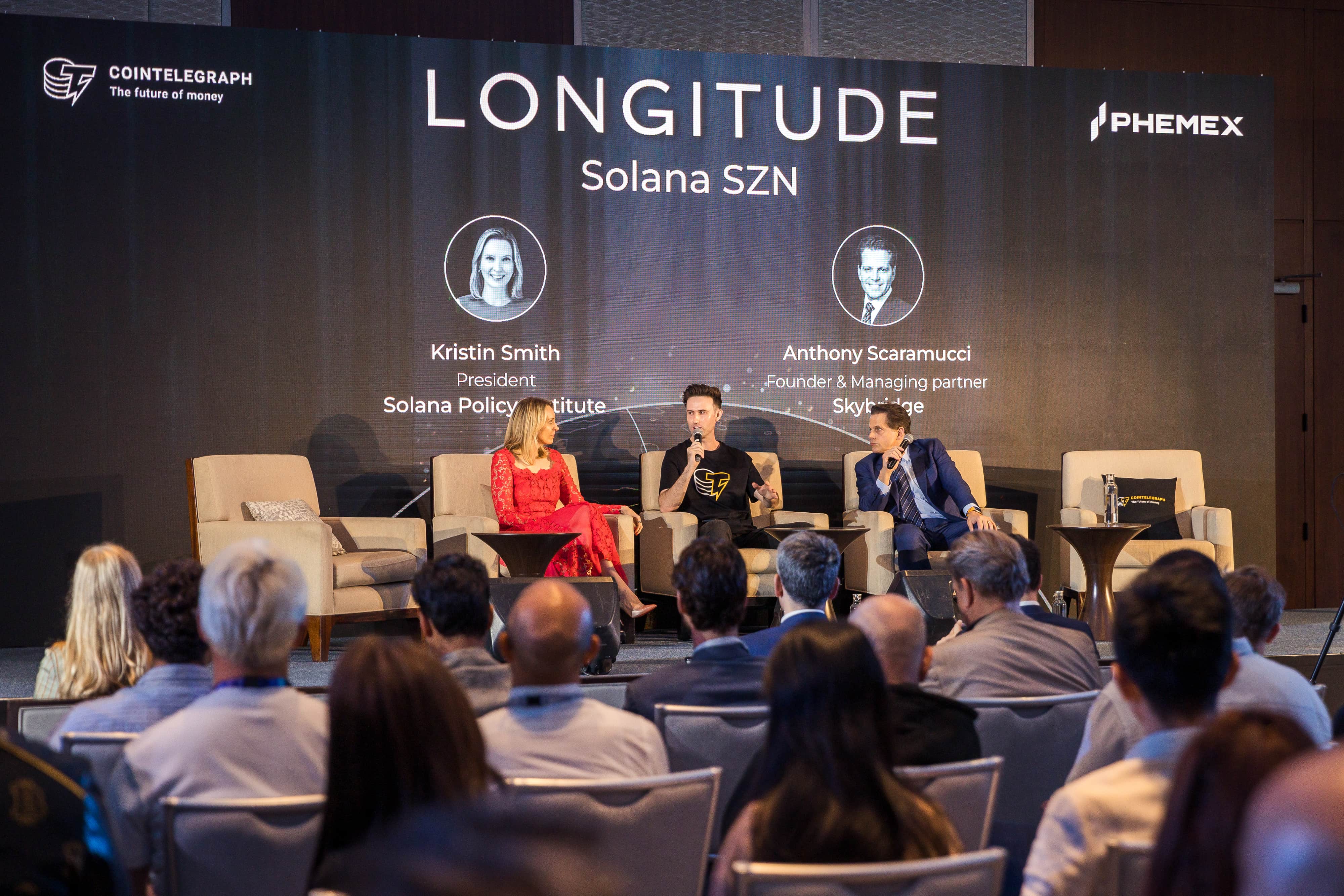
From left, Solana Policy Institute president Kristin Smith, Cointelegraph journalist Ciaran Lyons and SkyBridge founder Anthony Scaramucci.

“There’s been a tremendous amount of progress in 2025, an unprecedented amount,” Smith said. The president of the Solana Policy Institute has been intimately involved in crypto-focused discussions in Washington over the past 18 months.

“I think now that the US is catching up, you’re seeing policymakers around the globe figuring out what they need to do to stay competitive and keep crypto within their borders, which is different than trying to keep crypto outside of their borders.”

Scaramucci said educating policymakers remains a key hurdle to helping the traditional financial system adopt innovative protocols running on blockchain rails.

“Kristin has got to go into those rooms, and she’s got to explain to these people why this regulation needs to get passed so that we can retool the financial system and make the system less expensive and more seamless,” Scaramucci said.

The founder of SkyBridge Capital added that existing TradFi systems currently spend over $4 trillion on transaction verification globally. Shifting to protocols like Ethereum and Solana, which currently rank highest for RWA tokenization and onchain activity, could offer unrivalled efficiency and cost savings.

“That’s credit card fees, wire fees, a whole host of different things. If we were able to adopt Solana and use it in the process of tokenizing assets, you could save probably 75% of that, and that could be transformative for the global economy.”

Again, the major hurdle in recent years has been lagging regulations that have scuppered innovation and the ability for institutions to actively explore using blockchain protocols.

“We can do that today. It’s actually fairly easy to issue a share or a bond on a blockchain. The problem is the regulations don’t make sense when it comes to trading those assets. And so that’s a piece that we’re working on,” Smith said.

Related: Scaramucci family invested over $100M in Trump’s Bitcoin mining firm: Report

Scaramucci delivered a bullish parting message, highlighting the intent of America’s biggest financial institutions, BlackRock, Blackstone and JPMorgan, moving to tokenize assets on blockchain protocols.

“Don’t sit here myopically in 2025 and see this short-sighted opportunity. See the exponential technological opportunity that’s coming.”

Privacy in vogue

StarkWare founder Eli Ben-Sasson, who also co-founded the Zcash protocol, engaged in a thought-provoking fireside chat unpacking why privacy protocols have been in vogue in the latter half of 2025.

“I spent several decades of my life thinking about privacy, both the math and then the productization. Privacy is a spectrum.”

Ben-Sasson weighed in on the massive interest in Zcash (ZEC) in 2025. The privacy-focused cryptocurrency has been around since 2016, but saw a massive surge in value and interest off the back of support from various big names in the industry.

“At one extreme, you have the stuff we did at Zcash, which is resistance money level of privacy. If you need to jump on a plane and the government is pursuing you and you need to be fully you know, off the radar, then you have that,” Ben-Sasson said.
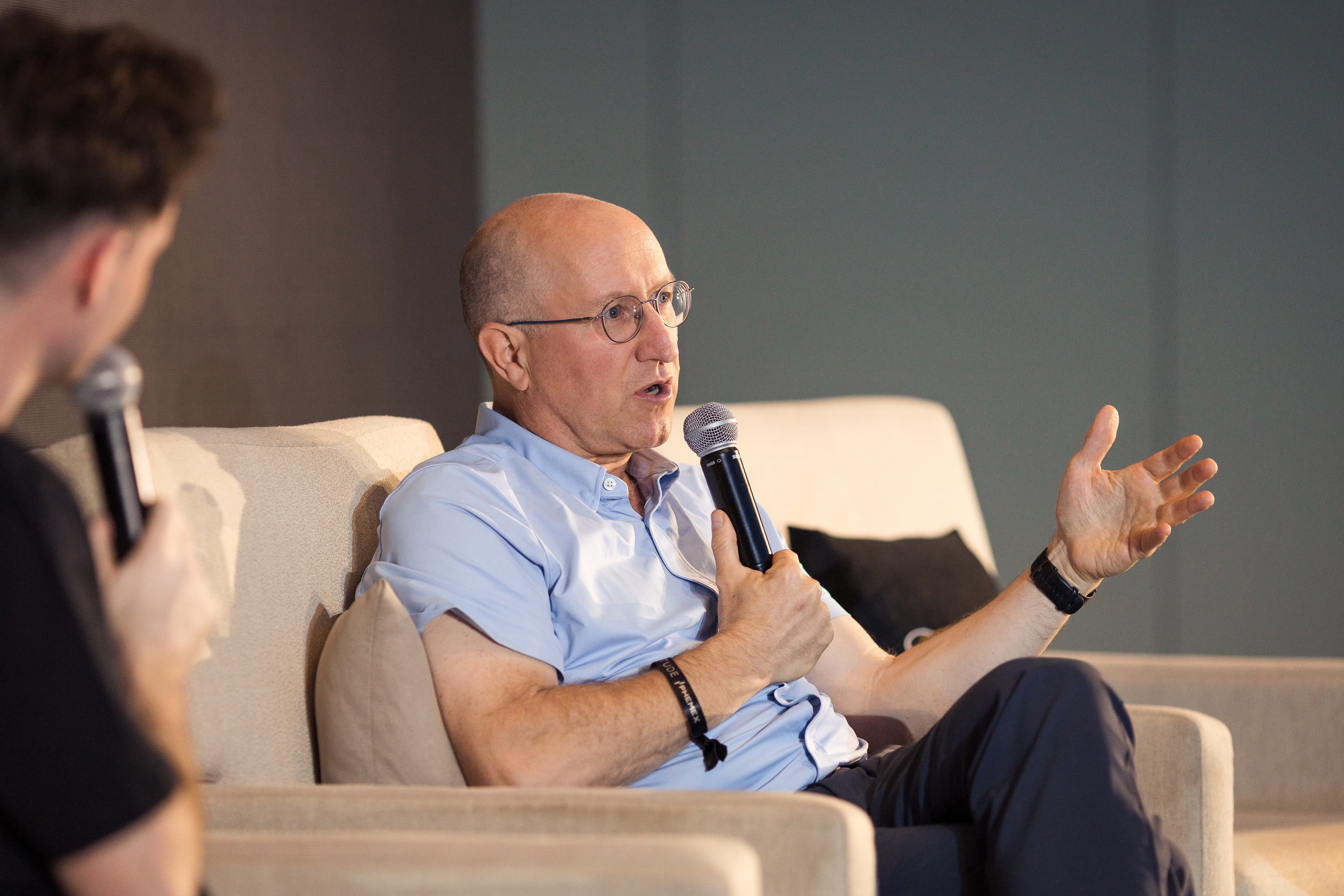
StarkWare co-founder Eli Ben-Sasson.

However, Ben-Sasson said the cost of that luxury is in the user experience. Wallets, programmability and user experience are harder to provide with that level of privacy. The less technical end of the spectrum affords a use case that is in high demand.

Related: Can Zcash’s rise revive the Bitcoin OP_CAT discussion?

“Enterprises come in, and they are going to want a different kind of privacy and also a different kind of privacy from the kind that we did on Zcash. They’re going to want privacy where they, as enterprises, and their customers are shielded away from other customers and from their competitors,” he said.

Security wake-up call

Security was another major talking point at LONGITUDE VII, given the spate of high-profile hacks and security incidents in 2025.
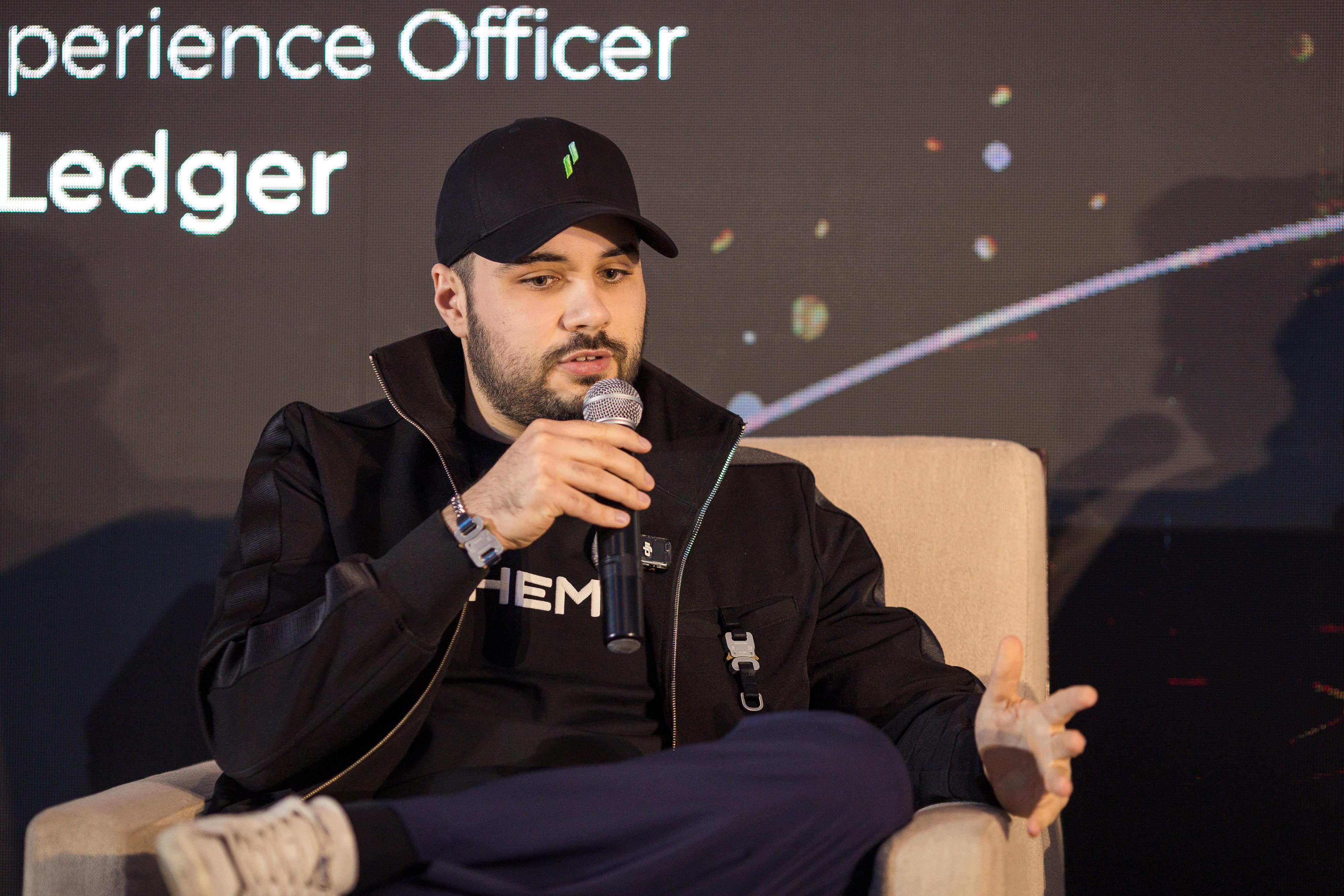
Phemex CEO Federico Variola. Source: Cointelegraph

The theft of $1.6 billion of Ether (ETH) from Bybit in March was a wake-up call for the industry. As Phemex CEO Federico Variola explained, social engineering and unverified access continue to be a major threat to everyday crypto users.

“I think combining the social layer of being a crypto participant with the financial layer, those kind of devices should be never interacting with each other.”

“It’s difficult in crypto because sometimes you need to participate in an airdrop, or like you want your Twitter account to be linked to the MegaETH ICO, for example. Nevertheless, you should be aware that you’re always exposing yourself to significant risk,” Variola said.

Related: Bybit hack: ‘Reckoning’ that led SafeWallet to rearchitect its systems

Ledger’s chief experience officer Ian Rodgers said that the onus is on service providers and infrastructure builders to think critically about the risks their platforms and users face.

“There are there is no way to make a risk go to zero. But it is the responsibility to minimize the risk as much as possible, to think about what is the worst thing that could possibly happen, what could go wrong here,” Rodgers said.

Cointelegraph’s exclusively LONGITUDE events will be back on the calendar in 2026, with editions planned for New York, Paris, Dubai, Hong Kong, Singapore, and Abu Dhabi.


Domande pertinenti

QWhat does Anthony Scaramucci predict for the cryptocurrency industry in 2026?

AAnthony Scaramucci predicts 'exponential opportunity' for crypto, driven by institutional investment and clear regulations, with major financial institutions like BlackRock and JPMorgan moving to tokenize assets on blockchain protocols.

QAccording to Kristin Smith, what is the current regulatory challenge for trading tokenized assets?

AKristin Smith states that while it is easy to issue shares or bonds on a blockchain, the regulations don't make sense for trading those assets, which is a key area being worked on.

QWhy has there been increased interest in privacy protocols like Zcash in 2025?

AEli Ben-Sasson explains that privacy protocols are in vogue due to high demand for different levels of privacy, from resistance-money level privacy for individuals to enterprise-focused privacy shielding customers and competitors.

QWhat was the significance of the $1.6 billion Bybit hack in March 2025?

AThe $1.6 billion Ether theft from Bybit was a wake-up call for the industry, highlighting the major threats of social engineering and unverified access to crypto users.

QHow does Anthony Scaramucci suggest blockchain protocols like Solana could transform the global economy?

AScaramucci suggests that adopting Solana for tokenizing assets could save up to 75% of the over $4 trillion spent globally on transaction verification in TradFi systems, leading to transformative efficiency and cost savings.

Letture associate

Gensyn AI: Don't Let AI Repeat the Mistakes of the Internet

In recent months, the rapid growth of the AI industry has attracted significant talent from the crypto sector. A persistent question among researchers intersecting both fields is whether blockchain can become a foundational part of AI infrastructure. While many previous AI and Crypto projects focused on application layers (like AI Agents, on-chain reasoning, data markets, and compute rentals), few achieved viable commercial models. Gensyn differentiates itself by targeting the most critical and expensive layer of AI: model training. Gensyn aims to organize globally distributed GPU resources into an open AI training network. Developers can submit training tasks, nodes provide computational power, and the network verifies results while distributing incentives. The core issue addressed is not decentralization for its own sake, but the increasing centralization of compute power among tech giants. In the era of large models, access to GPUs (like the H100) has become a decisive bottleneck, dictating the pace of AI development. Major AI companies are heavily dependent on large cloud providers for compute resources. Gensyn's approach is significant for several reasons: 1) It operates at the core infrastructure layer (model training), the most resource-intensive and technically demanding part of the AI value chain. 2) It proposes a more open, collaborative model for compute, potentially increasing resource utilization by dynamically pooling idle GPUs, similar to early cloud computing logic. 3) Its technical moat lies in solving complex challenges like verifying training results, ensuring node honesty, and maintaining reliability in a distributed environment—making it more of a deep-tech infrastructure company. 4) It targets a validated, high-growth market with genuine demand, rather than pursuing blockchain integration without purpose. Ultimately, the boundaries between Crypto and AI are blurring. AI requires global resource coordination, incentive mechanisms, and collaborative systems—areas where crypto-native solutions excel. Gensyn represents a step toward making advanced training capabilities more accessible and collaborative, moving beyond a niche controlled by a few giants. If successful, it could evolve into a fundamental piece of AI infrastructure, where the most enduring value in the AI era is often created.

marsbit12 h fa

Gensyn AI: Don't Let AI Repeat the Mistakes of the Internet

marsbit12 h fa

Why is China's AI Developing So Fast? The Answer Lies Inside the Labs

A US researcher's visit to China's top AI labs reveals distinct cultural and organizational factors driving China's rapid AI development. While talent, data, and compute are similar to the West, Chinese labs excel through a pragmatic, execution-focused culture: less emphasis on individual stardom and conceptual debate, and more on teamwork, engineering optimization, and mastering the full tech stack. A key advantage is the integration of young students and researchers who approach model-building with fresh perspectives and low ego, prioritizing collective progress over personal credit. This contrasts with the US culture of self-promotion and "star scientist" narratives. Chinese labs also exhibit a strong "build, don't buy" mentality, preferring to develop core capabilities—like data pipelines and environments—in-house rather than relying on external services. The ecosystem feels more collaborative than tribal, with mutual respect among labs. While government support exists, its scale is unclear, and technical decisions appear driven by labs, not state mandates. Chinese companies across sectors, from platforms to consumer tech, are building their own foundational models to control their tech destiny, reflecting a broader cultural drive for technological sovereignty. Demand for AI is emerging, with spending patterns potentially mirroring cloud infrastructure more than traditional SaaS. Despite challenges like a less mature data industry and GPU shortages, Chinese labs are propelled by vast talent, rapid iteration, and deep integration with the open-source community. The competition is evolving beyond a pure model race into a contest of organizational execution, developer ecosystems, and industrial pragmatism.

marsbit14 h fa

Why is China's AI Developing So Fast? The Answer Lies Inside the Labs

marsbit14 h fa

3 Years, 5 Times: The Rebirth of a Century-Old Glass Factory

Corning, a 175-year-old glass company, is experiencing a dramatic revival as a key player in AI infrastructure, driven by surging demand for high-performance optical fiber in data centers. AI data centers require vastly more fiber than traditional ones—5 to 10 times as much per rack—to handle high-speed data transmission between GPUs. This structural demand shift, coupled with supply constraints from the lengthy expansion cycle for fiber preforms, has created a significant supply-demand gap. Nvidia has invested in Corning, along with Lumentum and Coherent, in a $4.5 billion total commitment to secure the optical supply chain for AI. Corning's competitive edge lies in its expertise in producing ultra-low-loss, high-density, and bend-resistant specialty fiber, which is critical for 800G+ and future 1.6T data rates. Its deep involvement in co-packaged optics (CPO) with partners like Nvidia further solidifies its position. While not the largest fiber manufacturer globally, Corning's revenue from enterprise/data center clients now exceeds 40% of its optical communications sales, and it has secured multi-year supply agreements with major hyperscalers including Meta and Nvidia. Financially, Corning's optical communications revenue has surged, doubling from $1.3 billion in 2023 to over $3 billion in 2025. Its stock price has risen nearly 6-fold since late 2023. Key future catalysts include the rollout of Nvidia's CPO products and the scale of undisclosed customer agreements. However, risks include high current valuations and potential disruption from next-generation technologies like hollow-core fiber. The company's long-term bet on light over electricity, maintained even through the telecom bubble crash, is now being validated by the AI boom.

marsbit14 h fa

3 Years, 5 Times: The Rebirth of a Century-Old Glass Factory

marsbit14 h fa

Trading

Spot
Futures
活动图片




