Saylor Unveils Global Push To Make Bitcoin Quantum-Ready

bitcoinistPubblicato 2026-02-06Pubblicato ultima volta 2026-02-06

Introduzione

Michael Saylor, during MicroStrategy's Q4 2025 earnings call, announced a global initiative to prepare Bitcoin for the future threat of quantum computing. While acknowledging the seriousness of the quantum risk, which he estimates is at least a decade away, Saylor warned against panic and rushed protocol changes that could introduce new vulnerabilities. Instead of advocating for a specific technical solution or timeline, MicroStrategy will launch a "Bitcoin security program" to coordinate with global cybersecurity and crypto communities. The goal is to build consensus and develop solutions responsibly when the time is right. The company also reported holding 713,502 BTC after purchasing an additional 32,470 BTC in Q4 and establishing a $2.25 billion cash reserve.

Strategy used its Q4 2025 earnings call to spotlight what Michael Saylor framed as the next long-horizon security agenda for Bitcoin: coordinating a global “Bitcoin security program” aimed at quantum readiness, while warning against rushed protocol changes that could create more risk than they remove.

The remarks came as Strategy reported a quarter shaped by Bitcoin’s drawdown under fair-value accounting, even as it continued to add to its treasury. CFO Andrew Kang said the company ended 2025 with 713,502 Bitcoin—about 3.4% of all Bitcoin that will ever exist—after buying an additional 32,470 BTC in Q4 for roughly $3.1 billion.

Kang added that Strategy raised more than $25 billion of total capital during 2025 and established a $2.25 billion cash reserve designed to cover roughly 2.5 years of interest and dividend obligations.

Strategy Will Initiate A Bitcoin Security Program

Saylor addressed quantum computing directly at the end of the call, calling it the latest in a long sequence of recurring existential narratives around Bitcoin. His message was twofold: treat the risk seriously, but resist a “stampede” into premature changes.

“The concern today is quantum computers and many people ask if quantum computers represent a threat to Bitcoin,” Saylor said, before arguing the debate fits a familiar pattern. “What I would say is whenever dealing with each of these concerns we have to take them seriously... but we have to remember two things. One... ‘Don’t panic.’... The second observation, the hypocratic oath, does no harm... You don’t want an iatrogenic intervention where the cure is worse than the disease.”

In his view, the timing matters as much as the engineering. “Our position on quantum computing... we think it’s probably 10 or more years away before there’s a threat. That is the consensus,” he said. Saylor added that quantum-resistant work is happening broadly across industries that rely on conventional cryptography, and that Bitcoin-specific R&D is already underway, but emphasized that there is not yet “global consensus that existing cryptographic libraries are at risk.”

That lack of consensus, he argued, is precisely why Strategy won’t advocate a specific quantum roadmap today. “To stampede into a hypothetical fix before there is consensus would introduce new attack surfaces and new complexity and new failure modes that don’t currently exist,” Saylor said.

Pressed by Fundstrat’s Tom Lee on how Bitcoin might handle quantum-vulnerable wallet types, Saylor reiterated that Strategy would not try to steer the technical outcome. “I don’t think it’s appropriate for us to advocate a particular solution or a particular approach nor a particular time frame,” he said. “Our role is to support all of the various communities and facilitate the evolution of consensus about what should be done, how it should be done, when it should be done.”

The most concrete announcement was a commitment to formalize that support into an organized effort. “Strategy is going to initiate a Bitcoin security program that coordinates with the global cyber security community, the global crypto security community and the global Bitcoin security committee... to contribute to consensus and solutions to address the quantum computing threat as well as any other emergent security threats that evolve,” Saylor said.

He framed the initiative as a responsibility commensurate with Strategy’s scale as a holder, but also as a coordination problem: the goal is to engage “very brilliant minds,” align with the work already being done, and help solutions emerge “at the right time in a responsible fashion.”

At press time, BTC traded at $65,183.
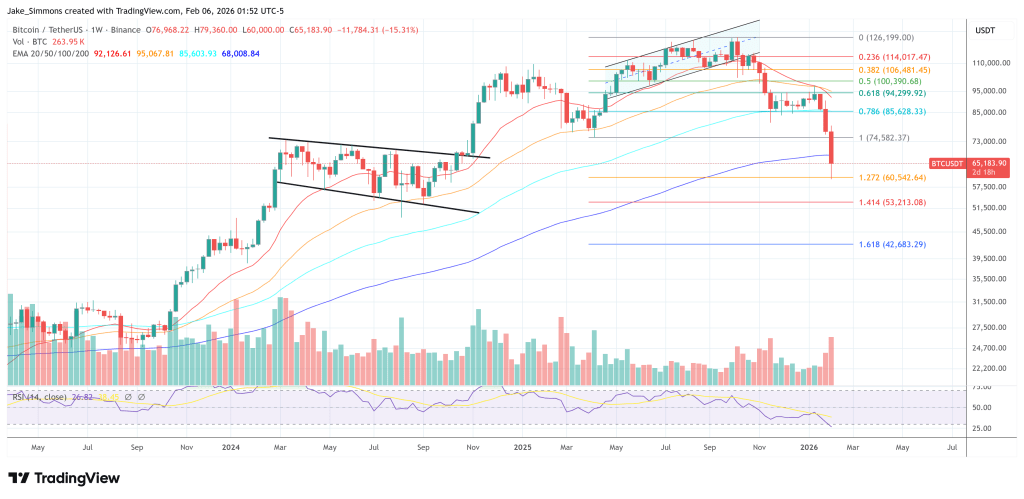
BTC needs a weekly closer above the 200-week EMA ideally, 1-week chart | Source: BTCUSDT on TradingView.com

Crypto di tendenza

Domande pertinenti

QWhat is the main focus of Michael Saylor's new Bitcoin security initiative announced during the Q4 2025 earnings call?

AThe main focus is coordinating a global 'Bitcoin security program' aimed at achieving quantum readiness and addressing emergent security threats, while cautioning against rushed protocol changes.

QHow many Bitcoin did MicroStrategy hold by the end of 2025, and what percentage of the total supply does this represent?

AMicroStrategy held 713,502 Bitcoin by the end of 2025, representing about 3.4% of all Bitcoin that will ever exist.

QWhat is Michael Saylor's estimated timeline for when quantum computing might pose a threat to Bitcoin?

AMichael Saylor estimates that a quantum computing threat to Bitcoin is probably 10 or more years away, which he states is the consensus view.

QAccording to Saylor, why is MicroStrategy not advocating for a specific quantum-resistant solution for Bitcoin at this time?

AMicroStrategy is not advocating for a specific solution because there is not yet a global consensus that existing cryptographic libraries are at risk, and rushing a fix could introduce new attack surfaces and complexity.

QWhat specific financial preparation did MicroStrategy's CFO mention regarding the company's obligations?

ACFO Andrew Kang stated that MicroStrategy established a $2.25 billion cash reserve designed to cover roughly 2.5 years of interest and dividend obligations.

Letture associate

2026 Mid-Year Report On-Chain RWA: Tokenized Stock Market Cap Doubles in a Year, But 90% of Rights Are Hollow Shells

The 2026 Mid-Year Report on On-Chain RWA highlights a significant growth in tokenized stock market capitalization, which nearly doubled from $951 million in March to $1.89 billion by July. However, the report reveals a fundamental contradiction in this "layer 2.5" ecosystem: products with the strongest legal foundation (like regulated U.S. infrastructure) lack liquidity and distribution, while freely tradable offshored wrapper products often lack substantive ownership rights. The increase is driven largely by a few products (SECZ, FGRS, STRCx) and platforms (Ondo, xStocks, Securitize collectively hold over 85% share). While distributed value across networks like Ethereum, Solana, and BNB Chain has grown, the market remains fragmented. Products referencing the same underlying asset (e.g., Apple stock) are distinct legal liabilities with different intermediaries and jurisdictional rules, offering varying degrees of legal claim. The report cautions that headline numbers are misleading, as they reflect changes in distributed token value—driven by issuance, conversions, and price movements—not pure investor inflows. True "canonical shares" with legal ownership, wide wallet distribution, institutional liquidity, and independent on-chain price discovery do not yet exist at scale. Tokenized treasuries show stronger product-market fit, and ETFs may be easier to scale than single stocks. The core takeaway is a trade-off: legal certainty versus liquidity and composability.

marsbit49 min fa

2026 Mid-Year Report On-Chain RWA: Tokenized Stock Market Cap Doubles in a Year, But 90% of Rights Are Hollow Shells

marsbit49 min fa

Coldcard Hardware Wallet Hacked: 594 Bitcoin Withdrawn in 25 Minutes

The Coldcard hardware wallet has been compromised, with hackers stealing approximately 594.5 Bitcoin (~$40 million) from 500 addresses in just 25 minutes. The root cause was a critical software bug, undetected for five years, which disabled the device's secure chip for generating true random numbers. This led to the creation of private keys based on predictable data like the processor's serial number, drastically reducing cryptographic security. The attackers exploited this offline by brute-forcing possible seed phrases, finding active addresses on the public ledger, and signing transactions. Initially, Coinkite (Coldcard's maker) claimed only older models were at risk but later admitted all devices running the compromised firmware were vulnerable. CEO Rodolphe Novak (NVK) apologized but ruled out financial compensation for affected users. To secure funds, owners must urgently update their firmware to specific safe versions, generate a completely new seed phrase on the updated device, and transfer all assets to new addresses created with that new seed. While a BIP-39 passphrase can help, it does not replace this migration process. Other Coinkite products like TAPSIGNER were not affected. This incident underscores that even specialized hardware requires rigorous, independent code audits, especially for cryptographic functions. It parallels past failures, like a 2006 OpenSSL bug in Debian, and raises questions about whether automated code analysis can ever fully replace human scrutiny in critical security areas.

cryptonews.ru3 h fa

Coldcard Hardware Wallet Hacked: 594 Bitcoin Withdrawn in 25 Minutes

cryptonews.ru3 h fa

Trading

Spot

Articoli Popolari

Come comprare PUSH

Benvenuto in HTX.com! Abbiamo reso l'acquisto di Push Protocol (PUSH) semplice e conveniente. Segui la nostra guida passo passo per intraprendere il tuo viaggio nel mondo delle criptovalute.Step 1: Crea il tuo Account HTXUsa la tua email o numero di telefono per registrarti il tuo account gratuito su HTX. Vivi un'esperienza facile e sblocca tutte le funzionalità,Crea il mio accountStep 2: Vai in Acquista crypto e seleziona il tuo metodo di pagamentoCarta di credito/debito: utilizza la tua Visa o Mastercard per acquistare immediatamente Push ProtocolPUSH.Bilancio: Usa i fondi dal bilancio del tuo account HTX per fare trading senza problemi.Terze parti: abbiamo aggiunto metodi di pagamento molto utilizzati come Google Pay e Apple Pay per maggiore comodità.P2P: Fai trading direttamente con altri utenti HTX.Over-the-Counter (OTC): Offriamo servizi su misura e tassi di cambio competitivi per i trader.Step 3: Conserva Push Protocol (PUSH)Dopo aver acquistato Push Protocol (PUSH), conserva nel tuo account HTX. In alternativa, puoi inviare tramite trasferimento blockchain o scambiare per altre criptovalute.Step 4: Scambia Push Protocol (PUSH)Scambia facilmente Push Protocol (PUSH) nel mercato spot di HTX. Accedi al tuo account, seleziona la tua coppia di trading, esegui le tue operazioni e monitora in tempo reale. Offriamo un'esperienza user-friendly sia per chi ha appena iniziato che per i trader più esperti.

573 Totale visualizzazioniPubblicato il 2024.12.13Aggiornato il 2026.06.02

Come comprare PUSH

Discussioni

Benvenuto nella Community HTX. Qui puoi rimanere informato sugli ultimi sviluppi della piattaforma e accedere ad approfondimenti esperti sul mercato. Le opinioni degli utenti sul prezzo di PUSH PUSH sono presentate come di seguito.

活动图片













