Saylor Names Solana And Ethereum As Future Of Digital Credit

bitcoinistPubblicato 2026-02-27Pubblicato ultima volta 2026-02-27

Introduzione

In his keynote at Strategy World 2026, Michael Saylor outlined a vision where Bitcoin serves as the foundational capital base for digital credit products, with Solana and Ethereum acting as key distribution platforms. He explained that his company, MicroStrategy, is shifting from merely accumulating Bitcoin to converting it into structured credit products like its Stretch (STRC) offering. This approach aims to extract steady yield from Bitcoin’s volatility and deliver it as programmable financial instruments. Saylor emphasized that digital credit can be tokenized and distributed across various platforms—including traditional exchanges like NASDAQ and crypto networks like Solana and Ethereum. He argued that if Bitcoin appreciates significantly, it can back large volumes of investment-grade credit. Solana and Ethereum are positioned not as the reserve asset but as scalable rails for deploying tokenized credit, yield, and liquidity products to a broader market.

Michael Saylor used his Strategy World 2026 keynote on Feb. 25 to argue that Bitcoin-backed “digital credit” is moving beyond Wall Street wrappers and toward programmable distribution on crypto rails, naming Solana and Ethereum as part of that future. The pitch matters because it pushes Strategy’s Bitcoin treasury model into a broader product thesis: use Bitcoin as the capital base, then package credit, yield and liquidity for corporates, retail investors and eventually tokenized markets.

Bitcoin Capital, Credit Product

Saylor framed Bitcoin as the foundation of the stack and Strategy’s Stretch (STRC) as the credit layer built on top of it. In his telling, the company’s business is no longer just accumulating Bitcoin, but “converting capital into credit” by using long-duration capital structures to strip cash flow from a volatile asset and deliver it as a steadier yield product.

“What is Strategy doing? Our company is converting capital into credit. We’re converting economic wealth into a stream of cash flows,” Saylor said. “You need an operating company in order to take a block of economic energy and turn it into a currency, peg it to a currency, strip away the risk, damp the volatility, extract the cash flows in the form of yield and compress the duration to now.”

That framework sits at the center of his case for STRC. Saylor said Strategy arrived there only after working through what he described as increasingly durable forms of leverage, from exchange leverage and margin loans to senior debt, junior debt, convertibles and preferred structures.

The key variable, in his view, is not just headline maturity, but the “stochastic duration” of capital, how long a company can realistically rely on it before covenants, mark-to-market stress or refinancing pressure force a problem.

He argued that variable preferred credit offered the best compromise short of common equity because it maximized optionality and reduced the risk of getting squeezed out of the position during a drawdown.

Saylor also laid out a simple quantitative case for digital credit. Strategy, he said, uses three internal metrics: BTC rating, or collateral coverage; BTC risk, the probability that collateral falls below required levels by the end of the term; and the implied credit spread needed to compensate investors. He contrasted current benchmarks of 78 basis points for investment-grade bonds and 288 basis points for high-yield debt with what he said digital credit could deliver if Bitcoin compounds faster than traditional assets.

His model depends heavily on a constructive view of Bitcoin’s long-run returns. If Bitcoin appreciates at 30% annually, Saylor said, sizable volumes of investment-grade credit can be created against it. If Bitcoin goes nowhere, the same structure starts to look like distressed debt.

He used recent performance to sharpen that distinction. Since Bitcoin’s all-time high about four and a half months ago, Saylor said, Bitcoin had fallen 45%, while STRC had lost “0% of its value” and paid 4.5% in dividends through the drawdown. That, he argued, is the commercial opening: offer a less volatile yield instrument to buyers who want Bitcoin-linked economics without owning the asset outright.

Solana And Ethereum As Distribution Rails

The keynote’s most consequential turn came when Saylor described digital credit as “programmable.” He was not using the term narrowly.

“Programmable means I take the credit and I create it. I turn it into a token, a private fund, a public fund, an ETF, an ETP. I make it a bank account. I make it a crypto account,” he said. “Then I put it on a platform — the NASDAQ, the London Stock Exchange, Solana, Ethereum, Binance, Coinbase Base. There are a lot of different platforms I can put that on.”

He went further, arguing that once credit is packaged as a modular product, issuers can tune volatility, liquidity, staking periods, payout frequency and currency exposure. In that framework, Solana and Ethereum are not the capital base (Bitcoin remains that in Saylor’s model) but potential rails for distributing tokenized versions of the credit product.

That leaves Strategy with a larger ambition than simply selling preferred stock. Saylor said the company intends to deepen STRC liquidity and scale the underlying asset base, while partners build “digital money” and “digital yield” products around it.

If that thesis holds, Strategy is betting Bitcoin-backed credit can move from a public-market niche into a cross-platform product category spanning brokerages, ETFs and on-chain ecosystems.

At press time, Solana traded at $86.97.
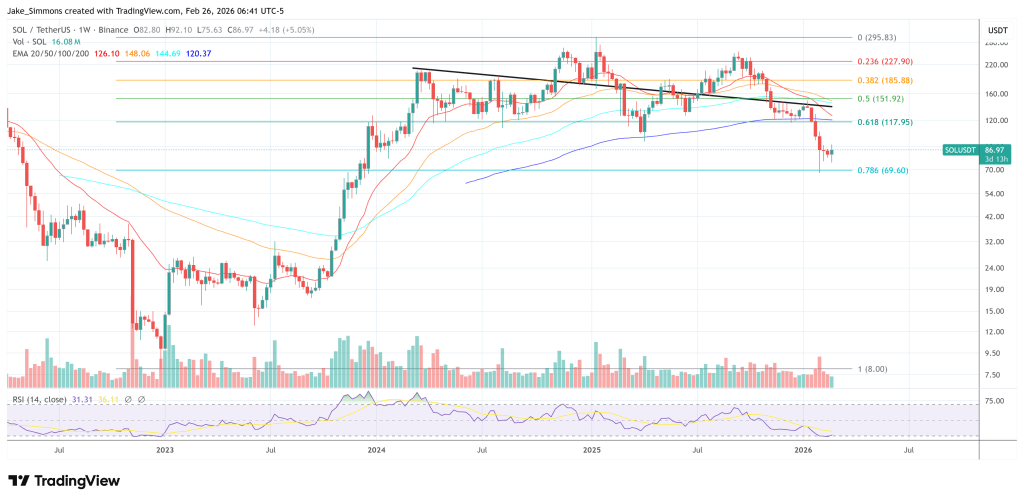
Solana must reclaim the 0.618 Fib, 1-week chart | Source: SOLUSDT on TradingView.com

Domande pertinenti

QWhat did Michael Sayer name as the future platforms for distributing programmable digital credit?

AMichael Saylor named Solana and Ethereum as future platforms for distributing programmable digital credit.

QAccording to Saylor, what is the role of Bitcoin in MicroStrategy's new business model?

ASaylor framed Bitcoin as the foundation of the capital stack, with MicroStrategy's Stretch (STRC) acting as the credit layer built on top of it. The company is converting capital into credit to create steadier yield products.

QWhat three internal metrics does MicroStrategy use to evaluate its digital credit model?

AThe three internal metrics are: BTC rating (collateral coverage), BTC risk (the probability collateral falls below required levels), and the implied credit spread needed to compensate investors.

QHow did Saylor contrast the performance of Bitcoin and STRC during the recent drawdown?

ASaylor stated that since Bitcoin's all-time high, it had fallen 45%, while STRC had lost '0% of its value' and paid 4.5% in dividends through the drawdown.

QWhat is the broader ambition for MicroStrategy's Bitcoin-backed credit, beyond selling preferred stock?

AThe broader ambition is to deepen STRC liquidity, scale the underlying asset base, and have partners build 'digital money' and 'digital yield' products, moving it from a public-market niche into a cross-platform product category spanning brokerages, ETFs, and on-chain ecosystems.

Letture associate

Must-Watch Events Next Week|CLARITY Act Could Face Senate Vote; SpaceX, Circle to Report Earnings (8.3-8.9)

**Summary: Key Events and Developments to Watch (August 3-9)** The upcoming week is marked by significant financial disclosures, key legislative deadlines, and notable product updates. **Major Financial Events:** Several companies are scheduled to release their Q2 2026 earnings. American Bitcoin (ABTC) will report on August 3, followed by SpaceX and Hut 8 Mining Corp. on August 4, and Circle on August 5. Notably, a significant portion of SpaceX shares (up to 12% of total shares) will be unlocked on August 6 following their earnings release. **Key Legislative Deadline:** The U.S. Senate faces an August 7 deadline to secure 60 votes for the CLARITY Act, a bipartisan bill aiming to establish a federal regulatory framework for cryptocurrencies. The Senate may hold a full vote on the bill during the week. **Economic Data:** The U.S. July Non-Farm Payrolls report will be released on August 7, providing crucial labor market data. **Technology & Product Updates:** * **Shutdowns:** DeFi portfolio tracker Zapper and wallet app Ctrl Wallet will cease operations on August 3. * **Upgrades:** LayerZero will deprecate its v1 relayers on August 3. XRP Ledger's new version 3.3.0, featuring five new functions, is expected next week. * **AI:** Elon Musk announced that the advanced Grok 4.6 AI model is set for release around August 7. * **Bitcoin:** The BIP-110 forced signaling for a potential Bitcoin network change is scheduled to begin around August 8. **Other Notable Events:** Chinese robotics firm Unitree Tech has set its preliminary price inquiry for its IPO for August 5. South Korean exchange Upbit will delist AQT and AERGO tokens on August 3.

marsbit1 h fa

Must-Watch Events Next Week|CLARITY Act Could Face Senate Vote; SpaceX, Circle to Report Earnings (8.3-8.9)

marsbit1 h fa

Stocks Are Plummeting More Sharply Than Cryptocurrencies. Where Has the Money Gone?

Stock Markets Plunge Deeper Than Cryptocurrencies: Where Did the Money Go? In late July, Seoul's Kospi index triggered circuit breakers for two consecutive days, plummeting over 40% from its June high. The collapse was led by heavyweight stocks like SK Hynix, whose record profits still disappointed investors, and devastating leveraged ETFs, with one major product losing over 83% of its value. This signaled a global, forced deleveraging targeting the most crowded trades. Interestingly, while stocks exhibited extreme volatility akin to crypto markets, Bitcoin rose nearly 15% in July after a prior steep drop. Analysis shows the money fleeing equities did not flow into Bitcoin. Instead, Bitcoin had already absorbed its sell-off in May-June, when U.S. spot Bitcoin ETFs saw historic outflows. The true safe-haven beneficiary was gold, whose price rose over 20% year-on-year, highlighting a decoupling between Bitcoin and gold as "digital gold." The sell-off was a targeted unwinding of leveraged positions in tech and semiconductors, accelerated by broker-dealer risk management and shifts in the AI narrative, including new competition from Chinese memory chipmakers. The retreat path was clear: from high-valuation tech stocks to cash and U.S. Treasuries, then to gold. For Bitcoin to attract sustained institutional inflows, conditions like eased global liquidity pressure, a "soft-landing" Fed rate cut, and U.S. regulatory clarity via legislation like the stalled CLARITY Act are needed. Currently, Bitcoin is not a safe haven but an already-cleared asset. Its low correlation with tech stocks, however, makes it a potential diversification play for institutional portfolios once the storm passes. The money isn't here yet, but the positioning is underway.

marsbit1 h fa

Stocks Are Plummeting More Sharply Than Cryptocurrencies. Where Has the Money Gone?

marsbit1 h fa

In Conversation with Ray Dalio: We Are Currently in an AI Bubble, with 1% of My Portfolio in Bitcoin

Ray Dalio, founder of Bridgewater Associates, warns in an interview that the current AI boom shows classic bubble characteristics, which could lead to significant economic downturns as seen in past cycles like 1929 or 2000. He explains that speculative enthusiasm, fueled by debt and overvaluation, often precedes a crash when rising rates or taxation force asset sales, causing widespread losses and recession. Dalio also outlines his "Big Cycle" theory, describing an approximate 80-year pattern where widening wealth gaps, massive government deficits, and shifting geopolitical power (like China's rise) create internal conflict and global instability. He emphasizes that we are in a late-cycle, transitional phase where traditional powers like the US and UK face decline. For personal wealth protection, Dalio advises diversification beyond cash into assets like stocks, bonds, real estate, and particularly gold, which he prefers over Bitcoin. While he holds about 1% of his portfolio in Bitcoin as a non-printable hard asset, he views gold as more secure from technological or governmental threats. Regarding AI's impact, Dalio believes it will disproportionately benefit capital owners, worsening inequality by replacing both physical and cognitive labor. He suggests that human intuition and emotional intelligence, combined with AI, will be key for future workers. On taxation, Dalio argues that wealth taxes are impractical and risk triggering asset sell-offs, reducing productive investment. He points to the UK as a cautionary example of debt, low productivity, and political strife. Geopolitically, Dalio foresees a more regionalized world, with the US showing weakness in prolonged conflicts like with Iran, akin to past imperial declines. The ideal outcome, he suggests, is coexisting powerful blocs (e.g., Americas, China-Asia Pacific) without major war.

marsbit5 h fa

In Conversation with Ray Dalio: We Are Currently in an AI Bubble, with 1% of My Portfolio in Bitcoin

marsbit5 h fa

Trading

Spot
活动图片





