Sanctions could turn Russia into a market for low-quality cryptocurrency

cryptonews.ruPubblicato 2026-08-28Pubblicato ultima volta 2026-08-28

Introduzione

Sanctions could turn Russia into a market for 'dirty' and low-quality cryptocurrency, according to a key participant in the country's soon-to-be-regulated crypto market. Russia is set to legalize crypto trading in September, but Vladislav Kochetkov, Chairman of the Finam financial group, warns that Western sanctions may isolate the Russian market, creating an "exotic" space where coins tainted by sanctions or linked to blocked platforms trade at a significant discount to global prices. This would form a separate, isolated market cycle with its own rules. The new "On Digital Currency" law, signed by President Putin in August, will allow licensed banks and brokers to act as intermediaries. Finam plans to enter as a major broker and exchange. However, the market is expected to be primarily speculative, with retail investors limited to investing in top assets like Bitcoin and Ethereum, capped at $4,000 annually per intermediary. Kochetkov notes the Russian approach departs from classic crypto ideology by enforcing intermediaries and a regulated architecture, including licensed platforms and digital depositories for asset custody. He described the future market as potentially "speculative, inflexible, and liquid," built on a rigid but functional framework.

According to a key participant in Russia's soon-to-be-regulated market, sanctions could turn the country into a platform for trading 'dirty' cryptocurrency at discounted prices.

In September, the country is preparing to legalize cryptocurrency transactions, but the assets circulating within it are likely to be too risky for other market participants.

Russia is said to be creating an 'exotic market for fraudulent cryptocurrency'

Western sanctions could lead to the creation of an isolated Russian digital asset market that foreign players will be unwilling to work with.

This means that coins traded there are likely to be offered at a discount compared to global prices, as stated by the CEO of a leading Russian broker.

Vladislav Kochetkov, Chairman of the Board of the Finam financial group, made these comments in an interview with the Russian news agency TASS.

Speaking ahead of the Eastern Economic Forum (EEF), a major international conference to be held next week in the far-eastern city of Vladivostok, he said:

"Sanctions could lead to Russia becoming a market for 'tainted' cryptocurrencies, that is, assets that have passed through blocked addresses or platforms and therefore pose a danger to international counterparties."

This could make the Russian market "extremely exotic," offering a significant discount compared to international benchmark rates, Kochetkov emphasized.

It's not just about being cut off from global liquidity. "It is about the formation of a separate, isolated pricing cycle, functioning according to its own rules," he explained.

Moscow to legalize cryptocurrency transactions from September 1

The president of Finam stated in excerpts from an interview published on Thursday that the company intends to enter the regulated Russian cryptocurrency market as a major participant, operating simultaneously as a broker and an exchange.

The country is preparing to legalize cryptocurrency operations, such as investing and trading, through the new "On Digital Currency and Digital Rights" law passed by the Russian parliament in July.

The legislation, Moscow's first attempt to comprehensively regulate the digital asset sector, was signed by President Putin in early August.

The main provisions of this nearly 300-page legal document will come into force on September 1, 2026, as previously stated. Commenting on this issue to Cryptopolitan, Vladislav Kochetkov said:

"Yes, we plan to enter the Russian cryptocurrency market and take leading positions. As for roles... definitely, we will be a broker and a cryptocurrency exchange."

Finam was one of the first Russian companies to offer cryptocurrency derivatives to qualified investors, along with Sberbank and MOEX, after the Central Bank of Russia (CBR) permitted it in May 2025.

The new regulatory framework allows traditional companies, such as banks and brokers, to enter the cryptocurrency market based on existing licenses and act as intermediaries.

It also introduces a licensing regime for cryptocurrency platforms, such as existing exchanges, and introduces a new category of participants — "digital depositories."

The latter will be responsible for the storage and accounting of cryptocurrency assets. Internal transactions will only be possible through authorized organizations.

Finam has not yet made a decision to create its own depository, Kochetkov said in the TASS interview, excerpts of which were published on Thursday and Friday.

"The decision has not been made yet, and the reason is purely economic: it's expensive," he noted, adding that such an investment would require at least 3 billion rubles ($35 million) and eight years to pay off.

Russian cryptocurrency market will be 'speculative, inflexible, and liquid'

The "digital currency" law will, for the first time, provide non-professional investors in Russia with a legal opportunity to invest in decentralized and fiat-pegged digital assets.

However, these will only be the most liquid and capitalized cryptocurrencies, such as Bitcoin and Ethereum, as well as the stablecoin Tether (USDT). Additionally, investments will be limited to less than $4,000 per year per intermediary.

The CEO of Finam believes the Russian cryptocurrency market will be predominantly speculative, rather than focused on acquiring cryptocurrency for payments or storage in personal non-custodial wallets. He noted:

"As usual, we are going our own way and moving away from the classic crypto ideology of free movement of assets without intermediaries."

Kochetkov is also convinced that, although the Russian market will be built on a "rigid architecture, unusual for cryptocurrencies," it will be "fully functional and liquid."


Domande pertinenti

QAccording to the head of Finam, what is the potential negative consequence of sanctions for the Russian crypto market?

AVladislav Kochetkov, the head of Finam, stated that Western sanctions could turn Russia into a market for 'dirty' or 'tainted' cryptocurrencies. These are assets that have passed through blocked addresses or platforms, making them risky for international counterparties. This could lead to the creation of an isolated market where such crypto assets trade at a significant discount compared to global prices.

QWhat are the key roles Finam plans to play in the newly regulated Russian cryptocurrency market?

AFinam plans to become a major participant in the regulated Russian crypto market by acting simultaneously as both a broker and a cryptocurrency exchange.

QStarting from September 1, 2026, what are the main investment options and limits for non-professional crypto investors in Russia?

AStarting September 1, 2026, non-professional investors in Russia will be legally allowed to invest only in the most liquid and capitalized cryptocurrencies like Bitcoin and Ethereum, as well as the stablecoin Tether (USDT). Investments will be capped at less than $4,000 per year per intermediary.

QHow does the new Russian crypto regulation fundamentally differ from the classic cryptocurrency ideology?

AThe new Russian regulation departs from the classic crypto ideology of free movement of assets without intermediaries. Instead, it establishes a system where all domestic transactions must go through authorized intermediaries like licensed brokers, exchanges, and new 'digital depositaries' responsible for custody, creating a more controlled and intermediated architecture.

QWhat is Finam's stated reason for hesitating to create its own digital depositary?

AFinam's head, Vladislav Kochetkov, stated that the company has not yet decided to create its own digital depositary, citing purely economic reasons. He noted that such an investment would require at least 3 billion rubles (approximately $35 million) and would take about eight years to recoup, making it a very expensive undertaking.

Letture associate

Bitcoin Added $14,264 in a Week; According to Galaxy, a Signal the Next Bottom is Near

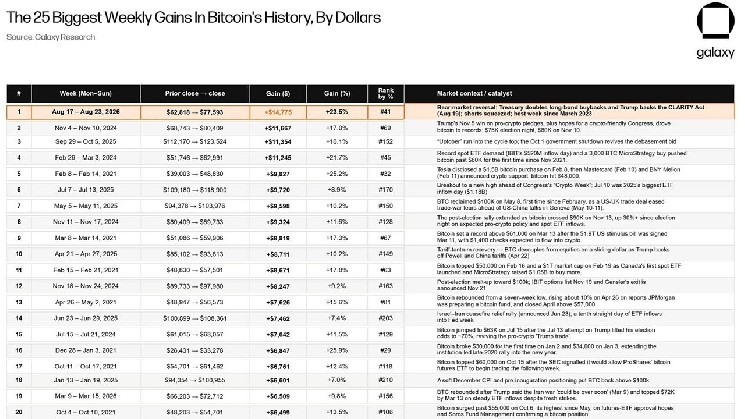
Bitcoin concluded the week ending August 23rd with a gain of $14,264, or 22.7%, closing at $77,387. This marked its largest weekly dollar gain on record, though percentage gains have been larger when prices were lower. The subsequent rally pushed prices to a three-month high above $81,000 before a slight pullback. The catalyst for the surge was identified as the U.S. Treasury's announcement to at least double its long-term bond buyback operations to support liquidity. Galaxy Digital's Head of Research, Alex Thorn, also noted a significant "buying shift" in BlackRock's iShares Bitcoin Trust (IBIT) by retail investors, a signal not seen in two years. Galaxy Research highlighted a key technical level to watch: the 50-week moving average around $82,470. Historical data shows that in 11 of the past 13 bear markets since 2011, a weekly close above this average has coincided with the cycle bottom being in. Failure to achieve this close could mean the rally is merely a corrective bounce within a longer downtrend rather than the start of a new bullish trend. Matt Cole, CEO of Strive, offered an optimistic view, suggesting the next Bitcoin cycle could be the strongest ever, citing its performance relative to the dollar and gold as evidence of changing dynamics. However, as the price base grows, record dollar gains become easier to achieve, making sustainability the key question.

cryptonews.ru28 min fa

Bitcoin Added $14,264 in a Week; According to Galaxy, a Signal the Next Bottom is Near

cryptonews.ru28 min fa

Trading

Spot
活动图片