Sam Bankman-Fried Backs Off New Trial Request, Keeps Pressure On Judge Removal

bitcoinistPubblicato 2026-04-24Pubblicato ultima volta 2026-04-24

Introduzione

Sam Bankman-Fried has withdrawn his request for a new trial, stating he does not expect a fair hearing from Judge Lewis Kaplan, who oversees his criminal case. He withdrew the motion without prejudice, meaning he can refile it after his appeal and a separate request to remove Kaplan from the case are resolved. Bankman-Fried is serving a 25-year sentence for fraud related to the collapse of FTX. The withdrawal followed a court-ordered inquiry into whether he had legal help drafting an earlier filing, which he denied. His efforts to replace the judge and appeal his conviction continue. Outside court, he has sought a pardon, but former President Trump has indicated he will not grant one.

Sam Bankman-Fried has told a federal court he does not expect a fair hearing from the judge overseeing his criminal case — and because of that, he is pulling his request for a new trial.

A Calculated Move In Federal Court

The former FTX chief executive filed a letter Wednesday in the US District Court for the Southern District of New York, withdrawing a Rule 33 motion he had been pursuing to overturn his conviction.

The withdrawal, he made clear, is not final. He dropped the motion without prejudice, meaning he can bring it back after his appeal and his separate request to have a different judge assigned to the case are resolved.

Bankman-Fried, 32, is currently held at the Federal Correctional Institution in Lompoc, California, where he is serving a 25-year sentence handed down after his 2023 conviction on fraud and related charges tied to the collapse of FTX.

At its peak, the crypto exchange was one of the largest in the world.
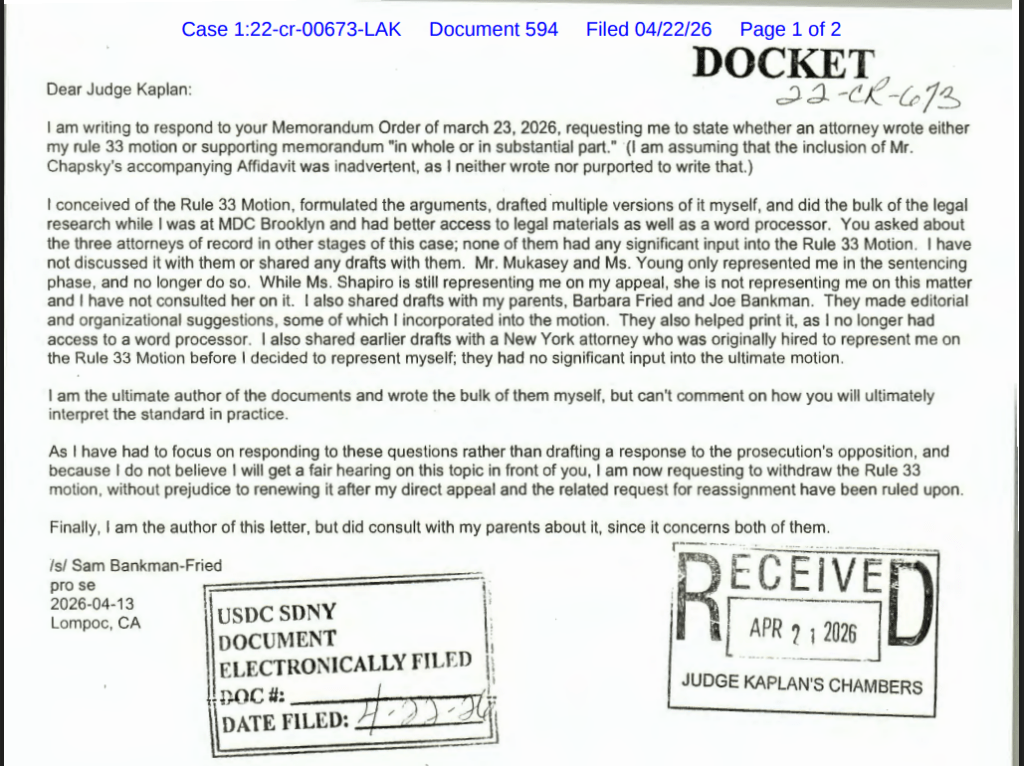
Sam Bankman-Fried's letter to Judge Kaplan released publicly Wednesday. Source: CourtListener.

His decision to pull the motion came after Judge Lewis Kaplan ordered him to explain whether lawyers had helped him draft an earlier filing — a pro se document, meaning one submitted without formal legal representation.

Federal prosecutors had raised doubts about whether Bankman-Fried had written the filing on his own, particularly after his mother, Barbara Fried, sent her own letter to the court. She had no legal standing to do so.

Questions About Who Wrote What

In his Wednesday response, Sam Bankman-Fried said he consulted with his parents while writing the letter but described himself as the “ultimate author of the documents.”

He said the need to respond to the court’s questions had taken time away from preparing a fuller response to prosecutors opposing his new trial request. That, combined with his stated belief that Judge Kaplan would not treat the matter fairly, led him to withdraw the motion.

BTCUSD currently trading at $77,600. Chart: TradingView

His bid to have Kaplan removed from the case predates Wednesday’s filing. Back in February, Bankman-Fried asked a court to assign a different judge to rule on his new trial request, accusing Kaplan of showing “extreme prejudice.”

That request remains active. So does his appeal of both his conviction and his sentence, which is pending before the US Court of Appeals for the Second Circuit.

Sam Bankman-Fried: Pardon Talk Has Done Little To Help His Cause

Outside the courtroom, Bankman-Fried has made no secret of his interest in a presidential pardon. According to reports, he has posted publicly praising US President Donald Trump’s crypto-related policies and his administration’s military moves in Iran.

But Trump has shown no sign of extending any relief. Based on reports from a January interview with The New York Times, Trump said flatly that he had no plans to pardon the convicted founder of FTX.

Featured image from Getty Images, chart from TradingView

Domande pertinenti

QWhy did Sam Bankman-Fried withdraw his request for a new trial?

AHe withdrew the request because he stated he does not expect a fair hearing from Judge Kaplan and the need to respond to the court's questions about who drafted an earlier filing took time away from preparing a fuller response.

QWhat is the status of Sam Bankman-Fried's request to have Judge Kaplan removed from his case?

AHis request to have a different judge assigned to the case remains active and is separate from his withdrawn motion for a new trial.

QWhat specific legal motion did Sam Bankman-Fried file and then withdraw?

AHe withdrew a Rule 33 motion, which is a request for a new trial based on newly discovered evidence.

QWhat was the reason federal prosecutors raised doubts about an earlier court filing from Sam Bankman-Fried?

AProsecutors raised doubts about whether he had written the pro se filing on his own, particularly after his mother, who has no legal standing, sent her own letter to the court.

QHas former President Donald Trump indicated he would pardon Sam Bankman-Fried?

ANo, based on a January interview with The New York Times, Trump said flatly that he had no plans to pardon the convicted founder of FTX.

Letture associate

UBS: The Crowdedness of A-Share Tech Stocks Is Far From Reaching Historical Peaks

UBS: A-share tech stocks still far from peak crowding levels A-shares' technology sector has seen a strong rebound, with trading activity hitting record highs, raising concerns about market crowding. However, UBS Securities argues that a key indicator of institutional positioning suggests the current crowding level remains well below historical peaks. While the large-cap tech sector's share of total A-share trading volume and market capitalization have reached historical highs, the overweight ratio of domestic mutual funds in this sector stood at 9.9% in Q1 2026. This is down from 11.6% in Q3 2025 and significantly lower than the historical peak of 14.1% in Q4 2015. It also pales in comparison to the historical peak overweight of 18.7% for the consumer sector. UBS notes that typical cycles from a low to a peak in fund overweighting last about three years, and the current outperformance of the tech/growth style has lasted less than two years since the policy pivot in September 2024. UBS expects A-share earnings recovery to accelerate, providing fundamental support. It forecasts 2026 A-share profit growth to rise to 11% from 3.9% in 2025. Non-financial A-share profits grew 11.8% YoY in Q1 2026, with gross and net profit margins at their highest since 2023. Persistent fund inflows, the expansion of thematic ETFs, and a recovery in private fund issuance are supporting market liquidity. In tactical allocation, UBS favors growth and cyclical styles under its "slow bull" base case, with overweight ratings on six sectors: Electronics (benefiting from semiconductor inventory recovery and AI innovation), Communications (driven by AI computing demand), Machinery (aided by domestic capex recovery), Non-ferrous Metals (due to rising copper/aluminum prices), Chemicals (supported by anti-involution policies), and Electrical Equipment (driven by policy support and AI data center power demand).

marsbit16 min fa

UBS: The Crowdedness of A-Share Tech Stocks Is Far From Reaching Historical Peaks

marsbit16 min fa

Trading

Spot
Futures
活动图片