Sai Launches Perps Platform Combining CEX Speed with Onchain Settlement

TheNewsCryptoPubblicato 2026-02-18Pubblicato ultima volta 2026-02-18

Introduzione

Sai has launched Sai Perps, a perpetuals trading platform designed to combine the speed and user experience of a centralized exchange (CEX) with the transparency and self-custody of onchain settlement. The platform offers gasless transactions to reduce friction while maintaining onchain security. Alongside the launch, Sai announced the "Let’s Go Saicho" trading competition, running from February 18 to March 19, 2026, with $25,000 in total prizes. The competition includes a PNL-based phase and a first-come, first-served phase to reward both performance and early participation. Key advantages of Sai Perps include a CEX-like interface, deep liquidity infrastructure, accessibility for all traders, and plans to expand into stocks, commodities, and FX markets. The platform aims to make advanced trading accessible without compromising on transparency or self-custody.

Panama City, Republic of Panama, February 18th, 2026, Chainwire

Sai today launched Sai Perps, a perpetuals trading platform built to be as fast and intuitive as a centralized exchange with the transparency and self-custody of onchain settlement. The platform features gasless transactions, removing friction for traders while maintaining full onchain security.

Sai also unveiled Let’s Go Saicho, a one-month onchain trading competition running February 18 through March 19, 2026, with $25,000 in total prizes. The campaign is structured in two phases designed to reward both performance and participation: a PNL competition for profitable traders, followed by a first-come, first-serve “Be Early” phase for traders who engage early and hit a minimum volume threshold.

“Onchain markets shouldn’t require traders to compromise between speed and self-custody,” said Matthias Darblade, a Sai contributor. “Sai Perps is designed for active traders who want a clean, CEX-like experience, while still getting the transparency and settlement guarantees that only onchain infrastructure can provide.”

Why Sai vs. Other Perps DEXs

Sai Perps is built around the premise: trading should be accessible without the usual friction of onchain perps. Compared to existing perpDEXs, Sai stands out in many ways:

  • CEX-like UX, onchain settlement: A streamlined trading experience designed to be fast and familiar, with trades settling onchain for transparency and verifiability.
  • Infrastructure built for deep, smooth markets: Sai has focused heavily on liquidity, risk systems, and oracle design to support more consistent execution and robust market integrity.
  • Accessible to both new and experienced traders: A platform experience optimized for speed and clarity, without sacrificing advanced trading capability.
  • Roadmap beyond crypto perps: Sai’s planned expansion includes stocks, commodities, and FX markets, plus user-focused capital efficiency features like Sai Savings (yield on deposits), and cross-chain deposits.

Let’s Go Saicho: $25,000 Trading Competition (Feb 18 – Mar 19, 2026)
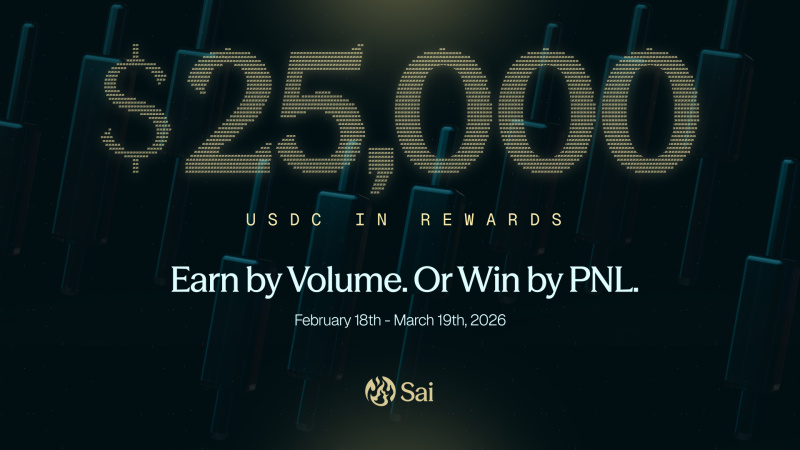
Let’s Go Saicho is a one-month competition rewarding trading on Sai across two two-week phases:

  • Phase 1 (Feb 18 – Mar 4): PNL Competition | $20,000 prize pool, 50 winners
  • Phase 2 (Mar 5 – Mar 19): Be Early (First Come First Serve) | $5,000 prize pool, 50 winners

All markets listed on Sai are eligible in both phases. Traders may go long or short on any listed pair using supported collateral (e.g., USDC and other supported assets such as stNIBI, as available on Sai). For more details on Sai’s Trading Competition, visit here.

About Sai

Sai is a new perpetuals trading platform designed to feel as easy and fast as a centralized exchange, while still settling fully onchain. Sai’s mission is to make advanced trading accessible without sacrificing transparency or self-custody.

Sai is focused on finalizing its core trading infrastructure and user experience, building liquidity and risk systems for smoother execution, and laying groundwork for yield features that help users earn on idle collateral. Next on the roadmap: expanded markets (stocks, commodities, FX), Sai Savings, cross-chain deposits, and smart accounts for gasless trading.

Contact

PR and Media Inquries
Press@sai.fun

Domande pertinenti

QWhat is Sai Perps and how does it combine CEX experience with onchain benefits?

ASai Perps is a perpetuals trading platform designed to offer the speed and intuitive user experience of a centralized exchange (CEX) while maintaining the transparency, verifiability, and self-custody of onchain settlement. It features gasless transactions to reduce friction for traders.

QWhat is the name and duration of the trading competition announced by Sai, and what is the total prize pool?

AThe trading competition is called 'Let’s Go Saicho'. It runs for one month, from February 18th through March 19th, 2026, and has a total prize pool of $25,000.

QHow is the 'Let’s Go Saicho' competition structured?

AThe competition is structured in two phases. Phase 1 (Feb 18 – Mar 4) is a PNL competition with a $20,000 prize pool for 50 profitable traders. Phase 2 (Mar 5 – Mar 19) is a 'Be Early' first-come, first-serve phase with a $5,000 prize pool for 50 traders who engage early and hit a minimum volume threshold.

QAccording to the article, what are some key ways Sai Perps differentiates itself from other perpetuals DEXs?

ASai differentiates itself with a CEX-like user experience, a strong focus on liquidity and risk systems for deep and smooth markets, accessibility for both new and experienced traders, and a roadmap that includes expanding beyond crypto into stocks, commodities, and FX markets.

QWhat future features are mentioned in Sai's roadmap beyond crypto perpetuals?

ASai's planned expansion includes adding markets for stocks, commodities, and FX. The roadmap also includes user-focused features like Sai Savings (yield on deposits), cross-chain deposits, and smart accounts for gasless trading.

Letture associate

Podcast Notes | Conversation with GSR Asset Management Head: To Determine if This Crypto Rally is Real, Just Watch the Lending Rates on Aave

Podcast Summary: Dialogue with GSR's Head of Asset Management: To Determine if This Crypto Rally is Real, Just Check Lending Rates on Aave Andy Baehr, Managing Director of Asset Management at GSR, discusses the current crypto market, characterizing it as stuck in a state of "ambivalence" with short-lived, unsustainable rallies. He outlines a simple framework: the market moves between "ambivalence" and "conviction" (sustained upward momentum). Currently, every rally resembles a single-stage rocket booster that quickly fizzles out. Baehr identifies three key signals to watch: 1) DeFi lending rates, 2) the potential passage of the CLARITY Act, and 3) the market forming a consensus on the "Fed hawkish peak." He emphasizes that the most immediate indicator for the sustainability of the recent CPI-triggered rally is the USDC borrowing rate on Aave, currently around 3.75%—close to U.S. Treasury yields. The absence of a credit spread indicates low leverage demand and a lack of market energy. He explains that a healthy, sustained rally requires layered buying pressure. Last year's rally progressed from an ETH short squeeze to crypto-native trader influx and finally to ETF inflows. Currently, this structure is missing. Other potential structural buyers like Digital Asset Treasury (DAT) companies are absent, and ETF flows have proven transient. Baehr notes that while small-cap crypto tokens outperformed large caps in Q2—a potential sign of capitation in major assets—capital is also flowing to more exciting opportunities like AI stocks and tech IPOs, leaving crypto sidelined. Regarding DeFi, he highlights that platforms like Aave provide a clear, real-time signal of leverage demand through their supply/demand-driven interest rates. A significant, sustained rate increase would signal genuine market conviction. He also observes the quiet emergence of fixed-income-like products and vaults in DeFi. On regulation, the probability of the CLARITY Act passing before the August 7th deadline has dropped linearly from 75% to below 40% on Polymarket. Baehr suggests its passage would be treated as a bullish surprise, a potent driver for price movement. However, political hurdles, including ethical clause debates and disclosures about the First Family's crypto profits, remain significant obstacles. Ultimately, the market awaits clarity on the Fed's terminal rate under Chair Warsh. Until the "Fed Solstice"—the point where the market collectively understands the peak of hawkish policy—sustained conviction will be difficult to achieve.

marsbit33 min fa

Podcast Notes | Conversation with GSR Asset Management Head: To Determine if This Crypto Rally is Real, Just Watch the Lending Rates on Aave

marsbit33 min fa

7 Months After the Collapse of Huiwang, Southeast Asia's Escrow Platforms Undergo a Major Reshuffle

Following the collapse of Huione Pay—dubbed the "Alipay of Southeast Asia"—seven months ago, the region's underground financial guarantee platform sector is undergoing a significant reshuffle. This power vacuum has been swiftly filled by emerging platforms such as XinBi, Tiger/Navigator, JinBei (renamed JinBo), Dali/Tiancheng, and FullyLight. These platforms, operating largely via Telegram and offering services like escrow for illicit transactions, have absorbed the vast user base and markets left behind by Huione. While positioning themselves as "trust intermediaries," their primary clientele consists of networks involved in online scams, money laundering, illegal gambling, and even human trafficking. For instance, the Tiger/Navigator platform explicitly provides "escrow" services for kidnapping-for-ransom operations ("强押车交易"). Data underscores the immense scale: Huione alone processed over $103 billion in cryptocurrency payments and facilitated over $31 billion through its escrow market before its downfall, linking it to Cambodia's notorious Prince Group. Since its collapse, competitors have seen explosive growth. For example, the XinBi platform has accumulated over $1.6 billion in total USDT revenue, while platforms like NewPay, OkPay (under Dali), and FullyLight Wallet collectively processed over $4.8 billion in USDT in a single year. This ecosystem thrives in regions like Cambodia and Myanmar, where regulatory gaps allow these platforms to act as critical financial infrastructure for sprawling cybercrime industries, from scam compounds to online casinos. The article concludes that the moniker "Southeast Asian Alipay" is a misnomer, obscuring the platforms' fundamental role in enabling serious criminal enterprises rather than representing legitimate financial innovation.

Odaily星球日报1 h fa

7 Months After the Collapse of Huiwang, Southeast Asia's Escrow Platforms Undergo a Major Reshuffle

Odaily星球日报1 h fa

Trading

Spot
活动图片





