Author: Seeking Counsel on Stock Trends, Tide Research
Today, Microsoft's annual Build developer conference kicked off at Fort Mason in San Francisco. The key message from Nadella's keynote was just one: AI is no longer an assistant that answers questions; it's now an employee that does the work for you.
The timing of this conference is interesting. Over the past five months, the US software sector has experienced a battle royale.
The market has dubbed this massacre the "SaaSpocalypse." From the beginning of the year to mid-May, Salesforce fell 33%, Intuit dropped nearly 30%, and even Workday and Adobe weren't spared. The panic logic is simple: if an AI agent can do the work of ten people, then companies don't need to buy software seats for ten people. The per-seat billing model that has underpinned the entire SaaS industry for twenty years has had its foundation pulled out.
But just last week, a group stood up amidst this slaughter.
On May 28th, Snowflake soared 36.5% in a single day, its biggest daily gain since listing. Datadog's stock price doubled year-to-date, hitting a new all-time high on May 29th. On the same day, MongoDB rose 10%, Palantir climbed 8%, with the three major indices hitting new highs.
Another group is still down. Intuit plunged 19% at one point after earnings. Although Salesforce's EPS crushed expectations by 24%, its stock still fell post-earnings and remains down about 28% year-to-date.
In the same battle royale, some have doubled while others have been halved. What's the difference?
The Spark Lit by Snowflake
Why could Snowflake light this spark? Because of its pricing model.
The core market fear over the past five months has been something very specific: per-seat pricing. The logic is simple: if an AI agent can do the work of ten people, then companies don't need software seats for ten people. Atlassian reported its first-ever decline in enterprise seat count this year, giving this fear real data support.
Snowflake happens to stand on the opposite side of this fear. It doesn't charge per seat; it charges for the computing power and data processing volume you consume. AI hasn't reduced its consumption; instead, it's furiously driving consumption: AI accounts on the platform grew from 9,100 to 13,600 in a quarter, product revenue grew 34% year-over-year, the company raised its full-year guidance, and announced a $6 billion AWS compute purchase.
Datadog tells the other side of the same story. Snowflake proved "AI is feeding volume to data platforms," Datadog proves "AI is feeding volume to monitoring platforms." Q1 revenue exceeded $1 billion for the first time, up 32% year-over-year, with growth accelerating for three consecutive quarters (from 25% to 29% to 32%). Full-year guidance was raised to $4.3-$4.34 billion. The logic is simple: the more AI workloads a business deploys, the more things need monitoring and debugging, and Datadog's consumption-based meter spins faster. Its RPO (Remaining Performance Obligations) grew 51% year-over-year to $3.48 billion, indicating customers are not only using more but also signing longer-term contracts. Its stock price doubled year-to-date, hitting a record high on May 29th.
One sentence can summarize the logic of this rebound: AI is creating more workload for certain platforms, not replacing them. Snowflake and Datadog are two of the cleanest examples.
The Market's Other Face in the Same Week
If you only look at Snowflake and shout "software stocks are saved," you'll fall into another trap.
Salesforce, which also reported Q1 earnings the same week, tells a story far more complex than just "weak guidance."
First, the good side: Q1 revenue of $11.13 billion, up 13% year-over-year, beat expectations; adjusted EPS of $3.88, 24% higher than the Wall Street consensus of $3.12; the most crucial metric, Agentforce (its AI agent platform) reached $1.2 billion in Annual Recurring Revenue (ARR), growing over 200% year-over-year. The company processed 380 million agent work units and 286 trillion AI tokens in a quarter. This is real AI monetization, not just PPT.
Salesforce is even proactively moving towards "consumption-based" billing. It launched "Flex Credits," charging not just per seat but based on the workload completed by its agents. Six of its top ten Q1 deals included Flex Credits from the start. The company is desperately trying to cross the dividing line between "per seat" and "per consumption."
Now look at the market reaction: after earnings were released, the stock still fell in after-hours trading. As of last Friday, Salesforce was still down about 28% year-to-date. The reasons were a Q2 guidance slightly below the most optimistic expectations and weaker performance in Tableau and Commerce Cloud.
What does this indicate? It shows that dividing line is real, but crossing it takes time. The market is willing to give a 36% single-day gain to a company already on the consumption side (Snowflake), but it's not willing to give credit to a company trying hard to cross over (Salesforce). Willingness to transform does not equal completion of transformation.
Intuit is another counter-example. Its stock opened down about 19% after earnings. Products like its TurboTax, which is task-based and oriented towards individuals for tax filing, are the most direct targets of the "AI replacing human labor" fear.
Build Conference: Three Signals Worth Watching
The Build conference is ongoing, and there are more noteworthy things than expected.
Signal One: Microsoft is cutting its OpenAI dependency.
Project Polaris, announced at Build, is Microsoft's in-house AI programming model. It will replace GPT-4 as GitHub Copilot's default engine in August this year. This model runs on Microsoft's own Maia AI accelerator, meaning Microsoft is bringing the entire chain—from model to chips to developer tools—back in-house. The relationship between OpenAI and Microsoft has always had commercial awkwardness, with two companies sharing overlapping user interests. Polaris is Microsoft's formal answer to this issue.
Signal Two: Agents are no longer demos; they're becoming part of the operating system.
Agent Mode has become the default for Office 365 Copilot. Open Word, Excel, PowerPoint, and the AI runs as an "agent," capable of planning and executing multi-step tasks. The Windows Agent Framework has been open-sourced (MIT license), the Windows Agent Store offers 85% revenue share to developers, with Adobe and Zoom among the first partners. Nadella's exact words: AI has gone from a "synchronous assistant" to an "asynchronous colleague capable of independently executing cross-domain, long-term tasks."
Signal Three: The $9.7 billion Pentagon contract.
Just the day before Build, the Pentagon announced a $9.7 billion, five-year software consolidation contract, bringing Microsoft 365 subscriptions scattered across various military branches, intelligence agencies, and the Coast Guard under one agreement. This money isn't new spending; it's consolidating previously disparate purchases for renegotiation. But the signal it sends is clear: at the world's largest single software buyer, Microsoft's seat-based model is not being weakened by AI; instead, it's being further locked in.
Where Exactly Is That Dividing Line?
Back to the core question. Who is this rebound rewarding, and who is it overlooking?
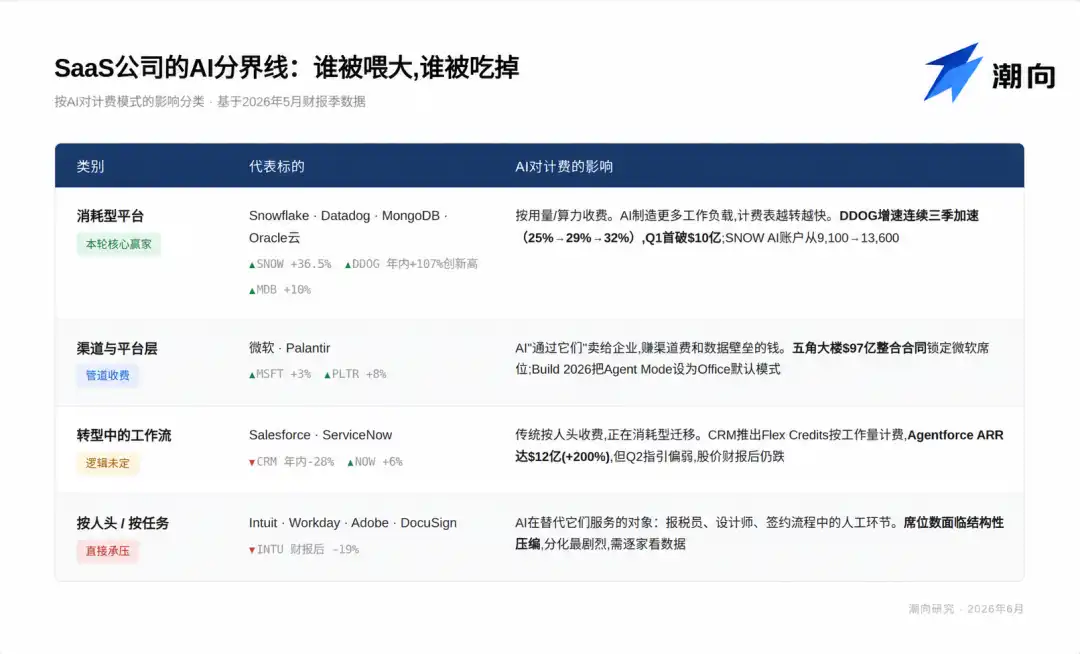
Software companies can be divided into four categories:
Category 1: Consumption-based platforms. Representatives: Snowflake, Datadog, MongoDB, Oracle Cloud business. AI creates more data processing, monitoring, and compute demands; their billing meters spin faster. Datadog is especially worth a separate look. Its growth is accelerating, from 25% to 29% to 32%, which is extremely rare among large-scale SaaS companies and makes it a core winner of this rebound.
Category 2: Channels and platform layers. Representatives: Microsoft and Palantir. AI is sold to enterprises "through them"; they earn channel fees and benefit from data barriers. Microsoft's $9.7 billion Pentagon contract, Copilot Studio, Azure AI Foundry are all reinforcing this position.
Category 3: Workflow companies in transition. Representatives: ServiceNow and Salesforce. Their traditional model is per-seat, but they are migrating towards value/consumption-based billing. Salesforce's Flex Credits is such an attempt. These companies have rebounded partly, but the market is still waiting for them to prove their transformation is fast enough.
Category 4: Directly pressured per-seat/per-task companies. Representatives: Intuit, Workday, Adobe, DocuSign. AI is replacing the objects of their services (tax preparers, designers, human steps in contracting processes). These companies face the most direct pressure, and differentiation is most intense, requiring scrutiny of seat data company by company.
What to Watch Next?
The peak of panic is over, but this isn't a signal to buy blindly. Three things are worth continuous tracking:
First, will the dividing line diffuse or narrow? Will the rebound spread from consumption-based platforms to companies that can provide hard evidence of "AI increasing per-seat value"? If it diffuses, it indicates the sector is broadly healing. If it stays only with the Snowflakes, it means the market has just adopted stricter screening criteria.
Second, can Salesforce's Flex Credits and Agentforce sustain acceleration? This is the largest single sample of "whether per-seat companies can successfully cross over." The $1.2 billion ARR proves the direction, but the drag from Tableau and Commerce Cloud shows old businesses are still consuming transformation momentum. The next earnings report (Sept 2) will reveal if Agentforce ARR can reach $1.5 billion and the proportion of Flex Credits in new contracts.
Third, enterprise adoption data for Microsoft Copilot post-Build. After Agent Mode becomes the default, changes in paid seat counts and token consumption will directly test the core hypothesis: "Are agents feeding platform revenue, or are they replacing human seats?"
The market has moved from "Will AI kill software?" into the differentiation stage of "Who is fed by AI, and who is eaten by AI?" Seeing clearly where that dividing line is matters more than chasing any single gain.
This article is an independent analysis by Tide Research based on publicly available information. The stocks and views mentioned are for research reference only and do not constitute any investment advice. The market carries risks; decision-making should be independent.
Data sources: Snowflake Q1 FY2027 Earnings · Salesforce Q1 FY2027 Earnings & SEC Filings · Microsoft Build 2026 Official Announcements · ChatForest Build 2026 Recap · CNBC · Reuters · Seeking Alpha


















