RWAs grow by 8% in 30 days – More than just a ‘safe’ bet?

ambcryptoPubblicato 2026-03-19Pubblicato ultima volta 2026-03-19

Introduzione

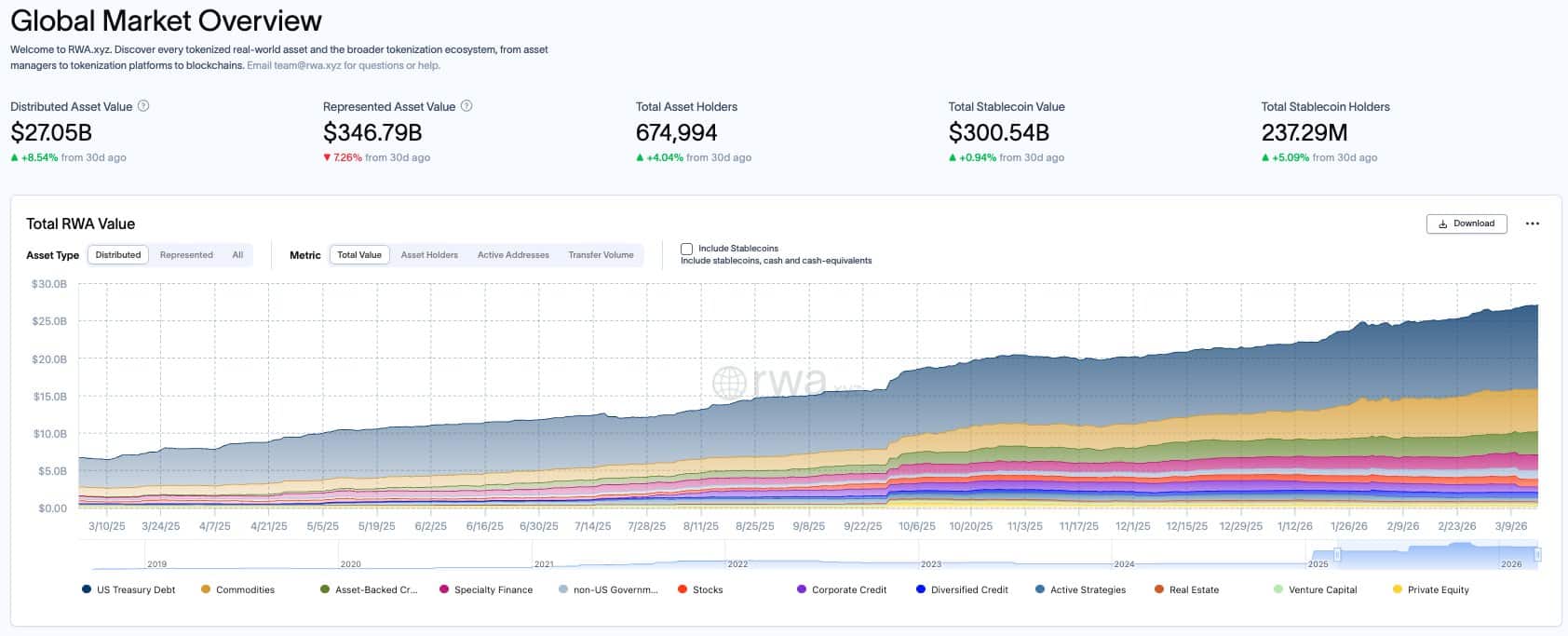
Real World Assets (RWAs) have demonstrated significant growth, increasing by 8% in the past 30 days despite broader crypto market struggles. The total RWA market has surpassed $27 billion, with non-Treasury assets like commodities, credit, and tokenized stocks now accounting for $15.8 billion and becoming the primary growth driver. A key development is the shift toward fully on-chain issuance, settlement, and management of these assets, leading to better integration with the crypto ecosystem and improved functionality and liquidity. This growth, including a record $3 billion TVL on BNB Chain, indicates the sector is maturing beyond low-risk instruments into a diversified, multi-asset market focused on real yield and utility.

Real world assets (RWAs) are one of the most interesting parts of crypto right now. Even when the market feels shaky, this sector just keeps moving.

At its core, it’s the simple idea of bringing real-world value onto the blockchain. Lately, that idea’s been catching on!

RWAs weather the storm

While most other crypto sectors struggle to find their footing, the RWA sector has grown by roughly 8% over the past 30 days! This, on the back of the overall market performance struggling under pressure.
Source: X

Simply put, RWAs are traditional financial assets (like bonds, commodities, or credit) brought onto the blockchain. However, unlike earlier versions that merely “represented” these assets, newer RWAs are issued and managed directly on-chain.
Source: Artemis

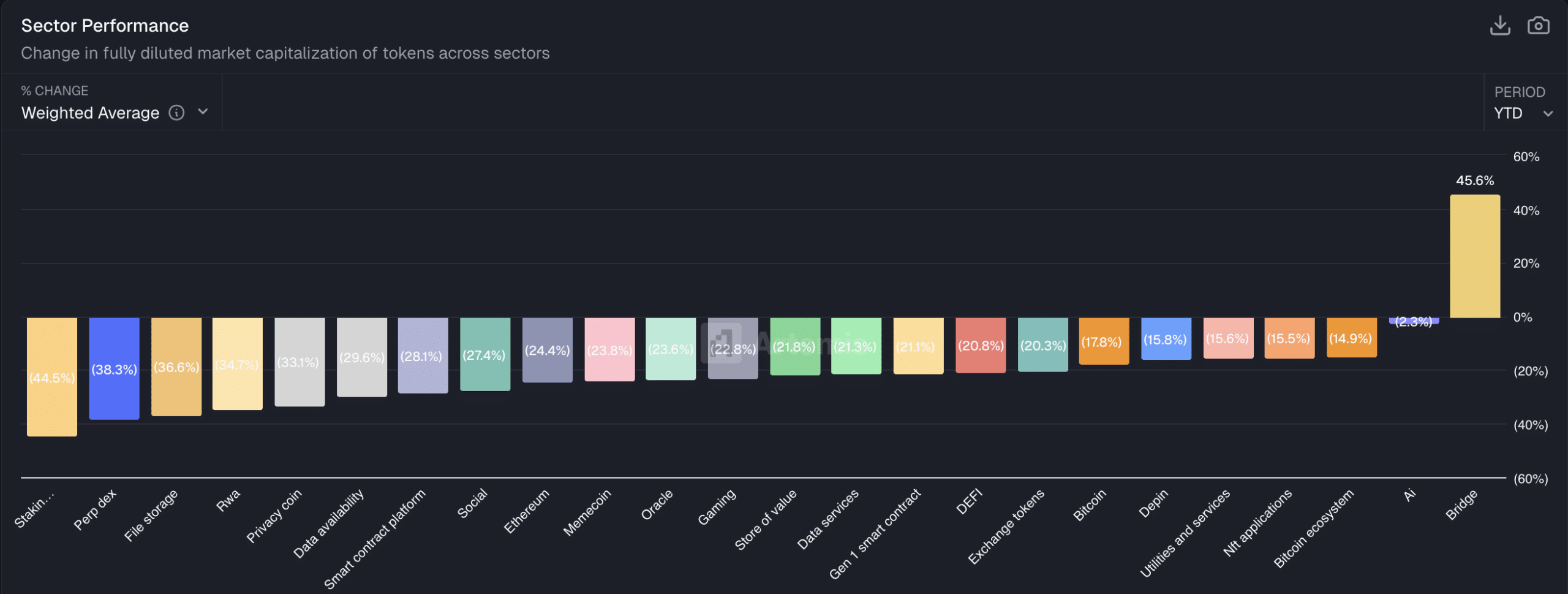
The change is helping its performance. While a majority of sectors have been deep in the red YTD, RWAs have held up fairly decently.

What’s causing this growth?

These days, RWAs are increasingly being built directly on the blockchain. Rather than relying on off-chain systems, key processes like issuance, settlement, and even collateral management are happening on-chain!

As a consequence, there’s better integration with the crypto ecosystem. This has made RWAs more functional, liquid, and accessible.
Source: X

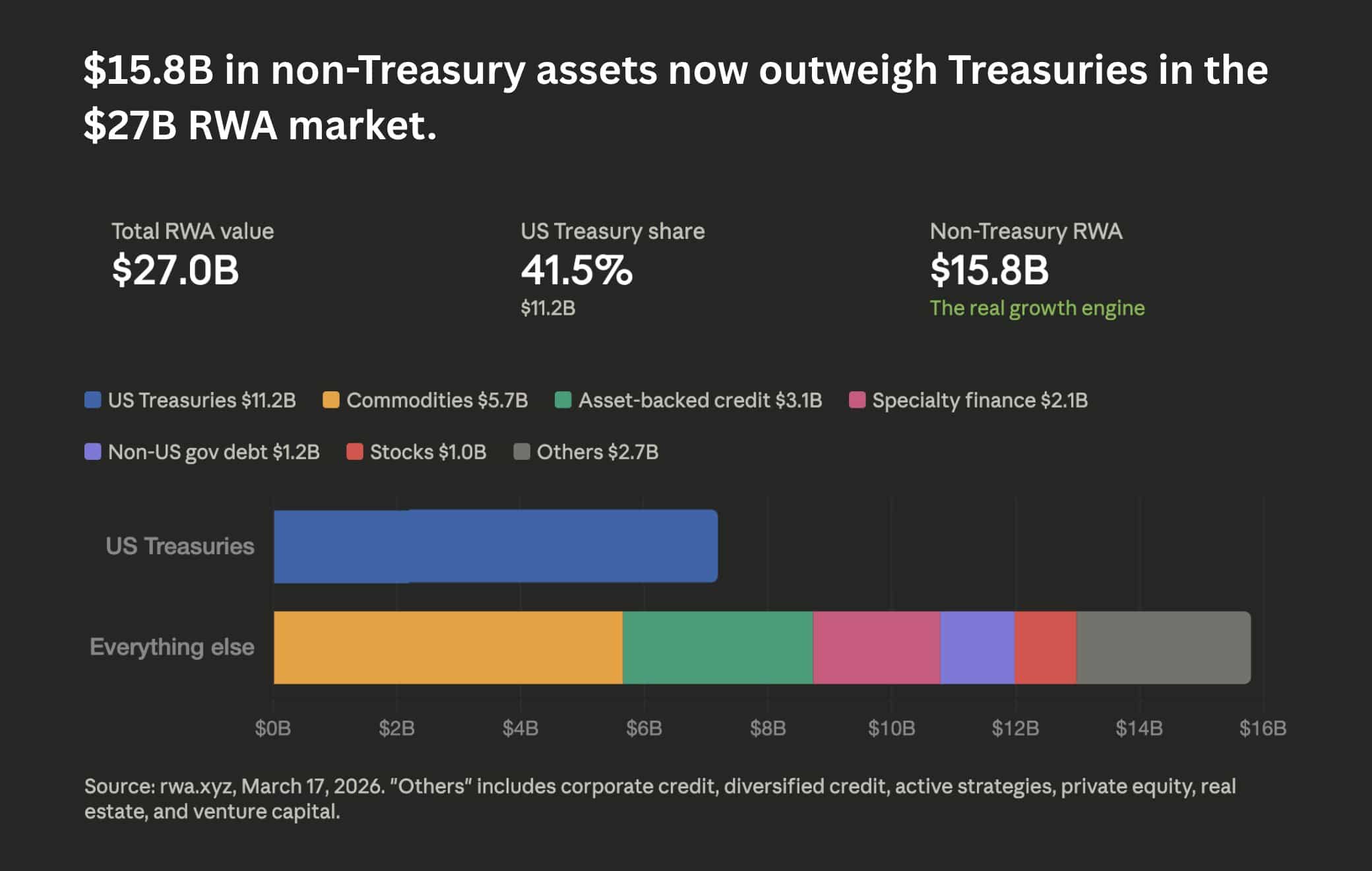
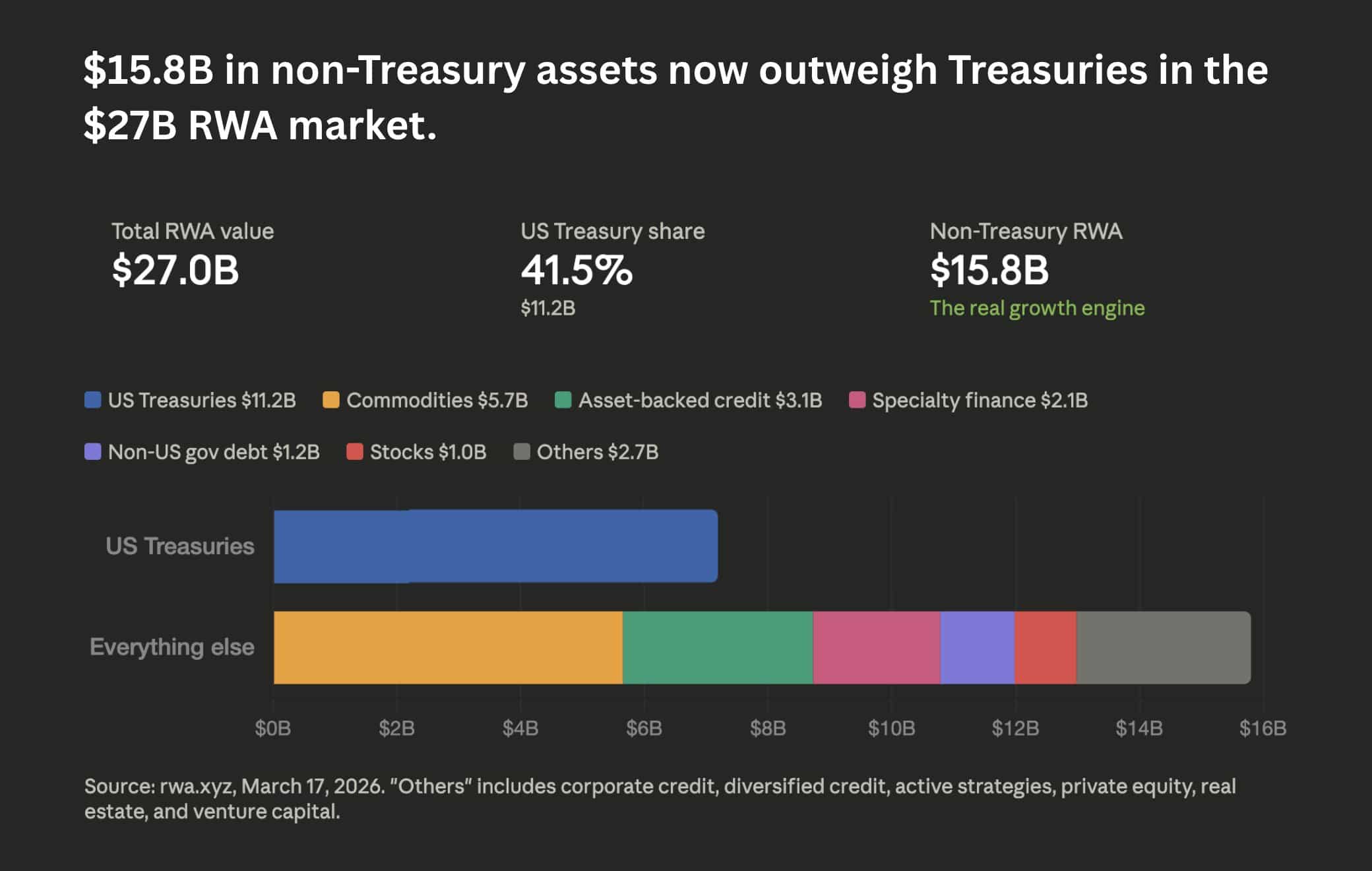
The numbers make that evident. The total RWA market has now crossed $27 billion, with non-Treasury assets accounting for $15.8 billion; overtaking U.S. Treasuries and emerging as the primary growth driver. This includes categories like commodities, asset-backed credit, and specialty finance, alongside tokenized stocks, which have now reached the $1 billion-mark.

Additionally, RWAs are surging on BNB Chain as well! Total value locked (TVL) there alone has climbed to an ATH of $3 billion.

The bottom line is that the sector is diversifying beyond low-risk instruments. It is now attracting attention as a fully formed, multi-asset market.


Final Summary

  • RWAs cross $27 billion as capital moves to real yield and utility-driven crypto sectors.
  • Non-Treasury RWAs at $15.8 billion prove that many are moving beyond “safe” assets, and deeper into on-chain markets.


Domande pertinenti

QWhat is the growth rate of the RWA sector over the past 30 days, and how does it compare to the overall market?

AThe RWA sector has grown by roughly 8% over the past 30 days, while the overall crypto market has been struggling under pressure.

QWhat is the fundamental concept behind Real World Assets (RWAs) in crypto?

AThe core idea is bringing real-world value, such as traditional financial assets like bonds, commodities, or credit, onto the blockchain.

QWhat key change in how newer RWAs are managed is contributing to their improved performance?

AUnlike earlier versions that merely 'represented' assets, newer RWAs are issued and managed directly on-chain, with key processes like issuance, settlement, and collateral management happening on-chain.

QWhat is the total value of the RWA market, and which segment has emerged as the primary growth driver?

AThe total RWA market has crossed $27 billion. Non-Treasury assets, valued at $15.8 billion, have overtaken U.S. Treasuries as the primary growth driver.

QWhat does the growth of non-Treasury RWAs indicate about the sector's evolution?

AIt indicates that the sector is diversifying beyond low-risk 'safe' assets and is becoming a fully formed, multi-asset market that is attracting deeper interest in on-chain markets.

Letture associate

70% of the Public Opposes AI, Americans Hope the U.S. Loses the AI War

70% of Americans believe AI development is moving too fast, with growing public resistance evolving from online criticism to real-world protests and violence. This widespread anti-AI sentiment stems from fears of job losses, rising utility costs, environmental damage, threats to democracy, and financial instability. Key incidents illustrate the backlash: Google's former CEO Eric Schmidt was loudly booed at a graduation for promoting AI; AI company ads are vandalized; protests and even violent attacks target AI firms and data centers. Polls show deep public pessimism and strong local opposition to data center construction, often surpassing resistance to nuclear power plants. The core grievances are economic and practical: AI is seen as automating jobs, concentrating wealth, and increasing household electricity and water bills due to massive data center resource demands. Environmentalists also oppose AI's high energy use and carbon emissions. This opposition has turned AI into a major political issue in the US. While the Trump administration prioritizes AI innovation for global competition, bipartisan pushback is growing. Democrats and factions within the MAGA movement are forming temporary alliances to support stricter regulations and local bans on new data centers, pressuring the administration to choose between its tech industry backers and its voter base. The situation highlights a profound national divide over AI's future.

marsbit9 min fa

70% of the Public Opposes AI, Americans Hope the U.S. Loses the AI War

marsbit9 min fa

Agents Take Over Traffic Distribution Power: What Are Tencent, ByteDance, and Alibaba Competing For?

In the race to dominate the AI era's entry point, China's tech giants—Tencent, ByteDance, and Alibaba—are aggressively deploying AI Agents to control the future of traffic distribution. Alibaba is pursuing a dual-track "closed loop + openness" strategy. Its Qianwen app is evolving into a super-Agent integrated across its ecosystem (Taobao, Alipay, etc.) to handle complex tasks like travel planning. Concurrently, it is opening its platform to external brands (Luckin Coffee, KFC) and has launched a B2B Agent platform, "Wukong," targeting enterprise automation. Its other flagship, Quark, aims to be an "AI super search box" for information and tasks. ByteDance is executing an omnipresent "sprawl strategy." Its Doubao app boasts over 300 million monthly active users and is evolving into a default AI entry point for daily life, with plans for paid versions and e-commerce integration. Its core weapon is the Kouzi platform, a visual "AI assembly factory" for developers to build custom Agents. ByteDance is also pushing hardware integration, collaborating on AI phones and developing smart glasses to embed Doubao everywhere. Tencent is playing its long-held "ultimate card" by quietly embedding an AI Agent directly into WeChat. This Agent, accessible via a swipe, can understand user commands and automatically execute tasks by calling upon WeChat's millions of mini-programs (e.g., finding and ordering coffee). This leverages WeChat's unparalleled 1.4-billion-user ecosystem to position the app as an AI-powered "service operating system," a move that could dramatically reshape the competitive landscape. The core battleground is shifting from competing for "user screen time" to competing to be the "default execution layer" for user intent. The business model is evolving from an "attention economy" to an "intent economy," where the Agent that can most efficiently fulfill a user's need gains control over service access and token flow. This represents a fundamental change in how users connect with digital services, making the fight for the Agent入口 (entry point) a pivotal moment for redefining industry leadership in the AI age.

marsbit2 h fa

Agents Take Over Traffic Distribution Power: What Are Tencent, ByteDance, and Alibaba Competing For?

marsbit2 h fa

Trading

Spot
Futures

Articoli Popolari

Come comprare ONE

Benvenuto in HTX.com! Abbiamo reso l'acquisto di Harmony (ONE) semplice e conveniente. Segui la nostra guida passo passo per intraprendere il tuo viaggio nel mondo delle criptovalute.Step 1: Crea il tuo Account HTXUsa la tua email o numero di telefono per registrarti il tuo account gratuito su HTX. Vivi un'esperienza facile e sblocca tutte le funzionalità,Crea il mio accountStep 2: Vai in Acquista crypto e seleziona il tuo metodo di pagamentoCarta di credito/debito: utilizza la tua Visa o Mastercard per acquistare immediatamente HarmonyONE.Bilancio: Usa i fondi dal bilancio del tuo account HTX per fare trading senza problemi.Terze parti: abbiamo aggiunto metodi di pagamento molto utilizzati come Google Pay e Apple Pay per maggiore comodità.P2P: Fai trading direttamente con altri utenti HTX.Over-the-Counter (OTC): Offriamo servizi su misura e tassi di cambio competitivi per i trader.Step 3: Conserva Harmony (ONE)Dopo aver acquistato Harmony (ONE), conserva nel tuo account HTX. In alternativa, puoi inviare tramite trasferimento blockchain o scambiare per altre criptovalute.Step 4: Scambia Harmony (ONE)Scambia facilmente Harmony (ONE) nel mercato spot di HTX. Accedi al tuo account, seleziona la tua coppia di trading, esegui le tue operazioni e monitora in tempo reale. Offriamo un'esperienza user-friendly sia per chi ha appena iniziato che per i trader più esperti.

319 Totale visualizzazioniPubblicato il 2024.12.12Aggiornato il 2026.06.02

Come comprare ONE

Discussioni

Benvenuto nella Community HTX. Qui puoi rimanere informato sugli ultimi sviluppi della piattaforma e accedere ad approfondimenti esperti sul mercato. Le opinioni degli utenti sul prezzo di ONE ONE sono presentate come di seguito.

活动图片











