RWAs grow by 8% in 30 days – More than just a ‘safe’ bet?

ambcryptoPubblicato 2026-03-19Pubblicato ultima volta 2026-03-19

Introduzione

Real World Assets (RWAs) have demonstrated significant growth, increasing by 8% in the past 30 days despite broader crypto market struggles. The total RWA market has surpassed $27 billion, with non-Treasury assets like commodities, credit, and tokenized stocks now accounting for $15.8 billion and becoming the primary growth driver. A key development is the shift toward fully on-chain issuance, settlement, and management of these assets, leading to better integration with the crypto ecosystem and improved functionality and liquidity. This growth, including a record $3 billion TVL on BNB Chain, indicates the sector is maturing beyond low-risk instruments into a diversified, multi-asset market focused on real yield and utility.

Real world assets (RWAs) are one of the most interesting parts of crypto right now. Even when the market feels shaky, this sector just keeps moving.

At its core, it’s the simple idea of bringing real-world value onto the blockchain. Lately, that idea’s been catching on!

RWAs weather the storm

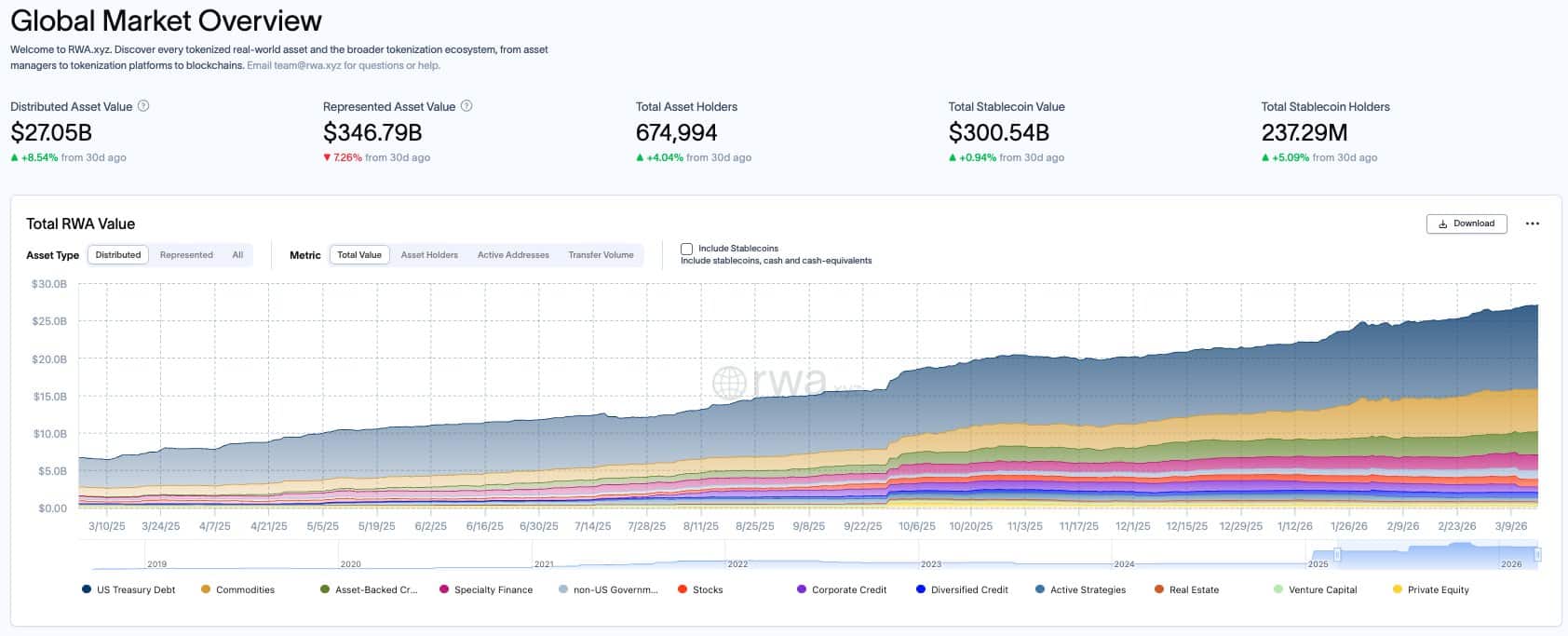
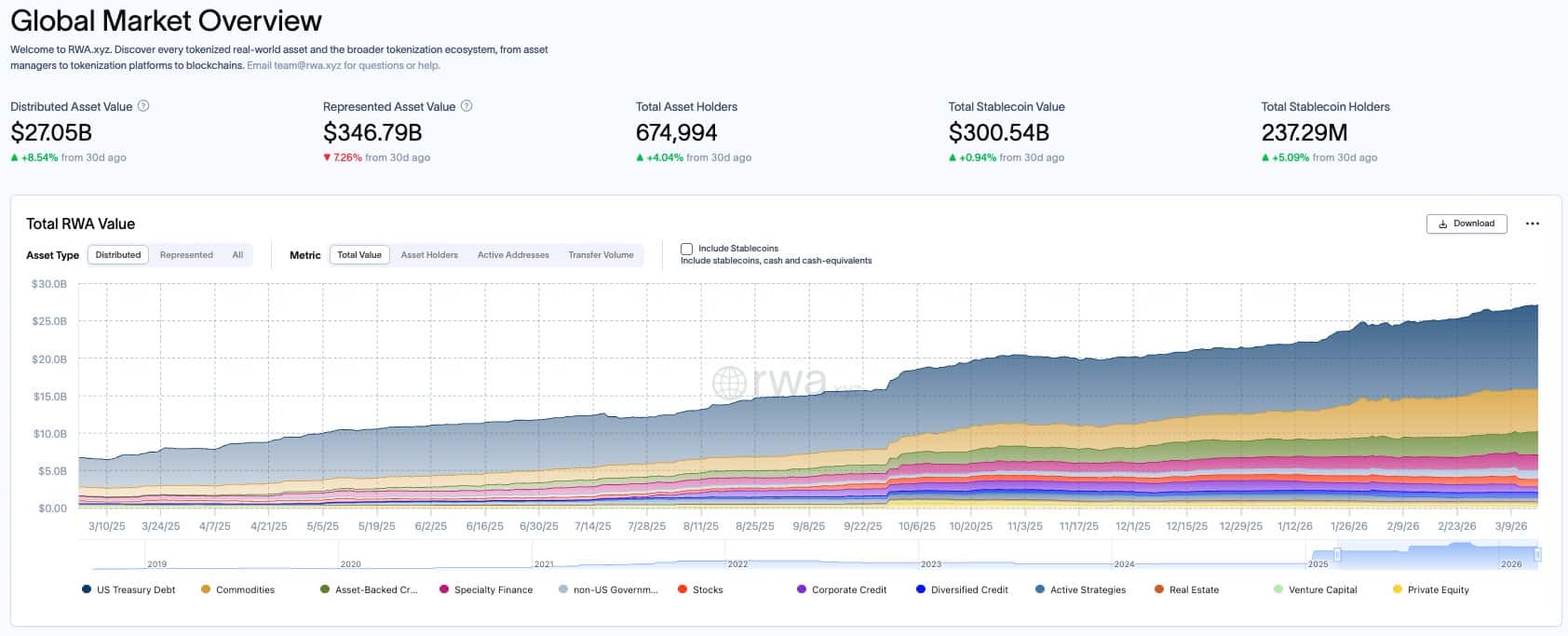
While most other crypto sectors struggle to find their footing, the RWA sector has grown by roughly 8% over the past 30 days! This, on the back of the overall market performance struggling under pressure.
Source: X

Simply put, RWAs are traditional financial assets (like bonds, commodities, or credit) brought onto the blockchain. However, unlike earlier versions that merely “represented” these assets, newer RWAs are issued and managed directly on-chain.
Source: Artemis

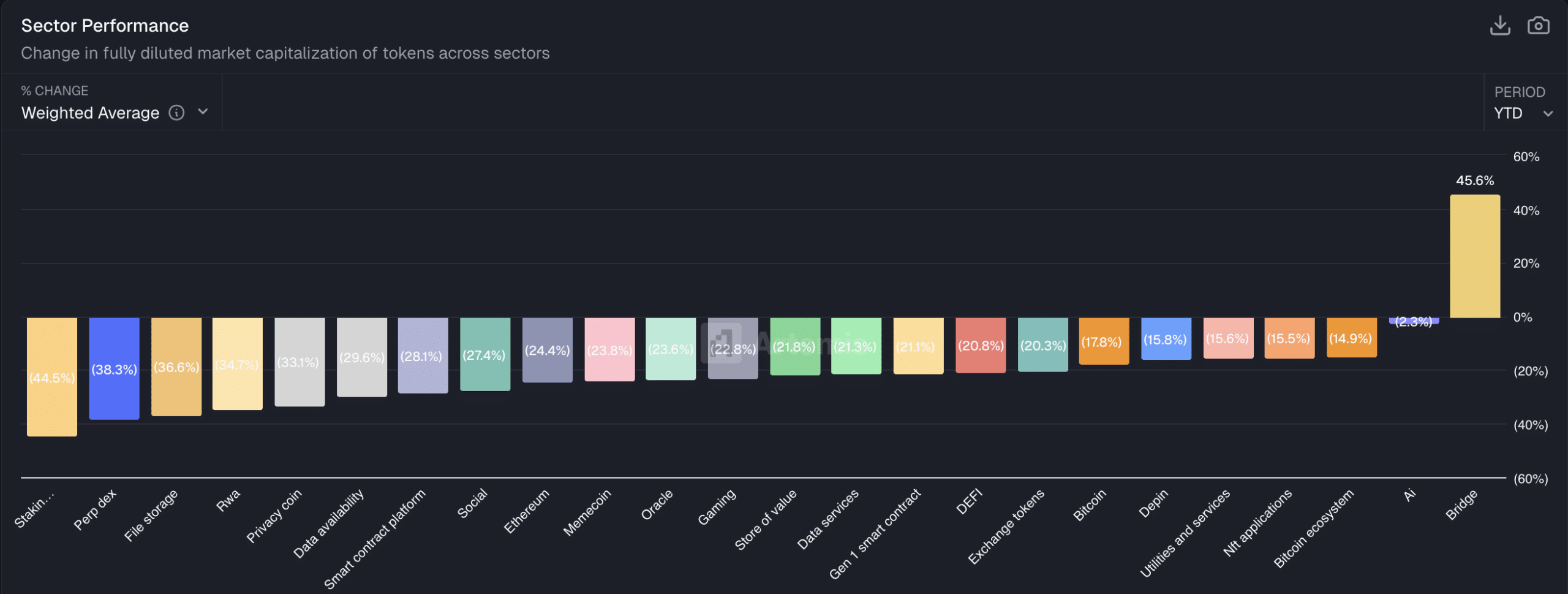
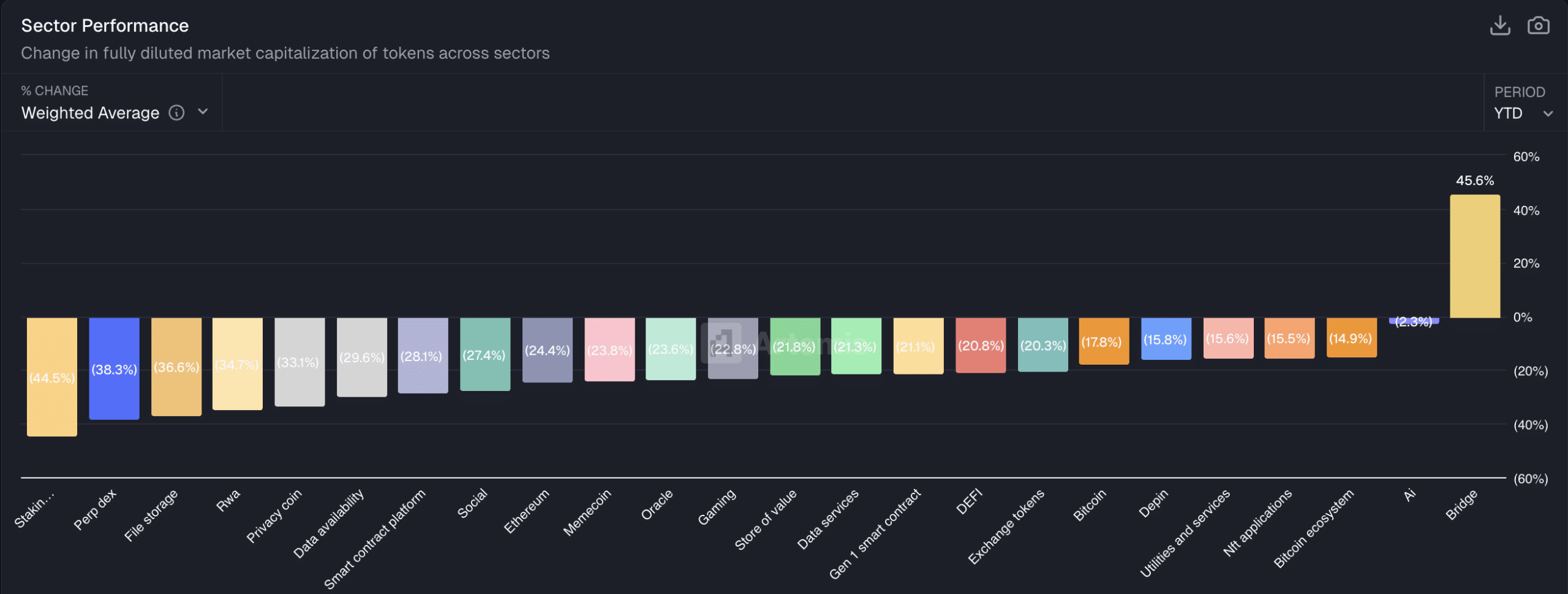
The change is helping its performance. While a majority of sectors have been deep in the red YTD, RWAs have held up fairly decently.

What’s causing this growth?

These days, RWAs are increasingly being built directly on the blockchain. Rather than relying on off-chain systems, key processes like issuance, settlement, and even collateral management are happening on-chain!

As a consequence, there’s better integration with the crypto ecosystem. This has made RWAs more functional, liquid, and accessible.
Source: X

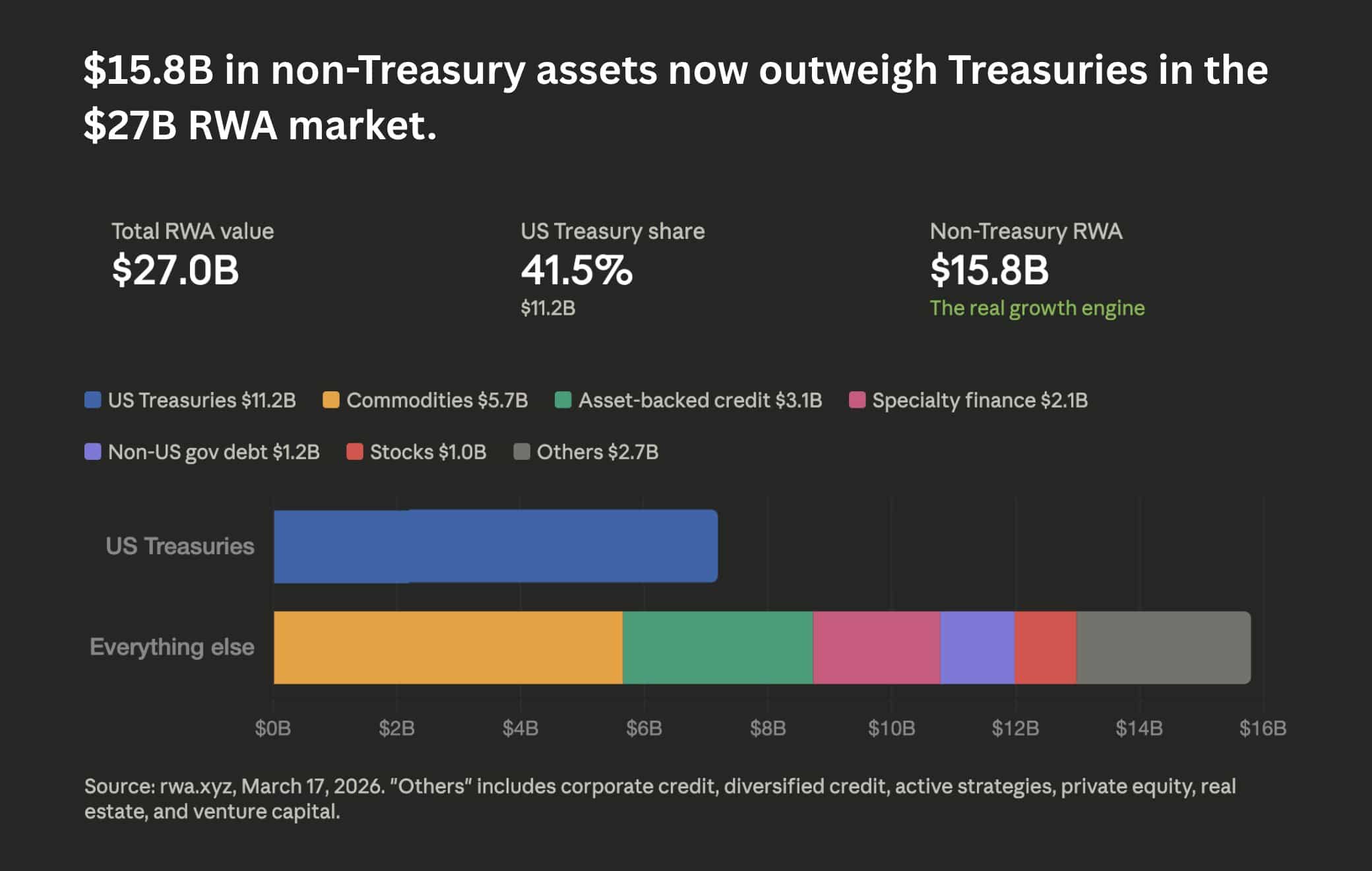
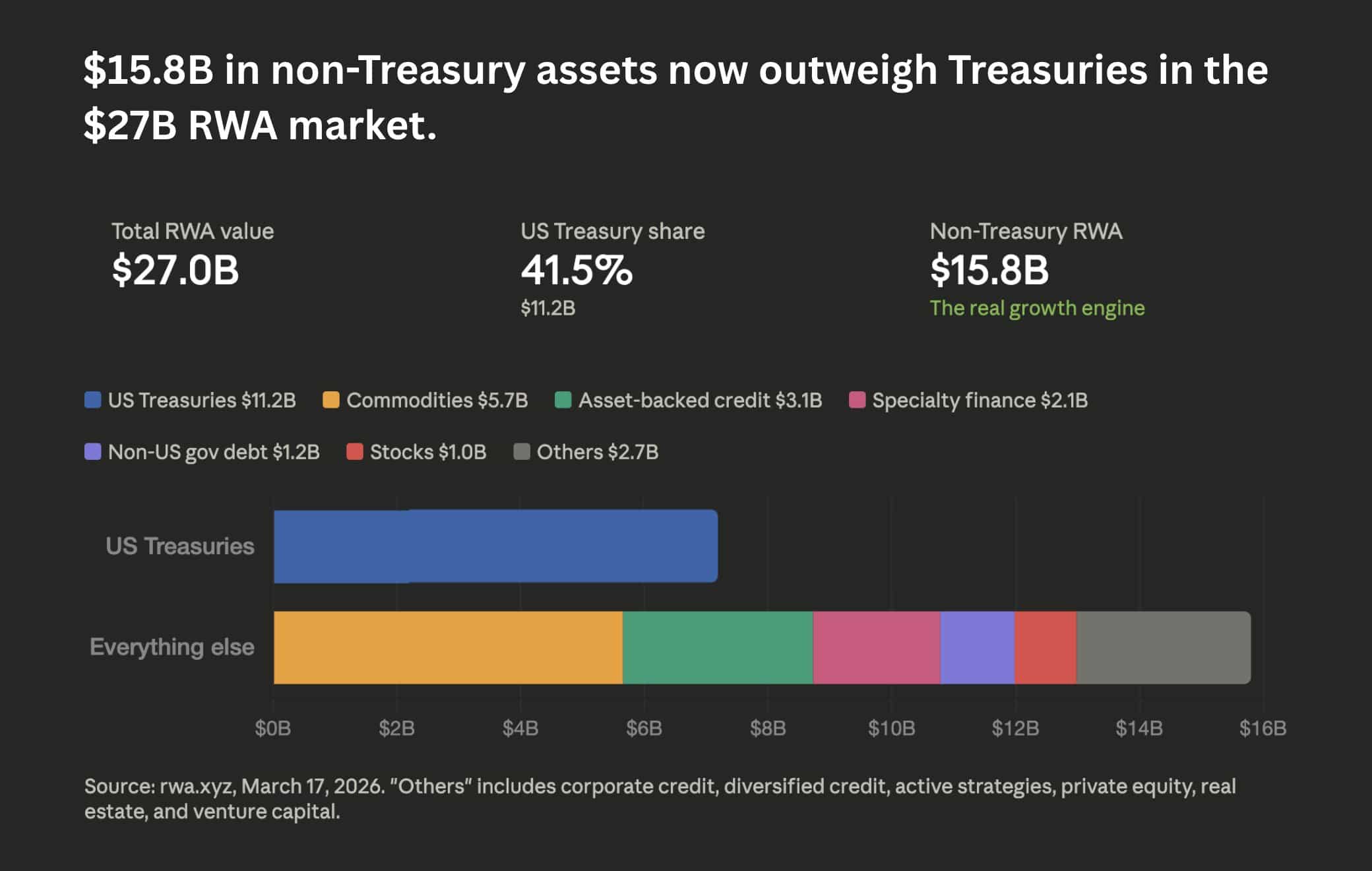
The numbers make that evident. The total RWA market has now crossed $27 billion, with non-Treasury assets accounting for $15.8 billion; overtaking U.S. Treasuries and emerging as the primary growth driver. This includes categories like commodities, asset-backed credit, and specialty finance, alongside tokenized stocks, which have now reached the $1 billion-mark.

Additionally, RWAs are surging on BNB Chain as well! Total value locked (TVL) there alone has climbed to an ATH of $3 billion.

The bottom line is that the sector is diversifying beyond low-risk instruments. It is now attracting attention as a fully formed, multi-asset market.


Final Summary

  • RWAs cross $27 billion as capital moves to real yield and utility-driven crypto sectors.
  • Non-Treasury RWAs at $15.8 billion prove that many are moving beyond “safe” assets, and deeper into on-chain markets.


Domande pertinenti

QWhat is the growth rate of the RWA sector over the past 30 days, and how does it compare to the overall market?

AThe RWA sector has grown by roughly 8% over the past 30 days, while the overall crypto market has been struggling under pressure.

QWhat is the fundamental concept behind Real World Assets (RWAs) in crypto?

AThe core idea is bringing real-world value, such as traditional financial assets like bonds, commodities, or credit, onto the blockchain.

QWhat key change in how newer RWAs are managed is contributing to their improved performance?

AUnlike earlier versions that merely 'represented' assets, newer RWAs are issued and managed directly on-chain, with key processes like issuance, settlement, and collateral management happening on-chain.

QWhat is the total value of the RWA market, and which segment has emerged as the primary growth driver?

AThe total RWA market has crossed $27 billion. Non-Treasury assets, valued at $15.8 billion, have overtaken U.S. Treasuries as the primary growth driver.

QWhat does the growth of non-Treasury RWAs indicate about the sector's evolution?

AIt indicates that the sector is diversifying beyond low-risk 'safe' assets and is becoming a fully formed, multi-asset market that is attracting deeper interest in on-chain markets.

Letture associate

ZEC Co-Founder Responds to Orchard Vulnerability: No Signs of Theft, Orchard Pool to Be Sealed

ZEC Co-Founder Addresses Orchard Vulnerability: No Signs of Theft, Plans to Sunset Orchard Pool A security vulnerability was recently discovered in Zcash's Orchard shielded pool, raising key concerns. The primary questions are whether the flaw was exploited, if user funds are safe, whether users can verify the total ZEC supply, and if other similar vulnerabilities exist. Analysis suggests the vulnerability was likely not exploited prior to its discovery. It was found proactively by a researcher using specialized tools, not due to an active breach. The development team and mining pools acted quickly to contain the issue. Typical financially-motivated attacks would likely have left visible on-chain evidence, which has not been observed. User funds in Orchard are considered safe and should be recoverable, assuming no prior exploitation. If the flaw was never used, all legitimate funds can be withdrawn. The article outlines risks associated with moving funds to transparent addresses or other pools, but concludes that leaving assets in place is a reasonable option. Currently, users cannot independently verify that the total ZEC supply hasn't been inflated due to this bug. However, the planned Ironwood network upgrade is designed to resolve this. It will permanently close the Orchard pool to new deposits and internal transfers, allowing only withdrawals. This mechanism will cap total withdrawals at the amount of legitimately deposited funds, enabling anyone to cryptographically verify the supply post-upgrade. Multiple teams, including Shielded Labs, have conducted extensive audits focused on counterfeiting vulnerabilities, assisted by advanced AI tools. No additional flaws of this type have been found so far, increasing confidence that no other similar undisclosed vulnerabilities exist. In summary, evidence indicates the Orchard bug was probably not used, user funds are secure, and no other counterfeiting flaws are currently known. The upcoming Ironwood upgrade will restore users' ability to independently verify the total ZEC supply, closing this chapter.

Foresight News5 min fa

ZEC Co-Founder Responds to Orchard Vulnerability: No Signs of Theft, Orchard Pool to Be Sealed

Foresight News5 min fa

Microsoft Announces Commercial-Grade Quantum Computer to be Completed in Three Years: Will the Boots Land?

Microsoft announces plans to build a commercially viable quantum computer by 2029, a significant acceleration from the previous industry consensus of a decade. The breakthrough is fueled by their new Majorana 2 quantum chip, which boasts a record-breaking average qubit lifetime of 20 seconds—a 1,000-fold reliability improvement over its predecessor. This leap was achieved by leveraging topological qubits, a theoretically more stable technology using Majorana zero modes, and switching the core superconducting material from aluminum to lead. Crucially, Microsoft's "Discovery" agentic AI platform accelerated the R&D process. AI agents autonomously analyzed vast experimental data, optimized manufacturing parameters (like the lead alloy composition), and solved issues like "ghost noise," dramatically speeding up experimentation. While the 20-second coherence time is a landmark, challenges remain: scaling from 12 qubits to the millions needed for practical applications, managing compilation costs, and verifying quantum results. Skeptics call for peer-reviewed data, and questions persist about whether even 20 seconds is sufficient for complex algorithms like breaking RSA encryption. The race is on with other approaches (superconducting, trapped ions), but Microsoft's confidence in its topological roadmap signals a potential shortcut to a scalable quantum future.

marsbit24 min fa

Microsoft Announces Commercial-Grade Quantum Computer to be Completed in Three Years: Will the Boots Land?

marsbit24 min fa

Is There Really a "World Cup Curse" in the Market?

Is there really a "World Cup Curse" affecting markets? Historical data shows global equity markets often underperform during the tournament. The S&P 500 has averaged negative returns of -1.5% to -2.11% across 19 World Cups since 1950, with declines in 58% of events. China's Shanghai Composite fell in 71% of tournaments since 1994. Studies confirm reduced trading activity during matches, with volumes dropping significantly, especially when a home nation plays. A team's loss can also lead to negative sentiment and selling pressure in its domestic market the next day. However, the "curse" may be partly attributed to seasonal weakness. Many tournaments are held in June-July, a historically weaker period for stocks ("Sell in May and go away"). The 2022 Qatar World Cup, held in November-December, saw a smaller drop in trading volume compared to summer events, suggesting timing plays a role. The cryptocurrency market's performance during World Cups has been mixed and largely driven by its own major catalysts (e.g., Mt. Gox hack, FTX collapse, halving cycles) rather than the tournament. Investment opportunities have shifted over time. Traditional beneficiaries like TV manufacturers have seen fading returns as streaming platforms become the core viewing channel. Classic consumer plays like beer and sportswear face challenges from changing consumption trends. Newer digital assets, like fractionalized collectible player cards on blockchain, have seen explosive growth. While gambling is a traditional sector, prediction markets are emerging. In conclusion, while a statistical correlation exists, the World Cup's direct impact on markets is likely limited and intertwined with seasonal patterns. With lower liquidity during the event, the simplest strategy for many might be to step back from trading and enjoy the games.

marsbit31 min fa

Is There Really a "World Cup Curse" in the Market?

marsbit31 min fa

Trading

Spot
Futures

Articoli Popolari

Come comprare ONE

Benvenuto in HTX.com! Abbiamo reso l'acquisto di Harmony (ONE) semplice e conveniente. Segui la nostra guida passo passo per intraprendere il tuo viaggio nel mondo delle criptovalute.Step 1: Crea il tuo Account HTXUsa la tua email o numero di telefono per registrarti il tuo account gratuito su HTX. Vivi un'esperienza facile e sblocca tutte le funzionalità,Crea il mio accountStep 2: Vai in Acquista crypto e seleziona il tuo metodo di pagamentoCarta di credito/debito: utilizza la tua Visa o Mastercard per acquistare immediatamente HarmonyONE.Bilancio: Usa i fondi dal bilancio del tuo account HTX per fare trading senza problemi.Terze parti: abbiamo aggiunto metodi di pagamento molto utilizzati come Google Pay e Apple Pay per maggiore comodità.P2P: Fai trading direttamente con altri utenti HTX.Over-the-Counter (OTC): Offriamo servizi su misura e tassi di cambio competitivi per i trader.Step 3: Conserva Harmony (ONE)Dopo aver acquistato Harmony (ONE), conserva nel tuo account HTX. In alternativa, puoi inviare tramite trasferimento blockchain o scambiare per altre criptovalute.Step 4: Scambia Harmony (ONE)Scambia facilmente Harmony (ONE) nel mercato spot di HTX. Accedi al tuo account, seleziona la tua coppia di trading, esegui le tue operazioni e monitora in tempo reale. Offriamo un'esperienza user-friendly sia per chi ha appena iniziato che per i trader più esperti.

324 Totale visualizzazioniPubblicato il 2024.12.12Aggiornato il 2026.06.02

Come comprare ONE

Discussioni

Benvenuto nella Community HTX. Qui puoi rimanere informato sugli ultimi sviluppi della piattaforma e accedere ad approfondimenti esperti sul mercato. Le opinioni degli utenti sul prezzo di ONE ONE sono presentate come di seguito.

活动图片











