RWA Weekly Report|On-Chain Total Value Rises Again; U.S. SEC Issues Crypto Asset Custody Guidance (12.10-12.17)

Odaily星球日报Pubblicato 2025-12-17Pubblicato ultima volta 2025-12-17

Introduzione

RWA Weekly Report: On-Chain Value Rebounds; SEC Issues Crypto Custody Guidance (Dec 10–17) The total distributed asset value (DAV) of real-world assets (RWA) on-chain rose to $18.74 billion, up 1.63% from the previous week, ending a period of stagnation. The represented asset value (RAV) increased 4.92% to $410.38 billion, marking the largest weekly gain in two months. The number of asset holders grew by over 14,000 to 575,752. Stablecoin market cap slightly declined to $300.18 billion, but user numbers increased by 1.42% to 210.72 million. U.S. Treasuries remained the largest asset class but decreased marginally to $8.7 billion. Commodity assets grew to $3.2 billion, while private credit saw a modest rise to $2.4 billion. Public equities and non-U.S. government debt also increased, whereas private equity slightly declined. Key developments include the U.S. Congress urging the SEC to allow cryptocurrencies in 401(k) plans, the SEC releasing crypto custody guidance emphasizing wallet risks, and approving DTCC to custody tokenized stocks and RWAs on blockchain. Nasdaq proposed extending trading hours to 23 hours daily to align with crypto markets. Visa began USDC settlement via Solana for U.S. banks. Ondo Finance announced plans to launch tokenized stocks and ETFs on Solana in early 2026 after the SEC closed its investigation without charges. MSX (STONKS) reported a record $2 billion in daily trading volume and is preparing for potential official tokenized stock adoption fo...

Original | Odaily Planet Daily (@OdailyChina)

Author | Ethan (@ethanzhang_web3)
RWA Sector Market Performance

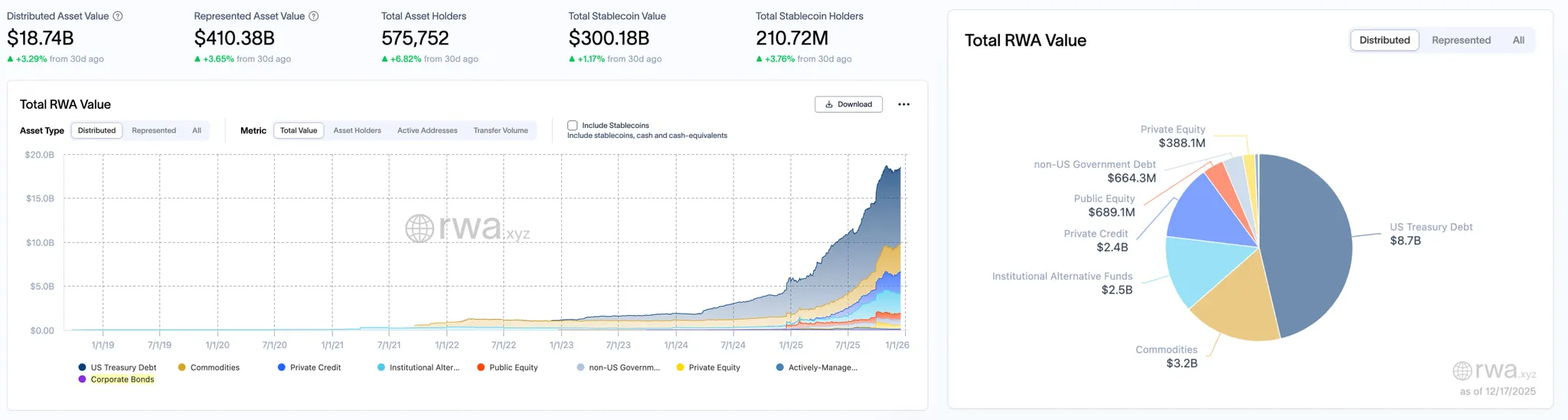
According to the rwa.xyz data panel, as of December 17, 2025, the total on-chain value of RWA (Distributed Asset Value) was $18.74 billion, an increase of $300 million from $18.44 billion on December 9, a rise of approximately 1.63%, ending a multi-day period of sideways movement and indicating a gradual recovery in on-chain asset activity. The broad Represented Asset Value increased from $391.66 billion to $410.38 billion, a weekly surge of 4.92%, the largest single-week increase in nearly two months, potentially related to the recovery of off-chain asset valuations. The total number of asset holders also continued its upward trend, rising from 561,558 to 575,752, a net increase of over 14,000 in one week, a growth rate of 2.52%. The stablecoin market was relatively stable, with the total market capitalization slightly decreasing from $3.0192 trillion to $3.0018 trillion, but still remaining high. The number of users grew from 207.75 million to 210.72 million, an increase of nearly 3 million, a growth rate of 1.42%.

In terms of asset structure, U.S. Treasury bonds remain the largest component of on-chain distributed assets, but saw a marginal decline this week, slightly decreasing from $8.8 billion to $8.7 billion, indicating a cooling off in the U.S. bond frenzy. Meanwhile, commodity assets remained stable, growing slightly from $3.1 billion to $3.2 billion, maintaining an upward trend for the third consecutive week and gradually showing potential as an emerging safe-haven asset. Private credit did not continue its previous rebound this week, with the scale only marginally increasing from $2.2 billion to $2.4 billion, maintaining a neutral stance. Institutional alternative funds remained unchanged at $2.5 billion, indicating a more cautious allocation of funds.

Among other segmented assets, public equity continued to rise, increasing from last week's $671.7 million to $689.1 million, performing relatively prominently among equity assets. Non-U.S. government debt also saw a slight synchronous increase, rising from $637.2 million to $664.3 million, but its scale is still less than 1/10th that of U.S. Treasuries. Private equity decreased from $391.6 million to $381 million this week, a slight numerical reduction.

Trend Analysis (Compared to Last Week)

The keywords for the RWA sector this week are "Valuation Repair + User Growth". The overall on-chain asset value recovered, and the scale of representative assets increased significantly, indicating that the repricing of off-chain assets may be driving the overall RWA valuation center upward. Structurally, the correction in U.S. Treasuries may be releasing some highly liquid funds, diverting them to the commodity and public equity sectors, forming new risk preference indicators. The growth in the stablecoin user base is particularly crucial, as off-market funds continue to enter the market, creating a "reservoir" for subsequent on-chain asset growth.

Market Keywords: Structural Optimization, Valuation Recovery, User Base Expansion.
Key Event Review

U.S. Congress Urges SEC to Allow Bitcoin and Other Cryptocurrencies into 401(k) Retirement Plans

The U.S. Congress is urging the U.S. Securities and Exchange Commission (SEC) to approve the inclusion of Bitcoin and other cryptocurrencies in 401(k) retirement plans. Members of the House Financial Services Committee sent a letter to SEC Chairman Paul Atkins urging him to update securities rules so that digital assets can be treated as an investment category equivalent to other alternative investments in retirement accounts. The letter stated that Americans saving for retirement deserve more investment choices, and current rules are outdated and overly restrictive, preventing millions of people from accessing new asset classes. Additionally, the letter emphasized the need to redefine the "accredited investor" standard. Current strict investor qualification rules limit participation in some private and alternative investment markets.

BNB Chain: A New Stablecoin to Be Launched

BNB Chain posted on platform X that a new stablecoin will be launched based on BNB Chain, aiming to integrate liquidity across various application scenarios and built for mass adoption.

According to community speculation, the project might be United Stables, with more details expected to be announced on December 18.

U.S. Crypto Market Structure Bill Negotiations Continue, Possibly Delayed Until Next January

Negotiations in the U.S. Senate on the crypto market structure bill may be delayed until next January for substantial progress due to several unresolved分歧点 (divergence points). The legislative text has been privately circulated among industry insiders, and industry executives briefly reviewed the current draft at a White House meeting on Thursday, chaired by U.S. President Donald Trump's crypto advisor Patrick Witt. The negotiations involve four parties: Senate Democrats, Republicans, the White House, and the crypto industry, with four major分歧点 still needing resolution. These分歧点 include ethical guidelines for government officials' involvement in digital assets, particularly the participation of U.S. President Donald Trump, whether stablecoins should be yield-bearing, and the jurisdiction of the U.S. Securities and Exchange Commission (SEC) over tokens and the handling of decentralized finance (DeFi). Patrick Witt posted on platform X that the White House and Senate Republicans are "aligned on the need to protect software developers and DeFi." Despite the分歧点, the intensity and pace of negotiations remain high. Digital Chamber CEO Cody Carbone stated that there is a genuine desire and momentum from all sides to complete the legislation, expecting practical progress early next year.

U.S. SEC Issues Crypto Asset Custody Guidance, Systematically Outlining Wallet Types and Main Risks

The U.S. Securities and Exchange Commission (SEC) issued guidance for investors on crypto wallets and asset custody on Friday local time, systematically outlining the advantages and risks of different crypto asset storage methods. The guidance compares self-custody and third-party custody models and reminds investors that when choosing third-party custody, they should focus on understanding whether the custodian engages in asset rehypothecation, whether customer assets are commingled, and other situations. The SEC also introduced the main differences between hot wallets and cold wallets: hot wallets, being connected to the internet, face higher risks of hacking and network security; cold wallets, while reducing the risk of online attacks, can lead to permanent loss of assets if the storage device is damaged, stolen, or the private key is lost. Market participants believe this guidance shows a significant shift in the SEC's regulatory attitude towards the crypto industry. The day before, SEC Chairman Paul Atkins stated that the traditional financial system is accelerating its migration on-chain, and the SEC has also approved DTCC to begin tokenization exploration for assets such as stocks, ETFs, and government bonds.

South Korea's Financial Services Commission Fails to Submit Won Stablecoin Regulatory Bill on Time

The ruling party in South Korea had previously called on ministries and the Financial Services Commission (FSC) to submit a Won stablecoin regulatory bill by December 10, but the FSC failed to meet the deadline. A spokesperson for the agency stated that the FSC needs more time to coordinate positions with relevant agencies, and rather than rushing to meet the stipulated deadline, it would announce its proposal while submitting the bill to the National Assembly.

Nasdaq Plans to Extend Stock and ETP Trading Hours to 23 Hours

Nasdaq has filed a document with the U.S. Securities and Exchange Commission (SEC) planning to extend the trading hours for stocks and exchange-traded products (ETPs) from 16 hours per day to 23 hours per day, five days a week. This move aims to meet the growing demand from global investors for extended trading hours in the U.S. stock market and to match the new investor expectations formed by the 24/7 trading cryptocurrency market. According to the proposal, Nasdaq's new trading hours will include: Day Session: 4:00 AM to 8:00 PM ET; One-hour break: 8:00 PM to 9:00 PM (for maintenance, testing, and trade settlement); Night Session: 9:00 PM to 4:00 AM the next day. The entire trading week will run from 9:00 PM Sunday to 8:00 PM Friday. The opening and closing times of the existing regular trading session (9:30 AM to 4:00 PM) remain unchanged. Nasdaq stated in the document that this move is to compete for order flow from foreign investors in different time zones like Asia and investors active in the crypto digital asset market. This will make stocks listed on Nasdaq, such as Coinbase (COIN), Robinhood (HOOD), and Strategy (MSTR), as well as many Bitcoin mining company stocks, more convenient for global traders.

U.S. SEC Allows DTCC to Custody and Recognize Tokenized Stocks and Other RWA Assets on Blockchain

The U.S. Securities and Exchange Commission (SEC) granted permission to the Depository Trust & Clearing Corporation (DTCC) in the form of a no-action letter, allowing the company to custody and recognize tokenized stocks and other real-world assets (RWA) on the blockchain. This allows DTCC to provide tokenization services on pre-approved blockchains for a three-year pilot period. SEC Commissioner Hester Peirce stated in a statement: "Although the project is still in its pilot phase and subject to various operational limitations, it marks an important step forward in the market's migration on-chain." Michael Winnike, Global Head of Strategy & Market Solutions at DTCC's Clearing & Securities Services division, said in an interview that after obtaining permission, DTCC will also extend its record-keeping work to the blockchain. DTCC, as the core clearing and settlement center of the U.S. financial system, plays a crucial role in the stock and fixed income product fields. Many liquid assets in the U.S. market are custodied at DTCC's depository unit—Depository Trust Co. The company expects to launch new tokenization services in the second half of next year.

Trump Family Crypto Project WLFI Plans to Deploy USD1 Stablecoin on Canton Network

Canton Network announced that the Trump family's crypto project, World Liberty Financial (WLFI), will deploy its USD1 stablecoin on its network, aiming to expand the coverage of USD1 in the institutional on-chain finance field and accelerate its adoption among globally regulated market participants, including collateral for derivatives and institutional loans, instant cross-border payments and 24/7 settlement, on-chain asset issuance, financing, and redemption.

U.S. SEC Chairman: DTC Participants Can Transfer Tokenized Securities to Other Participants' Registered Wallets

U.S. Securities and Exchange Commission (SEC) Chairman Paul Atkins posted on platform X, stating that the U.S. financial market is about to transition on-chain and will prioritize innovation and actively adopt new technologies. The SEC has issued a no-action letter to the Depository Trust & Clearing Corporation (DTC). The on-chain market will bring higher predictability, transparency, and efficiency to investors. Now DTC participants can directly transfer tokenized securities to other participants' registered wallets, and these transactions will be tracked by DTC's official records.

Trump Family Crypto Project WLFI Plans to Deploy USD1 Stablecoin on Canton Network

Canton Network announced that the Trump family's crypto project, World Liberty Financial (WLFI), will deploy its USD1 stablecoin on its network, aiming to expand the coverage of USD1 in the institutional on-chain finance field and accelerate its adoption among globally regulated market participants, including collateral for derivatives and institutional loans, instant cross-border payments and 24/7 settlement, on-chain asset issuance, financing, and redemption.

Visa Opens USDC Settlement Services to U.S. Banks via Solana

Visa has begun allowing U.S. banks and payment partners to use the USD-backed stablecoin USDC for transaction settlement within the United States.

Cross River Bank and Lead Bank are the first institutions to use Visa's USDC settlement service via the Solana blockchain. Visa plans to promote the service more widely in 2026.

Visa stated that this move aims to provide participating banks with faster fund transfers and a seven-day settlement window, without changing the consumer card experience. As of November 2025, the company's annualized stablecoin settlement volume run rate has exceeded $3.5 billion.

Hot Project Dynamics

Ondo Finance (ONDO)

One-Sentence Introduction:

Ondo Finance is a decentralized finance protocol focused on structured financial products and the tokenization of real-world assets. Its goal is to provide users with fixed-income products, such as tokenized U.S. Treasury bonds or other financial instruments, through blockchain technology. Ondo Finance allows users to invest in low-risk, highly liquid assets while maintaining decentralized transparency and security. Its token, ONDO, is used for protocol governance and incentive mechanisms. The platform also supports cross-chain operations to expand its application scope in the DeFi ecosystem.

Latest Developments:

On December 15, Ondo Finance announced on platform X that its tokenized stock and ETF platform will launch on the Solana blockchain in early 2026, aiming to bring Wall Street liquidity to the internet capital market.

Previously, it was reported that the U.S. Securities and Exchange Commission (SEC) has ended its investigation into tokenized asset company Ondo Finance without recommending any charges.

This investigation began in October 2023, initiated by former SEC Chairman Gary Gensler, primarily reviewing whether Ondo complied with U.S. securities laws when tokenizing U.S. Treasury products and whether the ONDO token should be classified as a security. An Ondo spokesperson stated that the company received formal notice in late November that this two-year SEC investigation had concluded. Since the pro-crypto SEC Chairman Paul Atkins took office, the agency has ended most crypto-related investigations. Ondo stated that the resolution of the investigation clears obstacles for its expansion in the U.S. The company had previously registered as an investment adviser and acquired Oasis Pro Markets, an SEC-registered broker-dealer, ATS operator, and transfer agent. Ondo is scheduled to host its annual Ondo Summit in New York on February 3, where new tools and products for tokenizing real-world assets are expected to be announced.

MSX (STONKS)
One-Sentence Introduction:

MSX is a community-driven DeFi platform focused on tokenizing U.S. stocks and other RWAs for on-chain trading. Through a partnership with Fidelity, the platform achieves 1:1 physical custody and token issuance. Users can use stablecoins like USDC, USDT, and USD1 to mint stock tokens such as AAPL.M and MSFT.M, and trade 24/7 on the Base blockchain. All trading, minting, and redemption processes are executed by smart contracts, ensuring transparency, security, and auditability. MyStonks is committed to bridging the gap between TradFi and DeFi, providing users with a high-liquidity, low-barrier entry to U.S. stock investment on-chain, building the "Nasdaq of the Crypto World".

Latest Developments:

On December 3, data from the MSX official website (msx.com) showed that the platform's trading volume reached $2 billion in the past 24 hours, setting a new all-time high for a single day. As of the time of writing, the total platform trading volume has exceeded $20.6 billion, surging by over $7.5 billion in the past 5 days, a cumulative increase of over 57%. Additionally, MSX ended its points season S1 on December 2. The M Credits (M Beans) earned by users will be directly used for future MSX token distribution.

On December 5, MSX founder Bruce posted on X that Nasdaq has submitted a stock token application, and MSX is prepared to convert to "official" tokens. He said: "Nasdaq submitted its stock token application to the SEC as early as September this year. If progress is fast, it will officially launch in Q1 next year. The launch of Nasdaq's stock tokens will impact all 'non-official stock tokens.' MSX is prepared to convert to 'official' tokens at any time."

Related Links

《RWA Weekly Report Series》

Curates the latest insights and market data on the RWA sector.

《5 Major L1 Public Chains Most Worth Watching in 2026: The Mainline Evolution from DeFi to RWA》

For investors, developers, and traders, helping to see which public chains are continuously gathering real activity, users, and long-term value.

Domande pertinenti

QWhat was the total Distributed Asset Value (DAV) of RWA on-chain as of December 17, 2025, and what was the weekly increase?

AThe total Distributed Asset Value (DAV) of RWA on-chain was $18.74 billion as of December 17, 2025, representing a weekly increase of approximately 1.63% from $18.44 billion on December 9.

QWhat significant action did the U.S. SEC take regarding crypto asset custody, and what key risks did it highlight for investors?

AThe U.S. SEC issued an investor guidance on crypto asset custody, systematically outlining the advantages and risks of different storage methods. It compared self-custody with third-party custody and warned investors to understand if a custodian engages in asset rehypothecation or commingles customer assets. It also highlighted that hot wallets face higher cybersecurity risks, while cold wallets risk permanent loss from device damage, theft, or lost private keys.

QWhich company received a no-action letter from the SEC to custody tokenized stocks and other RWA assets on a blockchain, and what is the significance of this move?

AThe Depository Trust & Clearing Corporation (DTCC) received a no-action letter from the SEC, permitting it to custody and recognize tokenized stocks and other real-world assets (RWA) on a pre-approved blockchain. This is a significant step marking the migration of traditional markets onto the blockchain, as DTCC is a core clearing and settlement hub for the U.S. financial system.

QWhat major announcement did Ondo Finance make regarding its platform, and what regulatory hurdle was recently cleared for the company?

AOndo Finance announced that its tokenized stock and ETF platform will launch on the Solana blockchain in early 2026. Additionally, the SEC recently concluded its investigation into the company without recommending any charges, which began in October 2023 to examine compliance with U.S. securities laws regarding its tokenized U.S. Treasury products and the classification of its ONDO token.

QWhat change did Nasdaq propose to the SEC regarding trading hours, and what was the stated reason for this proposal?

ANasdaq proposed to the SEC to extend the trading hours for stocks and exchange-traded products (ETPs) from 16 hours per day to 23 hours per day, five days a week. The stated reason was to meet the growing global demand for extended U.S. equity trading and to align with the new investor expectations set by the 24/7 cryptocurrency market, aiming to attract orders from foreign investors in different time zones and active crypto market participants.

Letture associate

Trading

Spot
Futures

Articoli Popolari

Cosa è $S$

Comprendere SPERO: Una Panoramica Completa Introduzione a SPERO Mentre il panorama dell'innovazione continua a evolversi, l'emergere delle tecnologie web3 e dei progetti di criptovaluta gioca un ruolo fondamentale nel plasmare il futuro digitale. Un progetto che ha attirato l'attenzione in questo campo dinamico è SPERO, denotato come SPERO,$$s$. Questo articolo mira a raccogliere e presentare informazioni dettagliate su SPERO, per aiutare gli appassionati e gli investitori a comprendere le sue basi, obiettivi e innovazioni nei domini web3 e crypto. Che cos'è SPERO,$$s$? SPERO,$$s$ è un progetto unico all'interno dello spazio crypto che cerca di sfruttare i principi della decentralizzazione e della tecnologia blockchain per creare un ecosistema che promuove l'impegno, l'utilità e l'inclusione finanziaria. Il progetto è progettato per facilitare interazioni peer-to-peer in modi nuovi, fornendo agli utenti soluzioni e servizi finanziari innovativi. Al suo interno, SPERO,$$s$ mira a responsabilizzare gli individui fornendo strumenti e piattaforme che migliorano l'esperienza dell'utente nello spazio delle criptovalute. Questo include la possibilità di metodi di transazione più flessibili, la promozione di iniziative guidate dalla comunità e la creazione di percorsi per opportunità finanziarie attraverso applicazioni decentralizzate (dApps). La visione sottostante di SPERO,$$s$ ruota attorno all'inclusività, cercando di colmare le lacune all'interno della finanza tradizionale mentre sfrutta i vantaggi della tecnologia blockchain. Chi è il Creatore di SPERO,$$s$? L'identità del creatore di SPERO,$$s$ rimane piuttosto oscura, poiché ci sono risorse pubblicamente disponibili limitate che forniscono informazioni dettagliate sul suo fondatore o fondatori. Questa mancanza di trasparenza può derivare dall'impegno del progetto per la decentralizzazione—un ethos che molti progetti web3 condividono, dando priorità ai contributi collettivi rispetto al riconoscimento individuale. Centrando le discussioni attorno alla comunità e ai suoi obiettivi collettivi, SPERO,$$s$ incarna l'essenza dell'empowerment senza mettere in evidenza individui specifici. Pertanto, comprendere l'etica e la missione di SPERO rimane più importante che identificare un creatore singolo. Chi sono gli Investitori di SPERO,$$s$? SPERO,$$s$ è supportato da una varietà di investitori che vanno dai capitalisti di rischio agli investitori angelici dedicati a promuovere l'innovazione nel settore crypto. Il focus di questi investitori generalmente si allinea con la missione di SPERO—dando priorità a progetti che promettono avanzamenti tecnologici sociali, inclusività finanziaria e governance decentralizzata. Queste fondazioni di investitori sono tipicamente interessate a progetti che non solo offrono prodotti innovativi, ma contribuiscono anche positivamente alla comunità blockchain e ai suoi ecosistemi. Il supporto di questi investitori rafforza SPERO,$$s$ come un concorrente degno di nota nel dominio in rapida evoluzione dei progetti crypto. Come Funziona SPERO,$$s$? SPERO,$$s$ impiega un framework multifunzionale che lo distingue dai progetti di criptovaluta convenzionali. Ecco alcune delle caratteristiche chiave che sottolineano la sua unicità e innovazione: Governance Decentralizzata: SPERO,$$s$ integra modelli di governance decentralizzati, responsabilizzando gli utenti a partecipare attivamente ai processi decisionali riguardanti il futuro del progetto. Questo approccio favorisce un senso di proprietà e responsabilità tra i membri della comunità. Utilità del Token: SPERO,$$s$ utilizza il proprio token di criptovaluta, progettato per servire varie funzioni all'interno dell'ecosistema. Questi token abilitano transazioni, premi e la facilitazione dei servizi offerti sulla piattaforma, migliorando l'impegno e l'utilità complessivi. Architettura Stratificata: L'architettura tecnica di SPERO,$$s$ supporta la modularità e la scalabilità, consentendo un'integrazione fluida di funzionalità e applicazioni aggiuntive man mano che il progetto evolve. Questa adattabilità è fondamentale per mantenere la rilevanza nel panorama crypto in continua evoluzione. Coinvolgimento della Comunità: Il progetto enfatizza iniziative guidate dalla comunità, impiegando meccanismi che incentivano la collaborazione e il feedback. Nutrendo una comunità forte, SPERO,$$s$ può affrontare meglio le esigenze degli utenti e adattarsi alle tendenze di mercato. Focus sull'Inclusione: Offrendo basse commissioni di transazione e interfacce user-friendly, SPERO,$$s$ mira ad attrarre una base utenti diversificata, inclusi individui che potrebbero non aver precedentemente interagito nello spazio crypto. Questo impegno per l'inclusione si allinea con la sua missione generale di empowerment attraverso l'accessibilità. Cronologia di SPERO,$$s$ Comprendere la storia di un progetto fornisce preziose intuizioni sulla sua traiettoria di sviluppo e sui traguardi. Di seguito è riportata una cronologia suggerita che mappa eventi significativi nell'evoluzione di SPERO,$$s$: Fase di Concettualizzazione e Ideazione: Le idee iniziali che formano la base di SPERO,$$s$ sono state concepite, allineandosi strettamente con i principi di decentralizzazione e focus sulla comunità all'interno dell'industria blockchain. Lancio del Whitepaper del Progetto: Dopo la fase concettuale, è stato rilasciato un whitepaper completo che dettaglia la visione, gli obiettivi e l'infrastruttura tecnologica di SPERO,$$s$ per suscitare interesse e feedback dalla comunità. Costruzione della Comunità e Prime Interazioni: Sono stati effettuati sforzi attivi di outreach per costruire una comunità di early adopters e potenziali investitori, facilitando discussioni attorno agli obiettivi del progetto e ottenendo supporto. Evento di Generazione del Token: SPERO,$$s$ ha condotto un evento di generazione del token (TGE) per distribuire i propri token nativi ai primi sostenitori e stabilire una liquidità iniziale all'interno dell'ecosistema. Lancio della Prima dApp: La prima applicazione decentralizzata (dApp) associata a SPERO,$$s$ è stata attivata, consentendo agli utenti di interagire con le funzionalità principali della piattaforma. Sviluppo Continuo e Partnership: Aggiornamenti e miglioramenti continui alle offerte del progetto, inclusi partnership strategiche con altri attori nello spazio blockchain, hanno plasmato SPERO,$$s$ in un concorrente competitivo e in evoluzione nel mercato crypto. Conclusione SPERO,$$s$ rappresenta una testimonianza del potenziale del web3 e delle criptovalute di rivoluzionare i sistemi finanziari e responsabilizzare gli individui. Con un impegno per la governance decentralizzata, il coinvolgimento della comunità e funzionalità progettate in modo innovativo, apre la strada verso un panorama finanziario più inclusivo. Come per qualsiasi investimento nello spazio crypto in rapida evoluzione, si incoraggiano potenziali investitori e utenti a ricercare approfonditamente e a impegnarsi in modo riflessivo con gli sviluppi in corso all'interno di SPERO,$$s$. Il progetto mostra lo spirito innovativo dell'industria crypto, invitando a ulteriori esplorazioni delle sue innumerevoli possibilità. Mentre il percorso di SPERO,$$s$ è ancora in fase di sviluppo, i suoi principi fondamentali potrebbero effettivamente influenzare il futuro di come interagiamo con la tecnologia, la finanza e tra di noi in ecosistemi digitali interconnessi.

75 Totale visualizzazioniPubblicato il 2024.12.17Aggiornato il 2024.12.17

Cosa è $S$

Cosa è AGENT S

Agent S: Il Futuro dell'Interazione Autonoma in Web3 Introduzione Nel panorama in continua evoluzione di Web3 e criptovalute, le innovazioni stanno costantemente ridefinendo il modo in cui gli individui interagiscono con le piattaforme digitali. Uno di questi progetti pionieristici, Agent S, promette di rivoluzionare l'interazione uomo-computer attraverso il suo framework agentico aperto. Aprendo la strada a interazioni autonome, Agent S mira a semplificare compiti complessi, offrendo applicazioni trasformative nell'intelligenza artificiale (AI). Questa esplorazione dettagliata approfondirà le complessità del progetto, le sue caratteristiche uniche e le implicazioni per il dominio delle criptovalute. Cos'è Agent S? Agent S si presenta come un innovativo framework agentico aperto, progettato specificamente per affrontare tre sfide fondamentali nell'automazione dei compiti informatici: Acquisizione di Conoscenze Specifiche del Dominio: Il framework apprende in modo intelligente da varie fonti di conoscenza esterne ed esperienze interne. Questo approccio duale gli consente di costruire un ricco repository di conoscenze specifiche del dominio, migliorando le sue prestazioni nell'esecuzione dei compiti. Pianificazione su Lungo Orizzonte di Compiti: Agent S impiega una pianificazione gerarchica potenziata dall'esperienza, un approccio strategico che facilita la suddivisione e l'esecuzione efficiente di compiti complessi. Questa caratteristica migliora significativamente la sua capacità di gestire più sottocompiti in modo efficiente ed efficace. Gestione di Interfacce Dinamiche e Non Uniformi: Il progetto introduce l'Interfaccia Agente-Computer (ACI), una soluzione innovativa che migliora l'interazione tra agenti e utenti. Utilizzando Modelli Linguistici Multimodali di Grandi Dimensioni (MLLM), Agent S può navigare e manipolare senza sforzo diverse interfacce grafiche utente. Attraverso queste caratteristiche pionieristiche, Agent S fornisce un framework robusto che affronta le complessità coinvolte nell'automazione dell'interazione umana con le macchine, preparando il terreno per innumerevoli applicazioni nell'AI e oltre. Chi è il Creatore di Agent S? Sebbene il concetto di Agent S sia fondamentalmente innovativo, informazioni specifiche sul suo creatore rimangono elusive. Il creatore è attualmente sconosciuto, il che evidenzia sia la fase embrionale del progetto sia la scelta strategica di mantenere i membri fondatori sotto anonimato. Indipendentemente dall'anonimato, l'attenzione rimane sulle capacità e sul potenziale del framework. Chi sono gli Investitori di Agent S? Poiché Agent S è relativamente nuovo nell'ecosistema crittografico, informazioni dettagliate riguardanti i suoi investitori e sostenitori finanziari non sono documentate esplicitamente. La mancanza di approfondimenti pubblicamente disponibili sulle fondazioni di investimento o sulle organizzazioni che supportano il progetto solleva interrogativi sulla sua struttura di finanziamento e sulla roadmap di sviluppo. Comprendere il supporto è cruciale per valutare la sostenibilità del progetto e il suo potenziale impatto sul mercato. Come Funziona Agent S? Al centro di Agent S si trova una tecnologia all'avanguardia che gli consente di funzionare efficacemente in contesti diversi. Il suo modello operativo è costruito attorno a diverse caratteristiche chiave: Interazione Uomo-Computer Simile a Quella Umana: Il framework offre una pianificazione AI avanzata, cercando di rendere le interazioni con i computer più intuitive. Mimando il comportamento umano nell'esecuzione dei compiti, promette di elevare le esperienze degli utenti. Memoria Narrativa: Utilizzata per sfruttare esperienze di alto livello, Agent S utilizza la memoria narrativa per tenere traccia delle storie dei compiti, migliorando così i suoi processi decisionali. Memoria Episodica: Questa caratteristica fornisce agli utenti una guida passo-passo, consentendo al framework di offrire supporto contestuale mentre i compiti si sviluppano. Supporto per OpenACI: Con la capacità di funzionare localmente, Agent S consente agli utenti di mantenere il controllo sulle proprie interazioni e flussi di lavoro, allineandosi con l'etica decentralizzata di Web3. Facile Integrazione con API Esterne: La sua versatilità e compatibilità con varie piattaforme AI garantiscono che Agent S possa adattarsi senza problemi agli ecosistemi tecnologici esistenti, rendendolo una scelta attraente per sviluppatori e organizzazioni. Queste funzionalità contribuiscono collettivamente alla posizione unica di Agent S all'interno dello spazio crittografico, poiché automatizza compiti complessi e multi-fase con un intervento umano minimo. Man mano che il progetto evolve, le sue potenziali applicazioni in Web3 potrebbero ridefinire il modo in cui si svolgono le interazioni digitali. Cronologia di Agent S Lo sviluppo e le tappe di Agent S possono essere riassunti in una cronologia che evidenzia i suoi eventi significativi: 27 Settembre 2024: Il concetto di Agent S è stato lanciato in un documento di ricerca completo intitolato “Un Framework Agentico Aperto che Usa i Computer Come un Umano”, mostrando le basi per il progetto. 10 Ottobre 2024: Il documento di ricerca è stato reso pubblicamente disponibile su arXiv, offrendo un'esplorazione approfondita del framework e della sua valutazione delle prestazioni basata sul benchmark OSWorld. 12 Ottobre 2024: È stata rilasciata una presentazione video, fornendo un'idea visiva delle capacità e delle caratteristiche di Agent S, coinvolgendo ulteriormente potenziali utenti e investitori. Questi indicatori nella cronologia non solo illustrano i progressi di Agent S, ma indicano anche il suo impegno per la trasparenza e il coinvolgimento della comunità. Punti Chiave su Agent S Man mano che il framework Agent S continua a evolversi, diversi attributi chiave si distinguono, sottolineando la sua natura innovativa e il potenziale: Framework Innovativo: Progettato per fornire un uso intuitivo dei computer simile all'interazione umana, Agent S porta un approccio nuovo all'automazione dei compiti. Interazione Autonoma: La capacità di interagire autonomamente con i computer attraverso GUI segna un passo avanti verso soluzioni informatiche più intelligenti ed efficienti. Automazione di Compiti Complessi: Con la sua metodologia robusta, può automatizzare compiti complessi e multi-fase, rendendo i processi più veloci e meno soggetti a errori. Miglioramento Continuo: I meccanismi di apprendimento consentono ad Agent S di migliorare dalle esperienze passate, migliorando continuamente le sue prestazioni e la sua efficacia. Versatilità: La sua adattabilità attraverso diversi ambienti operativi come OSWorld e WindowsAgentArena garantisce che possa servire un'ampia gamma di applicazioni. Man mano che Agent S si posiziona nel panorama di Web3 e delle criptovalute, il suo potenziale per migliorare le capacità di interazione e automatizzare i processi segna un significativo avanzamento nelle tecnologie AI. Attraverso il suo framework innovativo, Agent S esemplifica il futuro delle interazioni digitali, promettendo un'esperienza più fluida ed efficiente per gli utenti in vari settori. Conclusione Agent S rappresenta un audace passo avanti nell'unione tra AI e Web3, con la capacità di ridefinire il modo in cui interagiamo con la tecnologia. Sebbene sia ancora nelle sue fasi iniziali, le possibilità per la sua applicazione sono vaste e coinvolgenti. Attraverso il suo framework completo che affronta sfide critiche, Agent S mira a portare le interazioni autonome al centro dell'esperienza digitale. Man mano che ci addentriamo nei regni delle criptovalute e della decentralizzazione, progetti come Agent S giocheranno senza dubbio un ruolo cruciale nel plasmare il futuro della tecnologia e della collaborazione uomo-computer.

433 Totale visualizzazioniPubblicato il 2025.01.14Aggiornato il 2025.01.14

Cosa è AGENT S

Come comprare S

Benvenuto in HTX.com! Abbiamo reso l'acquisto di Sonic (S) semplice e conveniente. Segui la nostra guida passo passo per intraprendere il tuo viaggio nel mondo delle criptovalute.Step 1: Crea il tuo Account HTXUsa la tua email o numero di telefono per registrarti il tuo account gratuito su HTX. Vivi un'esperienza facile e sblocca tutte le funzionalità,Crea il mio accountStep 2: Vai in Acquista crypto e seleziona il tuo metodo di pagamentoCarta di credito/debito: utilizza la tua Visa o Mastercard per acquistare immediatamente SonicS.Bilancio: Usa i fondi dal bilancio del tuo account HTX per fare trading senza problemi.Terze parti: abbiamo aggiunto metodi di pagamento molto utilizzati come Google Pay e Apple Pay per maggiore comodità.P2P: Fai trading direttamente con altri utenti HTX.Over-the-Counter (OTC): Offriamo servizi su misura e tassi di cambio competitivi per i trader.Step 3: Conserva Sonic (S)Dopo aver acquistato Sonic (S), conserva nel tuo account HTX. In alternativa, puoi inviare tramite trasferimento blockchain o scambiare per altre criptovalute.Step 4: Scambia Sonic (S)Scambia facilmente Sonic (S) nel mercato spot di HTX. Accedi al tuo account, seleziona la tua coppia di trading, esegui le tue operazioni e monitora in tempo reale. Offriamo un'esperienza user-friendly sia per chi ha appena iniziato che per i trader più esperti.

849 Totale visualizzazioniPubblicato il 2025.01.15Aggiornato il 2025.03.21

Come comprare S

Discussioni

Benvenuto nella Community HTX. Qui puoi rimanere informato sugli ultimi sviluppi della piattaforma e accedere ad approfondimenti esperti sul mercato. Le opinioni degli utenti sul prezzo di S S sono presentate come di seguito.

活动图片