Russia's Banking Bleed and the Crypto Hunt: Citizens Have Withdrawn 24 Billion Euros from Banks This Year; Bill Limiting Total Crypto Purchases Set to Take Effect

marsbitPubblicato 2026-08-20Pubblicato ultima volta 2026-08-20

Introduzione

**Title: Russia's Banking System Bleeds Cash as Citizens Turn to Crypto, But New Law Imposes Strict Limits** **Summary:** Russia is witnessing a significant outflow of cash from its banking system, with citizens withdrawing approximately €24.4 billion in the first seven months of 2026. This trend accelerated in July, marking the highest monthly increase for the year. Major banks like Gazprombank and Sberbank have reported substantial deposit losses. Simultaneously, cryptocurrency transaction volumes have surged, with an estimated daily trading volume of around $650 million. Officials note that annual crypto transactions exceed 10 trillion rubles, largely occurring outside regulated channels. Citizens are increasingly using crypto as a tool to hedge against currency depreciation and financial uncertainty. In response, President Putin signed the "Digital Currency and Digital Rights Law," with key provisions taking effect on September 1, 2026. This law severely restricts access for ordinary citizens. Non-qualified retail investors will be limited to purchasing only about $3,600 worth of cryptocurrency (initially Bitcoin, Ethereum, and USDT) per year through any single licensed intermediary. Qualified investors and businesses face no such limits for cross-border settlements. Official explanations for the cash exodus cite technical factors like tax changes and digital payment disruptions. However, analysts and media point to deeper public concerns over potential asset freezes...

Author: Claude, Deep Tide TechFlow

Deep Tide Guide: On August 4th, Russian President Vladimir Putin signed the "Digital Currency and Digital Rights Law," with its core provisions taking effect on September 1st. Non-qualified retail investors in Russia will be limited to purchasing no more than 300,000 rubles (approximately $3600) worth of cryptocurrency annually through any single licensed intermediary. Furthermore, a central bank draft regulation limits the purchasable assets to Bitcoin, Ethereum, and USDT. Almost simultaneously, data from the Russian Central Bank shows that in the first 7 months of 2026, citizens withdrew approximately 24.4 billion euros in cash from the banking system, with July alone seeing the highest monthly increase in cash circulation for the year. On one hand, traditional bank deposits are rapidly fleeing; on the other, the purchase of crypto assets is being tightly restricted. For ordinary Russians, both potential escape routes are narrowing.

Banks Are Bleeding: 24.4 Billion Euros in Cash Outflow Over 7 Months
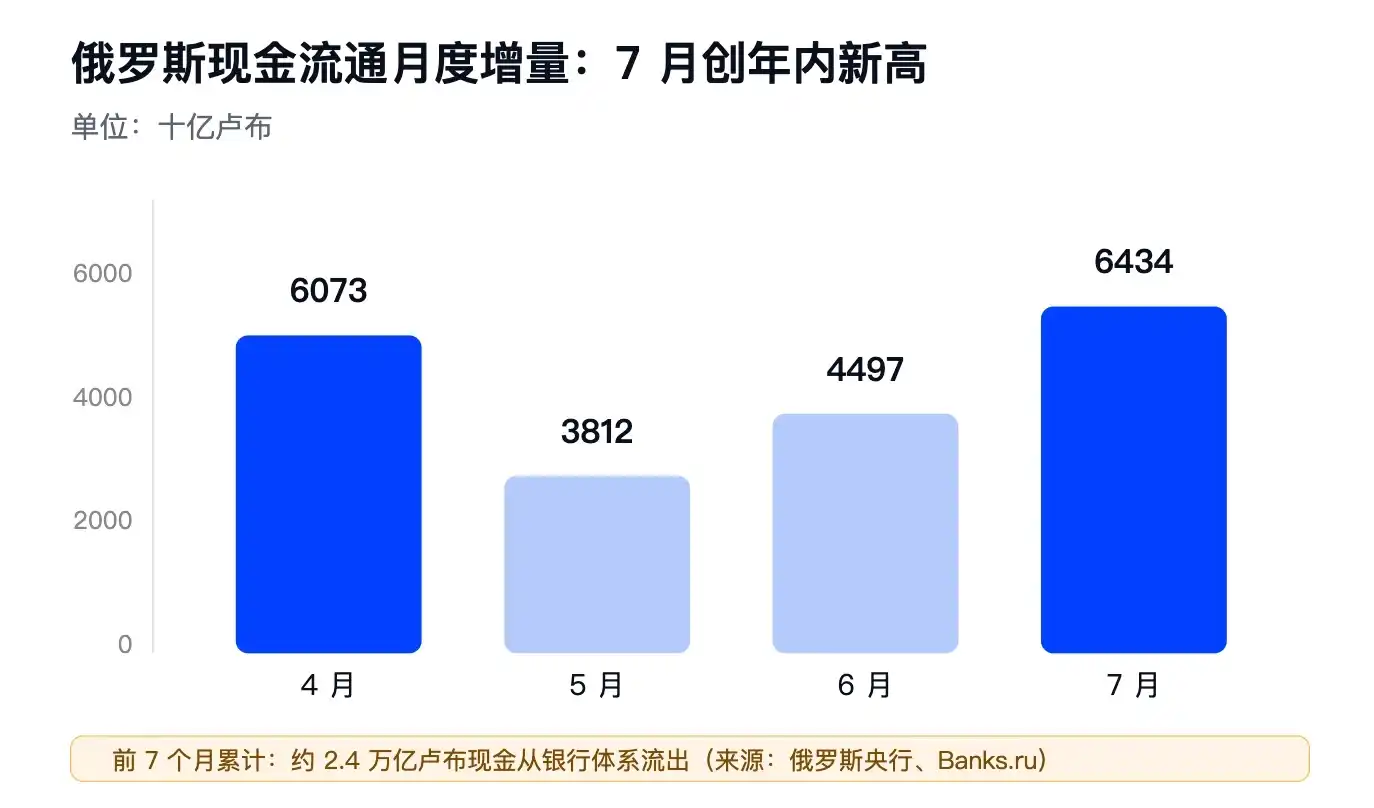
Russians are moving cash out of banks. According to reports from media outlets like the Financial Times and the Washington Post, in the first 7 months of 2026, Russians withdrew approximately 24.4 billion euros (about 2.4 trillion rubles) in cash from the banking system. Data from the Russian financial data platform Banks.ru indicates this withdrawal trend began in early March, with around 300 billion rubles leaving personal accounts each month.

The pace of outflow is accelerating. Data from the Russian Central Bank shows that cash in circulation increased by 607.3 billion rubles in April, by 381.2 billion rubles in May (a record high for May since 1995), by 449.7 billion rubles in June, and by another 643.4 billion rubles in July, marking the largest monthly increase in 2026. By July of this year, the total cash held by Russian citizens and businesses exceeded 21.9 trillion rubles.

Deposit data from specific banks paints a clearer picture. Gazprombank lost 299.5 billion rubles in personal deposits over 4 months, accounting for 10.8% of its total deposits; Rosselkhozbank lost 270.5 billion rubles, a decline exceeding 15%; Russia's largest private bank, Alfa-Bank, lost 179.4 billion rubles, a 5.6% decrease. Even the traditionally stable Sberbank was not spared, losing 211.6 billion rubles in June alone and another 31.8 billion rubles in July.

This Money Has Not Disappeared; It Has Flowed into Cryptocurrency
While cash flowed out of banks, cryptocurrency trading volume expanded rapidly. In February 2025, Russian Deputy Finance Minister Ivan Chebeskov stated at the Alfa Talk conference that daily cryptocurrency transaction volume among the Russian public reached approximately 50 billion rubles, equivalent to about $648 million at the then exchange rate, with millions of citizens participating annually.

Chebeskov's exact words were: "The annual volume of cryptocurrency transactions in our country exceeds 10 trillion rubles, all occurring outside the regulatory zone." This statement highlights the real anxiety of Russian regulators. The public is not treating cryptocurrency as a speculative toy but rather as a savings tool to hedge against ruble depreciation, circumvent capital controls, and cope with financial uncertainty.

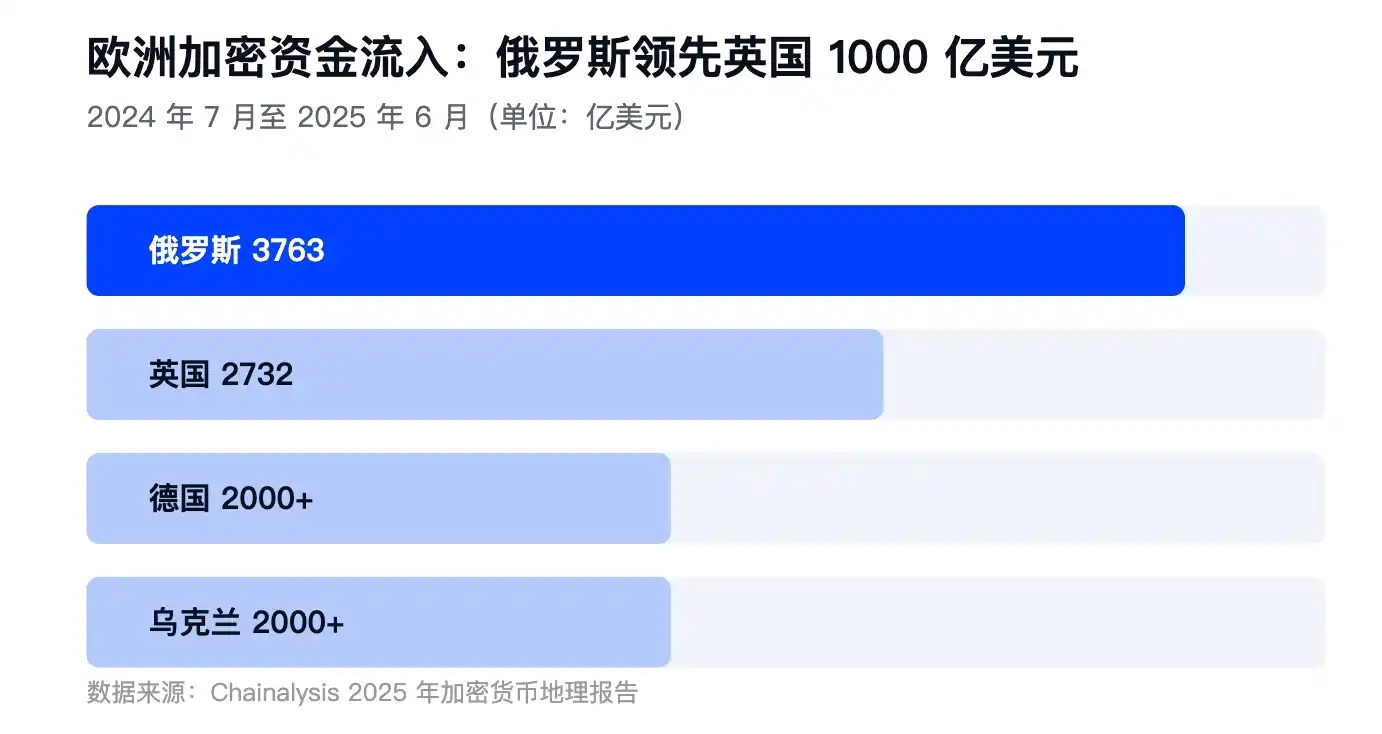
Data from Chainalysis corroborates the scale of this market. From July 2024 to June 2025, Russia received cryptocurrency inflows amounting to $376.3 billion, nearly 1.4 times the UK's $273.2 billion, ranking first in Europe. Sergei Shvetsov, Chairman of the Supervisory Board of the Moscow Exchange, estimated that Russian users pay approximately $15 billion in fees to overseas crypto platforms annually.

New Crypto Law Takes Effect September 1st, Locking Retail Investors at 300,000 Rubles Per Year
The government chose to formalize this gray channel through legislation. On July 21, 2026, the Russian State Duma passed the second and third readings of the "Digital Currency and Digital Rights Law" in a single day; Putin signed it into law on August 4th. The core provisions of this law will officially take effect on September 1, 2026.

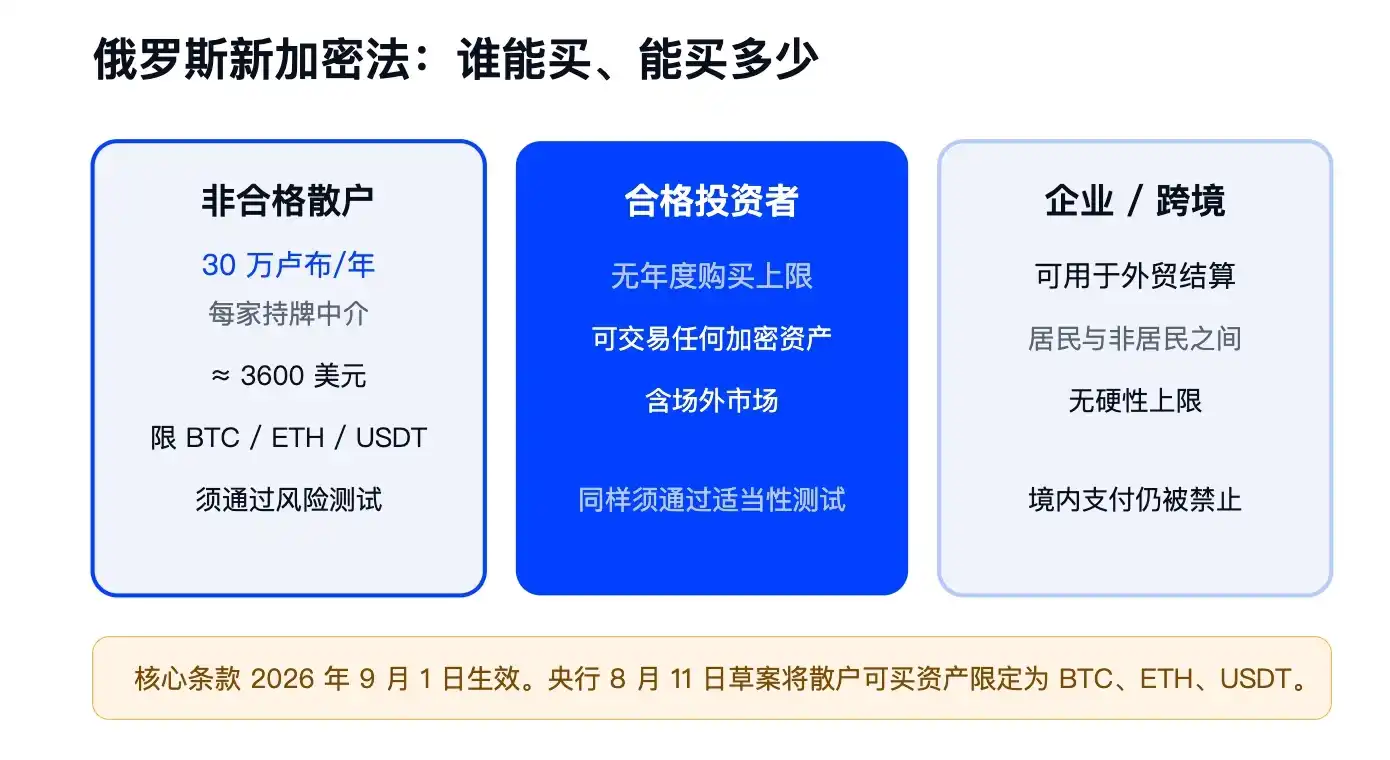
For ordinary retail investors, the law stipulates strict entry conditions. Non-qualified investors must pass a suitability test administered by the Russian Central Bank and are limited to purchasing no more than 300,000 rubles worth of cryptocurrency annually through any single licensed intermediary, roughly equivalent to $3600 to $3800. On August 11th, the Russian Central Bank released a draft instruction initially limiting the crypto assets retail investors can purchase to Bitcoin, Ethereum, and USDT.

Qualified investors are exempt from these restrictions and can trade freely on exchanges and over-the-counter markets. Businesses and import-export firms can also use cryptocurrency for cross-border settlements, with no rigid caps for this segment. The law simultaneously maintains the ban on using cryptocurrency for domestic payments of goods and services.

In other words, ordinary people looking to preserve value with crypto assets can only buy about $3600 worth per year per platform, while businesses and high-net-worth individuals retain ample channels. This design leaves the "large outflow" valve open on the institutional side while tightening it on the retail side.

Why Are Banks Bleeding? Two Explanations Coexist

Regarding the cash outflow, Russian officials and the market offer different explanations.

Russian Central Bank and Finance Ministry officials have repeatedly emphasized that there is no plan to freeze citizens' deposits, with Finance Minister Anton Siluanov dismissing related rumors as "fake news." Central Bank Deputy Governor Alexei Zabotkin publicly stated in August 2025 that restricting withdrawals would have "destructive consequences" for the financial system.

The central bank attributes the surge in cash to several technical factors: the increase in VAT from 20% to 22% starting January 2026, coupled with bank acquiring services also being subject to VAT, pushing small and medium enterprises towards cash to avoid taxes; frequent disruptions to mobile communications and the internet since spring, causing digital payments to fail and forcing the public and businesses to hoard cash; additionally, declining deposit interest rates have made deposits less attractive.

However, the market offers a different narrative. The Financial Times and the Washington Post, citing analysts and anonymous former finance officials, suggest that the public's withdrawals stem from concerns about rising war costs, asset nationalization, and banking system instability. Last year, Russian prosecutors transferred approximately $51.5 billion in private assets to state control, and in June seized about $7.6 billion in assets related to agricultural magnate Vadim Moshkovich. These events have fueled persistent rumors that "deposits might be requisitioned by the government."

September 1st Isn't Just for the Crypto Law; The Digital Ruble is Also Launching

Notably, September 1st is also the day the Russian central bank digital currency, the "Digital Ruble," opens to the general public. Systemically important banks like Sberbank, VTB, Alfa-Bank, Gazprombank, and T-Bank, among 12 in total, must enable their clients to conduct Digital Ruble transactions, and retailers with annual turnover exceeding 120 million rubles must accept Digital Ruble payments.

This means that on the same day, Russia will undertake two simultaneous actions: on one hand, bringing民间 crypto trading under a regulatory framework through licensed intermediaries; on the other hand, pulling retail payments back into the official system via the central bank digital currency. For ordinary Russians, the attractiveness of bank deposits is waning, cryptocurrency purchase limits are being fixed, and the Digital Ruble offers a third path—one that is entirely state-controlled.

As 24.4 billion euros in cash surged out of the banking system and $650 million in daily crypto transactions flowed through the gray market, the law Putin signed on August 4th resembles a watershed moment. For ordinary Russians, the channels to autonomously manage their wealth are diminishing, with each remaining choice carrying different implications for who holds the control.


Crypto di tendenza

Domande pertinenti

QAccording to the article, what is the main reason for the mass withdrawal of cash from Russian banks in 2026?

AThe article presents two main explanations. Russian officials attribute it to technical factors like VAT increases, digital payment disruptions, and lower deposit rates. Market analysts and reports, however, suggest the primary driver is public fear over rising war costs, asset nationalizations, and potential government confiscation of bank deposits.

QWhat are the key restrictions on cryptocurrency purchases for non-qualified retail investors under Russia's new law effective September 1, 2026?

ANon-qualified retail investors must pass a suitability test from the Russian Central Bank. They are limited to purchasing no more than 30,000 rubles (approx. $3600) worth of cryptocurrency per year through any single licensed intermediary. Furthermore, the Central Bank's draft instruction restricts permissible assets for these investors to Bitcoin, Ethereum, and USDT.

QHow does the article contrast the treatment of ordinary citizens and institutions/qualified investors under the new cryptocurrency law?

AThe law creates a sharp divide. Ordinary retail investors face strict annual purchase limits (30,000 rubles) and asset restrictions. In contrast, qualified investors face no such limits and can trade freely. Additionally, businesses and importers/exporters are permitted to use cryptocurrency for cross-border settlements without hard limits, while domestic payments with crypto remain banned for everyone.

QWhat significant financial technology event is scheduled to occur in Russia on the same day (September 1, 2026) as the new crypto law takes effect?

AOn September 1, 2026, the Russian Central Bank's Digital Ruble (CBDC) will be launched for general public use. Twelve systemically important banks are required to enable digital ruble transactions for their clients, and large retailers must accept it as payment.

QWhat does the article suggest is the ultimate consequence of the new regulations and trends for ordinary Russian citizens?

AThe article suggests that for ordinary Russians, the channels to autonomously manage and preserve their wealth are narrowing. Bank deposits are losing appeal due to outflow fears, cryptocurrency purchases are now severely capped by law, and the newly launched Digital Ruble offers a state-controlled alternative. This leaves them with fewer options, each carrying different degrees of government control.

Letture associate

UBS Research Report Analysis: Murata's MLCC Factory Opens to the Public for the First Time in 20 Years, 20% Production Increase Potential from Optimization of Existing Assets

On August 18, UBS analysts visited Murata's Fukui Takefu factory, its first public opening in about 20 years. As the global MLCC leader with ~35% market share, this plant serves as the mother factory for advanced MLCCs used in AI servers and premium smartphones. UBS confirmed key findings: deep technical barriers remain, existing equipment holds ~20% latent production capacity, and physical expansion is nearing its limits. Murata's competitive edge lies in a closed-loop system encompassing proprietary ceramic material uniformity control, capacitance-maximizing self-developed technology, and self-built production equipment—a "black box" model difficult to replicate. Its flexible segmented production system efficiently manages over 50,000 product types. With new facility construction constrained and equipment lead times lengthening, optimizing existing lines becomes a crucial, lower-cost path to increase output. Murata's strategy involves shifting generic production to overseas sites like Thailand while focusing Japanese facilities on advanced, high-margin products. UBS projects significant operating margin expansion from 15.4% in FY2026 to 37.6% in FY2029, driven by this product mix upgrade toward high-capacitance, small-size MLCCs for AI and smartphones. Primary risks include U.S. economic slowdown, technology diffusion in Asia, and circuit integration trends. UBS maintains a positive industry outlook, noting potential for guidance upgrades, and sets a 13,200 yen target price based on a 30x FY2029 P/E, implying ~76% upside contingent on successful MLCC product structure advancement.

marsbit5 min fa

UBS Research Report Analysis: Murata's MLCC Factory Opens to the Public for the First Time in 20 Years, 20% Production Increase Potential from Optimization of Existing Assets

marsbit5 min fa

Arthur Hayes: Awaiting Fed Signal, Replenishing Ammo to Position for Crypto Bull Market

Arthur Hayes, co-founder of BitMEX, argues that the yen is significantly undervalued and analyzes three potential paths for its appreciation. He dismisses the first two options—the Bank of Japan raising interest rates or Japanese institutions selling foreign assets—as politically or economically unfeasible. Instead, he identifies the preferred method: Japan's Ministry of Finance (MOF) using the Federal Reserve's FIMA (Foreign and International Monetary Authorities) repo facility to borrow dollars against its U.S. Treasury holdings, then selling those dollars to buy yen in the forex market. Hayes explains that U.S. Treasury Secretary "Besant" has already called for removing the FIMA per-counterparty limit to enable this. The execution depends on Fed Chair "Warsh" convening a subcommittee to adjust the FIMA rules. Hayes is confident this will happen, signaling a major shift in USD/JPY dynamics and the end of the "cheap" yen era. He connects this potential massive dollar liquidity injection directly to a surge in asset prices, particularly Bitcoin, physical gold, and gold miners' stocks, drawing parallels to the Fed's balance sheet expansion during COVID-19. Within crypto, besides Bitcoin, he views Ethereum as undervalued and highlights Ethena (ENA) as a high-potential, speculative altcoin that could see 5-10x returns if liquidity increases and boosts Bitcoin basis trade yields. Hayes concludes he is waiting for the Fed's signal to fully deploy capital, anticipating a significant crypto bull market.

marsbit43 min fa

Arthur Hayes: Awaiting Fed Signal, Replenishing Ammo to Position for Crypto Bull Market

marsbit43 min fa

BTC Sees Largest Single-Day Short Liquidation in History: Overnight $1.1 Billion Short Positions Evaporate, But Calling a Bull Return is Premature

Bitcoin experienced its largest single-day short liquidation in history, with approximately $1.191 billion in short positions being forcibly closed within 24 hours as the price surged nearly 7% to approach $70,000. This event, occurring on the evening of August 19, resulted in total liquidations of about $1.345 billion across the network. The massive short squeeze was attributed to a combination of catalysts: a White House meeting between former President Trump and crypto industry executives fueling regulatory optimism, and a more substantial signal from the U.S. Treasury doubling its liquidity support for long-term bond repurchases, hinting at looser macro liquidity for risk assets. Data showed strong institutional buying, with U.S. spot Bitcoin ETFs seeing significant inflows. The liquidation process itself created a feedback loop, accelerating the price rise as forced buy-backs pushed prices higher. This event surpassed the previous record for BTC perpetual short liquidations set during the volatile "5.19" period in 2021. While such extreme short liquidations have historically signaled a potential medium-term bottom formation, analysts caution that the market often undergoes weeks of consolidation and "cooling off" afterward. Current sentiment remains mixed, with the Fear & Greed Index still in "Fear" territory, and the key test for the rally being whether it can sustain momentum to challenge higher resistance levels like $75,000. The article concludes by warning against immediate "bull market is back" assumptions, emphasizing that history provides context but not guaranteed outcomes.

marsbit1 h fa

BTC Sees Largest Single-Day Short Liquidation in History: Overnight $1.1 Billion Short Positions Evaporate, But Calling a Bull Return is Premature

marsbit1 h fa

Websea Global RWA Summit Successfully Held: Focusing on New Opportunities in China-Kazakhstan Digital Economy, Releasing Signals of Cross-border Collaboration

Websea Global RWA Summit Successfully Held: Focusing on China-Kazakhstan Digital Economy Opportunities, Releasing Signals for Cross-Border Synergy When traditional industries seek new channels for globalization and digital technologies reshape capital, assets, and collaboration methods, an industrial dialogue connecting China, Kazakhstan, and global markets took place in Almaty. On August 18, 2026, the "2026 Global RWA Real-World Asset Tokenization Enterprise Globalization Resource Matching & China-Kazakhstan Industrial Investment Conference," co-hosted by Websea, concluded successfully in Almaty, Kazakhstan. Centered on RWA digitization, cross-border industrial synergy, and investment promotion, the summit gathered industry representatives, investors, digital economy practitioners, creators, and media from China and Kazakhstan to explore the future of a digital economy community. The event shifted focus from mere "project showcases" to fostering deeper "industrial synergy." It featured project roadshows and panel discussions on topics like "Mining Future·Digital Empowerment," "Real Estate Renewal·Urban Evolution," "Green Energy·RWA Opportunities," and "The Globalization Logic of Real Economy." Mr. Yerbol Kharbayev, Chairman of the Kazakhstan Association of Special Economic Zones, emphasized that RWA's significance lies not only in technology but in enhancing asset transparency, collaboration efficiency, and cross-border connectivity through digitization. The discussions highlighted a move towards a deeper "Digital Economy Community" between China and Kazakhstan. Key points included the need for an open, transparent, and stable business environment to attract long-term investment and the crucial role of synergy between governments, enterprises, platforms, and communities. The summit facilitated strategic cooperation signings and targeted B2G/B2B matching, providing a direct channel for Chinese enterprises exploring the Central Asian market. As an invited digital asset platform, Websea participated in brand presentations and the launch of initiatives like a Creator Alliance and a Web3 MCN agency. Herbert Sim, Global CMO of Websea, stated that platform development is fundamentally rooted in user trust and real experience. He expressed gratitude for user and partner trust, underscoring Websea's commitment to asset security, transaction experience, risk awareness, and user rights protection. Websea aims to contribute to the global digital economy through optimized services and open collaboration. The summit also launched the Web3 Beauty Alliance - Central Asia Chapter, a China-Kazakhstan Quality Creator Alliance, and Web3 MCN agencies, expanding the dialogue beyond industry and capital to include technology, content, community, and brand building. The event concluded by signaling that the future of the digital economy will be co-created by a broad range of participants. It requires institutional and infrastructural support, long-term commitment from enterprises, and the sustained trust of users, partners, and communities. With the summit's conclusion, a new chapter in China-Kazakhstan industrial synergy and digital economy cooperation has begun. Websea will use this as a starting point to continue exploring a secure, open, and sustainable digital future alongside global users and partners.

marsbit1 h fa

Websea Global RWA Summit Successfully Held: Focusing on New Opportunities in China-Kazakhstan Digital Economy, Releasing Signals of Cross-border Collaboration

marsbit1 h fa

Trading

Spot

Articoli Popolari

Cosa è $S$

Comprendere SPERO: Una Panoramica Completa Introduzione a SPERO Mentre il panorama dell'innovazione continua a evolversi, l'emergere delle tecnologie web3 e dei progetti di criptovaluta gioca un ruolo fondamentale nel plasmare il futuro digitale. Un progetto che ha attirato l'attenzione in questo campo dinamico è SPERO, denotato come SPERO,$$s$. Questo articolo mira a raccogliere e presentare informazioni dettagliate su SPERO, per aiutare gli appassionati e gli investitori a comprendere le sue basi, obiettivi e innovazioni nei domini web3 e crypto. Che cos'è SPERO,$$s$? SPERO,$$s$ è un progetto unico all'interno dello spazio crypto che cerca di sfruttare i principi della decentralizzazione e della tecnologia blockchain per creare un ecosistema che promuove l'impegno, l'utilità e l'inclusione finanziaria. Il progetto è progettato per facilitare interazioni peer-to-peer in modi nuovi, fornendo agli utenti soluzioni e servizi finanziari innovativi. Al suo interno, SPERO,$$s$ mira a responsabilizzare gli individui fornendo strumenti e piattaforme che migliorano l'esperienza dell'utente nello spazio delle criptovalute. Questo include la possibilità di metodi di transazione più flessibili, la promozione di iniziative guidate dalla comunità e la creazione di percorsi per opportunità finanziarie attraverso applicazioni decentralizzate (dApps). La visione sottostante di SPERO,$$s$ ruota attorno all'inclusività, cercando di colmare le lacune all'interno della finanza tradizionale mentre sfrutta i vantaggi della tecnologia blockchain. Chi è il Creatore di SPERO,$$s$? L'identità del creatore di SPERO,$$s$ rimane piuttosto oscura, poiché ci sono risorse pubblicamente disponibili limitate che forniscono informazioni dettagliate sul suo fondatore o fondatori. Questa mancanza di trasparenza può derivare dall'impegno del progetto per la decentralizzazione—un ethos che molti progetti web3 condividono, dando priorità ai contributi collettivi rispetto al riconoscimento individuale. Centrando le discussioni attorno alla comunità e ai suoi obiettivi collettivi, SPERO,$$s$ incarna l'essenza dell'empowerment senza mettere in evidenza individui specifici. Pertanto, comprendere l'etica e la missione di SPERO rimane più importante che identificare un creatore singolo. Chi sono gli Investitori di SPERO,$$s$? SPERO,$$s$ è supportato da una varietà di investitori che vanno dai capitalisti di rischio agli investitori angelici dedicati a promuovere l'innovazione nel settore crypto. Il focus di questi investitori generalmente si allinea con la missione di SPERO—dando priorità a progetti che promettono avanzamenti tecnologici sociali, inclusività finanziaria e governance decentralizzata. Queste fondazioni di investitori sono tipicamente interessate a progetti che non solo offrono prodotti innovativi, ma contribuiscono anche positivamente alla comunità blockchain e ai suoi ecosistemi. Il supporto di questi investitori rafforza SPERO,$$s$ come un concorrente degno di nota nel dominio in rapida evoluzione dei progetti crypto. Come Funziona SPERO,$$s$? SPERO,$$s$ impiega un framework multifunzionale che lo distingue dai progetti di criptovaluta convenzionali. Ecco alcune delle caratteristiche chiave che sottolineano la sua unicità e innovazione: Governance Decentralizzata: SPERO,$$s$ integra modelli di governance decentralizzati, responsabilizzando gli utenti a partecipare attivamente ai processi decisionali riguardanti il futuro del progetto. Questo approccio favorisce un senso di proprietà e responsabilità tra i membri della comunità. Utilità del Token: SPERO,$$s$ utilizza il proprio token di criptovaluta, progettato per servire varie funzioni all'interno dell'ecosistema. Questi token abilitano transazioni, premi e la facilitazione dei servizi offerti sulla piattaforma, migliorando l'impegno e l'utilità complessivi. Architettura Stratificata: L'architettura tecnica di SPERO,$$s$ supporta la modularità e la scalabilità, consentendo un'integrazione fluida di funzionalità e applicazioni aggiuntive man mano che il progetto evolve. Questa adattabilità è fondamentale per mantenere la rilevanza nel panorama crypto in continua evoluzione. Coinvolgimento della Comunità: Il progetto enfatizza iniziative guidate dalla comunità, impiegando meccanismi che incentivano la collaborazione e il feedback. Nutrendo una comunità forte, SPERO,$$s$ può affrontare meglio le esigenze degli utenti e adattarsi alle tendenze di mercato. Focus sull'Inclusione: Offrendo basse commissioni di transazione e interfacce user-friendly, SPERO,$$s$ mira ad attrarre una base utenti diversificata, inclusi individui che potrebbero non aver precedentemente interagito nello spazio crypto. Questo impegno per l'inclusione si allinea con la sua missione generale di empowerment attraverso l'accessibilità. Cronologia di SPERO,$$s$ Comprendere la storia di un progetto fornisce preziose intuizioni sulla sua traiettoria di sviluppo e sui traguardi. Di seguito è riportata una cronologia suggerita che mappa eventi significativi nell'evoluzione di SPERO,$$s$: Fase di Concettualizzazione e Ideazione: Le idee iniziali che formano la base di SPERO,$$s$ sono state concepite, allineandosi strettamente con i principi di decentralizzazione e focus sulla comunità all'interno dell'industria blockchain. Lancio del Whitepaper del Progetto: Dopo la fase concettuale, è stato rilasciato un whitepaper completo che dettaglia la visione, gli obiettivi e l'infrastruttura tecnologica di SPERO,$$s$ per suscitare interesse e feedback dalla comunità. Costruzione della Comunità e Prime Interazioni: Sono stati effettuati sforzi attivi di outreach per costruire una comunità di early adopters e potenziali investitori, facilitando discussioni attorno agli obiettivi del progetto e ottenendo supporto. Evento di Generazione del Token: SPERO,$$s$ ha condotto un evento di generazione del token (TGE) per distribuire i propri token nativi ai primi sostenitori e stabilire una liquidità iniziale all'interno dell'ecosistema. Lancio della Prima dApp: La prima applicazione decentralizzata (dApp) associata a SPERO,$$s$ è stata attivata, consentendo agli utenti di interagire con le funzionalità principali della piattaforma. Sviluppo Continuo e Partnership: Aggiornamenti e miglioramenti continui alle offerte del progetto, inclusi partnership strategiche con altri attori nello spazio blockchain, hanno plasmato SPERO,$$s$ in un concorrente competitivo e in evoluzione nel mercato crypto. Conclusione SPERO,$$s$ rappresenta una testimonianza del potenziale del web3 e delle criptovalute di rivoluzionare i sistemi finanziari e responsabilizzare gli individui. Con un impegno per la governance decentralizzata, il coinvolgimento della comunità e funzionalità progettate in modo innovativo, apre la strada verso un panorama finanziario più inclusivo. Come per qualsiasi investimento nello spazio crypto in rapida evoluzione, si incoraggiano potenziali investitori e utenti a ricercare approfonditamente e a impegnarsi in modo riflessivo con gli sviluppi in corso all'interno di SPERO,$$s$. Il progetto mostra lo spirito innovativo dell'industria crypto, invitando a ulteriori esplorazioni delle sue innumerevoli possibilità. Mentre il percorso di SPERO,$$s$ è ancora in fase di sviluppo, i suoi principi fondamentali potrebbero effettivamente influenzare il futuro di come interagiamo con la tecnologia, la finanza e tra di noi in ecosistemi digitali interconnessi.

413 Totale visualizzazioniPubblicato il 2024.12.17Aggiornato il 2024.12.17

Cosa è $S$

Cosa è AGENT S

Agent S: Il Futuro dell'Interazione Autonoma in Web3 Introduzione Nel panorama in continua evoluzione di Web3 e criptovalute, le innovazioni stanno costantemente ridefinendo il modo in cui gli individui interagiscono con le piattaforme digitali. Uno di questi progetti pionieristici, Agent S, promette di rivoluzionare l'interazione uomo-computer attraverso il suo framework agentico aperto. Aprendo la strada a interazioni autonome, Agent S mira a semplificare compiti complessi, offrendo applicazioni trasformative nell'intelligenza artificiale (AI). Questa esplorazione dettagliata approfondirà le complessità del progetto, le sue caratteristiche uniche e le implicazioni per il dominio delle criptovalute. Cos'è Agent S? Agent S si presenta come un innovativo framework agentico aperto, progettato specificamente per affrontare tre sfide fondamentali nell'automazione dei compiti informatici: Acquisizione di Conoscenze Specifiche del Dominio: Il framework apprende in modo intelligente da varie fonti di conoscenza esterne ed esperienze interne. Questo approccio duale gli consente di costruire un ricco repository di conoscenze specifiche del dominio, migliorando le sue prestazioni nell'esecuzione dei compiti. Pianificazione su Lungo Orizzonte di Compiti: Agent S impiega una pianificazione gerarchica potenziata dall'esperienza, un approccio strategico che facilita la suddivisione e l'esecuzione efficiente di compiti complessi. Questa caratteristica migliora significativamente la sua capacità di gestire più sottocompiti in modo efficiente ed efficace. Gestione di Interfacce Dinamiche e Non Uniformi: Il progetto introduce l'Interfaccia Agente-Computer (ACI), una soluzione innovativa che migliora l'interazione tra agenti e utenti. Utilizzando Modelli Linguistici Multimodali di Grandi Dimensioni (MLLM), Agent S può navigare e manipolare senza sforzo diverse interfacce grafiche utente. Attraverso queste caratteristiche pionieristiche, Agent S fornisce un framework robusto che affronta le complessità coinvolte nell'automazione dell'interazione umana con le macchine, preparando il terreno per innumerevoli applicazioni nell'AI e oltre. Chi è il Creatore di Agent S? Sebbene il concetto di Agent S sia fondamentalmente innovativo, informazioni specifiche sul suo creatore rimangono elusive. Il creatore è attualmente sconosciuto, il che evidenzia sia la fase embrionale del progetto sia la scelta strategica di mantenere i membri fondatori sotto anonimato. Indipendentemente dall'anonimato, l'attenzione rimane sulle capacità e sul potenziale del framework. Chi sono gli Investitori di Agent S? Poiché Agent S è relativamente nuovo nell'ecosistema crittografico, informazioni dettagliate riguardanti i suoi investitori e sostenitori finanziari non sono documentate esplicitamente. La mancanza di approfondimenti pubblicamente disponibili sulle fondazioni di investimento o sulle organizzazioni che supportano il progetto solleva interrogativi sulla sua struttura di finanziamento e sulla roadmap di sviluppo. Comprendere il supporto è cruciale per valutare la sostenibilità del progetto e il suo potenziale impatto sul mercato. Come Funziona Agent S? Al centro di Agent S si trova una tecnologia all'avanguardia che gli consente di funzionare efficacemente in contesti diversi. Il suo modello operativo è costruito attorno a diverse caratteristiche chiave: Interazione Uomo-Computer Simile a Quella Umana: Il framework offre una pianificazione AI avanzata, cercando di rendere le interazioni con i computer più intuitive. Mimando il comportamento umano nell'esecuzione dei compiti, promette di elevare le esperienze degli utenti. Memoria Narrativa: Utilizzata per sfruttare esperienze di alto livello, Agent S utilizza la memoria narrativa per tenere traccia delle storie dei compiti, migliorando così i suoi processi decisionali. Memoria Episodica: Questa caratteristica fornisce agli utenti una guida passo-passo, consentendo al framework di offrire supporto contestuale mentre i compiti si sviluppano. Supporto per OpenACI: Con la capacità di funzionare localmente, Agent S consente agli utenti di mantenere il controllo sulle proprie interazioni e flussi di lavoro, allineandosi con l'etica decentralizzata di Web3. Facile Integrazione con API Esterne: La sua versatilità e compatibilità con varie piattaforme AI garantiscono che Agent S possa adattarsi senza problemi agli ecosistemi tecnologici esistenti, rendendolo una scelta attraente per sviluppatori e organizzazioni. Queste funzionalità contribuiscono collettivamente alla posizione unica di Agent S all'interno dello spazio crittografico, poiché automatizza compiti complessi e multi-fase con un intervento umano minimo. Man mano che il progetto evolve, le sue potenziali applicazioni in Web3 potrebbero ridefinire il modo in cui si svolgono le interazioni digitali. Cronologia di Agent S Lo sviluppo e le tappe di Agent S possono essere riassunti in una cronologia che evidenzia i suoi eventi significativi: 27 Settembre 2024: Il concetto di Agent S è stato lanciato in un documento di ricerca completo intitolato “Un Framework Agentico Aperto che Usa i Computer Come un Umano”, mostrando le basi per il progetto. 10 Ottobre 2024: Il documento di ricerca è stato reso pubblicamente disponibile su arXiv, offrendo un'esplorazione approfondita del framework e della sua valutazione delle prestazioni basata sul benchmark OSWorld. 12 Ottobre 2024: È stata rilasciata una presentazione video, fornendo un'idea visiva delle capacità e delle caratteristiche di Agent S, coinvolgendo ulteriormente potenziali utenti e investitori. Questi indicatori nella cronologia non solo illustrano i progressi di Agent S, ma indicano anche il suo impegno per la trasparenza e il coinvolgimento della comunità. Punti Chiave su Agent S Man mano che il framework Agent S continua a evolversi, diversi attributi chiave si distinguono, sottolineando la sua natura innovativa e il potenziale: Framework Innovativo: Progettato per fornire un uso intuitivo dei computer simile all'interazione umana, Agent S porta un approccio nuovo all'automazione dei compiti. Interazione Autonoma: La capacità di interagire autonomamente con i computer attraverso GUI segna un passo avanti verso soluzioni informatiche più intelligenti ed efficienti. Automazione di Compiti Complessi: Con la sua metodologia robusta, può automatizzare compiti complessi e multi-fase, rendendo i processi più veloci e meno soggetti a errori. Miglioramento Continuo: I meccanismi di apprendimento consentono ad Agent S di migliorare dalle esperienze passate, migliorando continuamente le sue prestazioni e la sua efficacia. Versatilità: La sua adattabilità attraverso diversi ambienti operativi come OSWorld e WindowsAgentArena garantisce che possa servire un'ampia gamma di applicazioni. Man mano che Agent S si posiziona nel panorama di Web3 e delle criptovalute, il suo potenziale per migliorare le capacità di interazione e automatizzare i processi segna un significativo avanzamento nelle tecnologie AI. Attraverso il suo framework innovativo, Agent S esemplifica il futuro delle interazioni digitali, promettendo un'esperienza più fluida ed efficiente per gli utenti in vari settori. Conclusione Agent S rappresenta un audace passo avanti nell'unione tra AI e Web3, con la capacità di ridefinire il modo in cui interagiamo con la tecnologia. Sebbene sia ancora nelle sue fasi iniziali, le possibilità per la sua applicazione sono vaste e coinvolgenti. Attraverso il suo framework completo che affronta sfide critiche, Agent S mira a portare le interazioni autonome al centro dell'esperienza digitale. Man mano che ci addentriamo nei regni delle criptovalute e della decentralizzazione, progetti come Agent S giocheranno senza dubbio un ruolo cruciale nel plasmare il futuro della tecnologia e della collaborazione uomo-computer.

843 Totale visualizzazioniPubblicato il 2025.01.14Aggiornato il 2025.01.14

Cosa è AGENT S

Come comprare S

Benvenuto in HTX.com! Abbiamo reso l'acquisto di Sonic (S) semplice e conveniente. Segui la nostra guida passo passo per intraprendere il tuo viaggio nel mondo delle criptovalute.Step 1: Crea il tuo Account HTXUsa la tua email o numero di telefono per registrarti il tuo account gratuito su HTX. Vivi un'esperienza facile e sblocca tutte le funzionalità,Crea il mio accountStep 2: Vai in Acquista crypto e seleziona il tuo metodo di pagamentoCarta di credito/debito: utilizza la tua Visa o Mastercard per acquistare immediatamente SonicS.Bilancio: Usa i fondi dal bilancio del tuo account HTX per fare trading senza problemi.Terze parti: abbiamo aggiunto metodi di pagamento molto utilizzati come Google Pay e Apple Pay per maggiore comodità.P2P: Fai trading direttamente con altri utenti HTX.Over-the-Counter (OTC): Offriamo servizi su misura e tassi di cambio competitivi per i trader.Step 3: Conserva Sonic (S)Dopo aver acquistato Sonic (S), conserva nel tuo account HTX. In alternativa, puoi inviare tramite trasferimento blockchain o scambiare per altre criptovalute.Step 4: Scambia Sonic (S)Scambia facilmente Sonic (S) nel mercato spot di HTX. Accedi al tuo account, seleziona la tua coppia di trading, esegui le tue operazioni e monitora in tempo reale. Offriamo un'esperienza user-friendly sia per chi ha appena iniziato che per i trader più esperti.

1.6k Totale visualizzazioniPubblicato il 2025.01.15Aggiornato il 2026.06.02

Come comprare S

Discussioni

Benvenuto nella Community HTX. Qui puoi rimanere informato sugli ultimi sviluppi della piattaforma e accedere ad approfondimenti esperti sul mercato. Le opinioni degli utenti sul prezzo di S S sono presentate come di seguito.

活动图片