Russian Lawmaker Predicts Bitcoin Collapse While Smart Money Rotates into Layer 2 Utility

bitcoinistPubblicato 2026-02-10Pubblicato ultima volta 2026-02-10

Introduzione

A Russian lawmaker, Anatoly Aksakov, predicts Bitcoin's collapse due to its lack of state backing, contrasting with strong institutional investment flows. Meanwhile, capital is rotating into Layer 2 infrastructure like Bitcoin Hyper ($HYPER), which integrates Solana Virtual Machine (SVM) to enable high-speed smart contracts on Bitcoin. The project has raised over $31.3M in its presale, attracting significant whale activity. This shift aims to address Bitcoin's scalability issues, adding utility beyond "digital gold" and supporting decentralized applications. Despite regulatory skepticism, market data indicates growing investor confidence in Bitcoin's Layer-2 evolution.

Trusted Editorial content, reviewed by leading industry experts and seasoned editors. Ad Disclosure

Quick Facts:

  • ➡️ Russian official Anatoly Aksakov predicts Bitcoin’s collapse due to lack of state backing, though market data contradicts this outlook.
  • ➡️ Bitcoin Hyper counters utility concerns by integrating the Solana Virtual Machine (SVM) to bring high-speed smart contracts to Bitcoin.
  • ➡️ Sophisticated investors have poured over $31.3M into the project’s presale, signaling a shift toward Layer 2 infrastructure.
  • ➡️ Whale wallets are actively accumulating, with recent on-chain activity showing seven-figure positioning in the protocol.

Anatoly Aksakov, Chairman of the Russian State Duma Committee on Financial Market, is at it again. He has once again targeted the world’s leading cryptocurrency, asserting that Bitcoin is ‘destined to collapse.’

As a vocal fan of the Digital Ruble, Aksakov argues that without state backing, decentralized assets simply can’t survive the long haul. It’s a bold stance, especially given Russia’s mixed signals, legalizing industrial mining for tax revenue while strictly banning crypto for buying your morning coffee.

Headline-grabbing doom predictions from central bankers are nothing new (sound familiar?), but the market isn’t flinching. Institutional flows into Bitcoin products remain strong, suggesting investors see this as protectionist noise rather than serious analysis. Yet, Aksakov accidentally hits on a real issue: utility.

If Bitcoin wants to be more than just ‘digital gold’ and survive the pressures Aksakov describes, it has to evolve beyond simple storage.

Traders aren’t fleeing; they’re building. We’re seeing a massive capital rotation into high-performance infrastructure layers. Why? Because the base layer is slow and expensive. Liquidity is aggressively hunting for speed and programmability.

That’s where Bitcoin Hyper ($HYPER) enters the picture, a project aiming to bridge Bitcoin’s ironclad security with the execution speed modern finance actually demands.

Learn more about $HYPER here.

The First SVM-Powered Bitcoin Layer 2 Redefines Scalability

The main knock against Bitcoin, that it’s too rigid for mass adoption, is being fixed.

Bitcoin Hyper ($HYPER) addresses this not by altering the base layer, but by expanding it. By integrating the Solana Virtual Machine (SVM) directly as a Bitcoin Layer 2, the network allows for sub-second finality while keeping settlement anchored to Bitcoin’s proof-of-work. In plain English: it’s fast, but it’s still Bitcoin-secure.

This opens up a massive design space for developers. Before now, building complex DeFi or gaming apps on Bitcoin was a nightmare due to Script limitations. With the SVM, Bitcoin Hyper lets devs write in Rust and deploy dApps with Solana-like speeds, thousands of transactions per second, without leaving the Bitcoin ecosystem.
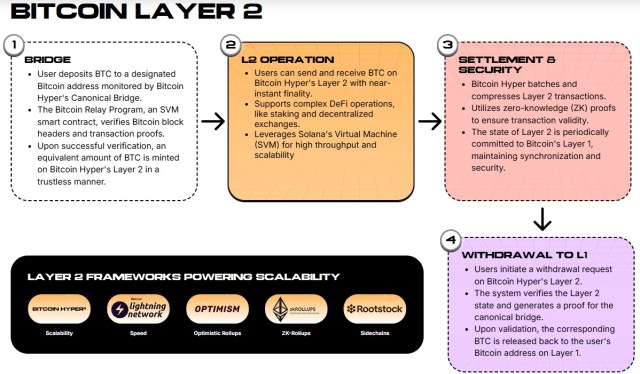
The liquidity implications are huge. A Decentralized Canonical Bridge lets holders actually use their $BTC in high-frequency trading or yield protocols instead of letting it gather dust. This utility effectively counters the ‘collapse’ narrative by turning Bitcoin from a passive rock into a programmable, active capital base.

Get your $HYPER today.

Smart Money Accumulates $31M as Whales Target Infrastructure

While regulators argue over theory, on-chain data shows where the smart money is actually going. The demand for Layer 2 infrastructure isn’t hypothetical.

According to the official presale page, Bitcoin Hyper has already raised $31.3M, signaling strong conviction from early-stage investors betting on the ‘fat protocol’ thesis applied to Bitcoin L2s.
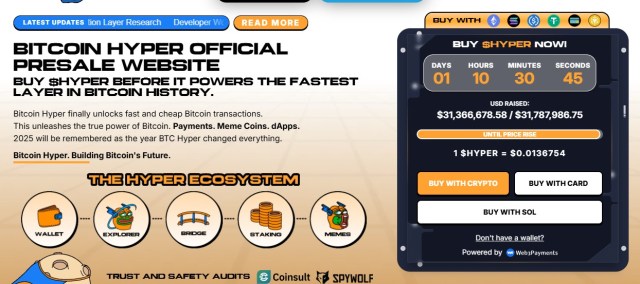
With tokens currently priced at $0.0136754, the project is attracting high-value participants hedging their Bitcoin bets. Smart money is moving.

Etherscan data confirms the trend: two high-net-worth wallets recently scooped up $1M+ worth of tokens, with the largest single buy hitting $500K. This kind of accumulation often happens right before retail catches on, large holders positioning themselves before the wider market grasps the full implications of SVM on Bitcoin.

It’s not just about price appreciation, either. The protocol offers immediate staking after the Token Generation Event (TGE). For yield-focused investors currently priced out of Ethereum’s mainnet (low APYs, high gas), this is a serious draw. By tackling the security-scalability-decentralization trilemma, this Layer 2 is shaping up to be a major liquidity sink for the next cycle.

Buy $HYPER here.

This article is for informational purposes only and does not constitute financial advice. Cryptocurrency investments are volatile and high-risk. Always conduct your own due diligence before investing.

Editorial Process for bitcoinist is centered on delivering thoroughly researched, accurate, and unbiased content. We uphold strict sourcing standards, and each page undergoes diligent review by our team of top technology experts and seasoned editors. This process ensures the integrity, relevance, and value of our content for our readers.

patrubogdan

Follow

Full Profile

Related Posts

AI Can’t Save the Market Alone, But It Can Transform It: How SUBBD Token Redefines Content Economics

Solana’s Low Fees Create Strong Competition for Base, BNB, and Polygon and Fuel SUBBD Token

Chainlink Founder Sergey Nazarov Identifies 3 Trends That Will Define the Cryptosphere as Hyper Token Soars

Bitcoin Demand Plunges Per CryptoQuant, Yet Maxi Doge Endures

Crypto Markets Catch A Breather As Outflows Begin To Slow: Analysts

SUBBD Token’s Massive Projected Impact on the Content Creation Market in 2026

Domande pertinenti

QWhat is Anatoly Aksakov's prediction about Bitcoin and what is his reasoning?

AAnatoly Aksakov, Chairman of the Russian State Duma Committee on Financial Market, predicts that Bitcoin is 'destined to collapse.' His reasoning is that without state backing, decentralized assets cannot survive in the long term.

QHow does Bitcoin Hyper aim to address Bitcoin's limitations?

ABitcoin Hyper ($HYPER) aims to address Bitcoin's limitations by integrating the Solana Virtual Machine (SVM) as a Bitcoin Layer 2. This allows for sub-second transaction finality and high-speed smart contracts while keeping settlement secured by Bitcoin's proof-of-work, thus adding programmability and scalability.

QWhat evidence from the market contradicts Aksakov's bearish outlook on Bitcoin?

AMarket data contradicts Aksakov's outlook, showing strong institutional flows into Bitcoin products. Furthermore, sophisticated investors have poured over $31.3 million into the Bitcoin Hyper presale, indicating a shift of capital into Bitcoin Layer 2 infrastructure rather than a flight from Bitcoin itself.

QWhat significant on-chain activity is mentioned regarding the Bitcoin Hyper token ($HYPER)?

ASignificant on-chain activity shows that high-net-worth 'whale' wallets are actively accumulating $HYPER tokens. Recent data indicates two wallets made seven-figure purchases, with the largest single buy hitting $500,000.

QWhat utility does the Bitcoin Hyper Layer 2 provide for Bitcoin holders?

ABitcoin Hyper provides utility for Bitcoin holders through a Decentralized Canonical Bridge. This allows holders to use their $BTC in high-frequency trading and yield-generating protocols on the Layer 2, transforming Bitcoin from a passive store of value into an active, programmable capital base.

Letture associate

Single-Day Plunge of 30%, Arthur Hayes Suddenly Liquidates: Why Did ZEC Get Exploded by Security Issues?

On June 5th, Zcash founder Zooko Wilcox disclosed a critical soundness vulnerability in the project's latest Orchard privacy pool. This flaw, found in the elliptic curve multiplication constraints, could allow an attacker to create unlimited counterfeit ZEC within the shielded pool, with transactions appearing valid. The vulnerability was discovered in late May by security researcher Taylor Hornby, who utilized Anthropic's new Opus 4.8 AI model for a targeted audit. The Zcash ecosystem had already performed an emergency network upgrade to patch the issue. However, the detailed disclosure triggered severe market panic, causing ZEC's price to plummet over 30% in a single day. Notably, prominent investor Arthur Hayes announced he had sold his entire ZEC position following the news. The incident starkly challenges the "technological trust" narrative central to privacy coins. Despite years of top-tier cryptographic audits, the bug persisted until uncovered with advanced AI-assisted research. This highlights the growing gap between theoretical perfection and practical implementation in privacy technology. The event serves as a industry-wide warning: in an AI-driven security landscape, the assumption that "undiscovered equals safe" is obsolete. It underscores the urgent need for continuous, proactive security practices combining AI audits, formal verification, and rapid response mechanisms.

foresightnews_api26 min fa

Single-Day Plunge of 30%, Arthur Hayes Suddenly Liquidates: Why Did ZEC Get Exploded by Security Issues?

foresightnews_api26 min fa

Breaking the Curse of DeFi Cascading Liquidations, Vitalik Proposes a New Solution

**Vitalik Buterin Proposes New DeFi Design to Eliminate Forced Liquidations** Ethereum co-founder Vitalik Buterin has published a proposal for a new decentralized finance (DeFi) architecture aimed at removing the automatic liquidation mechanisms prevalent in current lending protocols. The core idea involves creating synthetic assets using options as building blocks, fundamentally avoiding the抵押借贷结构 that triggers forced sell-offs. The proposal responds to a recurring flaw in DeFi: during sharp market downturns, mass自动清算 of under-collateralized positions can exacerbate price declines, creating systemic selling pressure and market instability, as evidenced by recent crypto market volatility. Buterin's model would split an asset like 1 ETH into two option-like derivatives, P and N, pegged to a price index with a set strike price and expiration. At expiry, an oracle determines the settlement price to allocate the underlying ETH between P and N holders. This design eliminates the "cliff" of instant liquidation. Instead, a position's value would gradually drift from its target peg if not actively rebalanced by the user, transferring the rebalancing decision from the protocol to the user or automated tools. A key advantage is the reduced reliance on high-frequency, real-time oracle price feeds, which are vulnerable to manipulation and errors in current systems. The delayed settlement in the options model allows for more robust, fault-tolerant oracle designs. However, significant challenges remain for practical adoption. High transaction costs (slippage) from frequent rebalancing on automated market makers (AMMs) could erode user funds. The model may not be suitable for stablecoins requiring a strict 1:1 dollar peg, as it inherently allows for value drift. Success would depend on developing new liquidity provisioning models and deep markets for these synthetic assets. The proposal represents a fundamental rethinking of DeFi risk management, challenging the industry to explore alternatives to被动集中平仓 rather than merely optimizing existing liquidation processes. It remains a theoretical framework awaiting implementation and testing by development teams.

foresightnews_api28 min fa

Breaking the Curse of DeFi Cascading Liquidations, Vitalik Proposes a New Solution

foresightnews_api28 min fa

Bitcoin's Decline Marks the Transformation of Crypto

Title: The Decline of Bitcoin Marks the Transformation of Crypto While Bitcoin's price recently fell below $70,000, down approximately 45% from its peak, the broader crypto industry is not following it into decline. Instead, crypto is maturing and evolving beyond its dependence on Bitcoin's price movements. Two of Bitcoin's core functions are being usurped. First, AI has captured its role as the primary speculative asset. AI, with its tangible revenue, explosive demand, and massive capital inflows ($700-830 billion in 2024), is siphoning off the speculative "hot money" that once drove Bitcoin. It also contributes to a sustained high-interest-rate environment, further tightening liquidity for assets like Bitcoin. Second, dollar-pegged stablecoins like USDC and USDT have replaced Bitcoin as the crypto market's foundational currency and primary on/off-ramp. Most trading pairs and on-chain transactions are now settled in stablecoins, severing the historical link where all capital inflows had to pass through Bitcoin first. This decoupling allows projects to thrive based on their own fundamentals rather than Bitcoin's price. Examples include Hyperliquid, an on-chain derivatives exchange with annual revenues of $8-13 billion, and prediction market platform Polymarket, valued at $200 billion with $3.65 billion in annual fees. These projects are evaluated on traditional metrics like revenue and user growth. New opportunities are emerging, particularly around privacy. Privacy coins like Zcash (ZEC) are seeing surging demand, while infrastructure like NEAR enables private, cross-chain asset transfers without requiring users to hold a specific token—privacy becomes a universal service layer. In this new paradigm, stablecoins are the universal cash, various project tokens represent equity, and privacy-enabled cross-chain coordination layers (like NEAR) act as the critical infrastructure connecting a fragmented, multi-chain ecosystem. Bitcoin is now just one asset among many. The era where the entire crypto market moved in lockstep with Bitcoin is over. The industry's health should now be judged by project fundamentals—real revenue, active users, and tokenomics that capture value—and the development of the underlying infrastructure enabling a mature, dollar-denominated crypto economy.

foresightnews_api31 min fa

Bitcoin's Decline Marks the Transformation of Crypto

foresightnews_api31 min fa

Lightspark CEO: In Ten Years, Bitcoin Will Be as Invisible as TCP/IP, Yet Power Trillions in Daily Transactions

A decade from now, Bitcoin will function like TCP/IP — invisible yet foundational, supporting trillions in daily transactions globally, according to Lightspark CEO David Marcus. In this future, a coffee shop in Lagos receives instant payment, a manufacturer in São Paulo settles an invoice with a supplier in Ho Chi Minh City, and a freelancer in Bangalore gets paid weekly from an Austin startup — all via Bitcoin's settlement layer, with none of the parties consciously interacting with it. This vision parallels the adoption of open protocols: first driven by necessity where existing systems fail, then scaling rapidly as tools mature and economic benefits become clear. The structural shift begins with wallets. Modern non-custodial wallets, like Spark, allow users to hold dollars, local currency, and Bitcoin in a single address, seamlessly switching between them. This eliminates friction and revolutionizes global custody, moving significant deposits to user-controlled keys not by ideology, but by superior utility. As a result, Bitcoin becomes the default savings layer for billions, as its fixed supply and appreciating value make it a rational choice for savers holding it alongside stablecoins in their everyday wallets. Businesses follow a similar path, from small companies in emerging markets to multinational corporations, holding Bitcoin alongside operational stablecoins. The latest trend is direct Bitcoin transactions for commerce. When both parties hold Bitcoin, transacting in it becomes the simplest option — no conversions, no intermediary currency. This starts in niche areas like high-value B2B settlements but grows as infrastructure makes sending Bitcoin as easy as stablecoins. An accelerating force is AI agents. By 2036, AI agents conducting commerce on behalf of individuals and firms will increasingly choose Bitcoin for settlement. Optimizing for speed, finality, and minimal counterparty risk across jurisdictions, they find Bitcoin's global, neutral, and programmable network ideal for netting and settling obligations. Thus, Bitcoin is becoming the native currency for machine commerce, just as it has become a native savings asset for humans. The global monetary system is being rebuilt from the protocol layer: open infrastructure, default self-custody, Bitcoin settling everything underneath, with stablecoins as the interface. Most users won't think about Bitcoin when they transact — and they won't need to.

foresightnews_api36 min fa

Lightspark CEO: In Ten Years, Bitcoin Will Be as Invisible as TCP/IP, Yet Power Trillions in Daily Transactions

foresightnews_api36 min fa

Trading

Spot
Futures

Articoli Popolari

Come comprare LAYER

Benvenuto in HTX.com! Abbiamo reso l'acquisto di Solayer (LAYER) semplice e conveniente. Segui la nostra guida passo passo per intraprendere il tuo viaggio nel mondo delle criptovalute.Step 1: Crea il tuo Account HTXUsa la tua email o numero di telefono per registrarti il tuo account gratuito su HTX. Vivi un'esperienza facile e sblocca tutte le funzionalità,Crea il mio accountStep 2: Vai in Acquista crypto e seleziona il tuo metodo di pagamentoCarta di credito/debito: utilizza la tua Visa o Mastercard per acquistare immediatamente SolayerLAYER.Bilancio: Usa i fondi dal bilancio del tuo account HTX per fare trading senza problemi.Terze parti: abbiamo aggiunto metodi di pagamento molto utilizzati come Google Pay e Apple Pay per maggiore comodità.P2P: Fai trading direttamente con altri utenti HTX.Over-the-Counter (OTC): Offriamo servizi su misura e tassi di cambio competitivi per i trader.Step 3: Conserva Solayer (LAYER)Dopo aver acquistato Solayer (LAYER), conserva nel tuo account HTX. In alternativa, puoi inviare tramite trasferimento blockchain o scambiare per altre criptovalute.Step 4: Scambia Solayer (LAYER)Scambia facilmente Solayer (LAYER) nel mercato spot di HTX. Accedi al tuo account, seleziona la tua coppia di trading, esegui le tue operazioni e monitora in tempo reale. Offriamo un'esperienza user-friendly sia per chi ha appena iniziato che per i trader più esperti.

287 Totale visualizzazioniPubblicato il 2025.02.11Aggiornato il 2026.06.02

Come comprare LAYER

Discussioni

Benvenuto nella Community HTX. Qui puoi rimanere informato sugli ultimi sviluppi della piattaforma e accedere ad approfondimenti esperti sul mercato. Le opinioni degli utenti sul prezzo di LAYER LAYER sono presentate come di seguito.

活动图片













