Russia May Block Global Crypto Exchanges Ahead Of New Regulatory Framework – Report

bitcoinistPubblicato 2026-02-19Pubblicato ultima volta 2026-02-19

Introduzione

Russia is preparing to restrict access to global cryptocurrency exchanges by summer 2026 as part of a new domestic regulatory framework, according to industry experts. The move aims to shift trading activity from foreign platforms to Russian-based services. Analysts suggest that authorities may block overseas exchanges using methods similar to previous restrictions on platforms like Telegram and YouTube. However, experts warn that such measures could drive part of the market underground, increasing fraud and complicating regulation. Meanwhile, the European Union is considering broader sanctions on all Russia-related crypto transactions to prevent sanctions evasion, including a potential ban on digital ruble transactions.

Russia is preparing to restrict access to global crypto exchanges this summer, experts said, suggesting that authorities are planning to shift trading from foreign platforms to domestic ones under the upcoming regulatory framework.

Russia To Restrict Foreign Crypto Exchanges

On Tuesday, experts said Russia will likely block foreign crypto exchanges by summer 2026 as lawmakers advance the highly anticipated domestic framework, expected by July 1, to bring the industry out of the shadows.

According to a report by local news outlet RBC Crypto, industry participants believe authorities will soon begin restricting access to overseas exchanges, similar to the Telegram and YouTube block.

Nikita Zuborev, senior analyst at crypto exchange aggregator Bestchange.ru, told the news media outlet that this scenario is likely, asserting that as soon as the domestic market enters the new regulatory regime, “there is an almost 100% chance that the fight against major competitors will begin.”

“We expect that Roskomnadzor may begin mass blocking of websites of crypto exchanges and large exchangers not registered in Russia as early as this summer. Most likely, they will act according to the YouTube blocking model — they will delete DNS records in the Russian segment of the Internet and continue to fight against means of circumventing the blocks,” the analyst stated.

However, Zuborev cautioned that if global exchanges are not allowed to obtain licenses or to operate as agents of domestic exchanges or brokers, a part of the market will move underground, increasing fraud, complicating regulation, and resulting in higher commission fees.

Meanwhile, Dmitry Machikhin, lawyer and founder of BitOK, considers a “Belarusian scenario” highly possible. Notably, only companies operating under Belarus’ special regime can conduct cryptocurrency transactions, while individuals are prohibited from buying and selling digital assets on foreign platforms.

Machikhin noted that completely restricting operations is impossible, citing Binance as an example. The global exchange still has over 1 million Russian customers despite its departure from the country’s market. Therefore, the chances of a direct ban on transactions using foreign exchanges are low, the lawmakers added.

EU Explores Broader Sanctions

Ignat Likhunov, founder of Cartesius law agency, agreed with the other two experts, affirming, “It seems that blocking measures are being prepared in parallel with the creation of a ‘white’ zone, and conditions for ‘illegal’ exchangers and unfriendly foreign exchanges will deteriorate.”

He pointed out that the lack of “real levers of influence” over foreign exchanges, noting that the platforms don’t need to hurry to comply with any requirements of Russian legislation.

As a result, authorities will likely hold them accountable in absentia and block access to the foreign exchanges that enforce sanctions against Russia for various reasons, including economic or non-compliance with the law on data landing.

It’s worth noting that the European Union has been exploring implementing strict sanctions on all crypto transactions linked to Russia to limit sanctions evasion. As reported by Bitcoinist, the European Commission is strengthening its crackdown on the country’s use of digital assets to evade sanctions by considering measures to ban all Russia-related crypto transactions.

Legal documents show that the Commission has proposed a broader prohibition “instead of attempting to ban copycat Russian crypto entities spun out of already sanctioned platforms.” The proposal focuses on stopping the growth of successors to Russia-linked crypto exchange Garantex, while aiming at payment platforms such as A7 and its related ruble-pegged stablecoin A7A5.

The Commission also suggested adding 20 banks to the list of sanctioned entities and a ban on any digital ruble-related transactions.
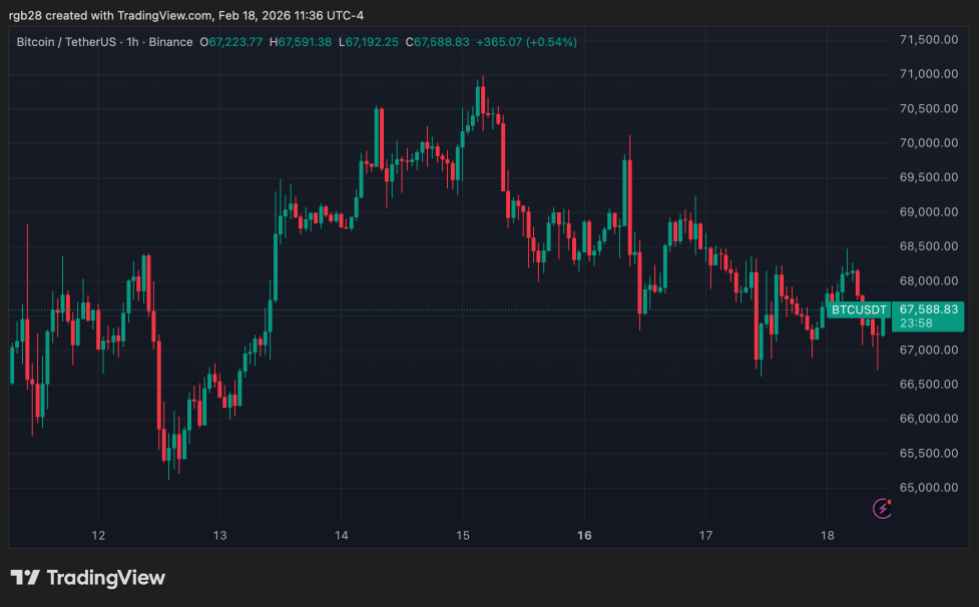
Bitcoin (BTC) trades at $67,588 in the one-week chart. Source: BTCUSDT on TradingView


Domande pertinenti

QWhat is Russia planning to do with global crypto exchanges according to the report?

ARussia is preparing to restrict access to global crypto exchanges, likely by blocking their websites, to shift trading activity to domestic platforms under a new regulatory framework expected by summer 2026.

QWhich Russian agency is expected to carry out the mass blocking of foreign crypto exchange websites?

ARoskomnadzor, Russia's federal executive body responsible for monitoring and controlling media and communications, is expected to begin mass blocking of these websites.

QWhat potential negative consequence did Nikita Zuborev warn about if global exchanges are not allowed to operate in Russia?

ANikita Zuborev warned that if global exchanges are not allowed to obtain licenses or operate as agents, a part of the market will move underground, leading to increased fraud, more difficult regulation, and higher commission fees.

QWhat alternative scenario, similar to another country's model, was suggested as a possibility for Russia's crypto regulation?

ADmitry Machikhin suggested a 'Belarusian scenario' is highly possible, where only companies operating under a special regime can conduct crypto transactions, while individuals are prohibited from using foreign platforms.

QWhat broader action is the European Union exploring regarding crypto transactions and Russia?

AThe European Union is exploring implementing strict sanctions to ban all crypto transactions linked to Russia to limit sanctions evasion, including a broader prohibition and a ban on any digital ruble-related transactions.

Letture associate

The Shutdown of Claude Mythos Revealed the True Cost of Renting AI to Me

The sudden shutdown of Claude Mythos this week starkly highlights a critical, often overlooked risk for founders: when your core capability relies entirely on someone else's platform, your fate is not in your own hands. The key question becomes: who truly owns the intelligence your product depends on? For years, the debate around open-source models focused on cost. Now, the evidence is clear: fine-tuned open-source models can achieve frontier-level quality for specific, mission-critical tasks at a fraction of the cost. However, the deeper issue is control. Relying on a third-party API is like renting; it works until the landlord changes the rules, raises the rent, or asks you to leave—as Mythos experienced. The lesson is not to stop using frontier models—they are incredible infrastructure. The goal is ownership. Ownership means starting with a powerful open-source model and shaping it around what makes your company unique: your data, workflows, domain expertise, and definition of "good." Over time, the model becomes less generic and more reflective of your business, creating durable value. The optimistic conclusion is that AI's future doesn't hinge on one superior model. There is no single frontier. The frontier includes proprietary models, models fine-tuned on company-specific knowledge, specialized models for narrow problems, and intelligent routers orchestrating model ensembles. The most interesting development is not models getting smarter, but intelligence becoming increasingly customizable. The winning companies will be those that transform intelligence into a unique, owned asset. Looking ahead, the vision is not one model dominating all, but many teams owning the part of the frontier that matters most to them.

marsbit14 min fa

The Shutdown of Claude Mythos Revealed the True Cost of Renting AI to Me

marsbit14 min fa

Tiger Research: U.S. Strategic Bitcoin Reserve - Should the Market Be Happy or Disappointed?

Tiger Research analyzes the evolution of U.S. legislative efforts regarding a strategic Bitcoin reserve, concluding the market impact is limited in the short term but potentially positive long-term. The core event was a March 2025 executive order by former President Trump, which designated confiscated Bitcoin as a strategic reserve and promised not to sell existing holdings (approx. 190k BTC). As it contained no mandate to purchase new Bitcoin, the market reacted negatively, with prices dropping 5.7%. Legislative history shows a significant retreat from initial ambitions. The 2024 "BITCOIN Act" proposed mandatory purchases of 1 million BTC over five years. Reintroduced in 2025, it stalled due to high fiscal costs, concerns over dollar hegemony, and opposition from the Treasury Secretary. The current frontrunner, the 2026 "American Retirement and Monetary Advancement (ARMA) Act," is a compromise. It lacks any purchase requirement, instead focusing on consolidating existing government-held Bitcoin and legally prohibiting its sale for at least 20 years. While ARMA has higher passage odds due to bipartisan support and no purchase mandate, its immediate market effect is neutral. It eliminates potential government selling pressure but creates no new demand. The long-term significance is that formally establishing Bitcoin as a national reserve asset in law could later reignite debates on mandatory purchases. Therefore, the path to a government buyer is longer than initially priced by the market, but the directional narrative remains intact.

marsbit17 min fa

Tiger Research: U.S. Strategic Bitcoin Reserve - Should the Market Be Happy or Disappointed?

marsbit17 min fa

US Stock Market Trend (June 16): SpaceX Rises 42% in Two Days, New Fed Chairman Takes Office Today

**U.S. Stocks Trend (June 16): SpaceX Soars 42% in Two Days, New Fed Chair Takes Office Today** Markets surged on Monday following former President Trump's social media announcement of a completed U.S.-Iran deal to reopen the Strait of Hormuz, pending a June 19 signing. The news triggered a broad risk-on rally: oil prices crashed, tech stocks soared, bond yields fell, and defensive sectors lagged. **Market Performance:** The Nasdaq jumped 3.07%, led by semiconductor stocks like Micron (+9.2%). The S&P 500 gained 1.65%, and the Dow rose 0.92% to a record high. However, the Russell 2000 small-cap index underperformed (+0.72%). SpaceX continued its hot streak, rising another 5% pre-market after disclosures of large buys by an Australian billionaire and Cathie Wood's ARK. Boeing also rallied on the transportation optimism. Conversely, energy stocks like Chevron fell over 3% on the oil price plunge, with other defensive sectors also selling off. The day's action showed a clear rotation of funds from energy/defensive plays into AI and tech narratives. **Macro & Outlook:** The VIX fear index fell 8.37%. Treasury yields declined, and WTI crude dropped over 5%. Attention now shifts to a packed schedule: the Bank of Japan is widely expected to hike rates to 1.0% on Tuesday. The Fed's June meeting concludes Wednesday, marking new Chair Wash's debut. While rates are expected to hold, his tone on stubborn inflation and the "dot plot" will be crucial for gauging the 2024 rate path. The formal Iran deal signing is set for Friday. **Trend Perspective:** While the peace deal is a genuine positive, Monday's explosive rally may have gotten ahead of itself, pricing in a swift resolution to inflation concerns. The shortened trading week faces a triple test: BoJ tightening, the Fed's policy stance, and deal implementation details. Tech and semiconductors, which led the surge, remain vulnerable to any disappointment from these key events. The real price discovery begins with the central banks' communications this week.

marsbit38 min fa

US Stock Market Trend (June 16): SpaceX Rises 42% in Two Days, New Fed Chairman Takes Office Today

marsbit38 min fa

Xiaohongshu's Second Great Voyage, This Time Sailing Towards AI

Xiaohongshu's Second Voyage: Navigating Towards AI Since ChatGPT's emergence, Xiaohongshu's founder Mao Wenchao has been acutely aware of AI's potential threat, recognizing that the life advice people seek from chatbots overlaps directly with his platform's core business. Founded in 2013 as a PDF shopping guide for Chinese tourists, Xiaohongshu evolved into a massive community where millions share authentic, personal experiences—from product reviews to travel tips. This vast repository of "I've tried this" human judgment became its most valuable asset. However, the rise of AI, which delivers instant answers, challenges the very need for users to sift through numerous personal notes. Fearing its treasure trove of lived experience could become mere training data for others, Xiaohongshu is proactively adapting. In 2026, it established a dedicated AI division (Dots), launched RED Skill to turn user experiences into usable AI tools, and acquired the AI search product "Diandian." Its investments now extend to AI firms like MiniMax and hardware startups, moving upstream to address needs before they even become search queries. The platform's commercialization strategy is also evolving. With a newly acquired payment license and tools like the AIPS model to track consumer decision journeys, Xiaohongshu aims to seamlessly integrate recommendations with transactions, embedding commerce within AI-generated answers. Yet, a critical tension remains. While building smarter machines to organize and leverage its human experiences, Xiaohongshu must prevent AI from drowning out the authentic, flawed, and trustworthy "I've tried this" voices that built its community. Its core challenge is to harness AI's power without letting the map—the machine's perfect, synthesized answer—replace the territory of genuine human experience. This balance between technological advancement and preserving human trust defines its current journey and its future.

marsbit1 h fa

Xiaohongshu's Second Great Voyage, This Time Sailing Towards AI

marsbit1 h fa

Trading

Spot
Futures
活动图片




