Running Gemma 4 Locally on iPhone Goes Viral: How Far Are We from the Zero Token Era?

marsbitPubblicato 2026-04-06Pubblicato ultima volta 2026-04-06

Introduzione

Google's newly open-sourced Gemma 4 model, built on the same architecture as Gemini 3, has gained significant attention for its ability to run locally on mobile devices like the iPhone and Samsung Galaxy. With smaller versions such as E2B (2.3B parameters) and E4B (4.5B parameters), it supports native multimodal capabilities and offers a 128K context window. Users report impressive speeds—over 40 tokens per second on Apple chips with MLX optimization—making it feel "like magic." The model is accessible via Google’s official AI Edge Gallery app, ensuring ease of use and security. While Gemma 4 excels in tasks like text generation, coding, and image understanding, it struggles with more complex agent-based workflows, such as tool calling and structured outputs, where models like Qwen3-coder perform better. Despite some limitations in reasoning, Gemma 4’s local performance hints at a future where everyday AI tasks—chat, coding, reasoning—can be handled offline, reducing reliance on cloud-based token services. Although cloud models still lead in advanced reasoning and large-scale multi-agent tasks, the trend suggests that as hardware and quantization improve, on-device models will increasingly handle high-frequency simple tasks. This shift could disrupt the AI industry’s reliance on token sales and API subscriptions, pushing providers to focus on more complex, data-intensive capabilities. Gemma 4 is just the beginning of this transformation.

Machine Heart Editorial Department

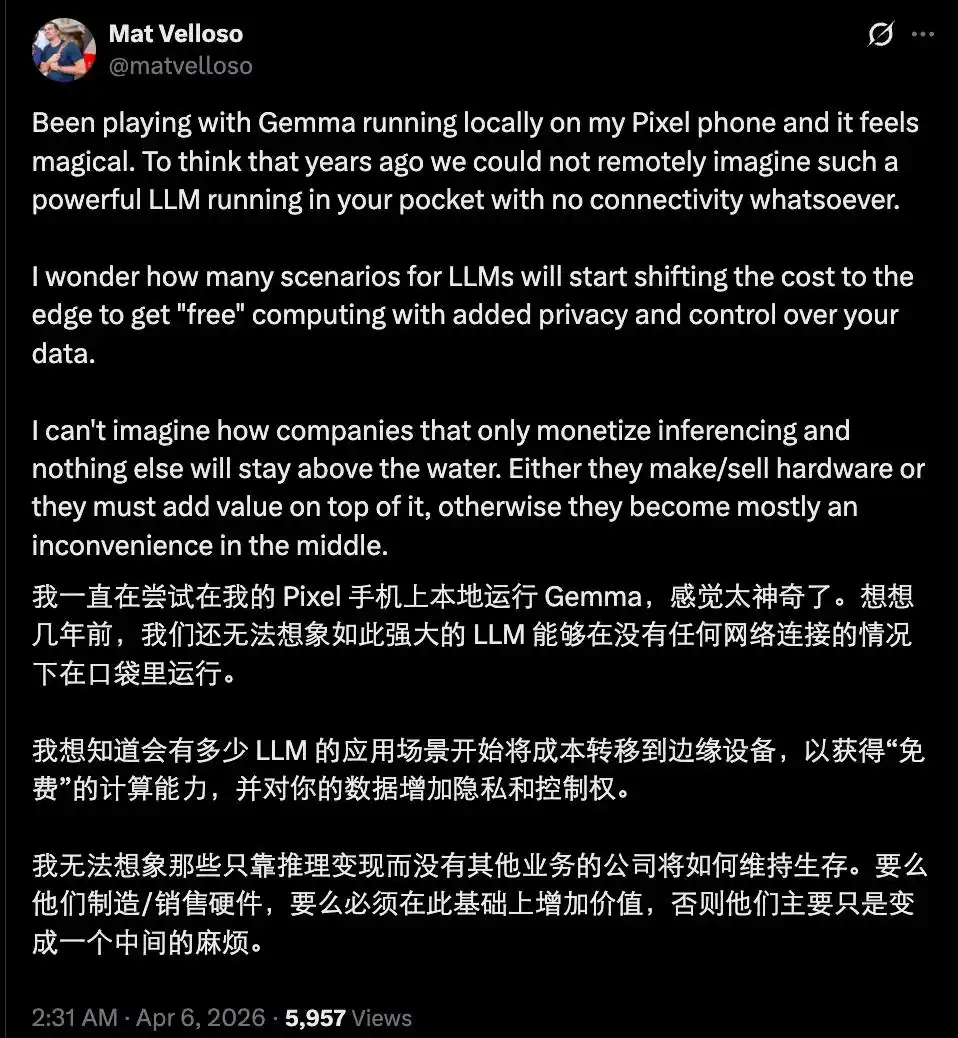
Google's newly open-sourced model, Gemma 4, released a few days ago, gave the industry a huge surprise.
It adopts the same technological architecture as Gemini 3, supports native full-modality, ranked third globally on the Arena AI leaderboard, and comes in multiple model sizes. Several smaller models — E2B (2.3B effective parameters) and E4B (4.5B effective parameters) — can be deployed directly to run locally on mobile devices, with a context window of 128K. They can be described as a "Gemini alternative that fits in your pocket".

As expected, the model quickly became a new toy for mobile users after its release.

Among them, a post by an X user was viewed hundreds of thousands of times. In the post, he shared a video demonstrating how he ran Gemma 4 locally on an iPhone, including processing images, audio, and controlling the flashlight. He stated that Gemma 4 is incredibly fast, feeling like magic.

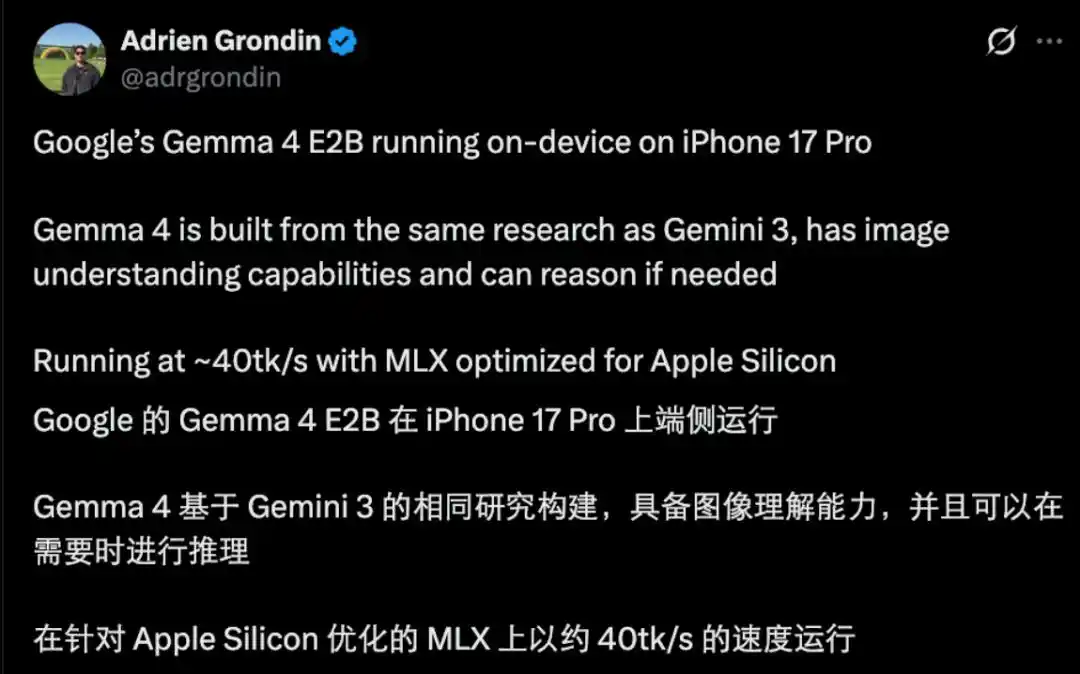
Someone quantified this speed on an iPhone 17 Pro, pointing out that if the phone uses Apple silicon, the model's inference speed can exceed 40 tokens per second with the help of MLX (Apple's machine learning framework) optimized for this chipset.
Others achieved similar speeds on a Samsung Galaxy, even with a 'thinking mode' enabled. This led people to exclaim that it's "unbelievably fast".
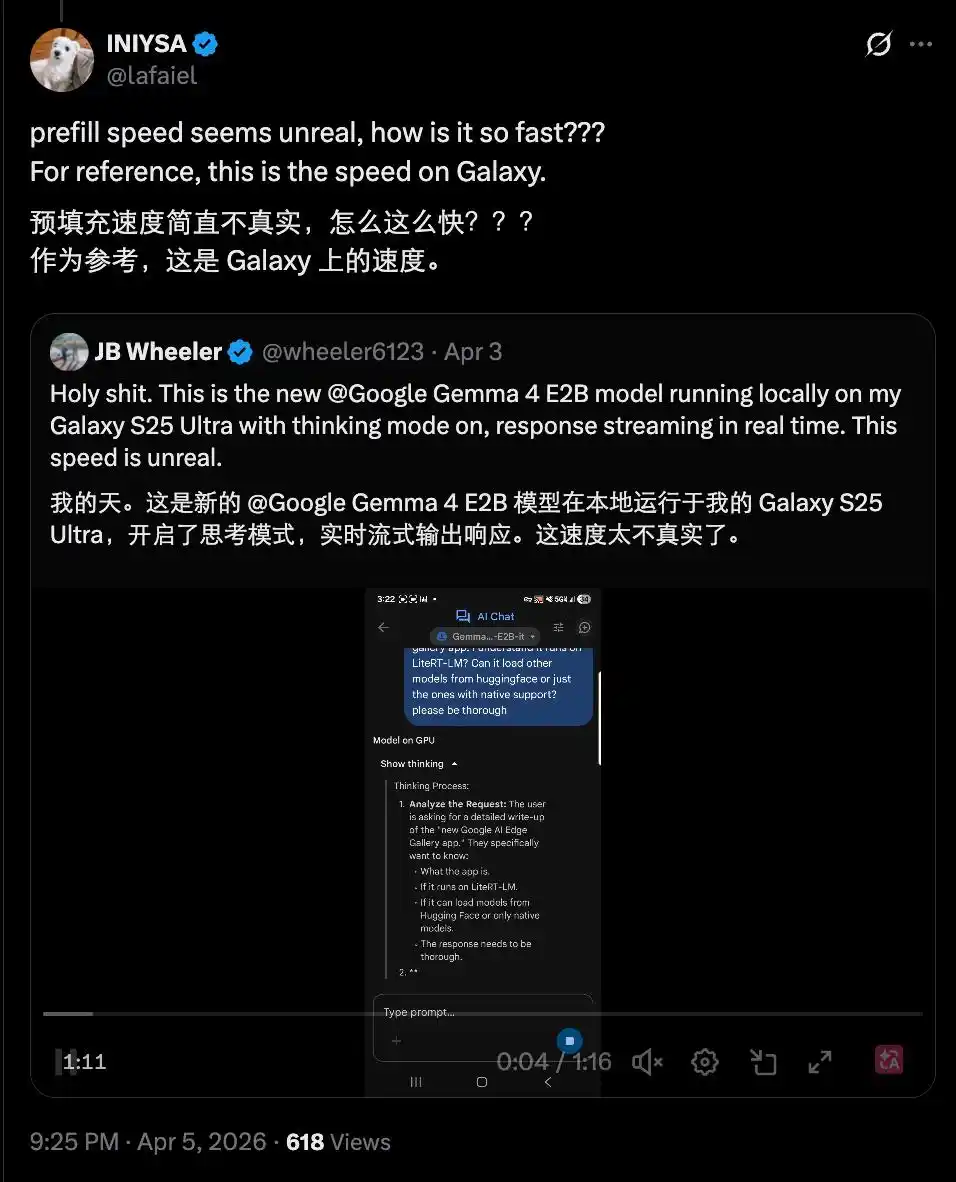
Such speeds make running AI models on mobile devices a viable option for the future, and are particularly useful in sensitive scenarios like healthcare.
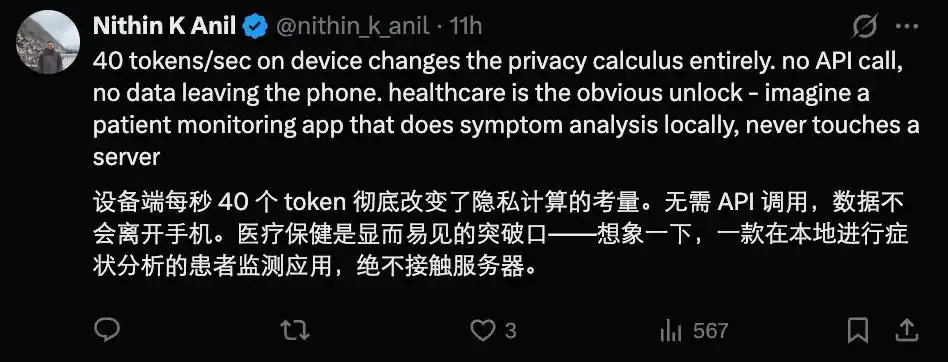
The 128k context window also makes these small models more attractive.

So how do you run it? It's actually very simple and not exclusive to geeks, because Google released an official App — Google AI Edge Gallery. Those who want to experience it on their phone can directly download this App, then download the desired model version, and open it to run.
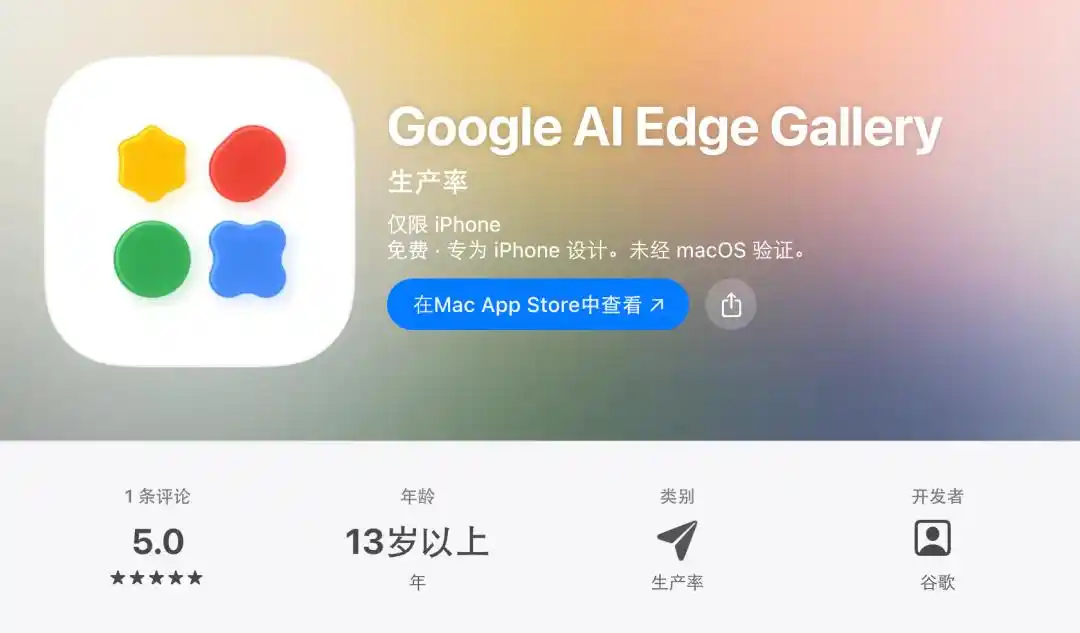
Moreover, since it's officially released by Google, security concerns are naturally less of an issue.

Beyond these small models running on phones, some have tried larger versions of Gemma 4 on more powerful hardware, such as running Gemma 4 Mixture-of-Experts 26B on a MacBook Pro with an M5 Pro chip.

For direct conversation, this model is still very fast, with smooth text generation and code explanation.

But when he actually tried to use Gemma 4 as a coding agent, problems arose. Because running an agent requires a large context (Gemma 4 26B has a 256k context window), complex prompts, and stable tool calls, Gemma 4 clearly couldn't handle it, often freezing, reporting errors, or outputting incorrect structures.

The turning point came when he switched the model to qwen3-coder. In the same environment, file creation, command execution, and multi-step tasks all ran normally. He believes the problem lies not with the agent framework, but with whether the model itself has been optimized for "tool calling + structured output". In this regard, Gemma 4 might not be sufficient, or perhaps this developer hasn't found the correct method yet.

Additionally, some say that Gemma 4's intelligence level is still somewhat lacking.

Even so, the emergence of a "performance powerhouse" like Gemma 4 should not be underestimated. If in the future, a large number of daily queries, chats, simple reasoning, code generation, and image understanding tasks can all be run locally without needing to buy tokens, wouldn't vendors who sell tokens be in an awkward position?
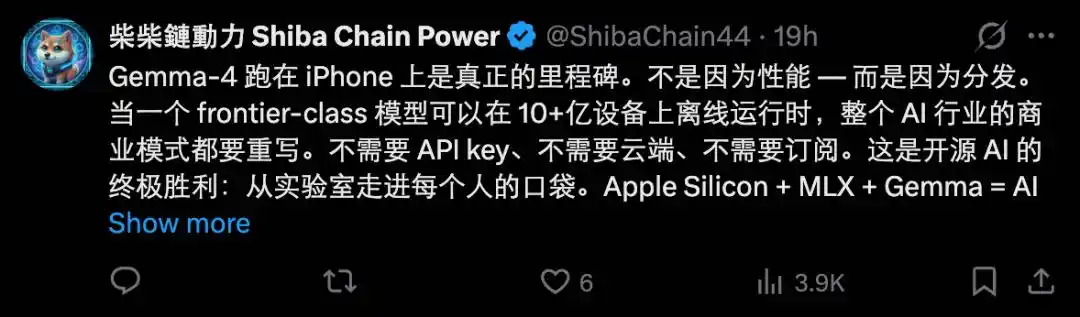
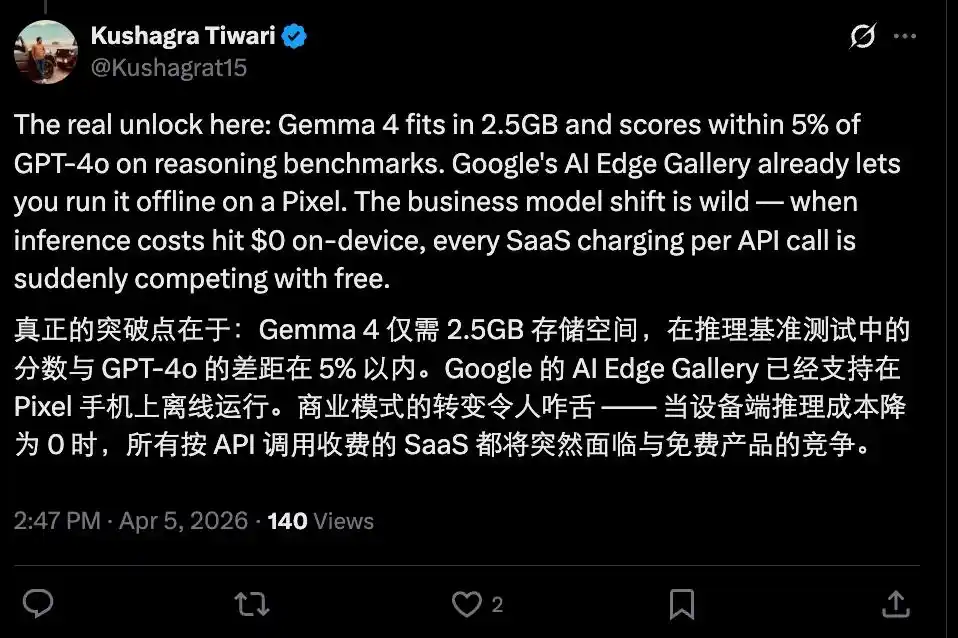
Of course, the current situation is not that pessimistic yet. After all, there is still a gap between the currently open-sourced models and the cutting-edge closed-source flagship models. Furthermore, most capable open-source models are still constrained by hardware capabilities and暂时 (zànshí - temporarily) haven't reached a usable level on the device side.

But the future trend is clear. In the short term, cloud-based closed-source models will still lead in cutting-edge complex reasoning and ultra-large-scale multi-agent collaboration. But in the long term, as hardware continues to advance and quantization techniques continue to optimize, on-device models will gradually encroach on the cloud's high-frequency simple tasks.

Those vendors who rely solely on selling tokens and API subscriptions will have to compete more fiercely on the "truly tough" parts — super-powered Agents, ultra-long reliable context, and specialized capabilities requiring massive real-time data.

Gemma 4 is just the beginning. The next surprise might be an on-device model that, in daily use, completely makes users unaware of the difference between "local" and "cloud". When that day comes, the entire AI industry's business model will undergo a real reshuffle.

This article is from the WeChat public account "Machine Heart" (ID: almosthuman2014), author: Machine Heart


Domande pertinenti

QWhat is the key feature of Google's newly open-sourced Gemma 4 model that makes it suitable for mobile devices?

AGemma 4 has smaller variants, E2B (2.3B effective parameters) and E4B (4.5B effective parameters), which are designed to run locally on mobile devices with a 128K context window.

QWhat speed was reported for running Gemma 4 on an iPhone 17 Pro with Apple's MLX framework?

AThe model's inference speed was reported to exceed 40 tokens per second on an iPhone 17 Pro using Apple's optimized MLX framework.

QWhat is the name of the official Google app that allows users to easily run Gemma 4 on their mobile devices?

AThe official app is called 'Google AI Edge Gallery', where users can download the model and run it directly.

QWhat was a significant limitation observed when using the larger Gemma 4 26B model as a coding agent?

AThe Gemma 4 26B model struggled with tasks requiring large context (256K), complex prompts, and stable tool calls, often leading to crashes, errors, or incorrect structured outputs.

QAccording to the article, what long-term impact could the advancement of on-device models like Gemma 4 have on the AI industry?

AOn-device models could gradually erode the market for cloud-based models on high-frequency simple queries, forcing API and token-selling companies to focus on more complex areas like super-powered Agents, ultra-long reliable context, and capabilities requiring massive real-time data.

Letture associate

"Water Scarcity": The Hidden Fatal Flaw of AI Infrastructure

“Water Scarcity: The Hidden Vulnerability of AI Infrastructure” In June 2026, SpaceX revised its IPO prospectus to highlight a core resource constraint alongside power and processors: water. This move signals a pivotal shift where water scarcity has transformed from an operational cost to a major, uncontrollable investment risk, directly threatening AI data center expansion. The scale of the problem is immense. U.S. data centers consumed an estimated 17 billion gallons of water for direct cooling in 2023, with indirect water use for power generation exceeding 211 billion gallons. Giants like Google alone use billions of gallons annually, with single sites consuming volumes equivalent to a medium-sized city. This water is largely “consumptive,” evaporated into the atmosphere and lost. This massive demand is colliding with scarcity. Tech companies are building “water tigers” in arid regions, sparking community protests in places like Mexico and Arizona, where data centers can legally use millions of gallons daily—enough for tens of thousands of residents. These conflicts are not about illegality, but about a mismatch between historic water allocation frameworks and new, colossal demand. The consequences are real. Community opposition, largely centered on water, has reportedly stalled or canceled $64 billion in U.S. data center projects over two years. Simultaneously, investors are pressuring companies for greater water footprint transparency, viewing it as a financial risk, not just an ESG metric. Technological solutions like air or liquid cooling involve trade-offs between water and electricity use, with final choices dictated by local constraints. The irony is stark: while industry leaders envision AI as a utility “like water,” its physical infrastructure is straining real-world water supplies. The race for AI supremacy may ultimately be governed not by the fastest chip, but by the slowest water meter.

marsbit23 min fa

"Water Scarcity": The Hidden Fatal Flaw of AI Infrastructure

marsbit23 min fa

Global Card Issuance Enters a Compliance-Driven Era: WasabiCard is Building the Next-Generation Payment Infrastructure

Global card issuance is entering a compliance-driven era, with WasabiCard building next-generation payment infrastructure. The platform asserts that as stablecoins increasingly enter cross-border payments, corporate settlements, and global commerce, the industry is shifting focus from "availability" and "growth-driven" models to long-term, compliant operation under global frameworks. Competition will center on sustainable compliance and global infrastructure capabilities. Stablecoins are evolving from on-chain assets into key payment tools in global business, with card issuance acting as critical infrastructure connecting digital assets to traditional payment networks like Visa and Mastercard. This expansion has revealed structural issues, including cross-regional issuance, BIN resource management, and insufficient AML and risk controls. In response, the industry is moving away from reliance on "grey efficiency" towards prioritizing compliance, risk management, and long-term operational stability. WasabiCard outlines its strategy: collaborating with licensed principals and local partners for localized operations, building robust KYC/AML systems, strictly separating commercial and consumer BIN usage, and enhancing global issuance, payment, and cross-border fund flow infrastructure. The goal is to build stable, scalable payment infrastructure amid evolving global regulations, shifting industry competition from scale to infrastructure capability. As stablecoins integrate further with global commerce, payment infrastructure will become a fundamental, embedded component of internet business. WasabiCard will continue to develop capabilities in global card issuance, stablecoin payments, cross-border fund flows, and API-driven financial workflows.

marsbit33 min fa

Global Card Issuance Enters a Compliance-Driven Era: WasabiCard is Building the Next-Generation Payment Infrastructure

marsbit33 min fa

Zhou Hang: How Much Is SpaceX Really Worth?

**Zhou Hang: How Much is SpaceX Really Worth?** SpaceX, arguably one of the greatest industrial companies of the past 50 years, is reportedly targeting a staggering $1.75 trillion valuation in its potential IPO. However, the author argues this figure is inflated by approximately $1.25 trillion when assessed through standard financial metrics. The analysis begins by acknowledging SpaceX's undeniable success: drastically reducing launch costs, achieving near-monopoly in commercial launches, and building the strategic Starlink network. Its achievement surpasses even Tesla's, given it disrupted a state-monopolized industry. Despite this greatness, a $1.75 trillion valuation places SpaceX above the combined market cap of Boeing, Lockheed Martin, Northrop Grumman, RTX, and General Dynamics. Projecting optimistic 2030 revenues of $50-80 billion and applying generous tech-sector multiples yields a "reasonable" valuation range of $500 billion to $1.2 trillion. The $1.25 trillion gap is attributed to three non-financial premiums: 1. **Long-term vision premium** for future Starship-enabled markets (e.g., space-based computing). 2. **Sovereign asset/strategic premium**, as SpaceX is deeply integrated into U.S. national security. 3. **Retail narrative/Musk cult premium**, driven by a heroic story and personal following. Post-IPO, three scenarios are outlined: valuation solidifying (25% probability), sideways volatility as narrative outpaces reality (50%), or a re-rating down to $800B-$1.2T if execution falters or Musk-related risks emerge (25%). The probability-weighted expected value is $1.3-1.5 trillion, suggesting negative expected returns for those buying at the IPO price. The conclusion advises investors to separate the company's excellence from its stock price. Buying at the IPO likely prices in excessive optimism. A more prudent strategy would be to wait for key milestones (e.g., Starship V3 stability) or a significant price correction before investing, or to treat an early purchase as a long-term, high-conviction hold with limited position size, not a short-term bet.

链捕手38 min fa

Zhou Hang: How Much Is SpaceX Really Worth?

链捕手38 min fa

Trading

Spot
Futures

Articoli Popolari

Come comprare 4

Benvenuto in HTX.com! Abbiamo reso l'acquisto di 4 (4) semplice e conveniente. Segui la nostra guida passo passo per intraprendere il tuo viaggio nel mondo delle criptovalute.Step 1: Crea il tuo Account HTXUsa la tua email o numero di telefono per registrarti il tuo account gratuito su HTX. Vivi un'esperienza facile e sblocca tutte le funzionalità,Crea il mio accountStep 2: Vai in Acquista crypto e seleziona il tuo metodo di pagamentoCarta di credito/debito: utilizza la tua Visa o Mastercard per acquistare immediatamente 44.Bilancio: Usa i fondi dal bilancio del tuo account HTX per fare trading senza problemi.Terze parti: abbiamo aggiunto metodi di pagamento molto utilizzati come Google Pay e Apple Pay per maggiore comodità.P2P: Fai trading direttamente con altri utenti HTX.Over-the-Counter (OTC): Offriamo servizi su misura e tassi di cambio competitivi per i trader.Step 3: Conserva 4 (4)Dopo aver acquistato 4 (4), conserva nel tuo account HTX. In alternativa, puoi inviare tramite trasferimento blockchain o scambiare per altre criptovalute.Step 4: Scambia 4 (4)Scambia facilmente 4 (4) nel mercato spot di HTX. Accedi al tuo account, seleziona la tua coppia di trading, esegui le tue operazioni e monitora in tempo reale. Offriamo un'esperienza user-friendly sia per chi ha appena iniziato che per i trader più esperti.

349 Totale visualizzazioniPubblicato il 2025.10.20Aggiornato il 2026.06.02

Come comprare 4

Discussioni

Benvenuto nella Community HTX. Qui puoi rimanere informato sugli ultimi sviluppi della piattaforma e accedere ad approfondimenti esperti sul mercato. Le opinioni degli utenti sul prezzo di 4 4 sono presentate come di seguito.

活动图片