RootData Launches Industry's First Cryptocurrency Exchange Transparency Ranking, Boosting Compliance and Growth

marsbitPubblicato 2026-01-20Pubblicato ultima volta 2026-01-20

Introduzione

RootData has launched the industry's first transparency-focused exchange ranking, "Top Cryptocurrency Exchanges Ranked by Transparency," moving beyond traditional volume-based metrics. The ranking, introduced during the December Binance Blockchain Week in Dubai, is now open for global exchange applications. It evaluates exchanges across six key dimensions: token economics and unlock transparency, project progress and key event disclosure, team background and capital endorsement, announcement accuracy, asset reserve transparency, token listing mechanisms, and regulatory compliance with audit data. This initiative aims to transform transparency from an abstract concept into a quantifiable standard, encouraging exchanges to disclose critical information as a mandatory practice rather than an option. Enhanced transparency helps build differentiated brand trust, attract institutional investors, and secure a competitive edge in an increasingly regulated market. RootData, a Web3 asset data platform processing over 4.2 million monthly search requests, is backed by investors such as NLVC, Boyaa Interactive, and Mask Network. Its data and research have been cited by leading institutions including The Wall Street Journal and Binance Research.

RootData has introduced the industry's first exchange ranking focused on transparency, titled "Top Cryptocurrency Exchanges Ranked by Transparency," breaking through the limitations of the traditional "volume-only" approach. It establishes a multi-dimensional evaluation system covering liquidity, asset value, compliance security, and information transparency.

The ranking was launched during the December Binance Blockchain Week in Dubai and is now open for applications from global exchanges. RootData transforms the abstract concept of transparency into quantifiable metrics, promoting the establishment of unified information disclosure standards in the industry.

RootData's Exchange Transparency Ranking Breaks the Limitations of the Traditional "Volume-Only" Approach

As the crypto market increasingly integrates with mainstream finance, RootData's transparency scoring system focuses on a core question: Are exchanges truly fulfilling their responsibility to disclose information?

Comprehensive information disclosure is not only a regulatory compliance requirement but also a necessary condition for protecting investor rights and promoting healthy market development. RootData aims to encourage exchanges to transform information disclosure from an "option" into a "mandatory task" through a standardized evaluation system.

Six Dimensions: Transforming Transparency into Quantifiable Standards

To convert the abstract concept of information transparency into quantifiable and comparable evaluation metrics, RootData has built a systematic information disclosure model, comprehensively assessing exchanges across the following six core dimensions: Token Economics and Unlock Transparency, Project Progress and Key Event Disclosure, Team Background and Capital Backing Transparency, Announcement Disclosure and Section Accuracy, Asset Reserve Transparency and Token Listing Mechanism, and Compliance Licenses and Audit Data.
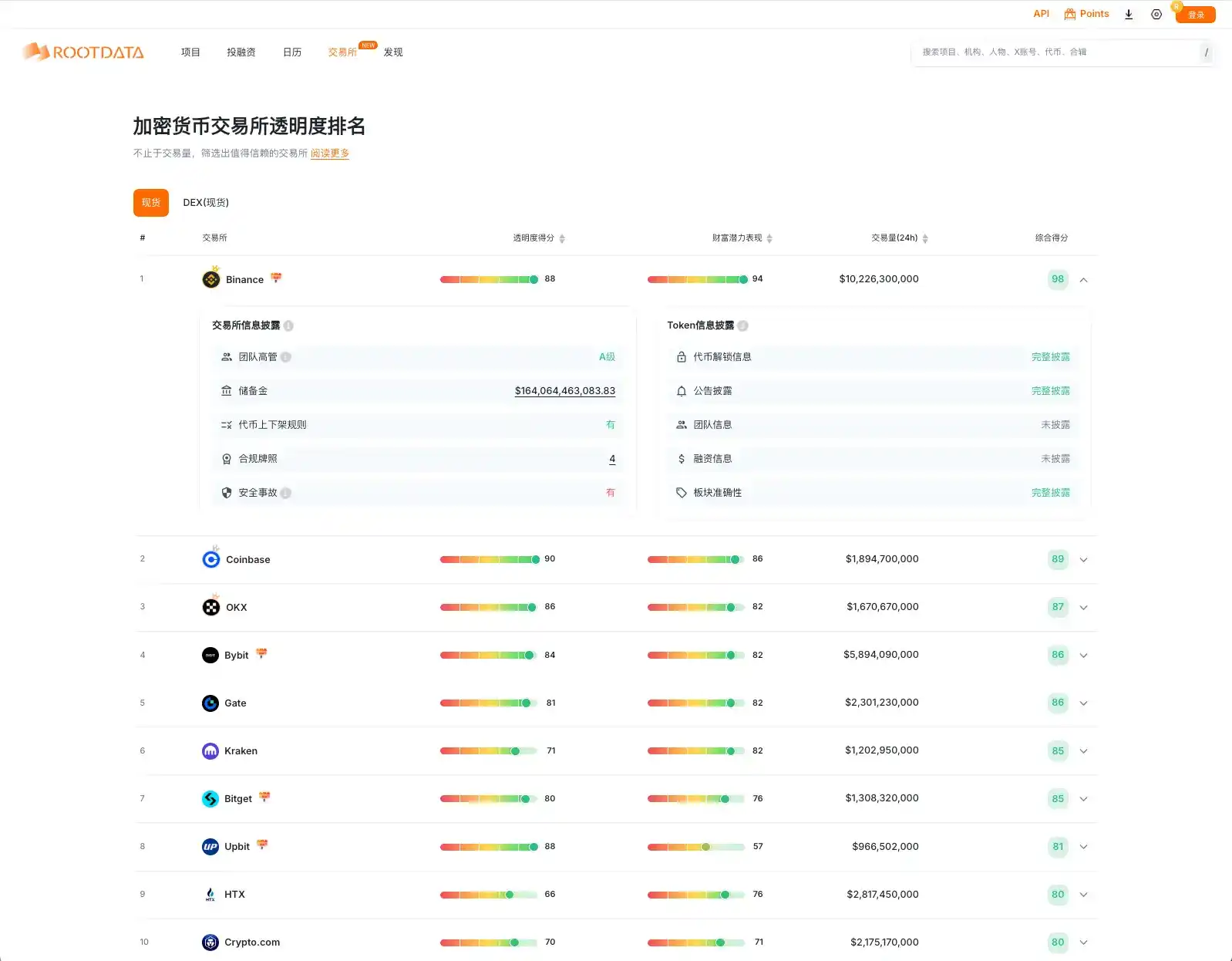
In a Highly Competitive Exchange Landscape, Comprehensive Information Disclosure Helps Build a Differentiated Brand Image

Transparency, as a quantifiable competitive metric, offers three major advantages for exchanges: First, it helps establish a differentiated brand image, becoming a hard-to-replicate trust identifier. Second, it attracts professional groups such as institutional investors, bringing high-quality users and stable trading volume. Third, it lays the foundation for long-term development, gaining a head start in an environment of increasing regulatory scrutiny.

The ranking is dynamically updated based on real-time data, allowing investors to track trends in exchange transparency changes. RootData believes that transparency should not remain a mere slogan for a few exchanges but should become a core arena that all mainstream participants must prioritize. Only in this way can the crypto market truly mature.

About RootData

RootData is a Web3 asset data platform that processes over 4.2 million search requests monthly. It has become an essential data platform for over 2 million Web3 users in their investment decision-making, committed to being a productivity-level tool for Web3 enthusiasts and investors.

RootData has received early investment support from top-tier institutions such as Asia's leading dollar fund NLVC Northern Light Venture Capital (Series B investor in Meituan-Dianping Group), Boyaa Interactive (00434.HK, the world's second-largest publicly traded company by Bitcoin holdings), and Mask Network. Additionally, RootData's data and research content have been repeatedly cited or reported by authoritative institutions both within and outside the industry, including The Wall Street Journal, Cointelegraph, Binance Research, and The Block.


Domande pertinenti

QWhat is the name of the new exchange ranking system launched by RootData and what is its main focus?

AThe new ranking system is called 'Top Cryptocurrency Exchanges Ranked by Transparency' and its main focus is on exchange transparency, moving beyond the limitations of traditional trading volume-based rankings.

QWhere and when was the RootData transparency ranking officially announced?

AThe ranking was announced during the December Binance Blockchain Week in Dubai.

QWhat are the six core dimensions used in RootData's transparency evaluation model for exchanges?

AThe six dimensions are: Token Economics & Unlock Transparency, Project Progress & Key Event Disclosure, Team Background & Capital Backing Transparency, Announcement Disclosure & Section Accuracy, Asset Reserve Transparency, and Token Listing Mechanism & Compliance Licenses/Audit Data.

QAccording to the article, what are the three main advantages that high transparency can bring to an exchange?

AThe three main advantages are: 1) Establishing a differentiated brand image as a trust identifier, 2) Attracting professional groups like institutional investors, and 3) Laying a foundation for long-term development and gaining a first-mover advantage in a tightening regulatory environment.

QWhat is RootData's role in the Web3 ecosystem and what scale does it operate at?

ARootData is a Web3 asset data platform that processes over 4.2 million search requests monthly and serves as an essential data platform for over 2 million Web3 users, aiming to be a productivity-level tool for Web3 enthusiasts and investors.

Letture associate

How to Do Research Well: Deliberately Practice the Real Skills That Matter

No one truly teaches you how to do research. You're often given a desk, a pre-selected problem, and vague instructions to "create something new." Consequently, many people reverse-engineer the job based on visible outputs—papers, posts, announcements—learning only how to *appear* like a researcher rather than how to *become* one. True research capability is built from stacking small, trainable skills, nearly all of which can be developed through deliberate practice. **Pick Your Own Problem:** Most researchers absorb problems from advisors or trends, lacking the underlying reasoning. Choosing a problem you genuinely care about, as John Schulman advises, leads to original work. Develop "taste" like a muscle: predict experiment outcomes, guess paper results from methods, and track which findings remain important over time. **Upgrade Your Inputs:** Relying on shared reading lists (arXiv hot lists, filtered group chats) leads to unoriginal conclusions. Undervalued old literature often holds crucial insights (e.g., MoE, LSTM, backpropagation). Richard Sutton's "The Bitter Lesson" or Claude Shannon's 1952 talk on creative thinking are more predictive than lengthy modern surveys. Breadth matters as much as depth: draw from neuroscience, mechanism design, hardware knowledge, and honest statistics. Read papers directly, especially appendices and limitations sections. **Write Everything Down:** As Paul Graham noted, writing exposes flaws in seemingly mature ideas. Writing is the cheapest defense against self-deception. Following Feynman's principle, Darwin programmatically wrote down facts contradicting his theory to combat memory bias. Maintain a detailed log of hypotheses, setups, predictions, results, and updated understandings. Reviewing past logs fosters essential humility.

marsbit53 min fa

How to Do Research Well: Deliberately Practice the Real Skills That Matter

marsbit53 min fa

Following US Ban on Fable 5, Zhipu AI's Stock Soars 47%

On June 15th, shares of Zhipu AI surged dramatically on the Hong Kong stock market, peaking at a 47.6% gain before closing 32.82% higher. This sharp increase was directly triggered by two recent industry events. On June 12th, Anthropic announced it was suspending global access to its latest flagship models, Claude Fable 5 and Claude Mythos 5, to comply with a U.S. government export control order. The next day, Zhipu AI announced it would open access to its latest open-source flagship model, GLM-5.2, under the permissive MIT license. The Anthropic incident highlighted a critical issue beyond raw model capability: the risk of sudden, unpredictable loss of access to advanced AI models, especially for developers and enterprises deeply integrated with them. This has shifted industry and market focus toward factors like stability, sustainable access, and controllability. Zhipu's move, promoting "frontier intelligence for all," positions its openly available model as a reliable and accessible alternative. The GLM-5.2 model emphasizes "Long Horizon Task" capabilities with a 1M context window, targeting complex, multi-step coding and engineering workflows where maintaining context is crucial. Analysts note this event exposes the risk of dependency on closed-source models subject to single jurisdictional controls, potentially accelerating a shift toward domestic base models and localized deployments. The market's reaction signals a new valuation dimension in AI: providers who can offer stable, long-term, and sustainably accessible AI capabilities are gaining strategic importance.

marsbit1 h fa

Following US Ban on Fable 5, Zhipu AI's Stock Soars 47%

marsbit1 h fa

Fully Entering the AI Era: Alipay Bets on Conversation, WeChat Holds Fast to Social

In May 2026, Alipay announced over 300 million AI payment transactions. Shortly after, WeChat opened its mini-programs for AI integration, sparking controversy by requiring developer source code access. This highlights their diverging approaches to AI integration. Alipay is testing "Project Treasure," an optional AI-native interface replacing traditional app grids with a conversational window. Users can command complex tasks (e.g., "book a ride and order coffee") handled end-to-end by AI. This shift follows an abandoned standalone AI app, focusing instead on enhancing its existing user base. For unmodified mini-programs, Alipay's AI uses "screen-reading" to simulate user interactions, bypassing the need for developer overhaul. It also introduced "Token Pay" for micro-transactions and "AI Wallets" for autonomous agent spending. WeChat, prioritizing its core social function, is taking an embedded approach. Its AI agent will operate within existing contexts like group chats and official accounts, assisting without a separate interface. To enable this, WeChat offers developers two paths: granting source code access for direct AI control ("Automatic Mode") or manually encapsulating services into standardized "Skills." Both place significant burden on developers. Key differences emerge in handling legacy services: WeChat demands developer cooperation (code or labor), while Alipay's screen-reading offers immediate, if potentially less stable, compatibility. Alipay's 3 billion AI transactions demonstrate user acceptance of AI-driven commercial actions. The divergent strategies may reshape mini-program ecosystems—Alipay passively "AI-fying" services, WeChat potentially favoring resource-rich developers—and set competing technical standards. Ultimately, the competition centers on where users entrust the command to "help me get things done."

marsbit1 h fa

Fully Entering the AI Era: Alipay Bets on Conversation, WeChat Holds Fast to Social

marsbit1 h fa

Trading

Spot
Futures
活动图片