Robinhood's Wealth Management Business Transformation Journey

marsbitPubblicato 2026-04-15Pubblicato ultima volta 2026-04-15

Introduzione

Robinhood's 2025 Wealth Management Transformation: A Case Study Robinhood successfully pivoted its business model in 2025, transitioning from a platform known for speculative trading to a comprehensive wealth management service. This strategic shift was driven by launching disruptive products like a high-match-rate IRA, a high-yield cash sweep program, and full-service banking, effectively guiding its young user base toward long-term saving and investing. Key to this success was an aggressive, internet-native customer acquisition strategy. Robinhood used cash match bonuses (up to 3% for Gold members) to lower the barrier for users to transfer retirement assets (e.g., 401(k) rollovers), calculating that the high lifetime value (LTV) of these sticky assets would far exceed the customer acquisition cost (CAC). The company's revenue model evolved significantly. It reduced reliance on volatile payment for order flow (PFOF) by building a robust base of Net Interest Income (NIM) from its high-yield cash product and growing recurring revenue from its SaaS-like Robinhood Gold service, which saw subscriber count soar to 4.2 million. Robinhood built a powerful ecosystem, seamlessly connecting high-frequency trading (stocks, crypto) with low-frequency, high-value activities (retirement investing, banking, spending with its cash-back card). This created a sticky super-app experience. The strategy was underpinned by a low-cost operational structure, enabled by a self-clearing platform...

Author: @BlazingKevin_, Blockbooster Researcher

Robinhood reached a turning point in its business model in 2025. By developing its wealth management business, including the launch of disruptive IRA retirement accounts, high-yield cash products, and comprehensive Robinhood Banking services, Robinhood successfully guided its young user base from high-frequency options and cryptocurrency trading towards long-term savings and investment.

In 2025, Robinhood's financial data fully validated the success of this strategy: full-year net revenue reached a record $4.5 billion, a 52% year-over-year increase; full-year net income reached $1.9 billion, a 35% year-over-year increase; retirement account Assets Under Custody (AUC) reached $26.5 billion by the end of Q4, a sharp 102% year-over-year increase; total platform assets reached $324 billion, a 68% year-over-year increase; full-year net deposits reached $68 billion.

This article will analyze the development trajectory of Robinhood's wealth management business in 2025 using data, and discuss its strategic advantages across five core dimensions: customer acquisition and asset transfer mechanisms, evolution of the profit model, ecosystem closure loop, brand repositioning, and operational cost structure.

1. Customer Acquisition and Asset Transfer Mechanisms

Traditional wealth management typically relies on financial advisors for high-cost customer acquisition and relationship maintenance, while Robinhood adopted a highly internet-based subsidy and incentive mechanism to break down barriers to asset transfer, thereby achieving rapid掠夺 of assets under management.
1.1 Matching Fund Subsidies: The Economics of "Buying AUM"

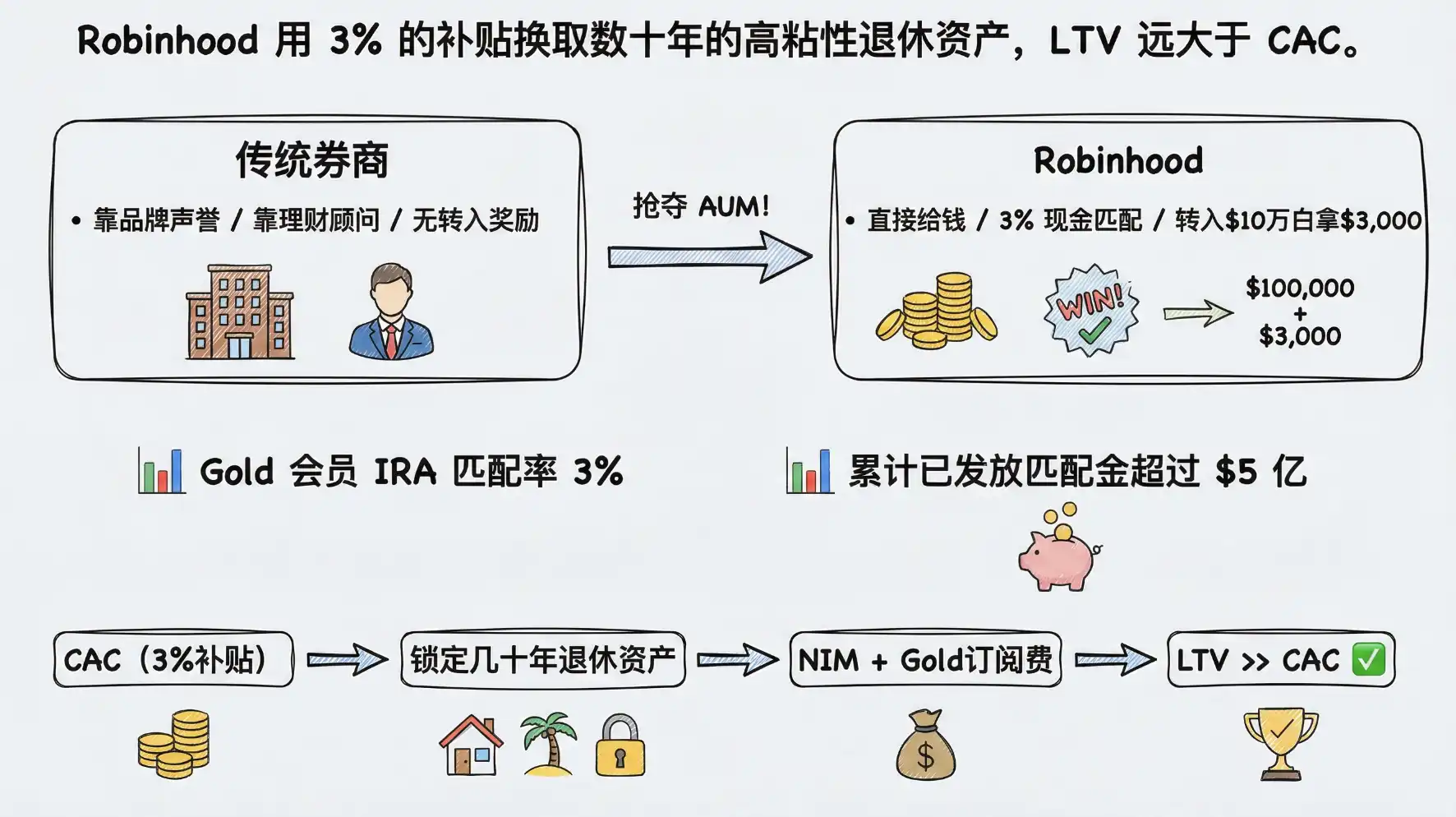
Traditional retirement account providers (such as Fidelity, Charles Schwab) typically rely on brand reputation and advisory services to attract customers, while Robinhood adopted a more direct and aggressive strategy: cash matching subsidies. Using real cash rewards to lower the psychological cost of user migration.

For Robinhood Gold members, the platform offers up to a 3% match on IRA deposits (1% for non-members). Based on the 2025 IRS contribution limit of $7,000 for individuals under 50, users can receive up to $210 in free matching funds annually. More aggressively, for 401(k) or IRA assets transferred (Rollover) from other brokerages, Robinhood also offers a matching reward of up to 3%. This means a user transferring $100,000 in 401(k) assets into a Robinhood IRA can immediately receive a $3,000 cash reward.

Is this economically viable? We can analyze it from the perspective of Customer Acquisition Cost (CAC) and Customer Lifetime Value (LTV). By the end of 2025, customers had received over $500 million in cumulative matching funds for retirement account transfers and contributions. This expenditure is treated by Robinhood as a customer acquisition cost. Given the extremely high stickiness of retirement accounts (typically held for decades), these assets not only bring long-term Net Interest Income (NIM) and potential advisory fees but also lock users into becoming Gold members (annual fee $50). Compared to the customer acquisition costs of traditional brokerages, which can be hundreds of dollars and have high churn rates, Robinhood exchanges a 3% subsidy for decades of highly sticky assets, where the LTV far exceeds the CAC.
1.2 Frictionless Account Transfer Experience: Technological Dimensionality Reduction Attack

Subsidies alone are not enough; if the transfer process is cumbersome, users will still be deterred. Robinhood used technological means to significantly lower the barrier for users to transfer from traditional brokerages.

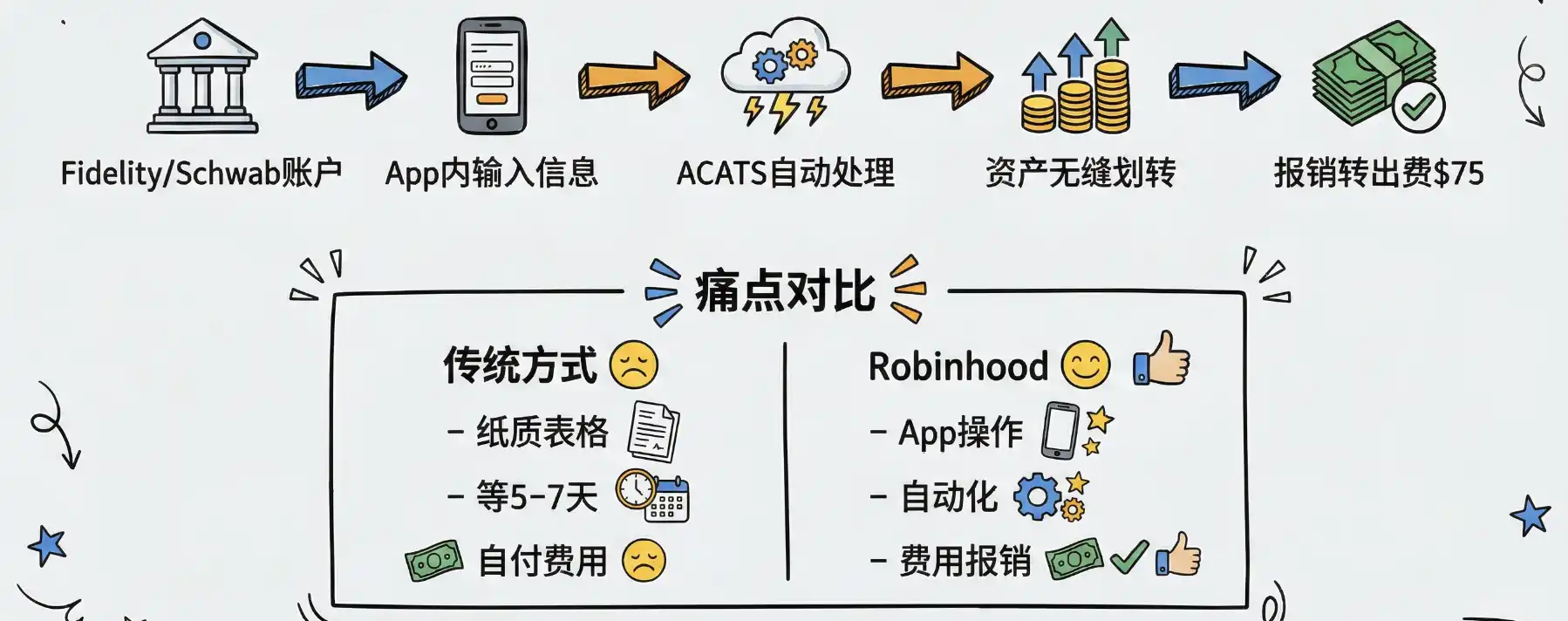
By integrating the Automated Customer Account Transfer Service (ACATS), Robinhood achieved seamless cross-brokerage asset transfers. Users simply need to enter their original brokerage account information within the App, often without manually liquidating existing assets, and Robinhood's clearing system can automatically complete the asset transfer in the background. For outgoing transfer fees charged by some brokerages (typically $75), Robinhood will also reimburse them if conditions are met. This "one-click move" experience completely breaks down the asset transfer barriers established by traditional institutions relying on cumbersome processes.

2. Profit Model Evolution from PFOF to Recurring Revenue

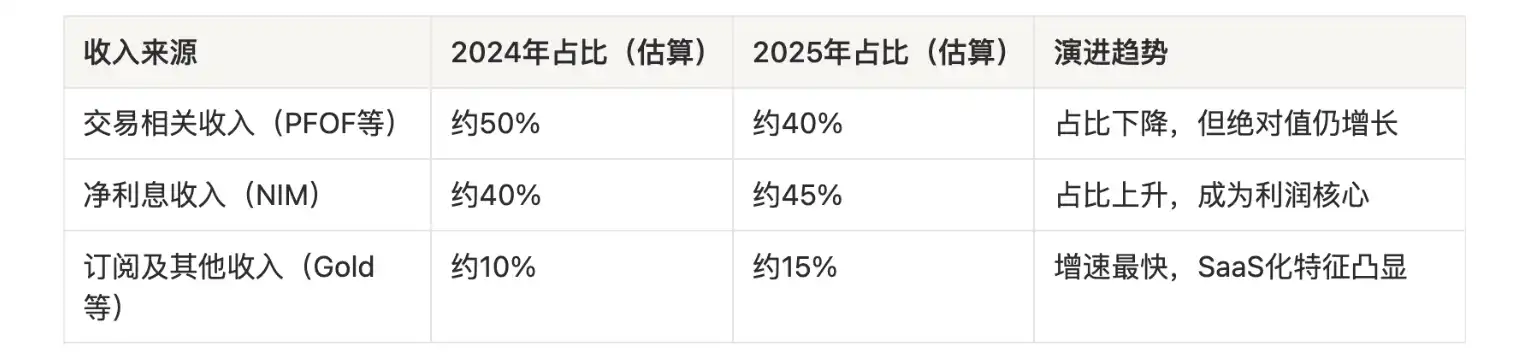
In the past, Wall Street's skepticism about Robinhood focused on its heavy reliance on Payment for Order Flow (PFOF) and high-frequency trading. This model is highly profitable in bull markets but extremely fragile in bear markets. In 2025, Robinhood successfully evolved towards a more stable asset management profit model.
2.1 Net Interest Income (NIM): Attracting Deposits with High-Yield Cash

By offering highly competitive cash yields, Robinhood liberated "cash management" from the low-yield trap of traditional banks, thereby attracting massive deposits.

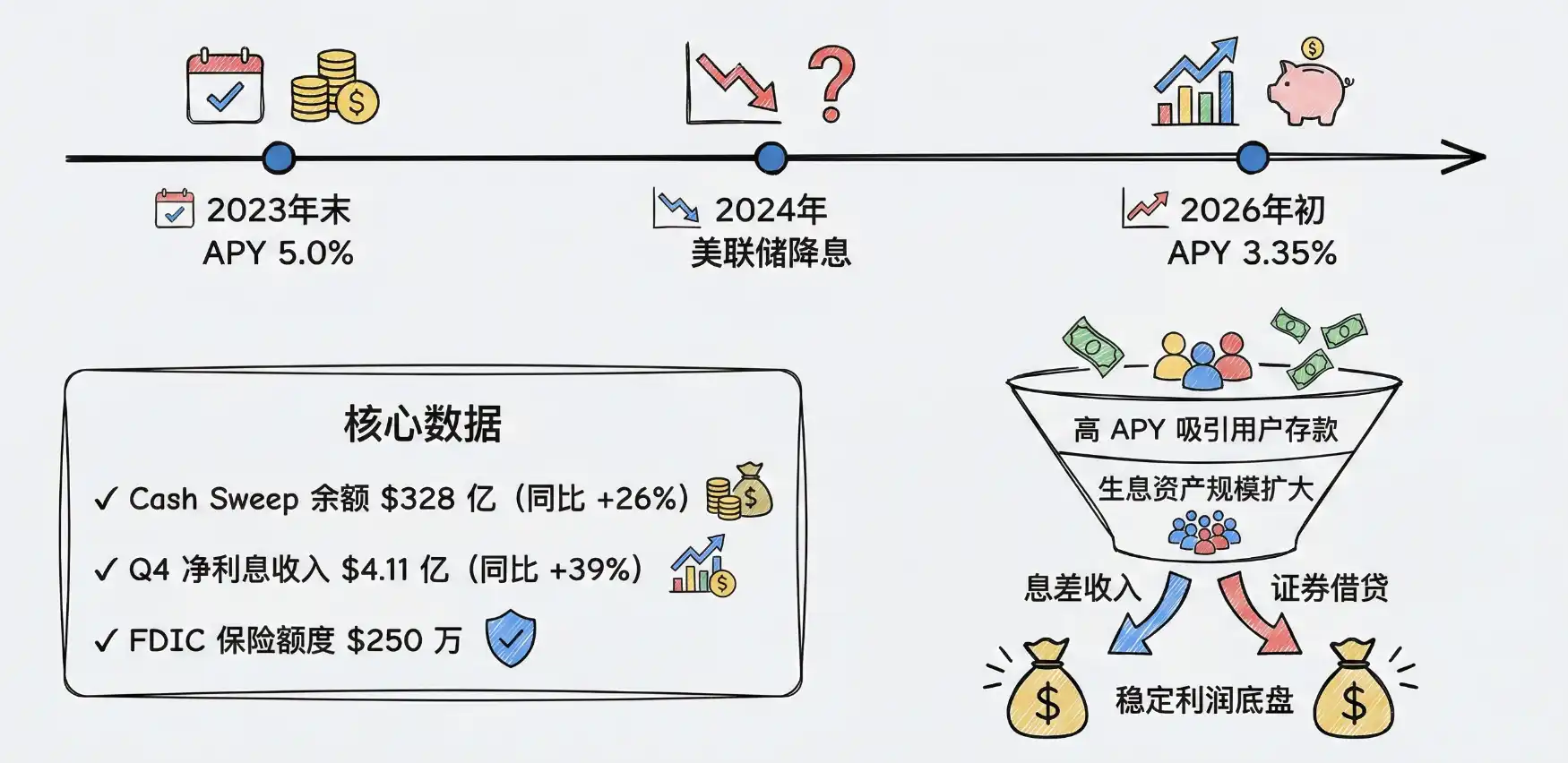
At the end of 2023, the APY for uninvested cash for Robinhood Gold members once reached as high as 5.0%, far exceeding the national average savings account rate at the time. As the Federal Reserve cut rates, the APY was gradually adjusted (to 3.35% as of early 2026), but it still remained significantly higher than the checking account rates offered by major banks. In Q4 2025, Robinhood's Cash Sweep balance grew 26% year-over-year to $32.8 billion.

This massive pool of interest-earning assets generated substantial net interest income for Robinhood. In Q4 2025, its net interest income grew 39% year-over-year to $411 million, primarily driven by growth in interest-earning assets and securities lending activities. Under specific interest rate cycles, this "earning interest spread" model provides a strong profit foundation.
2.2 Subscription Economy (Robinhood Gold): The SaaS-ification of Financial Services

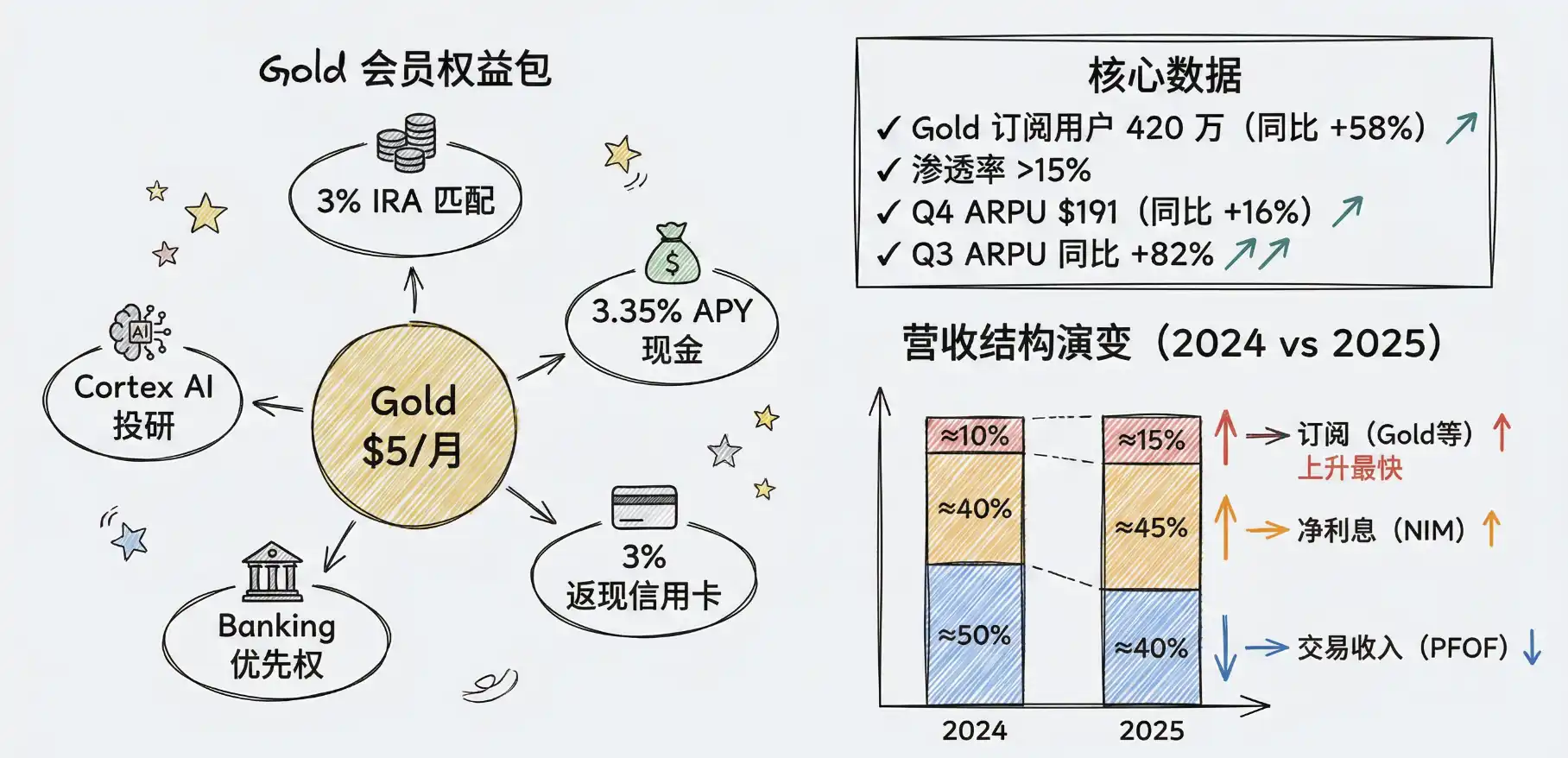
The Robinhood Gold subscription service ($5 monthly or $50 annually) is central to its profit model evolution. It exchanges a fee for high interest rates, in-depth research reports, a 3% IRA match, and a 3% cashback credit card on all categories. This is essentially an attempt to SaaS-ify financial services.

By the end of Q4 2025, Robinhood Gold subscription users reached a record 4.2 million, a 58% year-over-year increase, with a penetration rate of over 15% among its 27 million funded customers. This subscription model significantly increases user stickiness and Average Revenue Per User (ARPU). Q4 ARPU increased 16% year-over-year to $191, and Q3 ARPU surged 82% year-over-year.

The table below shows the evolution of Robinhood's revenue structure:
3. Ecosystem Closed Loop

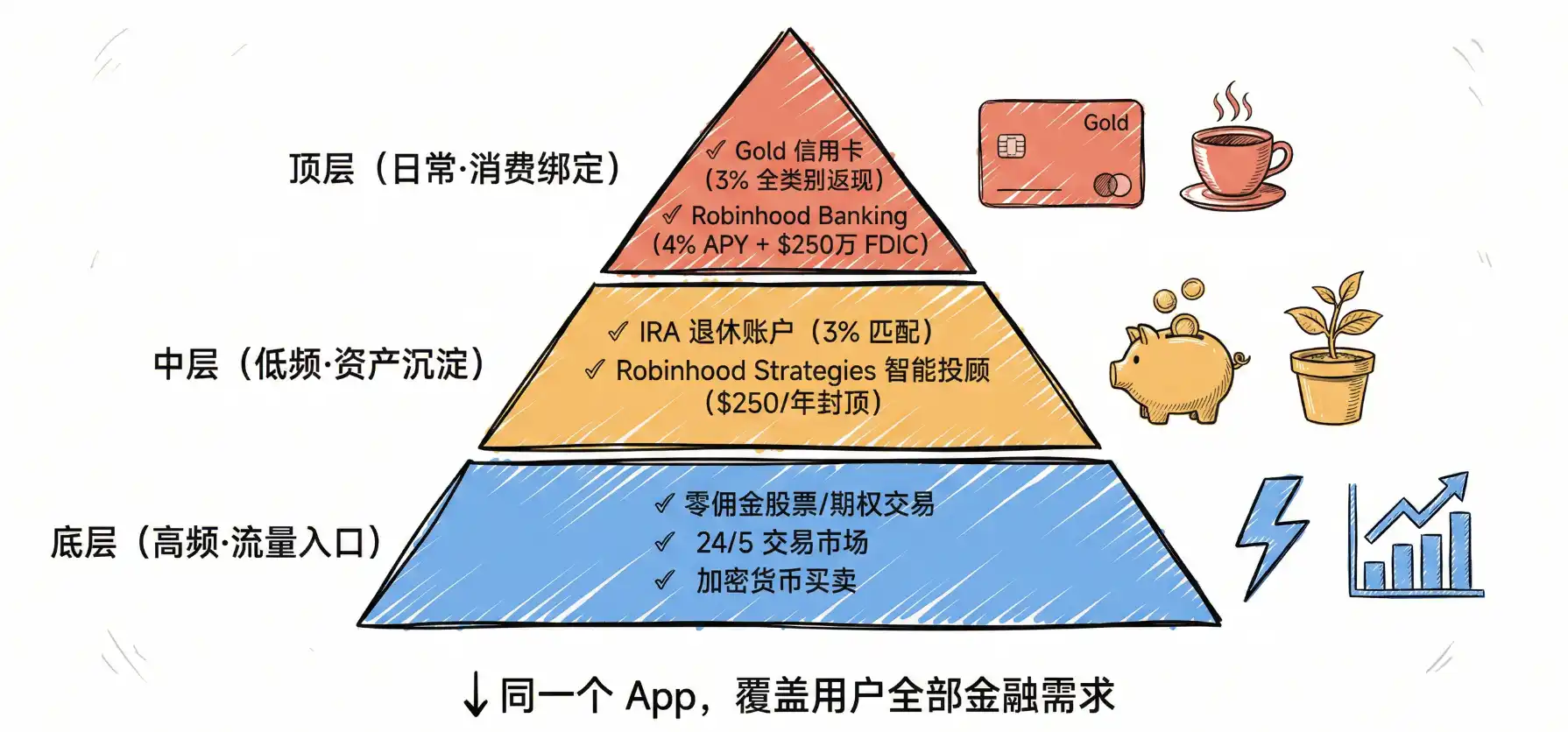
Young users dislike downloading multiple apps to manage their finances. Robinhood deeply understands this and is building a super app covering investing, saving, spending, and borrowing.
3.1 One-Stop Experience: Seamless Integration of High and Low-Frequency Scenarios

In 2025, Robinhood launched or upgraded several products, forming a complete ecosystem closed loop:

  • High-frequency scenarios: Zero-commission stock/options trading, 24/5 trading markets, cryptocurrency buying/selling.
  • Low-frequency defensive scenarios: IRA retirement accounts (3% match), Robinhood Strategies robo-advisor ($250/year capped management fee for Gold members).
  • Daily spending scenarios: Robinhood Gold credit card (3% cashback), Robinhood Banking (4% savings APY, FDIC insured).

Seamlessly integrating high-frequency speculative trading with low-frequency retirement investing and daily spending in the same App is Robinhood's killer feature.

3.2 Traffic Conversion: Smooth Cross-Selling from "IPO Investing" to "Retirement Planning"

Robinhood possesses the massive traffic that traditional asset managers dream of (27 million accounts as of end-2025). Its core strategy is: use high-frequency trading (like Meme stocks, cryptocurrencies) and high-yield cash as traffic entry points, then smoothly cross-sell low-frequency but high-value wealth management products.

For example, when a 22-year-old Gen Z user downloads Robinhood to trade Dogecoin, they might be attracted by the 5% cash yield to sign up for Gold membership; subsequently, the App will use precise push notifications to inform them that "as a Gold member, you can get a 3% free match by opening an IRA"; when their assets grow to $100,000, the system will recommend the "robo-advisor service for only $250 per year".

This conversion path from "traffic funnel" to "asset沉淀 (sedimentation)" allows Robinhood to acquire high-net-worth clients at extremely low marginal cost.

4. Trust Building

4.1 Compliance and Security Endorsement: Leveraging Traditional Finance's Safety Net

To make users feel safe entrusting their retirement savings for decades to the platform, Robinhood cleverly leveraged traditional finance's safety net to endorse its innovative products.

  • SIPC Protection & Additional Insurance: Robinhood emphasizes its status as an SIPC member (providing basic protection of $500,000) and has additionally purchased commercial insurance, providing up to $50 million in securities protection and $1.9 million in cash protection per client.
  • FDIC Deposit Insurance: When promoting Cash Sweep and Robinhood Banking, the platform, through partnerships with multiple banks, provides users with FDIC deposit insurance of up to $2.5 million, far exceeding the standard $250,000 coverage at ordinary banks.

This narrative strategy of being "safer than traditional banks" greatly alleviates young users' trust concerns about emerging Fintech platforms.

5. Operational Cost Structure

Robinhood's ability to offer a 3% IRA match and a capped $250 advisory fee stems not only from confidence in LTV but also from its far superior personnel efficiency and underlying technology costs compared to traditional institutions.

5.1 Technology-Driven Automation and High Personnel Efficiency Ratio

Robinhood lacks extensive physical branches and teams of financial advisors. All its advisory services (such as the ETF portfolios recommended by Robinhood Strategies) are highly automated, relying on algorithmic models for asset allocation and rebalancing.

This "light-asset" model results in an astonishing personnel efficiency ratio. According to public data, as of the end of 2025, Robinhood's total number of employees was approximately 2,900. Based on full-year revenue of $4.5 billion, its revenue per employee is as high as $1.55 million. In contrast, traditional financial giants with tens of thousands of employees often have revenue per employee only half or even less of this figure.

5.2 Decreasing Marginal Costs: The Power of a Self-Developed Clearing System

Robinhood freed itself from reliance on third-party clearing agencies (like Apex Clearing) as early as 2018 by building its own clearing system. This infrastructure investment demonstrated huge operating leverage during the asset scale explosion of 2025.

When AUC surged from $193 billion to $324 billion, the marginal cost of processing additional transactions and asset transfers was almost negligible because the clearing system is self-developed and highly automated. According to macro trend data, Robinhood's full-year 2025 operating expenses were $2.379 billion; although revenue surged 52%, the growth in operating expenses was relatively controlled, directly driving the full-year GAAP net income to $1.9 billion and significantly improving the adjusted EBITDA margin.

6. User Profile Transition

The core driver of the success of Robinhood's wealth management business is the profound transformation in the investment behavior of its young user base.

6.1 Younger User Base: Structural Advantage

According to research by ARK Invest, Gen Z and Millennials make up as much as 63% of Robinhood's user base, while this proportion is only 14% at Charles Schwab and relatively limited at Vanguard. The median age of a Robinhood user is approximately 32-35 years old (2025 data), while the average age of clients at Schwab and other traditional brokerages is over 50.

This structural advantage is also reflected in platform asset density. Currently, Schwab's average Assets Under Custody (AUC) per client is about $250,000, far higher than Robinhood's current level of approximately $12,000. However, the essence of this gap is an age gap. As Robinhood's young user base gradually enters their peak wealth accumulation years, this gap will gradually narrow.

6.2 From "Meme Stocks" to "Long-Termism": Profound Shift in Investment Behavior

Robinhood CEO Vlad Tenev pointed out at the end of 2025 that a trend is occurring: 19-year-old Gen Z individuals are actively opening retirement accounts.

This trend is supported by data. According to the latest savings data cited by USA Today, Gen Z's retirement savings rate has risen for several consecutive years, reaching 6.2% in 2025, up from 5.9% in 2024, while the savings rates for all other age groups are declining. Fidelity data shows that Gen Z investors allocate up to 95% of their IRA contributions to Roth accounts, demonstrating a clear awareness of long-term tax optimization.

6.3 Capturing the "Largest Intergenerational Wealth Transfer in Human History"

Over the next few decades, an estimated $124 trillion in assets is expected to transfer from the Baby Boomer generation to Millennials and Gen Z. Given Robinhood holds an overwhelming market share among the younger population, when these young users inherit wealth, they are highly likely to choose to keep the funds within the familiar and better-experienced Robinhood ecosystem, rather than transferring them to the traditional brokerages their parents used.

Conclusion: The Rise of a Financial Super App

2025 was a watershed year in Robinhood's development history. It successfully shed the label of a "casino for retail speculation only" and transformed into a comprehensive, mature, and highly competitive "super financial app".

The core logic of this transformation lies in Robinhood's deep understanding of its user base's lifetime value. A 22-year-old Gen Z user might just buy a few ETFs with Robinhood today; tomorrow, he will open an IRA account and enjoy a 3% match reward; the year after, he will roll over his workplace 401(k) into Robinhood; a few years later, when his asset size grows to $100,000, he will activate Robinhood Strategies to enjoy professional advisory services at a capped fee; finally, when he inherits an estate from his parents, he will naturally deposit it into Robinhood Banking.

Through aggressive customer acquisition mechanisms, stable recurring revenue models, a one-stop ecosystem closed loop, a重塑 (reshaped) trust brand, and an extreme low-cost structure, Robinhood has perfectly prepared its infrastructure to capture this "largest intergenerational wealth transfer in human history".

About BlockBooster:

BlockBooster is a next-generation alternative asset management company for the digital age. We use blockchain technology to invest in, incubate, and manage core assets of the digital era—from blockchain-native projects to Real World Assets (RWA). As value co-creators, we are committed to discovering and unleashing the long-term potential of assets, capturing卓越 (outstanding) value for our partners and investors in the wave of the digital economy. Disclaimer: This article/blog is for informational purposes only and represents the personal views of the author, not the position of BlockBooster.

This article is not intended to provide:

(i) investment advice or recommendations; (ii) an offer or solicitation to buy, sell, or hold digital assets; or (iii) financial, accounting, legal, or tax advice. Holding digital assets, including stablecoins and NFTs, is highly risky, with significant price volatility, and could potentially become worthless. You should carefully consider whether trading or holding digital assets is suitable for you based on your financial situation. Please consult your legal, tax, or investment advisor for matters related to specific situations. The information provided herein (including market data and statistical information, if any) is for general reference only. Reasonable care has been taken in compiling this data and charts, but no responsibility is accepted for any factual inaccuracies or omissions expressed therein.


Domande pertinenti

QWhat were the key financial results that validated Robinhood's wealth management strategy in 2025?

ARobinhood's 2025 financial results that validated its strategy included: record full-year net revenue of $4.5 billion (up 52% YoY), full-year net income of $1.9 billion (up 35% YoY), retirement account Assets Under Custody (AUC) reaching $26.5 billion in Q4 (up 102% YoY), total platform assets of $324 billion (up 68% YoY), and full-year net deposits of $68 billion.

QHow does Robinhood's IRA match subsidy program function as a customer acquisition tool, and why is it economically viable?

ARobinhood offers a cash match subsidy of up to 3% for IRA deposits and rollovers from other brokers for its Gold members. This is an aggressive customer acquisition cost (CAC) strategy. It is economically viable because retirement accounts are highly sticky (held for decades), locking users into Gold memberships and generating long-term net interest income and potential advisory fees. The calculated lifetime value (LTV) of these acquired customers far exceeds the initial CAC.

QDescribe the evolution of Robinhood's revenue model away from its historical dependence on PFOF.

ARobinhood evolved its revenue model from a heavy reliance on Payment for Order Flow (PFOF) to a more stable, asset-management-focused model. This new model is built on two pillars: 1) Net Interest Margin (NIM) from its high-yield cash sweep program, which generated $411 million in Q4 2025 (up 39% YoY), and 2) Recurring subscription revenue from its Robinhood Gold service, which had 4.2 million subscribers by Q4 2025 (up 58% YoY) and significantly increased Average Revenue Per User (ARPU).

QWhat are the core components of the 'ecosystem flywheel' or 'super app' that Robinhood is building?

ARobinhood's ecosystem flywheel integrates high-frequency and low-frequency financial scenarios into a single app: 1) High-frequency: $0 commission stock/options trading and 24/5 crypto trading. 2) Low-frequency defense: IRA retirement accounts (with 3% match) and Robinhood Strategies robo-advisory. 3) Daily spending: Robinhood Gold credit card (3% cash back) and Robinhood Banking (savings with FDIC insurance). This creates a seamless experience for users to invest, save, spend, and borrow.

QWhat demographic advantage does Robinhood possess, and how does it position the company for future growth?

ARobinhood's key demographic advantage is its overwhelmingly young user base, with 63% being Gen Z and Millennials (compared to 14% at Charles Schwab). The median user age is 32-35. This positions Robinhood to benefit from the 'great wealth transfer,' an estimated $124 trillion expected to pass from Baby Boomers to younger generations. As its young users age into their peak wealth accumulation years and inherit assets, they are likely to keep those assets within the familiar Robinhood ecosystem, significantly growing its Assets Under Custody (AUC).

Letture associate

Warsh Hearing Concludes: What Are the Notable Signals for the Crypto Industry?

The Senate Banking Committee held a confirmation hearing for Judy Shelton, a Federal Reserve nominee, who faced intense questioning regarding her ability to maintain the central bank's independence amid pressure from President Trump to lower interest rates. Shelton denied any pre-arranged commitments on rate cuts and emphasized her independence, though Democrats remained skeptical, citing contradictions with Trump's public statements. Shelton characterized post-pandemic inflation as a major policy failure and called for a "regime change" in the Fed’s approach, including reforms to inflation measurement and communication strategies. She criticized the current practice of Fed officials frequently signaling future rate moves and did not commit to maintaining post-meeting press conferences, suggesting potential reductions in transparency. Regarding crypto markets, Shelton’s extensive investments in digital asset companies—including Solana, DeFi, and blockchain infrastructure—were noted, though she has pledged to divest these holdings due to ethics rules. Her familiarity with the crypto industry and deregulatory leanings may signal a more open, though cautious, stance toward digital assets. However, concerns were raised about potential conflicts of interest, especially given Trump family involvement in crypto-financial ventures. The timing of her confirmation remains uncertain, pending a Justice Department investigation into current Chair Powell. Shelton’s potential leadership could lead to a more hawkish, productivity-focused Fed with tighter policy communication—factors that may significantly influence liquidity conditions and macro narratives for crypto markets.

marsbit2 h fa

Warsh Hearing Concludes: What Are the Notable Signals for the Crypto Industry?

marsbit2 h fa

Trading

Spot
Futures

Articoli Popolari

Cosa è $S$

Comprendere SPERO: Una Panoramica Completa Introduzione a SPERO Mentre il panorama dell'innovazione continua a evolversi, l'emergere delle tecnologie web3 e dei progetti di criptovaluta gioca un ruolo fondamentale nel plasmare il futuro digitale. Un progetto che ha attirato l'attenzione in questo campo dinamico è SPERO, denotato come SPERO,$$s$. Questo articolo mira a raccogliere e presentare informazioni dettagliate su SPERO, per aiutare gli appassionati e gli investitori a comprendere le sue basi, obiettivi e innovazioni nei domini web3 e crypto. Che cos'è SPERO,$$s$? SPERO,$$s$ è un progetto unico all'interno dello spazio crypto che cerca di sfruttare i principi della decentralizzazione e della tecnologia blockchain per creare un ecosistema che promuove l'impegno, l'utilità e l'inclusione finanziaria. Il progetto è progettato per facilitare interazioni peer-to-peer in modi nuovi, fornendo agli utenti soluzioni e servizi finanziari innovativi. Al suo interno, SPERO,$$s$ mira a responsabilizzare gli individui fornendo strumenti e piattaforme che migliorano l'esperienza dell'utente nello spazio delle criptovalute. Questo include la possibilità di metodi di transazione più flessibili, la promozione di iniziative guidate dalla comunità e la creazione di percorsi per opportunità finanziarie attraverso applicazioni decentralizzate (dApps). La visione sottostante di SPERO,$$s$ ruota attorno all'inclusività, cercando di colmare le lacune all'interno della finanza tradizionale mentre sfrutta i vantaggi della tecnologia blockchain. Chi è il Creatore di SPERO,$$s$? L'identità del creatore di SPERO,$$s$ rimane piuttosto oscura, poiché ci sono risorse pubblicamente disponibili limitate che forniscono informazioni dettagliate sul suo fondatore o fondatori. Questa mancanza di trasparenza può derivare dall'impegno del progetto per la decentralizzazione—un ethos che molti progetti web3 condividono, dando priorità ai contributi collettivi rispetto al riconoscimento individuale. Centrando le discussioni attorno alla comunità e ai suoi obiettivi collettivi, SPERO,$$s$ incarna l'essenza dell'empowerment senza mettere in evidenza individui specifici. Pertanto, comprendere l'etica e la missione di SPERO rimane più importante che identificare un creatore singolo. Chi sono gli Investitori di SPERO,$$s$? SPERO,$$s$ è supportato da una varietà di investitori che vanno dai capitalisti di rischio agli investitori angelici dedicati a promuovere l'innovazione nel settore crypto. Il focus di questi investitori generalmente si allinea con la missione di SPERO—dando priorità a progetti che promettono avanzamenti tecnologici sociali, inclusività finanziaria e governance decentralizzata. Queste fondazioni di investitori sono tipicamente interessate a progetti che non solo offrono prodotti innovativi, ma contribuiscono anche positivamente alla comunità blockchain e ai suoi ecosistemi. Il supporto di questi investitori rafforza SPERO,$$s$ come un concorrente degno di nota nel dominio in rapida evoluzione dei progetti crypto. Come Funziona SPERO,$$s$? SPERO,$$s$ impiega un framework multifunzionale che lo distingue dai progetti di criptovaluta convenzionali. Ecco alcune delle caratteristiche chiave che sottolineano la sua unicità e innovazione: Governance Decentralizzata: SPERO,$$s$ integra modelli di governance decentralizzati, responsabilizzando gli utenti a partecipare attivamente ai processi decisionali riguardanti il futuro del progetto. Questo approccio favorisce un senso di proprietà e responsabilità tra i membri della comunità. Utilità del Token: SPERO,$$s$ utilizza il proprio token di criptovaluta, progettato per servire varie funzioni all'interno dell'ecosistema. Questi token abilitano transazioni, premi e la facilitazione dei servizi offerti sulla piattaforma, migliorando l'impegno e l'utilità complessivi. Architettura Stratificata: L'architettura tecnica di SPERO,$$s$ supporta la modularità e la scalabilità, consentendo un'integrazione fluida di funzionalità e applicazioni aggiuntive man mano che il progetto evolve. Questa adattabilità è fondamentale per mantenere la rilevanza nel panorama crypto in continua evoluzione. Coinvolgimento della Comunità: Il progetto enfatizza iniziative guidate dalla comunità, impiegando meccanismi che incentivano la collaborazione e il feedback. Nutrendo una comunità forte, SPERO,$$s$ può affrontare meglio le esigenze degli utenti e adattarsi alle tendenze di mercato. Focus sull'Inclusione: Offrendo basse commissioni di transazione e interfacce user-friendly, SPERO,$$s$ mira ad attrarre una base utenti diversificata, inclusi individui che potrebbero non aver precedentemente interagito nello spazio crypto. Questo impegno per l'inclusione si allinea con la sua missione generale di empowerment attraverso l'accessibilità. Cronologia di SPERO,$$s$ Comprendere la storia di un progetto fornisce preziose intuizioni sulla sua traiettoria di sviluppo e sui traguardi. Di seguito è riportata una cronologia suggerita che mappa eventi significativi nell'evoluzione di SPERO,$$s$: Fase di Concettualizzazione e Ideazione: Le idee iniziali che formano la base di SPERO,$$s$ sono state concepite, allineandosi strettamente con i principi di decentralizzazione e focus sulla comunità all'interno dell'industria blockchain. Lancio del Whitepaper del Progetto: Dopo la fase concettuale, è stato rilasciato un whitepaper completo che dettaglia la visione, gli obiettivi e l'infrastruttura tecnologica di SPERO,$$s$ per suscitare interesse e feedback dalla comunità. Costruzione della Comunità e Prime Interazioni: Sono stati effettuati sforzi attivi di outreach per costruire una comunità di early adopters e potenziali investitori, facilitando discussioni attorno agli obiettivi del progetto e ottenendo supporto. Evento di Generazione del Token: SPERO,$$s$ ha condotto un evento di generazione del token (TGE) per distribuire i propri token nativi ai primi sostenitori e stabilire una liquidità iniziale all'interno dell'ecosistema. Lancio della Prima dApp: La prima applicazione decentralizzata (dApp) associata a SPERO,$$s$ è stata attivata, consentendo agli utenti di interagire con le funzionalità principali della piattaforma. Sviluppo Continuo e Partnership: Aggiornamenti e miglioramenti continui alle offerte del progetto, inclusi partnership strategiche con altri attori nello spazio blockchain, hanno plasmato SPERO,$$s$ in un concorrente competitivo e in evoluzione nel mercato crypto. Conclusione SPERO,$$s$ rappresenta una testimonianza del potenziale del web3 e delle criptovalute di rivoluzionare i sistemi finanziari e responsabilizzare gli individui. Con un impegno per la governance decentralizzata, il coinvolgimento della comunità e funzionalità progettate in modo innovativo, apre la strada verso un panorama finanziario più inclusivo. Come per qualsiasi investimento nello spazio crypto in rapida evoluzione, si incoraggiano potenziali investitori e utenti a ricercare approfonditamente e a impegnarsi in modo riflessivo con gli sviluppi in corso all'interno di SPERO,$$s$. Il progetto mostra lo spirito innovativo dell'industria crypto, invitando a ulteriori esplorazioni delle sue innumerevoli possibilità. Mentre il percorso di SPERO,$$s$ è ancora in fase di sviluppo, i suoi principi fondamentali potrebbero effettivamente influenzare il futuro di come interagiamo con la tecnologia, la finanza e tra di noi in ecosistemi digitali interconnessi.

75 Totale visualizzazioniPubblicato il 2024.12.17Aggiornato il 2024.12.17

Cosa è $S$

Cosa è AGENT S

Agent S: Il Futuro dell'Interazione Autonoma in Web3 Introduzione Nel panorama in continua evoluzione di Web3 e criptovalute, le innovazioni stanno costantemente ridefinendo il modo in cui gli individui interagiscono con le piattaforme digitali. Uno di questi progetti pionieristici, Agent S, promette di rivoluzionare l'interazione uomo-computer attraverso il suo framework agentico aperto. Aprendo la strada a interazioni autonome, Agent S mira a semplificare compiti complessi, offrendo applicazioni trasformative nell'intelligenza artificiale (AI). Questa esplorazione dettagliata approfondirà le complessità del progetto, le sue caratteristiche uniche e le implicazioni per il dominio delle criptovalute. Cos'è Agent S? Agent S si presenta come un innovativo framework agentico aperto, progettato specificamente per affrontare tre sfide fondamentali nell'automazione dei compiti informatici: Acquisizione di Conoscenze Specifiche del Dominio: Il framework apprende in modo intelligente da varie fonti di conoscenza esterne ed esperienze interne. Questo approccio duale gli consente di costruire un ricco repository di conoscenze specifiche del dominio, migliorando le sue prestazioni nell'esecuzione dei compiti. Pianificazione su Lungo Orizzonte di Compiti: Agent S impiega una pianificazione gerarchica potenziata dall'esperienza, un approccio strategico che facilita la suddivisione e l'esecuzione efficiente di compiti complessi. Questa caratteristica migliora significativamente la sua capacità di gestire più sottocompiti in modo efficiente ed efficace. Gestione di Interfacce Dinamiche e Non Uniformi: Il progetto introduce l'Interfaccia Agente-Computer (ACI), una soluzione innovativa che migliora l'interazione tra agenti e utenti. Utilizzando Modelli Linguistici Multimodali di Grandi Dimensioni (MLLM), Agent S può navigare e manipolare senza sforzo diverse interfacce grafiche utente. Attraverso queste caratteristiche pionieristiche, Agent S fornisce un framework robusto che affronta le complessità coinvolte nell'automazione dell'interazione umana con le macchine, preparando il terreno per innumerevoli applicazioni nell'AI e oltre. Chi è il Creatore di Agent S? Sebbene il concetto di Agent S sia fondamentalmente innovativo, informazioni specifiche sul suo creatore rimangono elusive. Il creatore è attualmente sconosciuto, il che evidenzia sia la fase embrionale del progetto sia la scelta strategica di mantenere i membri fondatori sotto anonimato. Indipendentemente dall'anonimato, l'attenzione rimane sulle capacità e sul potenziale del framework. Chi sono gli Investitori di Agent S? Poiché Agent S è relativamente nuovo nell'ecosistema crittografico, informazioni dettagliate riguardanti i suoi investitori e sostenitori finanziari non sono documentate esplicitamente. La mancanza di approfondimenti pubblicamente disponibili sulle fondazioni di investimento o sulle organizzazioni che supportano il progetto solleva interrogativi sulla sua struttura di finanziamento e sulla roadmap di sviluppo. Comprendere il supporto è cruciale per valutare la sostenibilità del progetto e il suo potenziale impatto sul mercato. Come Funziona Agent S? Al centro di Agent S si trova una tecnologia all'avanguardia che gli consente di funzionare efficacemente in contesti diversi. Il suo modello operativo è costruito attorno a diverse caratteristiche chiave: Interazione Uomo-Computer Simile a Quella Umana: Il framework offre una pianificazione AI avanzata, cercando di rendere le interazioni con i computer più intuitive. Mimando il comportamento umano nell'esecuzione dei compiti, promette di elevare le esperienze degli utenti. Memoria Narrativa: Utilizzata per sfruttare esperienze di alto livello, Agent S utilizza la memoria narrativa per tenere traccia delle storie dei compiti, migliorando così i suoi processi decisionali. Memoria Episodica: Questa caratteristica fornisce agli utenti una guida passo-passo, consentendo al framework di offrire supporto contestuale mentre i compiti si sviluppano. Supporto per OpenACI: Con la capacità di funzionare localmente, Agent S consente agli utenti di mantenere il controllo sulle proprie interazioni e flussi di lavoro, allineandosi con l'etica decentralizzata di Web3. Facile Integrazione con API Esterne: La sua versatilità e compatibilità con varie piattaforme AI garantiscono che Agent S possa adattarsi senza problemi agli ecosistemi tecnologici esistenti, rendendolo una scelta attraente per sviluppatori e organizzazioni. Queste funzionalità contribuiscono collettivamente alla posizione unica di Agent S all'interno dello spazio crittografico, poiché automatizza compiti complessi e multi-fase con un intervento umano minimo. Man mano che il progetto evolve, le sue potenziali applicazioni in Web3 potrebbero ridefinire il modo in cui si svolgono le interazioni digitali. Cronologia di Agent S Lo sviluppo e le tappe di Agent S possono essere riassunti in una cronologia che evidenzia i suoi eventi significativi: 27 Settembre 2024: Il concetto di Agent S è stato lanciato in un documento di ricerca completo intitolato “Un Framework Agentico Aperto che Usa i Computer Come un Umano”, mostrando le basi per il progetto. 10 Ottobre 2024: Il documento di ricerca è stato reso pubblicamente disponibile su arXiv, offrendo un'esplorazione approfondita del framework e della sua valutazione delle prestazioni basata sul benchmark OSWorld. 12 Ottobre 2024: È stata rilasciata una presentazione video, fornendo un'idea visiva delle capacità e delle caratteristiche di Agent S, coinvolgendo ulteriormente potenziali utenti e investitori. Questi indicatori nella cronologia non solo illustrano i progressi di Agent S, ma indicano anche il suo impegno per la trasparenza e il coinvolgimento della comunità. Punti Chiave su Agent S Man mano che il framework Agent S continua a evolversi, diversi attributi chiave si distinguono, sottolineando la sua natura innovativa e il potenziale: Framework Innovativo: Progettato per fornire un uso intuitivo dei computer simile all'interazione umana, Agent S porta un approccio nuovo all'automazione dei compiti. Interazione Autonoma: La capacità di interagire autonomamente con i computer attraverso GUI segna un passo avanti verso soluzioni informatiche più intelligenti ed efficienti. Automazione di Compiti Complessi: Con la sua metodologia robusta, può automatizzare compiti complessi e multi-fase, rendendo i processi più veloci e meno soggetti a errori. Miglioramento Continuo: I meccanismi di apprendimento consentono ad Agent S di migliorare dalle esperienze passate, migliorando continuamente le sue prestazioni e la sua efficacia. Versatilità: La sua adattabilità attraverso diversi ambienti operativi come OSWorld e WindowsAgentArena garantisce che possa servire un'ampia gamma di applicazioni. Man mano che Agent S si posiziona nel panorama di Web3 e delle criptovalute, il suo potenziale per migliorare le capacità di interazione e automatizzare i processi segna un significativo avanzamento nelle tecnologie AI. Attraverso il suo framework innovativo, Agent S esemplifica il futuro delle interazioni digitali, promettendo un'esperienza più fluida ed efficiente per gli utenti in vari settori. Conclusione Agent S rappresenta un audace passo avanti nell'unione tra AI e Web3, con la capacità di ridefinire il modo in cui interagiamo con la tecnologia. Sebbene sia ancora nelle sue fasi iniziali, le possibilità per la sua applicazione sono vaste e coinvolgenti. Attraverso il suo framework completo che affronta sfide critiche, Agent S mira a portare le interazioni autonome al centro dell'esperienza digitale. Man mano che ci addentriamo nei regni delle criptovalute e della decentralizzazione, progetti come Agent S giocheranno senza dubbio un ruolo cruciale nel plasmare il futuro della tecnologia e della collaborazione uomo-computer.

406 Totale visualizzazioniPubblicato il 2025.01.14Aggiornato il 2025.01.14

Cosa è AGENT S

Come comprare S

Benvenuto in HTX.com! Abbiamo reso l'acquisto di Sonic (S) semplice e conveniente. Segui la nostra guida passo passo per intraprendere il tuo viaggio nel mondo delle criptovalute.Step 1: Crea il tuo Account HTXUsa la tua email o numero di telefono per registrarti il tuo account gratuito su HTX. Vivi un'esperienza facile e sblocca tutte le funzionalità,Crea il mio accountStep 2: Vai in Acquista crypto e seleziona il tuo metodo di pagamentoCarta di credito/debito: utilizza la tua Visa o Mastercard per acquistare immediatamente SonicS.Bilancio: Usa i fondi dal bilancio del tuo account HTX per fare trading senza problemi.Terze parti: abbiamo aggiunto metodi di pagamento molto utilizzati come Google Pay e Apple Pay per maggiore comodità.P2P: Fai trading direttamente con altri utenti HTX.Over-the-Counter (OTC): Offriamo servizi su misura e tassi di cambio competitivi per i trader.Step 3: Conserva Sonic (S)Dopo aver acquistato Sonic (S), conserva nel tuo account HTX. In alternativa, puoi inviare tramite trasferimento blockchain o scambiare per altre criptovalute.Step 4: Scambia Sonic (S)Scambia facilmente Sonic (S) nel mercato spot di HTX. Accedi al tuo account, seleziona la tua coppia di trading, esegui le tue operazioni e monitora in tempo reale. Offriamo un'esperienza user-friendly sia per chi ha appena iniziato che per i trader più esperti.

830 Totale visualizzazioniPubblicato il 2025.01.15Aggiornato il 2025.03.21

Come comprare S

Discussioni

Benvenuto nella Community HTX. Qui puoi rimanere informato sugli ultimi sviluppi della piattaforma e accedere ad approfondimenti esperti sul mercato. Le opinioni degli utenti sul prezzo di S S sono presentate come di seguito.

活动图片