Robinhood Provides the Answer: Why Ethereum Becomes the Optimal Solution After Traditional Businesses Enter

Foresight NewsPubblicato 2026-07-13Pubblicato ultima volta 2026-07-13

Introduzione

The article argues that as real-world, cash-flow-focused businesses enter the blockchain space, they are increasingly choosing the Ethereum L1 + L2 architecture as the optimal infrastructure solution, in contrast to earlier crypto projects built primarily around token sales. It uses Robinhood as a prime example: after testing its stock tokenization product on Arbitrum One, Robinhood launched its own dedicated blockchain, "Robinhood Chain," which is built as an Ethereum L2 using Arbitrum's technology, relying on Ethereum for data availability (via blobs), using ETH as its native gas token, and employing a standard bridge to Ethereum. The author, Ryan Berckmans, distinguishes between two types of participants with different incentive structures: 1. **The "Old Crypto Economy":** Projects whose primary goal is to create and sell a token, with value derived from utility expectations, speculative "monetary premium," or distant cash-flow promises. Their technology stack choices are often flexible and driven by grants, copycat opportunities, or the need for a new token narrative. 2. **The Emerging "Real-World On-Chain Economy":** Traditional businesses using blockchain to improve existing services or create new cash-flow streams. Their goal is to maximize business profits, not token appreciation. For them, blockchain is infrastructure, and they prioritize low risk, security, user reach, operational control, liquidity, and interoperability. For these real-world enterprises, buildi...


Written by:@ryanberckmans, Member of the Ethereum Community

Compiled by:Saoirse, Foresight News


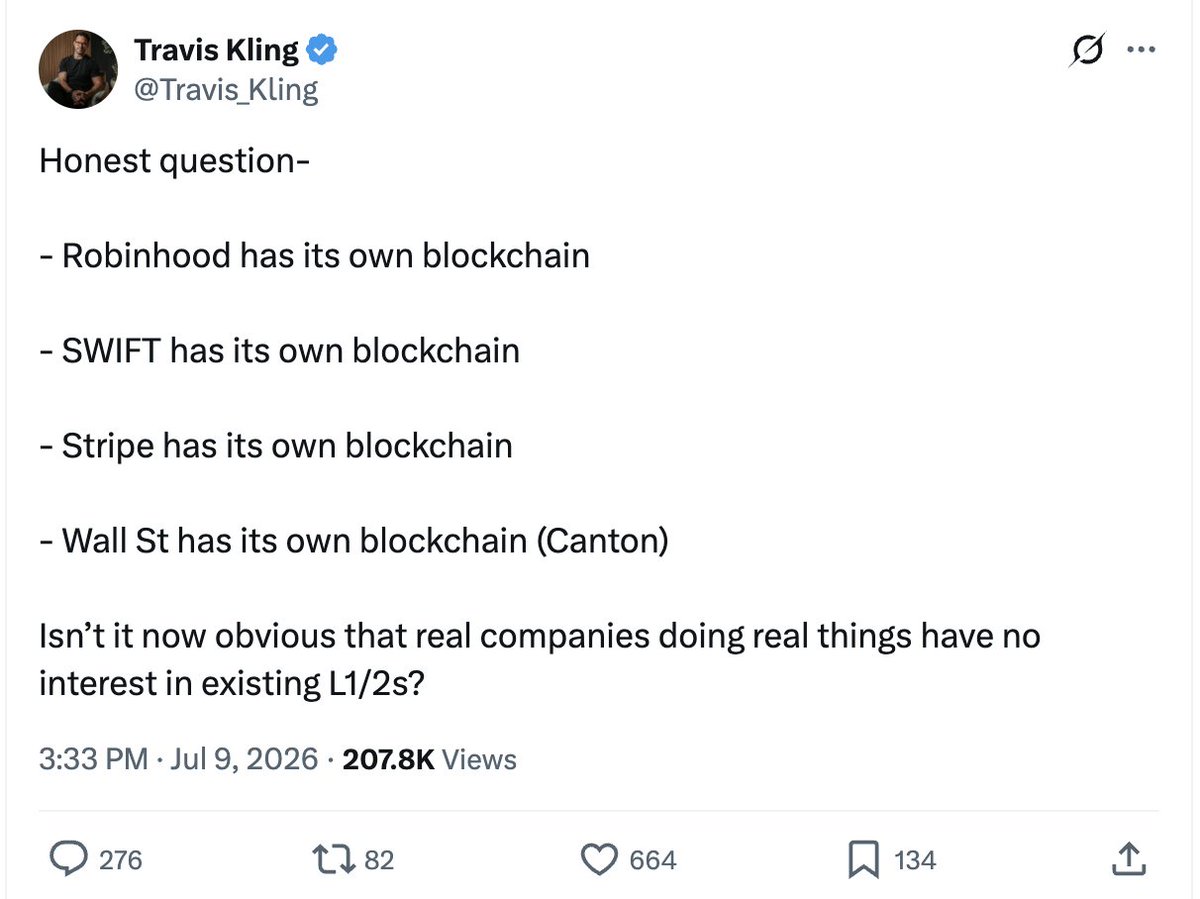
Travis Kling recently proposed a viewpoint: Is there now an obvious conclusion that businesses seriously conducting real-world operations have no interest whatsoever in the various existing L1 and L2 solutions? His first example was Robinhood. Yet, Robinhood is precisely the perfect counterexample: when real-world enterprises make decisions based on business logic, the vast majority will choose the Ethereum L1+L2 architecture.

(Note: Travis Kling is the founder and chief investment officer of the crypto asset management firm Ikigai, with years of investment experience at institutions like Point72 on Wall Street, and is a well-known crypto macro investor.)


Robinhood chose Ethereum as the underlying L1 and subsequently built its own Ethereum layer-2 network based on Arbitrum technology. Robinhood Chain relies on Ethereum Blobs for data availability, uses ETH as the native gas token, and is equipped with a standard cross-chain bridge secured by Ethereum.


This does not negate the Ethereum L1+L2 model; on the contrary, it confirms that this architecture is operating as originally designed.


The deeper core lies in the vastly different incentive mechanisms among participants. Early crypto industry players built public chains and chose technology stacks with the goal of issuing tokens. The emerging real-world on-chain economy is gradually establishing Ethereum L1+L2 as the underlying standard for cash-flow businesses.


These two types of participants have entirely different objective functions. As the market participant structure shifts, Ethereum's advantages will become increasingly evident.


Old Crypto Economy: Everything Optimized for Tokens


The "real-world enterprises serving real users" referred to in this article follow the classic corporate operation model: creating products consumers need, generating cash flow by providing services, and increasing the equity value corresponding to that cash flow.


Here, "real users" have demands stemming from normal economic activities, not merely speculative demand created by a new round of token issuance. Of course, crypto-native users also belong to real users.


This is not a judgment on whether various protocols are useful or whether builders have pure intentions; it is not a moral distinction. The core differentiating point lies in the economic objectives of the operating entities.


The value of a token can only come from three sources:


  1. Cash Flow: Possessing a reliable claim on future cash flow, akin to on-chain equity or bonds;
  2. Utility Value: Granting holders privileged access to, control over, or governance of a high-value system. Even without cash flow, a token that can control critical resources still holds value;
  3. Monetary Premium: People are willing to hold the asset long-term, convinced that others will recognize and accept it later. The asset transforms into a store-of-value carrier, becoming an ultimate unit of account, not just a voucher awaiting redemption for rights.


The monetary premium is real but extremely difficult to maintain. It requires powerful network effects in market confidence, liquidity, ecosystem adoption, scenario integration, and practical application. Gold, the US dollar, Bitcoin, and Ethereum have each established their own forms of monetary premium; hardly any other assets have achieved this.


Looking back, since the proliferation of programmable crypto assets, the vast majority of participants in the industry have not been formal enterprises pursuing stable cash flow. Their business models mostly involve selling tokens, with token value supported by utility expectations, hype-driven monetary premium, or distant, hard-to-fulfill cash flow narratives.


Some paths are very direct: developing a protocol and directly issuing a native token. Some are more roundabout: receiving grants from ecosystem projects funded by token sales, then selling the received tokens. Some projects do plan to generate revenue in the future. However, when token valuations are severely disconnected from reasonable expected cash flow, the essential business model still relies on market confidence in the token.


Almost everyone replicated similar playbooks, so this model slowly became the industry norm.


Important exceptions exist, of course: centralized exchanges are mostly pure cash-flow businesses, naturally adopting multi-chain strategies, where adding a new public chain is like adding a deposit/withdrawal channel. Some stablecoin issuers are also real-world cash-flow enterprises, initially serving the crypto circle but now expanding into the broader real economy.


But these exceptions precisely prove the core point: enterprises aiming to earn cash choose infrastructure to maximize their own business returns, not to boost token appreciation.


Incentive Mechanisms Ultimately Shape Technical Architecture


An entity's objective function determines its technical route choices. If a business's core mission is to operate a cash-flow business, the blockchain is just infrastructure. The enterprise selects a public chain to reduce risk, optimize products, reach users, and protect profits.


If the primary goal is token monetization, the choice of public chain becomes extremely flexible. Whichever public chain provides ecosystem grants, projects will develop on it. Seeing a successful protocol on Chain A, replicate a similar product on Chain B to facilitate investor valuation comparisons. As long as issuing a new token is desired, a brand new L1, L2, appchain, gas token, governance system, or niche technology stack can be packaged as marketing highlights.


The issue is not technological diversity itself. The crypto field will continue to see a Cambrian explosion of innovation with numerous applications, protocols, layer-2 solutions, and specialized execution environments emerging. The real industry-distorting trend is: for every new idea, there's a rush to independently build a sovereign ecosystem, separately set up an L1, prepare a security budget, cultivate liquidity, issue native monetary assets, completely disregarding whether the business itself necessitates it.


As the industry's focus gradually shifts towards cash-flow real-world businesses, innovation and exploration will not cease but will increasingly be built upon a unified underlying foundation. Enterprises will focus on differentiated development at the application layer and layer-2, relying on Ethereum L1 for settlement, security guarantees, liquidity hosting, and value storage. Ultimately, the industry will form a dumbbell structure: diverse applications flourish at the edges, while underlying infrastructure continues to consolidate.


The common logic of the old crypto industry: build the entire technical architecture around the token you want to sell to investors.


Market Participants Are Evolving


The future shape of the crypto industry will inevitably differ from the past, for one core reason: the players have changed.


The previous US administration persistently suppressed on-chain industry development, but now the wind has shifted. The "GENIUS Act" has been formally enacted, establishing a federal regulatory framework for payment stablecoins. The EU's MiCA regulatory framework is fully effective. Brokers, payment companies, banks, asset management institutions, and governments worldwide are beginning to deploy strategies around stablecoins, asset tokenization, and on-chain business.


This does not mean all regulatory challenges are solved, but large institutions can finally engage in long-term planning for on-chain business.


We are at the starting point of the large-scale adoption S-curve.


As the industry matures, crypto and traditional financial systems will no longer be fragmented. Assets, money, transactions, finance, identity, and trust will all be carried by a combination of on-chain and off-chain systems. Eventually, the term "Web3" will fade from public consciousness, much like "Web2" did, and everything will simply be called the internet.


By then, within the crypto market, the proportion of real-world enterprises serving ordinary users from the real economy will significantly increase. Not only will the number of such enterprises rise, but more crucially, capital volume, user scale, asset volume, and institutional influence will tilt towards these entities.


They will no longer be crypto projects struggling to find business models merely to support token narratives. Instead, they will be real companies using blockchain to improve existing businesses and create entirely new cash-flow avenues.


The market landscape will be rewritten. The infrastructure selection logic of the token economy era is entirely unsuitable for the cash-flow real economy.


Real-World Enterprises Procure Blockchain Infrastructure


Real-world enterprises have very low budgets for infrastructure trial-and-error risks. Companies do not want to bear the extra burden of consensus mechanisms, cross-chain bridges, validator systems, gas assets, governance tokens, liquidity operations, and a pile of unrelated additional modules. Any new technical module must create user value; otherwise, it is a liability.


Blockchain should serve the business, not the other way around.


Some businesses are naturally suited for multi-chain deployment: exchanges, wallets, stablecoin issuers, and various asset issuance platforms require broad user coverage. However, even when operating across multiple chains, it doesn't mean all public chains are equal; usually, a core public chain is designated to handle liquidity, asset issuance, settlement, business data storage, and deep ecosystem integration.


For the vast majority of on-chain businesses, the focus will be on deeply cultivating one main chain or a few chains within the same system.


Enterprises generally have three choices:


  1. Ethereum L1: Used when the business pursues ultimate decentralization, credible neutrality, minimal risk, and deep liquidity. L1 has higher transaction costs, exchanged for the industry's strongest shared security environment.
  2. Build a custom Ethereum L2: Used when the enterprise needs operational control, high customization, compliance capabilities, stable cost models, low latency, and high throughput. This allows operating an independent blockchain according to its own needs while remaining bound to the Ethereum foundation.
  3. Use mature shared layer-2: Used when the business scale is insufficient to support an independent L2, deploying directly on existing public L2s. Base, Arbitrum One, Robinhood Chain, and other Ethereum layer-2s become general-purpose development platforms.


Such enterprises will still engage in asset cross-chain operations, export products externally, and connect to other networks. Having a core main chain does not equate to isolation; asset interoperability and business interconnection have become standard for on-chain businesses.


But the core home chain is crucial. It determines the security foundation, standard data state, liquidity flows, operational model, and long-term development dependencies of the entire system.


Why the Ethereum L1+L2 Architecture Fits Enterprise Needs


Ethereum precisely splits the two core demands of large enterprises: L1 creates a highly decentralized, credibly neutral, and liquidity-rich global settlement hub; various L2s constitute a diverse market of execution environments, enabling high speed, low cost, vertical customization, and operator autonomy.


The foundation remains solid and neutral, while the upper layers flexibly adapt to different operating entities, jurisdictions, differentiated products, and user groups. Layer-2 solutions not only achieve Ethereum scaling at the technical level but also achieve scaling at the institutional level: institutions can operate their businesses according to their own rules without requiring the global base layer to accommodate their needs.


Independent L1s can also provide operational autonomy and high performance. In some scenarios, having full control over consensus and data availability holds value. But full sovereignty comes at a high cost.


A brand new independent L1 must build from scratch and continuously maintain a security budget, validator nodes, cross-chain trust assumptions, liquidity, development tools, ecosystem partnerships, and institutional credibility.


It creates a new security and liquidity island, significantly increasing friction costs for interaction with Ethereum L1 and the vast layer-2 ecosystem. Only when the independent consensus mechanism itself can create enormous commercial value is it worth bearing these costs for an enterprise.


For the vast majority of enterprises, the benefits of building an independent L1 cannot cover the comprehensive costs.


A customized Ethereum layer-2 can secure almost all the advantages of an independent L1: high TPS, control over execution logic, independent upgrades, custom fee structures, transaction ordering, latency control, access rules, and product-specific features.


Simultaneously, layer-2 inherently possesses advantages that are difficult for a native L1 to build quickly: settlement and data availability relying on Ethereum, native standard cross-chain bridges, seamless connection to Ethereum's existing funds and assets, and cross-chain interaction with minimized trust requirements based on the same underlying layer.


The design details of layer-2 solutions remain crucial. Admin permissions, upgrade keys, proof systems, and withdrawal guarantee mechanisms determine how much underlying security users can inherit.


Even a layer-2 with relatively high operator control still relies on Ethereum L1 to establish an unbreakable settlement foundation. For an enterprise simply conducting business, there's no need to independently operate and secure a base-layer L1.


An Ethereum layer-2 is both an independent blockchain and part of the Ethereum economic system. The operator can customize the execution environment while reusing Ethereum for settlement, Blob data storage, and cross-chain interoperability. Most will deeply integrate ETH into the ecosystem, directly using ETH as the gas token. The native standard bridge allows L1 assets to flow into the layer-2 economy with low trust thresholds.


Each new layer-2 creates a differentiated product segment, continuously amplifying Ethereum's network effects.


Robinhood's Decision is Highly Instructive


Robinhood's development path holds textbook-level reference value. The company first launched its stock token business on the mature shared layer-2 Arbitrum One. After validating the product model and clarifying its needs, it launched its own proprietary blockchain based on the Arbitrum platform.


This will likely become a common industry development path: first validate the product using shared infrastructure, then upgrade to a proprietary L2 once business scale, product requirements, and profit models are met.


Robinhood Chain is customized for financial services. Leveraging Arbitrum technology, it achieves 100-millisecond latency, predictable transaction pricing, and high throughput. The entire infrastructure meets all of Robinhood's requirements for performance, security, and regulatory compliance.


Simultaneously, Robinhood Chain is inherently an Ethereum layer-2: it relies on Ethereum Blobs for data, uses ETH for gas, and connects via a standard bridge to Ethereum that doesn't require third-party verifiers.


This is the standard template for real-world enterprises building on-chain products.


Robinhood doesn't need to create its own gas token from scratch and then justify to the market that the token possesses a long-term monetary premium. Robinhood itself is a publicly traded company with equity; all its profit growth comes from users, products, existing assets, and transaction-generated cash flow.


Blockchain is just infrastructure.


Choosing ETH to pay for gas is a purely rational business decision. The layer-2 itself needs to pay ETH to Ethereum for L1 underlying services. ETH has ample liquidity and is natively integrated across the ecosystem. Issuing a proprietary gas token would only add extra costs for promotion, liquidity maintenance, price volatility, and reputational risk without improving Robinhood's core business.


The metric for judging Robinhood's success or failure is the application-layer product and its off-chain derivative businesses, not whether it can create a new asset with monetary properties.


Therefore, many people misunderstand: some claim Robinhood developing its own blockchain means it abandoned the existing L1/L2 system. The opposite is true: Robinhood simply did not want to share a single execution environment with everyone. It did not abandon Ethereum; it chose Ethereum as the underlying parent chain for its own blockchain.


The Ethereum L1+L2 architecture is no longer just a theoretical concept.


Coinbase made the same choice when building Base. Coinbase is not an Ethereum evangelist; Brian Armstrong (Coinbase co-founder and CEO) has publicly stated he is more bullish on Bitcoin long-term. Yet, when the enterprise selected underlying infrastructure for its on-chain business, it still built Base as an Ethereum layer-2.


This choice is highly persuasive—the decision stemmed from commercial interests, unrelated to belief preferences.


When an enterprise's goal is to build a cash-flow business, not to host a token sale, it will ultimately only make rational business judgments. The default optimal commercial solution at this stage: Ethereum L1+L2.


What the Landscape Shift Means for Ethereum and ETH


The shift in market participant structure is extremely beneficial for Ethereum in the long term.


In the past, the competitive landscape of the public chain sector was largely dominated by projects enthusiastic about issuing tokens, distributing ecosystem grants, and relying on token valuation narratives.


Going forward, the industry's competitive entities become real-world enterprises, making decisions centered around security, user acquisition, operational control, market coverage, liquidity, and cross-chain interoperability optimization—all serving cash-flow businesses.


Market demand will continue to aggregate towards Ethereum's dumbbell architecture: L1 bears the demands for ultimate security and liquidity; various L2s handle demands for scaling, customization, and autonomous operation.


Ethereum's path to mass adoption does not lie in forcing all enterprises onto the same shared execution chain but in becoming the common settlement, security, liquidity, and asset foundation for thousands of upper-layer environments.


This also benefits ETH. ETH's growth logic relies on building a global monetary network and accumulating market consensus; it is not itself a cash-flow business.


ETH is a high-quality store-of-value asset, the native asset of Ethereum's global settlement layer. It serves as collateral, a liquidity vehicle, treasury reserve asset, productive asset within the ecosystem, and is continuously growing into an ultimate store-of-value asset.


As more real-world enterprises conduct business based on Ethereum, they will continuously expose ETH to massive numbers of users, embed ETH into various products, and constantly expand application scenarios. As liquidity and consensus deepen, ETH's monetary premium is further consolidated, and the monetary premium is essentially a powerful network effect.


Old crypto economy: Design the entire technical architecture around the token you want to sell. Emerging on-chain real economy: Choose the technical architecture around the product you want to deliver to customers.


These two types of participants have completely different optimization objectives, which will shape a drastically different public chain competitive landscape.


Robinhood is not an exception; it is a beacon.


Real-world enterprises choose Ethereum L1 when pursuing the industry's strongest neutrality, lowest risk, and top-tier shared liquidity environment. They build Ethereum L2 when needing operational autonomy, customization capabilities, and high performance. When business scale is insufficient to support an independent blockchain, they deploy on mature shared layer-2s (mostly Ethereum-based L2s).


Enterprises make this choice not because they are Ethereum maximalists, but purely out of business considerations.

Crypto di tendenza

Domande pertinenti

QWhy does the article argue that real-world businesses will increasingly choose the Ethereum L1+L2 architecture?

AThe article argues that as the crypto industry shifts towards businesses focused on generating cash flow rather than token speculation, their incentives change. These businesses prioritize security, user reach, operational control, and liquidity. Ethereum's L1 provides a highly decentralized, trust-minimized settlement and security base, while its L2s offer the customization, low cost, and high throughput required for diverse business models, making it the optimal default choice based on commercial logic, as exemplified by Robinhood.

QHow does the article differentiate the 'old crypto economy' from the emerging 'real-world chain economy'?

AThe article states that in the 'old crypto economy,' most participants (projects, builders, ecosystems) optimized their technology stack and architecture around launching and promoting a token to capture value. In contrast, the emerging 'real-world chain economy' consists of businesses running classic corporate models that aim to create products/services for customers to generate cash flow, with blockchain merely serving as infrastructure to optimize their business, not as the primary revenue model via token appreciation.

QAccording to the article, what is the three-fold path for a real-world business to choose its blockchain infrastructure?

AThe article outlines three primary choices for real-world businesses: 1) Use Ethereum L1 directly for maximum decentralization, security, and deep liquidity (despite higher costs). 2) Build a dedicated Ethereum L2 for operational control, customization, compliance, and high performance while inheriting L1 security. 3) Deploy on an existing, mature shared L2 (like Base, Arbitrum One, or Robinhood Chain) if the business scale doesn't justify a dedicated chain. The core principle is to have a primary 'home' chain while maintaining interoperability.

QWhy is Robinhood's choice to build its own chain seen as a counter-argument to the idea that businesses are not interested in L1s/L2s?

AThe article uses Robinhood as the perfect counter-example because while Robinhood did build its own blockchain (Robinhood Chain), it deliberately built it as an Ethereum L2. It relies on Ethereum for data availability (via Blobs), uses ETH as the native gas token, and incorporates a standard bridge secured by Ethereum. This shows Robinhood didn't abandon existing L1/L2 infrastructure; instead, it chose Ethereum as the foundational settlement layer, validating the L1+L2 model as the optimal commercial solution for businesses seeking both control and robust underlying security.

QWhat long-term impact does the shift towards real-world, cash-flow businesses have on Ethereum and ETH, according to the article?

AThe article argues this shift is extremely bullish for Ethereum and ETH long-term. As more real-world businesses build on Ethereum (either L1 or L2s), they will onboard massive numbers of users, embed ETH into various products, and expand its use cases. This increases ETH's liquidity and network effects, further solidifying its monetary premium as the native asset of the global settlement layer, a store of value, and the core collateral and liquidity asset within the ecosystem.

Letture associate

8,000 BTC Fails to Support Stock Price; Can a Reverse Stock Split Save American Bitcoin?

American Bitcoin, a company closely linked to Eric Trump, faces a paradox: despite significantly increasing its Bitcoin holdings to 8,000 BTC, its stock price continues to decline. The company recently executed a 1-for-15 reverse stock split, effective July 2, aimed at raising its per-share price to meet Nasdaq listing requirements. While this action does not change the company's overall valuation, it carries risks, including potential negative market perception and reduced liquidity. The company's strategy involves using its profitable mining operations, with a cost below market price, to accumulate Bitcoin, unlike competitors who primarily issue new shares to fund purchases. However, its Q1 2026 financials revealed a net loss and significant digital asset impairment losses, highlighting that mere Bitcoin accumulation does not guarantee stock performance. The core challenge is whether the stock offers value beyond direct Bitcoin ownership. Bullish arguments focus on the growing BTC reserves and the sustainable mining model. Bearish concerns center on weak liquidity, the threat of future share dilution from potential fundraising, and the market's reluctance to award a premium simply for holding Bitcoin. The reverse split, necessary to maintain its listing, underscores underlying business weakness. The company's future hinges on stabilizing its stock liquidity, transparently managing its BTC treasury, and proving its model can grow reserves without excessively diluting shareholders. Its performance serves as a critical test for the publicly traded Bitcoin treasury sector.

marsbit15 min fa

8,000 BTC Fails to Support Stock Price; Can a Reverse Stock Split Save American Bitcoin?

marsbit15 min fa

Bitcoin Volatility Unchanged Amid Dominant Downtrend; HYPE Faces Repeated Tests at Critical Trendline | Guest Analysis

This weekly market analysis updates the outlook for Bitcoin (BTC) and HYPE based on recent price action, largely confirming prior predictions. **Bitcoin (BTC) Analysis:** The report maintains that BTC is in a downtrend but currently within a corrective rebound phase that began from the July 1st low of $57,820. This rebound has reached a key resistance near $64,700. The daily chart shows a developing "descending central zone," suggesting a shift into a consolidation/range-bound phase. The 4-hour chart indicates the rebound may be completing, with proprietary models showing potential short-term topping signals near the current levels. **BTC Trading Strategy (July 13-19):** * **Key Levels:** Resistance is at $64,700, $65,700-$67,300, and $69,500-$71,000. Support lies at $60,950-$62,000, $57,820, and $55,000. * **Mid-term:** The overall structure is bearish. Hold ~20% short positions. Consider increasing shorts to 50% if price rallies to the $65,700-$67,300 zone and shows weakness. * **Short-term:** Use 30% capital for tactical trades. Three scenarios are outlined: 1. **A (Buying Dip):** Consider buying if price drops to $60,950-$62,000 support and shows signs of stabilization. 2. **B (Selling Rally):** Consider shorting if price rallies to the $65,700-$67,300 resistance zone with confirming signals. 3. **C (Buying Higher Low):** Consider buying if, after a breakout above $65,700, a pullback finds support above $57,820. **HYPE Analysis:** HYPE performed as anticipated last week, facing resistance and correcting from the warned level near $72.97 ("Endpoint 61"), with a maximum drop of 9.39%. The current (61-62) correction leg on the 4-hour chart has broken below a previous low ($68.16), damaging the prior upward structure. **HYPE Trading Strategy:** * **Key Levels:** Resistance is at $68-$69.5, $72.97, and $76.94. Support is at $65.5 and $60.5-$61.5. * **Outlook:** The focus is on where the current correction ends and whether any subsequent rebound can surpass the $72.97 resistance. * **Strategy:** Stay观望 if a rebound breaks above $72.97 (near the all-time high). However, if a rebound fails to reach $72.97, consider establishing short positions (up to 30%仓位) with strict stop-losses. **General Risk Management:** The article emphasizes strict trade execution: set initial stop-loss immediately, move stop-loss to breakeven at +1% profit, and then trail it upwards by 1% for every additional 1% gain to lock in profits dynamically. *Disclaimer: The analysis is based on personal technical models for journaling purposes and is not investment advice. Markets are volatile; trade cautiously.*

Odaily星球日报25 min fa

Bitcoin Volatility Unchanged Amid Dominant Downtrend; HYPE Faces Repeated Tests at Critical Trendline | Guest Analysis

Odaily星球日报25 min fa

Trading

Spot

Articoli Popolari

Cosa è ETH 3.0

ETH3.0 e $eth 3.0: Un'Analisi Approfondita del Futuro di Ethereum Introduzione Nel panorama in rapida evoluzione delle criptovalute e della tecnologia blockchain, ETH3.0, spesso indicato come $eth 3.0, è emerso come un argomento di considerevole interesse e speculazione. Il termine comprende due concetti principali che warrantono chiarimenti: Ethereum 3.0: Questo rappresenta un potenziale futuro aggiornamento volto ad aumentare le capacità dell'attuale blockchain di Ethereum, concentrandosi principalmente sul miglioramento della scalabilità e delle prestazioni. ETH3.0 Meme Token: Questo progetto di criptovaluta distinto cerca di sfruttare la blockchain di Ethereum per creare un ecosistema incentrato sui meme, promuovendo il coinvolgimento all'interno della comunità delle criptovalute. Comprendere questi aspetti di ETH3.0 è essenziale non solo per gli appassionati di criptovalute, ma anche per coloro che osservano tendenze tecnologiche più ampie nello spazio digitale. Che cos'è ETH3.0? Ethereum 3.0 Ethereum 3.0 è pubblicizzato come un aggiornamento proposto per la rete Ethereum già stabilita, che è stata la spina dorsale di molte applicazioni decentralizzate (dApps) e contratti smart sin dalla sua nascita. I miglioramenti previsti si concentrano principalmente sulla scalabilità, integrando tecnologie avanzate come lo sharding e le prove a conoscenza zero (zk-proofs). Queste innovazioni tecnologiche mirano a facilitare un numero senza precedenti di transazioni al secondo (TPS), potenzialmente raggiungendo milioni, affrontando così una delle limitazioni più significative della tecnologia blockchain attuale. Il miglioramento non è meramente tecnico, ma anche strategico; è volto a preparare la rete Ethereum per un'adozione e un'utilità diffuse in un futuro contrassegnato da un aumento della domanda di soluzioni decentralizzate. ETH3.0 Meme Token Al contrario di Ethereum 3.0, l'ETH3.0 Meme Token si avventura in un dominio più leggero e giocoso, combinando la cultura dei meme di internet con la dinamica delle criptovalute. Questo progetto consente agli utenti di acquistare, vendere e scambiare meme sulla blockchain di Ethereum, fornendo una piattaforma che promuove il coinvolgimento della comunità attraverso la creatività e interessi condivisi. L'ETH3.0 Meme Token mira a dimostrare come la tecnologia blockchain possa intersecarsi con la cultura digitale, creando casi d'uso che siano sia divertenti che finanziariamente praticabili. Chi è il Creatore di ETH3.0? Ethereum 3.0 L'iniziativa verso Ethereum 3.0 è principalmente propulsa da un consorzio di sviluppatori e ricercatori all'interno della comunità di Ethereum, tra cui Justin Drake. Conosciuto per le sue intuizioni e contributi all'evoluzione di Ethereum, Drake è stato una figura di spicco nelle discussioni riguardanti la transizione di Ethereum verso un nuovo livello di consenso, chiamato “Beam Chain.” Questo approccio collaborativo allo sviluppo significa che Ethereum 3.0 non è il prodotto di un creatore singolo, ma piuttosto una manifestazione di ingegno collettivo focalizzato sul progresso della tecnologia blockchain. ETH3.0 Meme Token I dettagli riguardanti il creatore dell'ETH3.0 Meme Token sono attualmente non rintracciabili. La natura dei token meme conduce spesso a una struttura più decentralizzata e guidata dalla comunità, il che potrebbe spiegare la mancanza di attribuzione specifica. Questo si allinea con l'etica della comunità crypto più ampia, dove l'innovazione spesso nasce da sforzi collaborativi piuttosto che individuali. Chi sono gli Investitori di ETH3.0? Ethereum 3.0 Il supporto per Ethereum 3.0 proviene principalmente dalla Ethereum Foundation insieme a una comunità entusiasta di sviluppatori e investitori. Questa associazione fondamentale fornisce un considerevole grado di legittimità e migliora le prospettive di implementazione di successo poiché sfrutta la fiducia e la credibilità costruite nel corso degli anni di operazioni della rete. Nel clima in rapida evoluzione delle criptovalute, il supporto della comunità gioca un ruolo cruciale nello sviluppo e nell'adozione, posizionando Ethereum 3.0 come un serio contenditore per i futuri progressi della blockchain. ETH3.0 Meme Token Sebbene le fonti attualmente disponibili non forniscano informazioni esplicite riguardo ai fondamenti o alle organizzazioni di investimento che sostengono l'ETH3.0 Meme Token, ciò è indicativo del modello di finanziamento tipico per i token meme, che spesso si basa sul supporto di base e sul coinvolgimento della comunità. Gli investitori in tali progetti sono tipicamente individui motivati dal potenziale per innovazioni guidate dalla comunità e dallo spirito di cooperazione trovato all'interno della comunità crypto. Come Funziona ETH3.0? Ethereum 3.0 Le caratteristiche distintive dell'Ethereum 3.0 risiedono nella sua proposta di implementazione della tecnologia di sharding e zk-proof. Lo sharding è un metodo di partizionamento della blockchain in pezzi più piccoli e gestibili o “shard,” che possono elaborare transazioni in modo concorrente piuttosto che sequenziale. Questa decentralizzazione dell'elaborazione aiuta a prevenire la congestione e garantisce che la rete rimanga reattiva anche sotto un carico pesante. La tecnologia delle prove a conoscenza zero (zk-proof) contribuisce con un ulteriore livello di sofisticazione consentendo la validazione delle transazioni senza rivelare i dati sottostanti coinvolti. Questo aspetto non solo migliora la privacy, ma aumenta anche l'efficienza complessiva della rete. Si parla anche di incorporare una macchina virtuale Ethereum a conoscenza zero (zkEVM) in questo aggiornamento, amplificando ulteriormente le capacità e l'utilità della rete. ETH3.0 Meme Token L'ETH3.0 Meme Token si distingue capitalizzando sulla popolarità della cultura dei meme. Stabilisce un mercato per gli utenti che desiderano partecipare al trading di meme, non solo per divertimento, ma anche per potenziale guadagno economico. Integrando funzioni come lo staking, la fornitura di liquidità e meccanismi di governance, il progetto promuove un ambiente che incentiva l'interazione e la partecipazione della comunità. Offrendo una miscela unica di intrattenimento e opportunità economica, l'ETH3.0 Meme Token mira ad attrarre un pubblico variegato, che va dagli appassionati di crypto ai semplici intenditori di meme. Timeline di ETH3.0 Ethereum 3.0 11 Novembre 2024: Justin Drake accenna al prossimo aggiornamento ETH 3.0, incentrato sui miglioramenti della scalabilità. Questo annuncio segna l'inizio delle discussioni formali riguardo l'architettura futura di Ethereum. 12 Novembre 2024: La proposta attesa per Ethereum 3.0 dovrebbe essere svelata a Devcon a Bangkok, preparando il terreno per un feedback più ampio della comunità e potenziali passi successivi nello sviluppo. ETH3.0 Meme Token 21 Marzo 2024: L'ETH3.0 Meme Token viene ufficialmente elencato su CoinMarketCap, segnando il suo ingresso nel dominio pubblico delle criptovalute e aumentando la visibilità per il suo ecosistema basato sui meme. Punti Chiave In conclusione, Ethereum 3.0 rappresenta una significativa evoluzione all'interno della rete Ethereum, concentrandosi sul superamento delle limitazioni riguardanti scalabilità e prestazioni attraverso tecnologie avanzate. I suoi aggiornamenti proposti riflettono un approccio proattivo alle future esigenze e usabilità. D'altra parte, l'ETH3.0 Meme Token incarna l'essenza della cultura guidata dalla comunità nello spazio delle criptovalute, sfruttando la cultura dei meme per creare piattaforme coinvolgenti che incoraggiano la creatività e la partecipazione degli utenti. Comprendere gli scopi e le funzionalità distinte di ETH3.0 e $eth 3.0 è fondamentale per chiunque sia interessato ai continui sviluppi nello spazio crypto. Con entrambe le iniziative che tracciano percorsi unici, esse sottolineano collettivamente la natura dinamica e multifacetica dell'innovazione blockchain.

205 Totale visualizzazioniPubblicato il 2024.04.04Aggiornato il 2024.12.03

Cosa è ETH 3.0

Cosa è ETHEREUM

HarryPotterTrumpHomerSimpson777Inu: Panoramica di un Progetto Crypto Web3 Introduzione Nel mondo in rapida evoluzione delle criptovalute e della finanza decentralizzata, progetti innovativi emergono frequentemente, catturando l'interesse della comunità degli investitori e degli appassionati di crypto. Uno di questi progetti è HarryPotterTrumpHomerSimpson777Inu, una criptovaluta che si trova all'incrocio tra cultura popolare e tecnologia blockchain. Questo token guidato dalla comunità mescola personaggi e figure politiche ben noti, con l'obiettivo di creare una piattaforma coinvolgente e promuovere un'adozione diffusa. Che cos'è HarryPotterTrumpHomerSimpson777Inu? HarryPotterTrumpHomerSimpson777Inu è un token costruito sulla blockchain di Ethereum, progettato per essere accessibile e divertente per un pubblico diversificato. L'unicità di questo progetto deriva dal suo approccio tematico, che intreccia elementi di fantasia, politica e intrattenimento. Sfruttando il fascino nostalgico di personaggi amati, il progetto cerca di creare un'esperienza di criptovaluta coinvolgente, incoraggiando il coinvolgimento e la partecipazione della comunità. L'obiettivo principale di HarryPotterTrumpHomerSimpson777Inu è stabilire un token che risuoni con gli utenti a livello personale, promuovendo sia il divertimento che il coinvolgimento nell'ambito crypto. Questo branding distintivo mira ad attrarre individui che in precedenza potrebbero non essersi interessati alle criptovalute, facilitando un nuovo punto di ingresso per utenti potenziali. Creatore di HarryPotterTrumpHomerSimpson777Inu L'identità del creatore dietro HarryPotterTrumpHomerSimpson777Inu rimane sconosciuta. Questa non è una pratica rara nel dominio delle criptovalute, dove l'anonimato è spesso preferito dai fondatori come mezzo di protezione della privacy e promozione di un ethos decentralizzato. Questa oscurità non diminuisce il valore del progetto; al contrario, riflette una tendenza più ampia all'interno del settore, dove molti progetti di successo sono emersi da origini anonime. Investitori di HarryPotterTrumpHomerSimpson777Inu Le informazioni pubbliche riguardo agli investitori di HarryPotterTrumpHomerSimpson777Inu sono limitate. La natura del progetto, incentrata sul coinvolgimento della comunità, suggerisce una dipendenza da investimenti di piccole dimensioni da parte di singoli appassionati piuttosto che da sostegni sostanziali da fondazioni di investimento consolidate o corporation. Questo livello di trasparenza nel finanziamento è tipico di molti progetti di criptovaluta guidati dalla comunità, dove il supporto spesso proviene da movimenti di base piuttosto che da investitori istituzionali. Come Funziona HarryPotterTrumpHomerSimpson777Inu? Operando sulla blockchain di Ethereum, HarryPotterTrumpHomerSimpson777Inu sfrutta la sua solida infrastruttura per facilitare transazioni e promuovere interazioni tra gli utenti all'interno della comunità. Ciò che distingue questo progetto è il suo posizionamento tematico: canalizzando il carisma di personaggi iconici provenienti da diversi ambiti culturali, crea un'identità di marca distintiva. Questo approccio non solo attrae gli utenti, ma coltiva anche una comunità fedele attorno al token. Le meccaniche operative del progetto si concentrano sul coinvolgimento della comunità. Adotta un modello decentralizzato che incoraggia la partecipazione, consentendo agli utenti di interagire attraverso vari canali mentre promuovono lo scambio di idee e esperienze. Inoltre, il progetto abbraccia i principi del Web3, privilegiando la sovranità degli utenti e la decentralizzazione, che sono i pilastri del futuro di Internet. Timeline di HarryPotterTrumpHomerSimpson777Inu La storia di HarryPotterTrumpHomerSimpson777Inu è segnata da diversi eventi decisivi: 12 agosto 2023: L'inizio di HarryPotterTrumpHomerSimpson777Inu, segnando il suo ingresso nell'ecosistema delle criptovalute. Fase di Sviluppo: Un periodo focalizzato sulla costruzione di una strategia completa per stimolare la crescita guidata dalla comunità e il coinvolgimento degli utenti. Listing sugli Scambi: Sebbene i dettagli specifici di listing non siano stati divulgati, il progetto è stato reso accessibile su vari scambi di criptovalute, migliorando la sua visibilità nel mercato. Coinvolgimento della Comunità: Sforzi continui per coinvolgere attivamente la comunità, stabilendo canali di dialogo e promuovendo la partecipazione attraverso varie attività, tra cui concorsi, discussioni e votazioni comunitarie. Aspetti Chiave di HarryPotterTrumpHomerSimpson777Inu Focus sulla Comunità Un tratto distintivo di HarryPotterTrumpHomerSimpson777Inu è la sua forte enfasi sul coinvolgimento della comunità. Il progetto incoraggia attivamente gli utenti a partecipare a discussioni, condividere idee e contribuire all'evoluzione del progetto. Questa interazione coltiva un senso di appartenenza e di ownership tra i membri della comunità, essenziale per la sostenibilità a lungo termine del token. Utilizzo della Blockchain di Ethereum La scelta di costruire sulla blockchain di Ethereum consente a HarryPotterTrumpHomerSimpson777Inu di sfruttare le sue caratteristiche di sicurezza ben consolidate e architettura decentralizzata. Questa base garantisce affidabilità per le transazioni e fornisce un framework affidabile su cui sviluppare varie funzionalità. Approccio Tematico Unico Fusione di elementi della cultura pop nella sua identità, HarryPotterTrumpHomerSimpson777Inu crea una narrazione coinvolgente che lo differenzia da altre criptovalute. L'amalgama di personaggi e temi genera riconoscimento e intrigo immediati, rendendo il token relazionabile a un'ampia gamma di utenti potenziali. Anonimato nello Sviluppo Il creatore anonimo del progetto rimane una caratteristica ricorrente in molte iniziative di criptovaluta. Questo aspetto evidenzia un ethos di decentralizzazione, introducendo anche un livello di mistero che potrebbe affascinare un segmento della comunità crypto, attirando l'attenzione sul progetto e invitando l'impegno da parte di utenti che supportano l'idea di un'iniziativa decentralizzata e gestita dalla comunità. Conclusione HarryPotterTrumpHomerSimpson777Inu si presenta come un'aggiunta distintiva al panorama delle criptovalute, combinando il fascino della cultura popolare con le meccaniche innovative della tecnologia blockchain. Sebbene i dettagli riguardanti il creatore e gli investitori specifici rimangano non divulgati, il focus del progetto sulla comunità e il suo approccio tematico lo contraddistinguono come un potenziale attore influente nel contesto del Web3 e delle criptovalute. Man mano che l'ecosistema delle criptovalute continua ad espandersi, iniziative come HarryPotterTrumpHomerSimpson777Inu ci ricordano le molteplici modalità in cui la blockchain può connettere le comunità globali attraverso narrazioni e valori condivisi.

1.0k Totale visualizzazioniPubblicato il 2024.04.06Aggiornato il 2024.12.03

Cosa è ETHEREUM

Come comprare ETH

Benvenuto in HTX.com! Abbiamo reso l'acquisto di Ethereum (ETH) semplice e conveniente. Segui la nostra guida passo passo per intraprendere il tuo viaggio nel mondo delle criptovalute.Step 1: Crea il tuo Account HTXUsa la tua email o numero di telefono per registrarti il tuo account gratuito su HTX. Vivi un'esperienza facile e sblocca tutte le funzionalità,Crea il mio accountStep 2: Vai in Acquista crypto e seleziona il tuo metodo di pagamentoCarta di credito/debito: utilizza la tua Visa o Mastercard per acquistare immediatamente EthereumETH.Bilancio: Usa i fondi dal bilancio del tuo account HTX per fare trading senza problemi.Terze parti: abbiamo aggiunto metodi di pagamento molto utilizzati come Google Pay e Apple Pay per maggiore comodità.P2P: Fai trading direttamente con altri utenti HTX.Over-the-Counter (OTC): Offriamo servizi su misura e tassi di cambio competitivi per i trader.Step 3: Conserva Ethereum (ETH)Dopo aver acquistato Ethereum (ETH), conserva nel tuo account HTX. In alternativa, puoi inviare tramite trasferimento blockchain o scambiare per altre criptovalute.Step 4: Scambia Ethereum (ETH)Scambia facilmente Ethereum (ETH) nel mercato spot di HTX. Accedi al tuo account, seleziona la tua coppia di trading, esegui le tue operazioni e monitora in tempo reale. Offriamo un'esperienza user-friendly sia per chi ha appena iniziato che per i trader più esperti.

3.0k Totale visualizzazioniPubblicato il 2024.12.10Aggiornato il 2026.06.02

Come comprare ETH

Discussioni

Benvenuto nella Community HTX. Qui puoi rimanere informato sugli ultimi sviluppi della piattaforma e accedere ad approfondimenti esperti sul mercato. Le opinioni degli utenti sul prezzo di ETH ETH sono presentate come di seguito.

活动图片