Robinhood Chain's DeFi Long March: Replicating the Ethereum Classic, Reshaping the RWA Financial Landscape

marsbitPubblicato 2026-08-27Pubblicato ultima volta 2026-08-27

Introduzione

Robinhood Chain is evolving from a primary hub for meme coins into a diversified DeFi ecosystem. Core DeFi primitives—AMM, CLOB, lending, perpetual contracts, ve(3,3), and OHM-style protocols—are being deployed and adapted for new assets, particularly tokenized stocks and RWAs. Key developments include Uniswap (V2/V3/V4) dominating as the core AMM and liquidity layer, with V4 enabling programmable pools. Deepstate introduces a fully on-chain order book (CLOB) model for efficient price discovery, suited for traditional assets. Lending protocols like Morpho and Arrow Finance allow users to earn yield on stablecoins and use tokenized stocks as collateral for loans. Perpetual DEXs like Lighter and Arcus support crypto and tokenized stocks as both trading pairs and margin collateral, with Arcus further tokenizing positions for DeFi composability. The ve(3,3) model is implemented by protocols like UponRH, which ties token emissions to actual trading fees, and Fables, which uses Uniswap V4 hooks for dynamic fee markets tailored to RWAs. NetNet offers an OHM-style reserve currency protocol with code-enforced parameters and a Risk-Free Value (RFV) backed by stable assets. The overarching trend is the growing composability of traditional financial assets (like stocks) within Robinhood Chain's DeFi landscape, moving beyond mere replication of existing models to create tailored financial infrastructure for RWAs.

Author: Nancy, PANews

Meme coins continue to create “noise” on Robinhood Chain, but they are gradually no longer the only main attraction. As on-chain funds continue to accumulate and trading activities heat up, DeFi building blocks are being assembled on this hot L2.

Classic DeFi mechanisms like AMM, CLOB, lending, perpetual contracts, ve(3,3), OHM are being replicated on Robinhood Chain, with “adaptations” for new assets and new scenarios emerging. Some protocols have even climbed to the top of the chain in terms of revenue and TVL. Simultaneously, the underlying assets are expanding from purely crypto assets to RWA assets like tokenized stocks, with “Lego building” happening around these assets.

AMM: Evolving from Trading Pools to Programmable Liquidity Layer

Since the launch of Robinhood Chain’s mainnet, Uniswap has quickly become the core Automated Market Maker (AMM) and liquidity infrastructure on the chain, meeting the main trading demand for assets like tokenized stocks, RWAs, and Meme coins. In less than two months since its launch, the cumulative trading volume of Uniswap on Robinhood Chain has exceeded $20 billion.

Liquidity demand on Robinhood Chain is currently distributed mainly across Uniswap V2, V3, and V4. Dune data shows that on August 27 alone, the combined daily trading volume of various Uniswap versions accounted for nearly 95% of Robinhood Chain’s overall daily trading volume, handling almost the vast majority of on-chain trading demand.
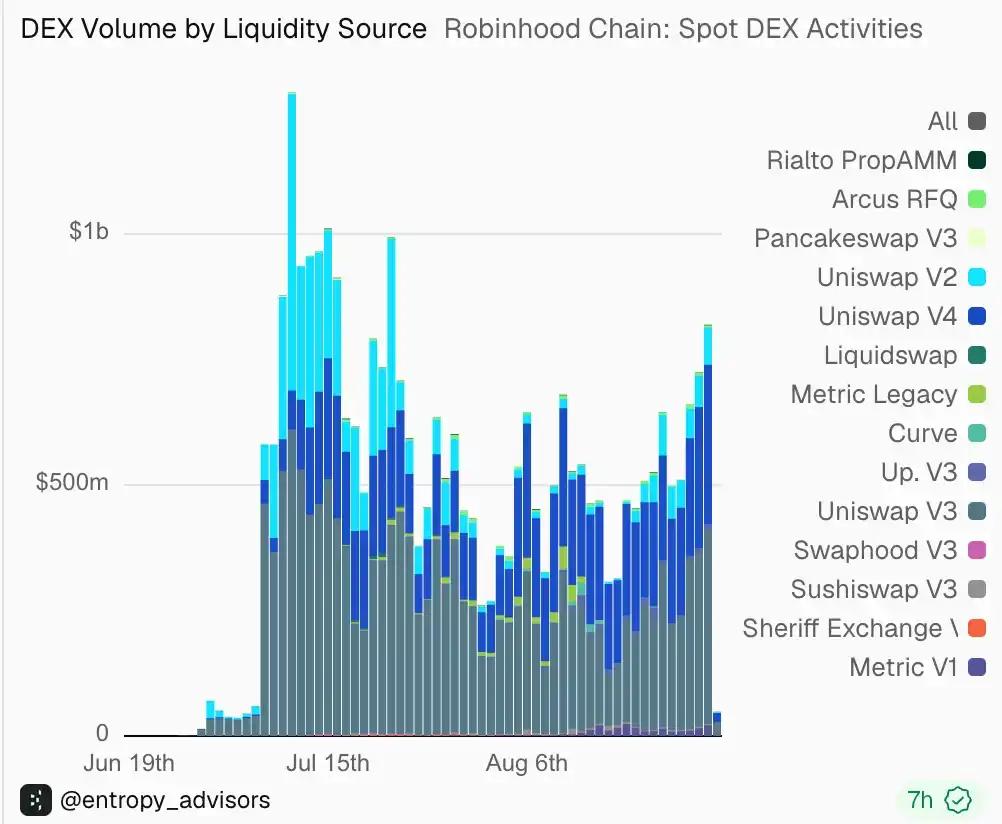
Among them, V3 remains the main layer for large transactions and deep liquidity, while V4 has begun to introduce more programmable mechanisms on top of the traditional AMM model, becoming an important traffic entry point for new assets and applications.

Particularly, the launch of Uniswap Labs' own Launchpad pools.trade on August 5th directly integrates the token issuance process with permanently locked V4 liquidity pools. On one hand, this taps into the high-frequency traffic entry point of Meme issuance and trading; on the other hand, it further drives trading demand for V4. Data shows that as of August 25, pools.trade's daily trading volume already accounted for 12.2% of Robinhood Chain's overall trading volume, pushing V4's trading volume to rapidly approach that of V3.

Uniswap V4 innovations change the role of AMM in on-chain finance, transforming relatively standardized trading pools into a programmable liquidity layer, and also provide differentiated trading mechanisms for different types of assets like tokenized stocks, RWAs, and Memes.

Deepstate: Bringing the Traditional Order Book On-Chain

Compared to some order book DEXs that use off-chain matching and on-chain settlement, Fully On-Chain CLOBs (Central Limit Order Books) place the logic for placing orders, canceling orders, and matching on the blockchain. Hyperliquid is a typical representative of this model.

Deepstate, built by the former CTO of SushiSwap, is a new DEX deployed on Robinhood Chain. Its core adopts a Fully On-Chain Order Book model (CLOB) where limit orders, cancellations, and matching logic are all executed within smart contracts. Unlike AMMs which rely on liquidity pools and mathematical curves for pricing, order books allow traders to directly submit specific buy and sell prices, with price discovery completed by market supply and demand.

Another advantage of the order book model is its closer resemblance to the trading experience of traditional exchanges. Market makers can concentrate their funds at price points where execution is most likely, instead of dispersing liquidity along a curve as in AMMs. Therefore, in theory, it can provide deeper effective order book depth with less capital, while avoiding the impermanent loss faced by traditional AMM LPs.

This model is particularly suitable for the developing tokenized stock and stablecoin markets on Robinhood Chain. Traditional financial assets like stocks typically have clear price ranges and higher trading frequencies. Large transactions are also more sensitive to order book depth, spreads, and slippage. Order books theoretically provide tighter spreads and lower slippage with higher capital efficiency, making them closer to the trading logic of traditional securities markets.

Of course, Fully On-Chain CLOBs also impose higher demands on blockchain performance, as placing, canceling, and matching orders all require on-chain execution. Robinhood Chain's low costs and high performance provide a more suitable infrastructure environment for Fully On-Chain CLOBs like Deepstate, also giving them the opportunity to further migrate the traditional exchange order book model on-chain.

Lending: Making Stocks Go from Tradable to Financeable

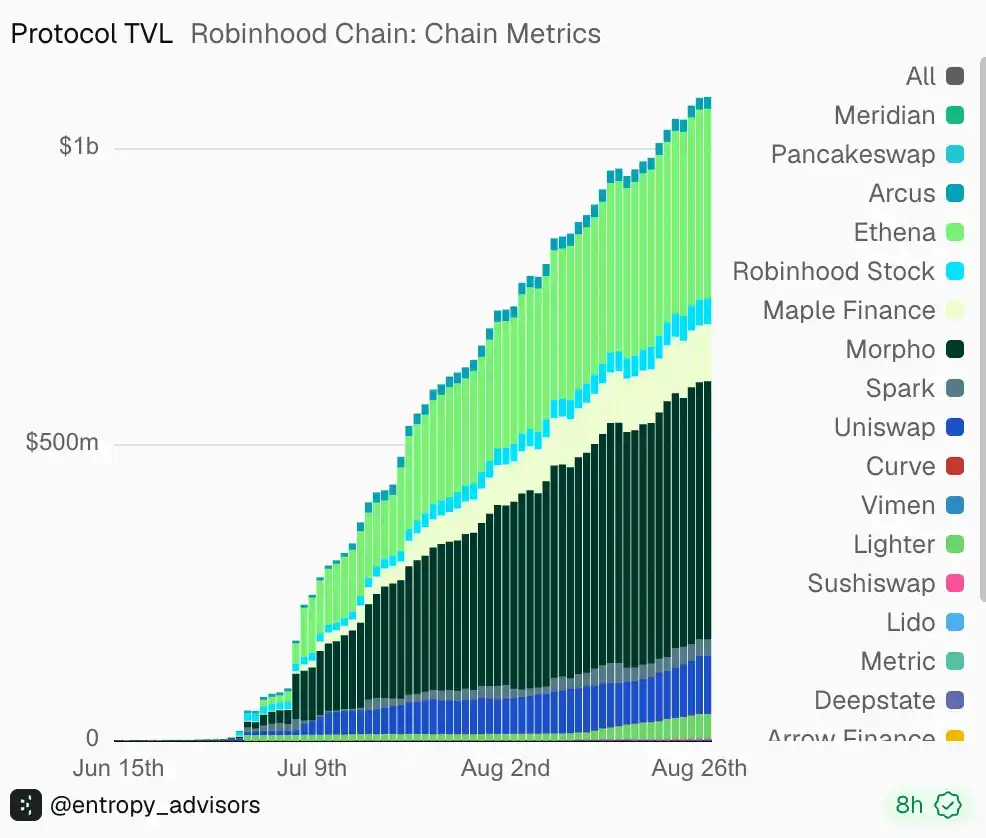
The Earn lending product launched by Robinhood in partnership with Morpho primarily caters to the savings and yield needs for USDG. Here, Morpho serves as the underlying lending protocol, providing isolated lending markets; Steakhouse acts as a risk curator, responsible for screening borrowing markets and managing risk parameters; while Ethena, Maple, Spark, etc., provide assets that can serve as collateral and generate yield, constituting the source of Earn's returns. The core of this model is not to let users borrow against collateralized stocks, but to channel stablecoin savings demand from the Robinhood ecosystem into on-chain lending markets, providing yields for USDG through collateral and lending spreads.

In terms of capital scale, Morpho has become one of the largest lending infrastructure providers on Robinhood Chain. Dune data shows that the total size of lending markets related to Morpho on the chain has exceeded $870 million, with Vault TVL over $430 million, and cumulative borrowing volume around $390 million, demonstrating high capital utilization.
Arrow Finance is a natively deployed Overcollateralized Debt Position (CDP) and DeFi gateway on Robinhood Chain. Users can deposit crypto assets, ETFs, and tokenized stocks into vaults, and mint the stablecoin aUSD under an overcollateralized condition, thereby releasing on-chain liquidity without directly selling assets. This means users can gain stablecoin liquidity while continuing to hold their stock exposure. In terms of risk control, Arrow employs isolated Vaults and independent liquidation mechanisms, equipped with stability pools and an oracle system for crypto assets, stablecoins, and tokenized stocks, also considering price processing issues during traditional stock market closures.

And as stocks can be traded, collateralized, and lent on-chain, they are no longer just on-chain stock certificates but begin to possess DeFi asset attributes.

Perps: Stocks Can Not Only Be Traded But Also Become Collateral for Leverage

Perpetual contracts are becoming another important DeFi track on Robinhood Chain.

Lighter is the official perpetual trading entry point within Robinhood Wallet and also one of the largest Perp DEXs on Robinhood Chain currently. Its trading products are mainly perpetual contracts for crypto assets like BTC and ETH, while also supporting tokenized stocks as margin. With the launch of Robinhood Chain points incentives, Lighter's trading volume and liquidity have grown rapidly.

According to Castle Labs data, since launching points on Robinhood Chain, Lighter's Perp trading volume has seen significant growth, with a daily average trading volume of $280 million and cumulative trading volume exceeding $3 billion. Meanwhile, Dune data shows that Lighter's TVL on Robinhood Chain has surpassed $41.22 million.

In terms of protocol revenue, DeFiLlama data shows that in the past 7 days, Lighter's revenue on Robinhood Chain exceeded $196,000, ranking fifth on the chain for protocol revenue.

Arcus is launched by the dYdX team, with investment from Robinhood Crypto. It supports 24/7 perpetual contract trading for both crypto assets and tokenized U.S. stocks, while also allowing users to use tokenized stocks as collateral for leveraged trading.

Recently, Arcus further launched the pToken protocol, which converts perpetual contract account shares under specific markets and leverage levels into transferable ERC-20 tokens. This gives positions, originally confined within trading accounts, the potential to further enter the on-chain DeFi ecosystem, such as being used in lending or other protocols. Concurrently, Arcus launched a multi-asset collateral feature, allowing tokenized assets like SPY, QQQ, and the MAG7 (Magnificent Seven) stocks to serve as collateral for perpetual trading.

It can be seen that Perp DEXs on Robinhood Chain are not only incorporating tokenized stocks into trading targets and collateral systems but also further attempting to tokenize Perp positions themselves, endowing them with transferable, composable on-chain asset attributes, and further connecting them to more on-chain scenarios.

ve(3,3): Binding Token Emissions, Governance, and Real Trading Together

The ve(3,3) mechanism combines Curve's Vote-Escrowed (ve) model with the DEX token economic model of OlympusDAO's (3,3) game theory: users lock tokens to obtain veToken voting rights, use votes to decide which trading pairs receive emission incentives, and simultaneously share the trading fees from corresponding pools—the core logic is to bind "locking, voting, rewards" together, incentivizing long-term holders rather than short-term sell pressure. This mechanism was first proposed by Solidly, with Velodrome and Aerodrome later becoming typical representatives.

UponRH is a native ve(3,3) DEX and liquidity layer on Robinhood Chain, with a mechanism design similar to Velodrome. After users lock $UP as veUP NFTs, they can participate in weekly Gauge voting to determine the direction of token emissions; trading fees and incentives generated by the protocol are then distributed to voters. Meanwhile, UponRH supports both traditional AMM and Concentrated Liquidity (CL) pools, achieves automatic yield compounding through Vaults, and is deeply integrated with the StonkBrokers launchpad to provide default locked liquidity and emission support for new tokens.

Compared to early ve(3,3) protocols, UponRH's Gauge Cap (emission cap) mechanism is its biggest highlight, linking token emissions to the actual trading fees generated by the liquidity pool. When emissions exceed the pool's actual income-carrying capacity, the excess portion is burned. This binds token incentives more closely to real trading demand, thereby improving capital efficiency and token deflation potential.

Fables, on the other hand, is a ve(3,3) DEX built on Uniswap v4 Hooks, specifically designed for differentiated markets for RWAs like tokenized stocks (NVDA, AAPL, TSLA), ETFs (SPY, GLD), as well as crypto assets. Unlike traditional AMMs treating all assets with the same fixed fee schedule, Fables uses Hooks to write separate logic for each pool, allowing fees to adjust in real-time based on factors like time, volatility, and market sentiment, enabling LPs to earn up to 2.1 times more under the same risk.

Currently, Fables' points and Creator Fees program has launched, providing liquidity grants both points and fee shares; its $PROLOGUE token is designed as a future airdrop voucher, planned to be exchanged for the official governance token FABLES at a certain ratio after TGE, with TGE expected in October.

From UponRH to Fables, it can be seen that this is not simply a copy of previous ve(3,3) gameplay. The former attempts to constrain single-pool emissions through Gauge Caps linked to real trading fees, reducing vampire-like mining in low-activity or even “dead” pools. The latter integrates ve governance with Uniswap V4 Hooks, adapting to the market-making needs of RWA assets like tokenized stocks through dynamic fee mechanisms, then connecting liquidity incentives and governance mechanisms to the pools.

OHM Model: Remaking Reserve Currency with Code Constraints and Real Reserves

The OHM model, represented by Olympus DAO, is a decentralized reserve currency protocol. It enriches the treasury by selling tokens at a discount through bonds, while attracting long-term holding with high APY staking (Staking + Rebase), aiming to create a DeFi base currency with fluctuating price but intrinsic value anchor, rather than a stablecoin pegged to fiat.

NetNet is a modified OHM-style protocol deployed on Robinhood Chain. Unlike traditional OHM models relying on policy committees to adjust economic parameters and sustaining high yields through continuous issuance and new capital inflows, NetNet attempts to reconstruct this mechanism through code constraints and real asset reserves.

Its core idea is to hand over key parameters like issuance, bond pricing, fees, and buybacks to on-chain formulas for automatic execution, reducing human intervention. Simultaneously, it introduces a Risk-Free Value (RFV) mechanism, requiring that for every NET token issued, the treasury must hold at least one unit of stable assets like USDG, thereby providing rigid asset value support for the token. According to the protocol design, when NET's market price falls below the Net Asset Value (NAV) corresponding to the treasury's assets, the protocol can provide some price support through buyback and burn mechanisms. Additionally, NetNet attempts to shift the source of yield from mere token issuance to real asset yields. Idle stablecoins in the treasury can earn interest via lending protocols like Morpho, while an RWA Sleeve is set up to allocate assets like tokenized U.S. stocks, aiming to increase treasury asset value through capital appreciation and dividends.

It's important to note that RFV constrains the lower limit of token issuance and the treasury's repayment capacity; it does not equate to setting a hard floor for secondary market prices. Asset reserves can provide a certain value anchor but cannot eliminate risks from liquidity drying up, severe price volatility, or high-premium trading. If market prices deviate long-term from the treasury's NAV, liquidity contraction or even a stampede could still occur.

Currently, Robinhood Chain is gradually evolving from a token launch playground to a richer DeFi financial experimental field. But what might be more noteworthy is perhaps not how many DeFi models are being replicated, but rather how these financial building blocks, while accommodating crypto-native assets, are enabling more TradFi assets to gain stronger on-chain composability.

Crypto di tendenza

Domande pertinenti

QWhat are the main DeFi sectors being built on Robinhood Chain, as described in the article?

AThe main DeFi sectors being built on Robinhood Chain include Automated Market Makers (AMMs) like Uniswap, Central Limit Order Book (CLOB) DEXs like Deepstate, lending protocols like Morpho and Arrow Finance, Perpetual DEXs like Lighter and Arcus, ve(3,3) DEXs like UponRH and Fables, and OHM-style reserve currency protocols like NetNet.

QHow is Uniswap V4 described as different from its predecessors on Robinhood Chain?

AUniswap V4 is described as transforming AMMs from relatively standardized trading pools into a programmable liquidity layer. It uses Hooks to allow the implementation of customized logic for individual liquidity pools, enabling differentiated trading mechanisms suitable for various assets like tokenized stocks, RWAs, and memecoins.

QWhat specific adaptation do protocols on Robinhood Chain make for tokenized traditional finance (TradFi) assets like stocks?

AProtocols on Robinhood Chain adapt for tokenized TradFi assets by making them tradable, usable as collateral for loans (in protocols like Arrow Finance), and acceptable as margin for leveraged perpetual trading (on DEXs like Lighter and Arcus). This transforms them from simple on-chain certificates into DeFi assets with composability.

QWhat are the key innovations of the NetNet protocol compared to the original OHM model?

ANetNet's key innovations compared to the original OHM model are: 1) Governing key economic parameters like issuance and bond pricing with on-chain formulas to minimize human intervention. 2) Introducing a Risk-Free Value (RFV) mechanism, which requires the treasury to hold at least one unit of stable assets (like USDG) for each NET token issued, providing a rigid asset backing. 3) Sourcing yield from real asset returns via lending protocols and a 'RWA Sleeve' for tokenized stocks, rather than relying solely on token emissions.

QAccording to the article, what is the larger significance of the DeFi developments on Robinhood Chain beyond replicating existing models?

AThe larger significance is not merely the replication of DeFi models, but how these financial building blocks (DeFi Legos) are enhancing the on-chain composability of Traditional Finance (TradFi) assets like tokenized stocks, in addition to handling crypto-native assets. This is reshaping the financial landscape for Real-World Assets (RWA).

Letture associate

Who is Claiming SRO Status in the Cryptocurrency Exchange Market. Why They Are Needed

Russia is establishing self-regulatory organizations (SROs) for cryptocurrency exchanges as part of the new "Digital Currencies and Digital Rights" law, which came into effect on September 1. The law requires exchanges making over 3.5 million rubles per month to register with the Central Bank of Russia (CBR), meet capital requirements of at least 15 million rubles, store software domestically, and join an SRO by July 2027 after a transitional period. Currently, no SROs exist, but industry participants are preparing. Potential candidates include the newly formed Association of Digital Currency Exchange Organizations (AOCV), the Association of Russian Banks, and a possible broker association. The SRO model, based on existing financial market laws, will allow these organizations to set detailed operational standards under CBR oversight, perform compliance monitoring, and act as a unified voice for the industry with the regulator. Experts highlight several advantages: SROs could establish compensation funds and insurance, provide legal clarity and guarantees for users, offer a centralized platform for dispute resolution, and streamline dialogue with the CBR. For businesses, SROs may simplify adaptation to new rules. However, potential downsides include market consolidation that could reduce competition and increase costs for users, additional regulatory and financial burdens for member companies (such as compliance with AML/KYC standards), and initial operational uncertainties. The entry requirements are seen as significant, with the 15-million-ruble capital threshold being just a starting point. The real cost involves substantial investments in compliance, security, legal staffing, and audits. While some smaller exchanges may exit, experts expect new services from banks and a core group of 150-200 exchanges to join the SROs. The AOCV, aiming to become an SRO, states its primary goal is to legitimize the market and provide members with the necessary tools for legal operation under the new framework.

cryptonews.ru20 min fa

Who is Claiming SRO Status in the Cryptocurrency Exchange Market. Why They Are Needed

cryptonews.ru20 min fa

Pi Network Price Forecast: Can PI Break $0.10 or is the Next Stop $0.070?

Pi Network Price Consolidates in Bearish Wedge Amid Key Developments The price of PI is currently consolidating within an ascending wedge pattern formed after hitting a July low near $0.070. Trading at $0.08978, the asset faces immediate resistance at the 20-day EMA ($0.08940) and the 50-day EMA ($0.09411). Analysts note that such wedges following a sharp prior downtrend, like PI's April-July fall, statistically tend to break downward. A confirmed break below the wedge's support could see a retest of the $0.070 low, while a bullish breakout above the wedge and the 50-day EMA could target the 100-day EMA at $0.10984. Key network news is influencing sentiment. Pi Network has significantly increased Pi App Studio fees to 30.30 PI for app creation and 2.5 PI for editing, aiming to deter low-quality projects. Meanwhile, the payment platform OpenPay has publicly stated it has completed all required integrations and submitted its KYB application, and is now awaiting Pi Network's internal approval for Mainnet listing. Additionally, Protocol 27, introducing enhanced smart contract authentication, has been deployed to Testnet with a target Mainnet launch date of September 15, 2026. The bearish scenario hinges on a wedge breakdown, potentially driven by reduced developer activity from higher fees and uncertainty around partner approvals. The bullish case requires a convincing breakout above key resistance, possibly fueled by positive progress on Protocol 27 and the resolution of OpenPay's Mainnet integration. The core bottleneck appears to be Pi Network's internal approval processes, which, until clarified, may limit positive momentum despite fee hikes intended to improve ecosystem quality.

cryptonews.ru20 min fa

Pi Network Price Forecast: Can PI Break $0.10 or is the Next Stop $0.070?

cryptonews.ru20 min fa

Trading

Spot

Articoli Popolari

Cosa è ETH 3.0

ETH3.0 e $eth 3.0: Un'Analisi Approfondita del Futuro di Ethereum Introduzione Nel panorama in rapida evoluzione delle criptovalute e della tecnologia blockchain, ETH3.0, spesso indicato come $eth 3.0, è emerso come un argomento di considerevole interesse e speculazione. Il termine comprende due concetti principali che warrantono chiarimenti: Ethereum 3.0: Questo rappresenta un potenziale futuro aggiornamento volto ad aumentare le capacità dell'attuale blockchain di Ethereum, concentrandosi principalmente sul miglioramento della scalabilità e delle prestazioni. ETH3.0 Meme Token: Questo progetto di criptovaluta distinto cerca di sfruttare la blockchain di Ethereum per creare un ecosistema incentrato sui meme, promuovendo il coinvolgimento all'interno della comunità delle criptovalute. Comprendere questi aspetti di ETH3.0 è essenziale non solo per gli appassionati di criptovalute, ma anche per coloro che osservano tendenze tecnologiche più ampie nello spazio digitale. Che cos'è ETH3.0? Ethereum 3.0 Ethereum 3.0 è pubblicizzato come un aggiornamento proposto per la rete Ethereum già stabilita, che è stata la spina dorsale di molte applicazioni decentralizzate (dApps) e contratti smart sin dalla sua nascita. I miglioramenti previsti si concentrano principalmente sulla scalabilità, integrando tecnologie avanzate come lo sharding e le prove a conoscenza zero (zk-proofs). Queste innovazioni tecnologiche mirano a facilitare un numero senza precedenti di transazioni al secondo (TPS), potenzialmente raggiungendo milioni, affrontando così una delle limitazioni più significative della tecnologia blockchain attuale. Il miglioramento non è meramente tecnico, ma anche strategico; è volto a preparare la rete Ethereum per un'adozione e un'utilità diffuse in un futuro contrassegnato da un aumento della domanda di soluzioni decentralizzate. ETH3.0 Meme Token Al contrario di Ethereum 3.0, l'ETH3.0 Meme Token si avventura in un dominio più leggero e giocoso, combinando la cultura dei meme di internet con la dinamica delle criptovalute. Questo progetto consente agli utenti di acquistare, vendere e scambiare meme sulla blockchain di Ethereum, fornendo una piattaforma che promuove il coinvolgimento della comunità attraverso la creatività e interessi condivisi. L'ETH3.0 Meme Token mira a dimostrare come la tecnologia blockchain possa intersecarsi con la cultura digitale, creando casi d'uso che siano sia divertenti che finanziariamente praticabili. Chi è il Creatore di ETH3.0? Ethereum 3.0 L'iniziativa verso Ethereum 3.0 è principalmente propulsa da un consorzio di sviluppatori e ricercatori all'interno della comunità di Ethereum, tra cui Justin Drake. Conosciuto per le sue intuizioni e contributi all'evoluzione di Ethereum, Drake è stato una figura di spicco nelle discussioni riguardanti la transizione di Ethereum verso un nuovo livello di consenso, chiamato “Beam Chain.” Questo approccio collaborativo allo sviluppo significa che Ethereum 3.0 non è il prodotto di un creatore singolo, ma piuttosto una manifestazione di ingegno collettivo focalizzato sul progresso della tecnologia blockchain. ETH3.0 Meme Token I dettagli riguardanti il creatore dell'ETH3.0 Meme Token sono attualmente non rintracciabili. La natura dei token meme conduce spesso a una struttura più decentralizzata e guidata dalla comunità, il che potrebbe spiegare la mancanza di attribuzione specifica. Questo si allinea con l'etica della comunità crypto più ampia, dove l'innovazione spesso nasce da sforzi collaborativi piuttosto che individuali. Chi sono gli Investitori di ETH3.0? Ethereum 3.0 Il supporto per Ethereum 3.0 proviene principalmente dalla Ethereum Foundation insieme a una comunità entusiasta di sviluppatori e investitori. Questa associazione fondamentale fornisce un considerevole grado di legittimità e migliora le prospettive di implementazione di successo poiché sfrutta la fiducia e la credibilità costruite nel corso degli anni di operazioni della rete. Nel clima in rapida evoluzione delle criptovalute, il supporto della comunità gioca un ruolo cruciale nello sviluppo e nell'adozione, posizionando Ethereum 3.0 come un serio contenditore per i futuri progressi della blockchain. ETH3.0 Meme Token Sebbene le fonti attualmente disponibili non forniscano informazioni esplicite riguardo ai fondamenti o alle organizzazioni di investimento che sostengono l'ETH3.0 Meme Token, ciò è indicativo del modello di finanziamento tipico per i token meme, che spesso si basa sul supporto di base e sul coinvolgimento della comunità. Gli investitori in tali progetti sono tipicamente individui motivati dal potenziale per innovazioni guidate dalla comunità e dallo spirito di cooperazione trovato all'interno della comunità crypto. Come Funziona ETH3.0? Ethereum 3.0 Le caratteristiche distintive dell'Ethereum 3.0 risiedono nella sua proposta di implementazione della tecnologia di sharding e zk-proof. Lo sharding è un metodo di partizionamento della blockchain in pezzi più piccoli e gestibili o “shard,” che possono elaborare transazioni in modo concorrente piuttosto che sequenziale. Questa decentralizzazione dell'elaborazione aiuta a prevenire la congestione e garantisce che la rete rimanga reattiva anche sotto un carico pesante. La tecnologia delle prove a conoscenza zero (zk-proof) contribuisce con un ulteriore livello di sofisticazione consentendo la validazione delle transazioni senza rivelare i dati sottostanti coinvolti. Questo aspetto non solo migliora la privacy, ma aumenta anche l'efficienza complessiva della rete. Si parla anche di incorporare una macchina virtuale Ethereum a conoscenza zero (zkEVM) in questo aggiornamento, amplificando ulteriormente le capacità e l'utilità della rete. ETH3.0 Meme Token L'ETH3.0 Meme Token si distingue capitalizzando sulla popolarità della cultura dei meme. Stabilisce un mercato per gli utenti che desiderano partecipare al trading di meme, non solo per divertimento, ma anche per potenziale guadagno economico. Integrando funzioni come lo staking, la fornitura di liquidità e meccanismi di governance, il progetto promuove un ambiente che incentiva l'interazione e la partecipazione della comunità. Offrendo una miscela unica di intrattenimento e opportunità economica, l'ETH3.0 Meme Token mira ad attrarre un pubblico variegato, che va dagli appassionati di crypto ai semplici intenditori di meme. Timeline di ETH3.0 Ethereum 3.0 11 Novembre 2024: Justin Drake accenna al prossimo aggiornamento ETH 3.0, incentrato sui miglioramenti della scalabilità. Questo annuncio segna l'inizio delle discussioni formali riguardo l'architettura futura di Ethereum. 12 Novembre 2024: La proposta attesa per Ethereum 3.0 dovrebbe essere svelata a Devcon a Bangkok, preparando il terreno per un feedback più ampio della comunità e potenziali passi successivi nello sviluppo. ETH3.0 Meme Token 21 Marzo 2024: L'ETH3.0 Meme Token viene ufficialmente elencato su CoinMarketCap, segnando il suo ingresso nel dominio pubblico delle criptovalute e aumentando la visibilità per il suo ecosistema basato sui meme. Punti Chiave In conclusione, Ethereum 3.0 rappresenta una significativa evoluzione all'interno della rete Ethereum, concentrandosi sul superamento delle limitazioni riguardanti scalabilità e prestazioni attraverso tecnologie avanzate. I suoi aggiornamenti proposti riflettono un approccio proattivo alle future esigenze e usabilità. D'altra parte, l'ETH3.0 Meme Token incarna l'essenza della cultura guidata dalla comunità nello spazio delle criptovalute, sfruttando la cultura dei meme per creare piattaforme coinvolgenti che incoraggiano la creatività e la partecipazione degli utenti. Comprendere gli scopi e le funzionalità distinte di ETH3.0 e $eth 3.0 è fondamentale per chiunque sia interessato ai continui sviluppi nello spazio crypto. Con entrambe le iniziative che tracciano percorsi unici, esse sottolineano collettivamente la natura dinamica e multifacetica dell'innovazione blockchain.

368 Totale visualizzazioniPubblicato il 2024.04.04Aggiornato il 2024.12.03

Cosa è ETH 3.0

Cosa è ETHEREUM

HarryPotterTrumpHomerSimpson777Inu: Panoramica di un Progetto Crypto Web3 Introduzione Nel mondo in rapida evoluzione delle criptovalute e della finanza decentralizzata, progetti innovativi emergono frequentemente, catturando l'interesse della comunità degli investitori e degli appassionati di crypto. Uno di questi progetti è HarryPotterTrumpHomerSimpson777Inu, una criptovaluta che si trova all'incrocio tra cultura popolare e tecnologia blockchain. Questo token guidato dalla comunità mescola personaggi e figure politiche ben noti, con l'obiettivo di creare una piattaforma coinvolgente e promuovere un'adozione diffusa. Che cos'è HarryPotterTrumpHomerSimpson777Inu? HarryPotterTrumpHomerSimpson777Inu è un token costruito sulla blockchain di Ethereum, progettato per essere accessibile e divertente per un pubblico diversificato. L'unicità di questo progetto deriva dal suo approccio tematico, che intreccia elementi di fantasia, politica e intrattenimento. Sfruttando il fascino nostalgico di personaggi amati, il progetto cerca di creare un'esperienza di criptovaluta coinvolgente, incoraggiando il coinvolgimento e la partecipazione della comunità. L'obiettivo principale di HarryPotterTrumpHomerSimpson777Inu è stabilire un token che risuoni con gli utenti a livello personale, promuovendo sia il divertimento che il coinvolgimento nell'ambito crypto. Questo branding distintivo mira ad attrarre individui che in precedenza potrebbero non essersi interessati alle criptovalute, facilitando un nuovo punto di ingresso per utenti potenziali. Creatore di HarryPotterTrumpHomerSimpson777Inu L'identità del creatore dietro HarryPotterTrumpHomerSimpson777Inu rimane sconosciuta. Questa non è una pratica rara nel dominio delle criptovalute, dove l'anonimato è spesso preferito dai fondatori come mezzo di protezione della privacy e promozione di un ethos decentralizzato. Questa oscurità non diminuisce il valore del progetto; al contrario, riflette una tendenza più ampia all'interno del settore, dove molti progetti di successo sono emersi da origini anonime. Investitori di HarryPotterTrumpHomerSimpson777Inu Le informazioni pubbliche riguardo agli investitori di HarryPotterTrumpHomerSimpson777Inu sono limitate. La natura del progetto, incentrata sul coinvolgimento della comunità, suggerisce una dipendenza da investimenti di piccole dimensioni da parte di singoli appassionati piuttosto che da sostegni sostanziali da fondazioni di investimento consolidate o corporation. Questo livello di trasparenza nel finanziamento è tipico di molti progetti di criptovaluta guidati dalla comunità, dove il supporto spesso proviene da movimenti di base piuttosto che da investitori istituzionali. Come Funziona HarryPotterTrumpHomerSimpson777Inu? Operando sulla blockchain di Ethereum, HarryPotterTrumpHomerSimpson777Inu sfrutta la sua solida infrastruttura per facilitare transazioni e promuovere interazioni tra gli utenti all'interno della comunità. Ciò che distingue questo progetto è il suo posizionamento tematico: canalizzando il carisma di personaggi iconici provenienti da diversi ambiti culturali, crea un'identità di marca distintiva. Questo approccio non solo attrae gli utenti, ma coltiva anche una comunità fedele attorno al token. Le meccaniche operative del progetto si concentrano sul coinvolgimento della comunità. Adotta un modello decentralizzato che incoraggia la partecipazione, consentendo agli utenti di interagire attraverso vari canali mentre promuovono lo scambio di idee e esperienze. Inoltre, il progetto abbraccia i principi del Web3, privilegiando la sovranità degli utenti e la decentralizzazione, che sono i pilastri del futuro di Internet. Timeline di HarryPotterTrumpHomerSimpson777Inu La storia di HarryPotterTrumpHomerSimpson777Inu è segnata da diversi eventi decisivi: 12 agosto 2023: L'inizio di HarryPotterTrumpHomerSimpson777Inu, segnando il suo ingresso nell'ecosistema delle criptovalute. Fase di Sviluppo: Un periodo focalizzato sulla costruzione di una strategia completa per stimolare la crescita guidata dalla comunità e il coinvolgimento degli utenti. Listing sugli Scambi: Sebbene i dettagli specifici di listing non siano stati divulgati, il progetto è stato reso accessibile su vari scambi di criptovalute, migliorando la sua visibilità nel mercato. Coinvolgimento della Comunità: Sforzi continui per coinvolgere attivamente la comunità, stabilendo canali di dialogo e promuovendo la partecipazione attraverso varie attività, tra cui concorsi, discussioni e votazioni comunitarie. Aspetti Chiave di HarryPotterTrumpHomerSimpson777Inu Focus sulla Comunità Un tratto distintivo di HarryPotterTrumpHomerSimpson777Inu è la sua forte enfasi sul coinvolgimento della comunità. Il progetto incoraggia attivamente gli utenti a partecipare a discussioni, condividere idee e contribuire all'evoluzione del progetto. Questa interazione coltiva un senso di appartenenza e di ownership tra i membri della comunità, essenziale per la sostenibilità a lungo termine del token. Utilizzo della Blockchain di Ethereum La scelta di costruire sulla blockchain di Ethereum consente a HarryPotterTrumpHomerSimpson777Inu di sfruttare le sue caratteristiche di sicurezza ben consolidate e architettura decentralizzata. Questa base garantisce affidabilità per le transazioni e fornisce un framework affidabile su cui sviluppare varie funzionalità. Approccio Tematico Unico Fusione di elementi della cultura pop nella sua identità, HarryPotterTrumpHomerSimpson777Inu crea una narrazione coinvolgente che lo differenzia da altre criptovalute. L'amalgama di personaggi e temi genera riconoscimento e intrigo immediati, rendendo il token relazionabile a un'ampia gamma di utenti potenziali. Anonimato nello Sviluppo Il creatore anonimo del progetto rimane una caratteristica ricorrente in molte iniziative di criptovaluta. Questo aspetto evidenzia un ethos di decentralizzazione, introducendo anche un livello di mistero che potrebbe affascinare un segmento della comunità crypto, attirando l'attenzione sul progetto e invitando l'impegno da parte di utenti che supportano l'idea di un'iniziativa decentralizzata e gestita dalla comunità. Conclusione HarryPotterTrumpHomerSimpson777Inu si presenta come un'aggiunta distintiva al panorama delle criptovalute, combinando il fascino della cultura popolare con le meccaniche innovative della tecnologia blockchain. Sebbene i dettagli riguardanti il creatore e gli investitori specifici rimangano non divulgati, il focus del progetto sulla comunità e il suo approccio tematico lo contraddistinguono come un potenziale attore influente nel contesto del Web3 e delle criptovalute. Man mano che l'ecosistema delle criptovalute continua ad espandersi, iniziative come HarryPotterTrumpHomerSimpson777Inu ci ricordano le molteplici modalità in cui la blockchain può connettere le comunità globali attraverso narrazioni e valori condivisi.

1.3k Totale visualizzazioniPubblicato il 2024.04.06Aggiornato il 2024.12.03

Cosa è ETHEREUM

Come comprare ETH

Benvenuto in HTX.com! Abbiamo reso l'acquisto di Ethereum (ETH) semplice e conveniente. Segui la nostra guida passo passo per intraprendere il tuo viaggio nel mondo delle criptovalute.Step 1: Crea il tuo Account HTXUsa la tua email o numero di telefono per registrarti il tuo account gratuito su HTX. Vivi un'esperienza facile e sblocca tutte le funzionalità,Crea il mio accountStep 2: Vai in Acquista crypto e seleziona il tuo metodo di pagamentoCarta di credito/debito: utilizza la tua Visa o Mastercard per acquistare immediatamente EthereumETH.Bilancio: Usa i fondi dal bilancio del tuo account HTX per fare trading senza problemi.Terze parti: abbiamo aggiunto metodi di pagamento molto utilizzati come Google Pay e Apple Pay per maggiore comodità.P2P: Fai trading direttamente con altri utenti HTX.Over-the-Counter (OTC): Offriamo servizi su misura e tassi di cambio competitivi per i trader.Step 3: Conserva Ethereum (ETH)Dopo aver acquistato Ethereum (ETH), conserva nel tuo account HTX. In alternativa, puoi inviare tramite trasferimento blockchain o scambiare per altre criptovalute.Step 4: Scambia Ethereum (ETH)Scambia facilmente Ethereum (ETH) nel mercato spot di HTX. Accedi al tuo account, seleziona la tua coppia di trading, esegui le tue operazioni e monitora in tempo reale. Offriamo un'esperienza user-friendly sia per chi ha appena iniziato che per i trader più esperti.

3.4k Totale visualizzazioniPubblicato il 2024.12.10Aggiornato il 2026.06.02

Come comprare ETH

Discussioni

Benvenuto nella Community HTX. Qui puoi rimanere informato sugli ultimi sviluppi della piattaforma e accedere ad approfondimenti esperti sul mercato. Le opinioni degli utenti sul prezzo di ETH ETH sono presentate come di seguito.

活动图片