Written by: The Defiant Team
Compiled by: Saoirse, Foresight News
This week, a combination of the meme coin hype, the integration of the Pump.fun platform, and the announcement of an application migrating from Solana to this new blockchain just one week after its launch have collectively driven a surge in activity on Robinhood Chain. Notably, however, the single largest inflow of funds on-chain came from stablecoin staking, not meme coin trading.
According to data from a network dashboard published by Entropy Advisors on Dune Analytics: this layer-2 network built on Arbitrum has seen its cumulative address count approach 200,000, with a total protocol value locked (TVL) of approximately $234 million.
The public chain officially opened mainnet access on July 1st, meaning almost all of this growth has occurred within the week following its launch, and on-chain activity has continued to accelerate in recent days.
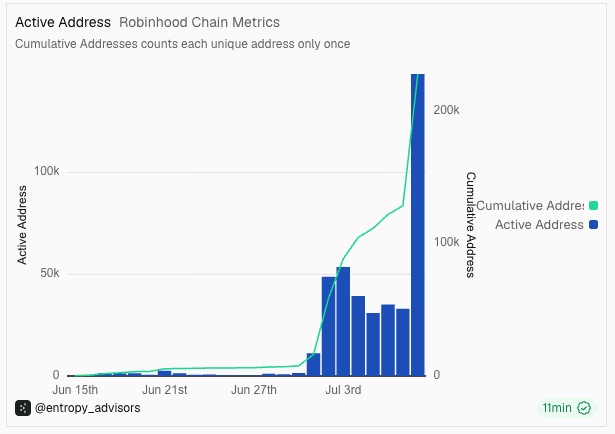
Robinhood Active Address Count. Source: Dune Analytics
CEO's Official Stance Completely Reverses
The shift in strategic direction began at the top. On the evening of July 7th, CEO Vlad Tenev posted on platform X: "We built Robinhood Chain to be the best public chain for real world assets (RWA)... but the chain is also really great for memes."
This statement overturned his position from just days before. On the day of the mainnet launch, July 2nd, he stated in a CNBC interview that meme coins were essentially dead. In his view, tokens without practical utility were unsustainable in the long run, and tokenized real-world assets were a more viable path for the crypto industry.
When Robinhood officially launched the mainnet at its London keynote presentation "Robinhood Presents: The World is Flat," it consistently positioned the chain as infrastructure for tokenized stocks and various real-world assets; integrations with Uniswap, Chainlink, Alchemy, and BitGo were completed on launch day.
Pump.fun Diverts a Large Number of Traders
On July 8th, the token launch platform Pump.fun, born in the Solana ecosystem, announced support for trading Robinhood Chain tokens, significantly lowering the barrier for traders to participate in the chain's meme coins.
The platform's official account posted on platform X: "You can now trade Robinhood Chain tokens on the Pump.fun app! No bridge needed, trade seamlessly with SOL, all popular Robinhood chain tokens are supported."
Pump.fun co-founder Alon Cohen stated that this update is merely an extension of the platform's existing multi-chain trading tool features, not a separate new business. He posted: "Pump.fun is not just for launching platform-native tokens, it supports all cross-chain trading. You can trade Robinhood tokens now, fee-free via Solana rails."
World Project Migrates Out of Solana Ecosystem
Robinhood Chain successfully poached project resources from the Solana ecosystem. The on-chain prediction market World launched on Solana on July 1st, accessible directly within the Phantom wallet. Now, the project's officials have announced a complete migration to this new public chain.
The project team announced on platform X on July 8th: "World has decided to migrate from Solana to Robinhood Chain." The team stated that the strategic adjustment was made after careful evaluation over the past 24 hours and expressed gratitude to the Solana Foundation and community.
CASHCAT Ignites Meme Coin Frenzy
The most popular token currently is CASHCAT, named after Robinhood's early stock-trading era mascot "Cash Cat," traded on the Uniswap V3 exchange deployed on Robinhood Chain.
CoinGecko data shows that on July 8th, CASHCAT traded around $0.1373, a 24-hour increase of 1320%, with a market cap nearing $137 million and a 24-hour trading volume of approximately $194 million; its price fluctuated between $0.0089 and $0.1475 that day.
User Base Expands Rapidly From Zero
Setting aside the meme coin frenzy, on-chain monitoring data shows growth across all aspects of the ecosystem. Active addresses during the testnet phase in June were nearly zero, but daily active addresses surged to tens of thousands in early July, with cumulative unique addresses approaching 200,000.
Decentralized exchange volume performed remarkably, peaking at nearly $400 million on July 7th, with the vast majority of trades completed via Uniswap V3, V4, and PancakeSwap V3. Meanwhile, on-chain fees remained low, with Gas prices around 0.021 Gwei and an average transaction fee of just $0.005.
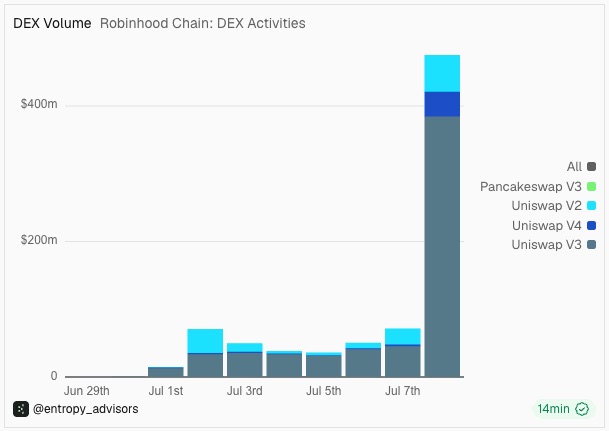
Robinhood Chain DEX Trading Volume. Source: Dune Analytics
Core Driver of TVL Surge is Ethena Stablecoin, Not Meme Coins
While market attention is focused on meme coin speculation, the most critical factor driving the surge in Robinhood Chain's total value locked (TVL) is a deposit of stablecoin funds. Ethena injected approximately $50 million into the USDG pool managed by Steakhouse Financial within the lending protocol Morpho. Morpho is the underlying protocol for Robinhood's Earn product on the chain, which can offer an annualized yield of about 7% for USDG.
DefiLlama data shows this capital inflow directly propelled the protocol's TVL to a single-day increase of over 160%. Morpho hosts the vast majority of statistically trackable DeFi liquidity on the chain, with stablecoins (primarily USDG) constituting the bulk of on-chain asset value.
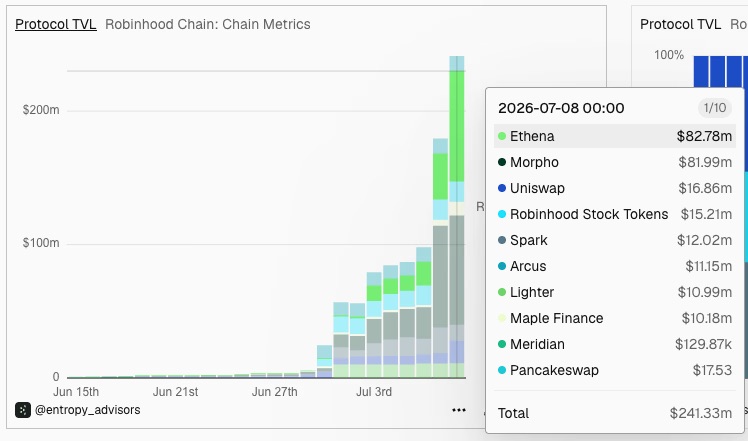
Robinhood Chain Total Value Locked. Source: Dune Analytics
The data reflects two parallel development paths for the public chain: institutional stablecoin capital and lending business solidify the underlying capital base; the retail-driven meme coin frenzy boosted by Pump.fun continuously drives up transaction counts and active users. Confusing the relationship between the two would severely overstate the contribution of meme trading to the total value locked metric.
RWA Business Still Accounts for a Tiny Fraction
Despite Robinhood Chain's focus on the RWA narrative, tokenized real-world asset business currently constitutes an extremely low proportion. The total value of tokenized assets like U.S. Treasuries, stocks, ETFs, and commodities is only about $12.8 million, far less than the TVL supported by stablecoins and lending funds.
The stock tokens launched by Robinhood are tokenized debt certificates that track the prices of U.S. stocks and ETFs but do not grant holders shareholder voting rights. The product is open to users in over 120 countries globally and is not offered to users within the United States.
This gap summarizes the state of Robinhood Chain in its first week: speculative trading and stablecoin deposits seeking yield bring initial liquidity and on-chain activity, while the chain's originally planned core focus — tokenized securities business — remains in its slow early stages.