Ripple Global Footprint Expands, Quietly Building A Banking Empire – Here’s Why February 26 Is Important

bitcoinistPubblicato 2026-02-23Pubblicato ultima volta 2026-02-23

Introduzione

Ripple, a leading US payment company, is expanding its global footprint and building a modern digital banking empire through strategic alliances, regulatory approvals, and infrastructure development. Key acquisitions like Metaco and Hidden Road have bolstered its institutional custody, prime brokerage, and treasury infrastructure. A crucial date is February 26, when the SEC is set to announce a decision on a proposed crypto ETF, potentially providing clearer pathways for traditional investors. Meanwhile, investor interest in XRP is surging, with data showing a rapid increase in long positions, indicating growing optimism for a price rebound.

In a significant development that could shape the finance sector, Ripple, a leading American-based payment company, has disclosed its financial ambitions, which signal a growing banking powerhouse. With this move, the firm is extending its global reach in the crypto and financial landscape, reinforcing its modern-day banking infrastructure.

A Bid From Ripple To Reshape Global Banking

Ripple is taking the spotlight after an update about the firm’s latest move that underscores its financial ambitions. The company is progressively growing its global presence and establishing the foundation for what is beginning to seem like a modern digital banking empire.

By forming strategic alliances, gaining regulatory approval, and building infrastructure in important financial areas, the business is putting itself in a position to lead institutional blockchain adoption and cross-border payments. Pumpius, a crypto expert and investor, stated that Ripple is bringing together the full institutional stack in a similar pattern to how banks do it, one regulated component at a time.

The expert has also underlined the firm’s acquisitions in recent years, which tells a story. This is evidenced by the firm’s acquisition of Metaco and Hidden Road. While Metaco gave the firm institutional custody rails, Hidden Road has added prime brokerage-grade execution, financing, and access to real market plumbing. As a result of this, Ripple’s rail plugs into high-volume payment distribution.

While several prices are displayed to the public, some of them are not. However, the trajectory is clear, which is indicated by custody payments, prime brokerage, and treasury infrastructure under one roof. With the inclusion of the OCC Trust bank angle, Ripple is already moving through the United States banking pathway, generating conditional approvals observed among firms in that field.

This is considered the cheat code. Getting involved with the regulated perimeter leads to a barrier to permission, and a company becomes the system that institutions are allowed to use.

As the payment builds a banking stack, February 26 stands as a crucial date in its journey. On the day, the US Securities and Exchange Commission (SEC) is scheduled to announce its decision in a Federal Register proceeding linked to a proposed T Rowe Price crypto Exchange-Traded Fund (ETF). “That is the calendar of when traditional allocators get clearer lanes,” Pumpius added.

Long Positions In XRP Are Heating Up Once Again

With excitement surrounding several updates of Ripple, investors appear to be doubling down on XRP again. Interest in the altcoin has improved over the past few days, as long positions in the leading altcoin are reemerging at a fast rate.

Using data from Binance, the cryptocurrency exchange leader, CW has disclosed a rapid increase in XRP positions from top traders. When investors start to open longs again, it may suggest that they are positioning ahead of a potential bounce.
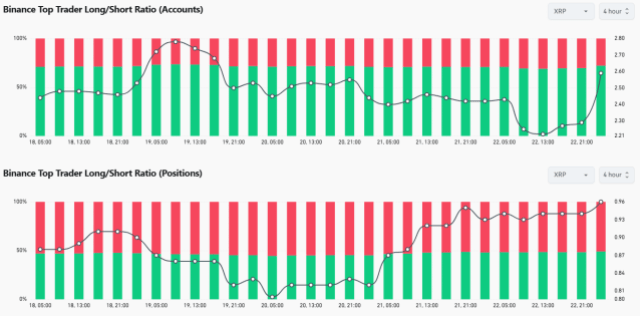
Source: Chart from CW on X

CW noted that these traders were previously positioned heavily on the short side, but the chart shows that they are now becoming neutral. As a result of the renewed conviction, the expert believes that XRP will soon regain the upper hand.

XRP trading at $1.36 on the 1D chart | Source: XRPUSDT on Tradingview.com

Domande pertinenti

QWhat is the significance of February 26th for Ripple, according to the article?

AFebruary 26th is the date the US Securities and Exchange Commission (SEC) is scheduled to announce its decision in a Federal Register proceeding linked to a proposed T Rowe Price crypto Exchange-Traded Fund (ETF), which is seen as a crucial moment for traditional allocators to get clearer regulatory lanes.

QWhich two key companies has Ripple acquired to build its institutional infrastructure?

ARipple has acquired Metaco, which provided institutional custody rails, and Hidden Road, which added prime brokerage-grade execution, financing, and access to real market plumbing.

QHow are top traders on Binance positioning themselves regarding XRP, as reported in the article?

AData from Binance shows a rapid increase in long positions for XRP from top traders, indicating they are positioning ahead of a potential price bounce after previously being heavily positioned on the short side.

QWhat strategy is Ripple using to build a modern digital banking empire, as described by the expert Pumpius?

ARipple is building its empire by forming strategic alliances, gaining regulatory approvals, and building infrastructure in key financial areas, bringing together the full institutional stack one regulated component at a time, similar to how traditional banks operate.

QWhat specific advantage does the article say Ripple gains by operating within the regulated perimeter?

AOperating within the regulated perimeter creates a barrier to permission and allows the company to become the system that institutions are officially allowed to use, which is described as 'the cheat code' for success.

Letture associate

Can Generative Models Finally Be Trained End-to-End? The Core Is a For Loop

This article introduces a novel training paradigm for generative models called Explorative Modeling (XM), which enables true end-to-end training. Traditionally, powerful generative models like autoregressive and diffusion models are not trained end-to-end. They are trained to predict a single small step but require iterative multi-step sampling for inference. This "exposure bias" leads to error accumulation and limits performance. The core challenge XM addresses is "mode blurring." In generative tasks, a single input (e.g., "generate a dog") corresponds to many valid outputs (multiple modes). Standard training objectives like reconstruction loss force the model to average these modes, producing unrealistic, blurry outputs. To avoid this, existing models break generation into many small, almost deterministic steps, sacrificing end-to-end training. XM tackles this by restructuring the training loop itself. Its key insight is to amplify "generative expressivity." For each training input, instead of generating one sample, the model generates K candidate outputs. Only the candidate closest to the real data is used for computing the loss and updating the model via backpropagation. This simple "best-of-K" mechanism is implemented as a short for-loop. By exploring multiple possibilities, the model learns to distribute its guesses across different modes rather than collapsing to their uninformative average. The paper demonstrates that "exploration" acts as a new, powerful scaling axis. Gains from XM increase with model size, data scale, and compute. Experiments show improvements in FID scores for image generation and significant efficiency gains, sometimes outperforming larger models without exploration. When pushed to the limit, XM enables fully single-step, end-to-end generative models. In robotics tasks, an "Explorative Policy" matched the performance of a 100-step Diffusion Policy with a single forward pass, drastically improving inference speed. While the best-of-K concept is not entirely new, the authors' contribution lies in formally understanding it as a direct method to boost generative expressivity without fragmenting the generation process. This work suggests that as models scale, enhancing exploration during training may become crucial for overcoming fundamental performance bottlenecks.

marsbit8 min fa

Can Generative Models Finally Be Trained End-to-End? The Core Is a For Loop

marsbit8 min fa

Annual Salary of Millions Competing for Electricians, Meta Rushes to Open Its Own Technical School

The AI boom is facing an unexpected bottleneck: a severe shortage of skilled construction workers and electricians. As tech giants like Meta, OpenAI, and Alphabet race to build massive data centers—such as OpenAI's $16 billion "Stargate" project—they are hitting a critical labor wall. The U.S. needs an estimated 130,000 more electricians, 240,000 construction workers, and 150,000 supervisors by 2030 for AI infrastructure alone, but tens of thousands of electrician jobs go unfilled each year. While AI companies offer high premiums, with electricians earning up to $280,000 annually, worker scarcity still causes massive losses—delays on a single project can cost $14.2 million per month. The complexity of building AI data centers, which require immense power (equivalent to powering hundreds of thousands of homes), sophisticated electrical systems, and advanced liquid cooling solutions, demands highly skilled technicians who are in short supply. To combat this, companies are investing heavily in training. Meta has committed $115 million to a free training school offering tuition, housing, and stipends, targeting 5,000 new workers. OpenAI is partnering with unions to secure skilled labor. These efforts are paying off, with a significant rise in Gen Z interest in trade schools over college. However, the power demands are staggering. AI data centers are driving a rapid surge in electricity consumption, projected to account for up to 12% of U.S. power use by 2028 and raising costs for consumers. Furthermore, the construction boom is project-based, leading to a potential future glut of trained workers once building peaks, which could depress wages industry-wide. The race for AI supremacy now depends as much on skilled hands as on advanced chips.

marsbit1 h fa

Annual Salary of Millions Competing for Electricians, Meta Rushes to Open Its Own Technical School

marsbit1 h fa

Trading

Spot
活动图片