Author: Sanqing, Foresight News
During the Sibos 2025 conference in Frankfurt, Swift's Chief Business Officer Thierry Chilosi and Standard Chartered Bank's Global Head of Transaction Banking, Michael Spiegel, discussed a major transformation in global finance. As tokenization moves from pilot programs to reality, Swift officially announced the addition of a blockchain-based shared ledger to its infrastructure, aiming to achieve trusted and interoperable digital finance on a global scale. This ledger will serve as a secure, real-time transaction record between financial institutions, using smart contracts to validate transaction sequences and execute agreed-upon rules. It is designed to complement existing systems and seamlessly bridge traditional finance with tokenized assets.
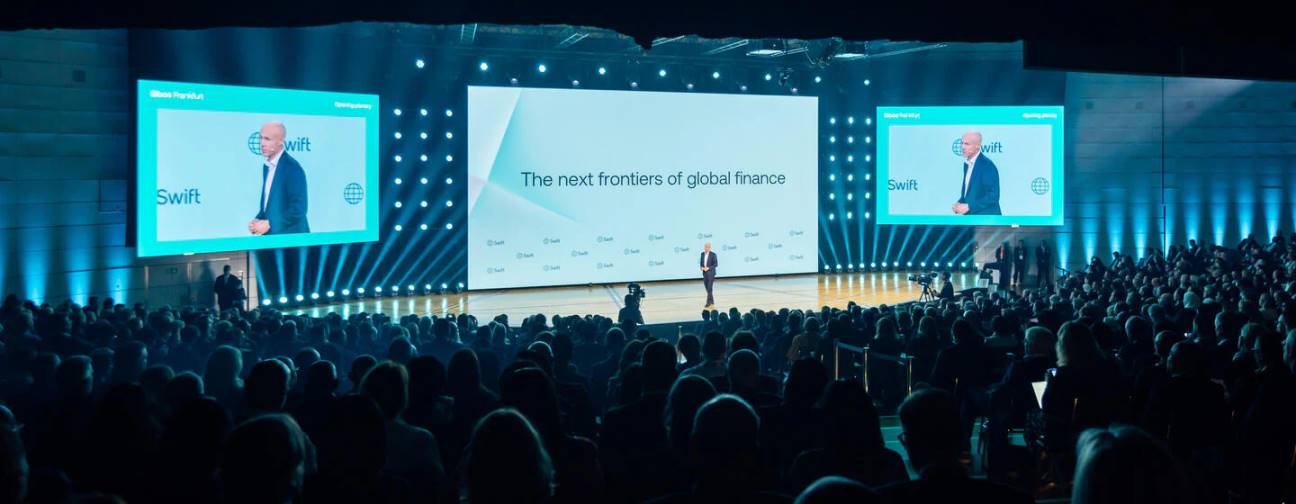
Image Source: Swift Official Website
Although Swift did not explicitly state the technical platform when initially announcing this major development to the banking industry, Consensys CEO Joe Lubin revealed at the Token2049 conference in Singapore that Swift is leveraging the Ethereum Layer 2 network Linea to build its new payment settlement platform. By adopting Linea's zk-EVM rollup technology, Swift can significantly reduce costs and latency while meeting the financial industry's stringent requirements for 24/7 real-time settlement and security. Currently, over 30 top financial institutions, including JPMorgan Chase, Bank of America, and Citibank, are preparing to participate in the pilot of this new blockchain-based payment rail built on Linea.
Ripple's In-Depth Efforts and Current Status
Before discussing Swift, we must revisit the pioneer that challenged the old system for over a decade: Ripple.
In 2012, Ripple emerged with the XRP Ledger (XRPL), with the core goal of replacing the inefficient Swift correspondent banking model. During this period, Ripple successfully built the global payment network RippleNet, connecting over 300 financial institutions. In fragmented markets like Southeast Asia, its On-Demand Liquidity (ODL) service demonstrated that XRP, as a bridge currency, could reduce cross-border settlement times from several days to just 3 to 5 seconds.
By 2020, affected by the U.S. SEC lawsuit, Ripple faced a blockade and stagnation in the U.S. market due to securities allegations. However, its global scale continued to expand. By 2022, its business had reached over 40 payment markets, with total payment volume doubling to approximately $30 billion.
In 2023, Ripple saw a turning point when a court ruled that XRP itself is not a security, marking a milestone victory for Ripple and the industry.
In August 2025, with the SEC completely abandoning its appeal, the five-year legal battle came to an end. The full clarification of its status led to the approval of an XRP spot ETF, marking its official entry into mainstream institutional asset allocation portfolios.
Today, Ripple is conducting cross-border payment and receipt businesses in multiple real-world scenarios, ranging from retail remittances (To C) to enterprise-level payments (To B).
In the retail sector, Japan's SBI Remit uses XRP to bridge real-time remittance channels to the Philippines, Vietnam, and Indonesia, significantly reducing the pre-funding costs for overseas workers. Santander Bank offers transparent real-time transfers to its customers through the One Pay FX app. Meanwhile, the Southeast Asian payment platform Tranglo has significantly improved the efficiency of peso and baht conversions with the support of Ripple ODL.
At the enterprise level, American Express and PNC Bank use RippleNet to optimize B2B trade settlements and international payment collection experiences.
Additionally, in national infrastructure, Ripple is collaborating with over 20 countries, including Palau, Montenegro, and Bhutan, to develop CBDC platforms, applying blockchain technology to the issuance and清算 systems of sovereign currencies.
Why Did Swift Choose Linea?
When giants in the industry布局 the Ethereum ecosystem, they have shown a high degree of consistency in their preference for Layer 2 technology: Coinbase's Base chain is built on OP Stack, while Robinhood announced earlier this year the launch of Robinhood Chain based on Arbitrum technology to support the tokenization and 24/7 trading of RWA.
This preference stems from L2's ability to leverage Ethereum's security while meeting high-performance demands through a modular architecture. Swift's choice of Linea over OP or Arbitrum lies in the core difference in underlying validation logic.
OP and Arbitrum use Optimistic Rollup, which operates on the logic of assuming transactions are valid by default and only verifying them if challenged. Asset withdrawals typically require a multi-day challenge period, which is a significant time cost for financial清算追求流动性.
Linea, on the other hand, uses zk-EVM, which provides instant validity proofs mathematically. For Swift and its partner banks, which need to process massive value settlements, zk-EVM not only offers faster finality but also ensures compliance verification while protecting transaction privacy.
Swift's choice of Linea embodies the first principle of capital operation: maximizing flow velocity.
Capital will flow like a fluid from low-velocity systems (requiring large amounts of idle准备金预存 in Nostro/Vostro accounts), high-friction systems (layers of correspondent bank fees), and slow-settlement systems (settlement taking days) of the traditional telegraphic instruction era to high-velocity, low-friction, fast-settlement blockchain digital systems.
Swift processes approximately $150 trillion in global payments annually. If it can achieve atomic-level reconciliation and 24/7 real-time settlement through Linea's technology stack, it means that trillions of dollars in准备金 currently积压 in the global financial system to hedge against清算 delays will be released and reinjected into the real economy.
As Consensys CEO Joe Lubin stated at the Token 2049 conference in Singapore, this is not merely a technological upgrade but the true convergence of TradFi and DeFi, marking the global value transfer protocol's official transition from the "Telegraphic Instruction Era" to the "Mathematical Verification Era."
The Significance of Swift Embracing Blockchain
As the global financial backbone network handling approximately $150 trillion in annual transaction volume, Swift's decision to build its ledger on Linea, an Ethereum Layer 2, signifies that blockchain technology will become the heart of mainstream finance.
Swift will eliminate fragmentation between different tokenized networks through unified technical standards, breaking down the long-standing barrier between TradFi and DeFi and implanting the efficiency genes of decentralized finance into the traditional清算 system.
Through a 24/7 operational real-time shared ledger, global financial institutions will no longer be limited by the cumbersome manual reconciliation and time-zone delays of the correspondent banking model. The massive amounts of idle capital currently积压 in correspondent bank accounts to hedge against清算 risk will be effectively released. This will enable the speed of capital flow to truly match the demands of the modern economy, ushering in a new era of global value transfer that is more transparent, lower cost, and更具互操作性.
Ripple struggled for a decade to build a new city based on the XRP Ledger outside the old system. However, the scale of financial institutions it currently connects appears势单力薄 compared to Swift's存量 network, which covers over 11,000 institutions across more than 200 countries.
The core threat from Swift lies in its "asset neutrality." Unlike Ripple's ODL model, which heavily relies on XRP as a bridge currency, Swift's blockchain ledger is designed to support multiple assets, including fiat currencies, stablecoins, and CBDCs.
Banks within the Swift system can achieve instant settlement by upgrading their existing rails without bearing the volatility risk of a single asset. This combination of "存量优势 (incumbent advantage) + technical compliance" is giving Ripple its most bone-chilling challenge since its inception.



















