Rhythm Interview with OpenMind: From x402 Payments to Building the 'Android for Robots'

marsbitPubblicato 2026-01-22Pubblicato ultima volta 2026-01-22

Introduzione

In a 2025 interview, OpenMind founder and Stanford professor Jan Liphardt discusses his vision for building the "brain" for humanoid robots, positioning it as a potential "Android for robots." Following a $20 million funding round, OpenMind has accelerated its product roadmap, launching a suite of offerings from an underlying operating system to a payment protocol. A core of OpenMind’s strategy is enabling the emerging "Machine Economy," where robots act as independent economic agents. A key development is its partnership with Circle and the implementation of the x402 protocol, allowing robots to autonomously conduct transactions using USDC stablecoins—exemplified by robots independently paying for charging at stations in San Francisco. Beyond payments, OpenMind is creating a modular operating system (OM1) and a dedicated app store where users can download skills and applications for their robots. The company aims to address critical challenges in robotics, including value exchange, identity authentication, data privacy, and collaborative governance through its FABRIC protocol and blockchain technology, envisioning a future of seamless human-robot collaboration.

In 2025, humanoid robots are transitioning from science fiction to reality. From Tesla's Optimus to Figure AI's Figure 01, the capabilities of general-purpose humanoid robots are rapidly expanding with the support of large language models. According to Goldman Sachs predictions, the humanoid robot market could reach $154 billion by 2035. A trillion-dollar market is attracting the world's top tech companies and brightest minds to dive in.

However, as robots' "limbs" become increasingly advanced, a more core question arises: how to build an intelligent, open, and secure enough "brain"? When thousands of robots enter homes, hospitals, and cities, how will they collaborate, exchange value, and seamlessly integrate with human society?

Stanford professor and OpenMind founder Jan Liphardt provides his answer. After securing $20 million in funding led by Pantera Capital in August 2025, OpenMind hit the fast-forward button, releasing a series of products from the underlying operating system to upper-layer payment protocols, gradually outlining the complete blueprint for its "robot brain."
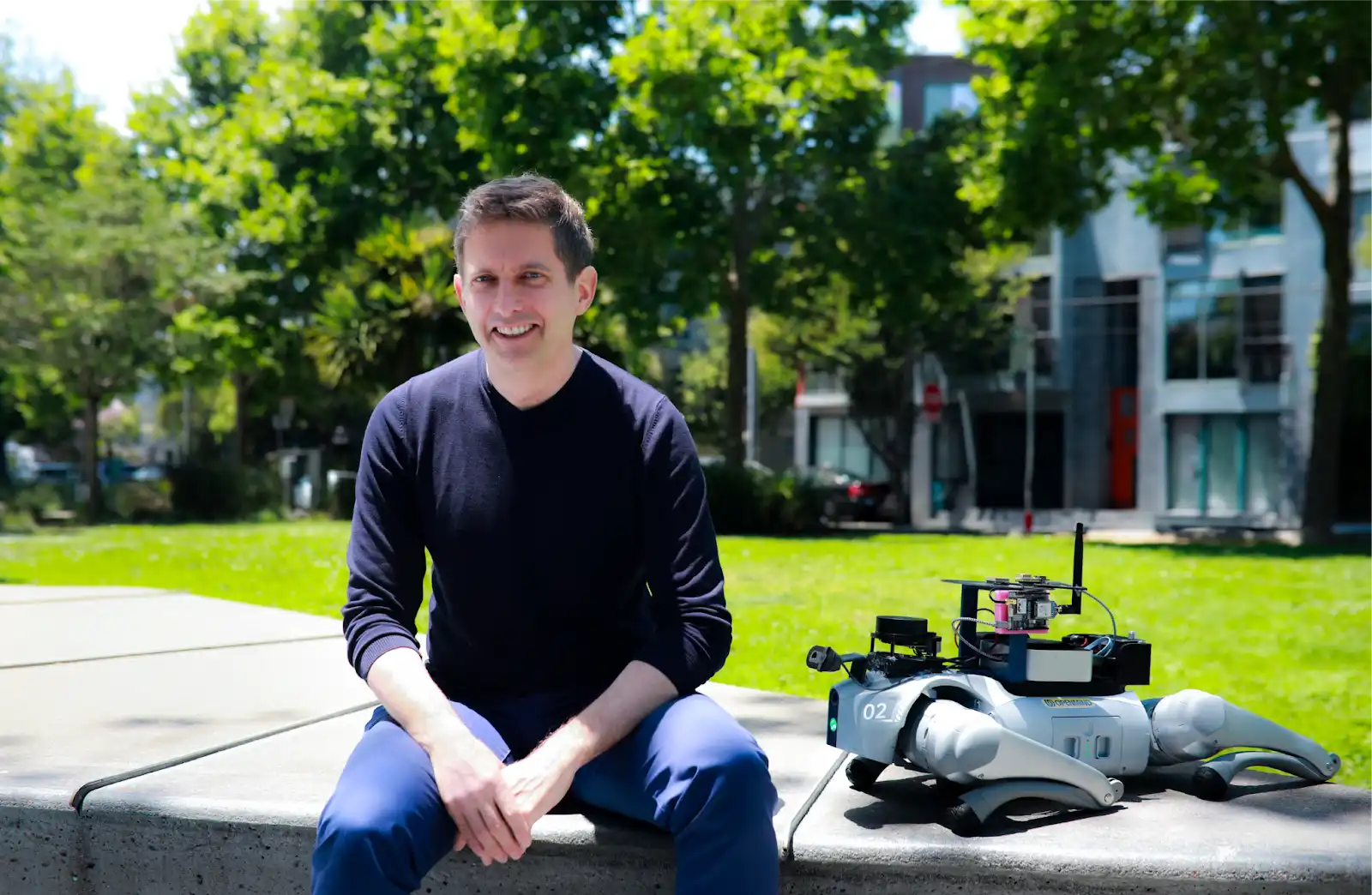
OpenMind's core business is providing SaaS-based cloud cognitive services to enterprises. But they keenly observed that as robots become independent economic participants, blockchain will play a crucial role in payment systems, identity authentication, data privacy, and collaborative governance.

Recently, OpenMind's collaboration with stablecoin issuer Circle and the deployment of robot charging stations on the streets of San Francisco are initial implementations of this vision. Robots can independently complete charging payments using USDC, which may mark the dawn of the "Machine Economy" era.

Simultaneously, OpenMind is building a dedicated app store for robots, allowing users to download applications and skills to their robots in one place, much like customizing phone apps on the Apple App Store or Google Play Store. The app was launched last week on the OpenMind App Store.

In this exclusive interview, we delved into the philosophy behind building the robot "brain," the design理念 of the modular operating system OM1, and how the FABRIC protocol and blockchain technology can构建 a future where machines and humans collaborate efficiently. He shared OpenMind's technical roadmap and offered profound insights on key issues such as developer ecosystems, remote operation, and data privacy.

Below is the interview content:

Establishing a "Bank Account" for Robots

In December 2025, OpenMind and stablecoin issuer Circle jointly announced the launch of a robot autonomous payment system based on the x402 protocol. As robots' capabilities improve, they will no longer be mere tools for executing tasks but will start to act as autonomous economic entities. They will need to purchase computing power, data, skills, and even hire other robots or humans to complete complex tasks.

To achieve this, a financial system designed specifically for machines, requiring no human intervention, becomes indispensable. The traditional banking system is clearly not prepared for this, and cryptocurrency and blockchain technology, with their native digital and decentralized characteristics, have become the most natural choice.


Domande pertinenti

QWhat is the core business of OpenMind as mentioned in the article?

AOpenMind's core business is providing SaaS-based cloud cognitive services for enterprises.

QWhich company led the $20 million funding round for OpenMind in August 2025?

APantera Capital led the $20 million funding round for OpenMind in August 2025.

QWhat specific payment protocol did OpenMind collaborate with Circle to implement for robots?

AOpenMind collaborated with Circle to implement a robot autonomous payment system based on the x402 protocol.

QWhat is the name of the modular operating system that OpenMind is developing for robots?

AOpenMind is developing a modular operating system called OM1 for robots.

QWhat recent development did OpenMind announce for customizing robot capabilities, similar to smartphone app stores?

AOpenMind announced a dedicated app store for robots, allowing users to download applications and skills to their robots, similar to smartphone app stores.

Letture associate

CRCL 暴涨暴跌,COIN 跟着跳水:CLARITY Act 背后真正的利益战争

A recent draft of the CLARITY Act sparked market volatility, with Circle (CRCL) and Coinbase (COIN) stocks plunging. The core issue is Section 404 of the draft, which proposes prohibiting digital asset service providers from paying interest or rewards *solely* for holding payment stablecoins. The article argues this is not merely a technical debate over rewards, but a fundamental battle over the future role of stablecoins: Will they remain purely payment/transaction tools, or evolve into on-chain savings accounts that compete with bank deposits? US banks, fearing deposit outflow, have lobbied heavily for such restrictions. While Circle and Coinbase were both hit, their exposures differ. Circle's direct revenue primarily comes from reserve earnings, so the draft impacts its future growth narrative. Coinbase, however, relies heavily on USDC rewards and balances as part of its "Everything Exchange" platform strategy, making its growth engine more directly vulnerable. The analysis identifies three deeper layers often missed: 1) The political economy of preventing stablecoins from becoming savings substitutes. 2) The distinct impact on issuers (Circle) versus distributors/platforms (Coinbase). 3) The migration of yield demand to other tokenized securities (like MMFs) regulated under existing frameworks, as hinted in Section 505 of the same draft. In essence, three major battles are underway: banks defending their deposit base, Coinbase fighting for user entry and distribution rights, and Wall Street aiming to control the compliant path for tokenization. While a short-term headwind for crypto-native platforms, the article suggests this regulatory push could force the industry to build more sustainable value in real payment and B2B infrastructure.

marsbit33 min fa

CRCL 暴涨暴跌,COIN 跟着跳水:CLARITY Act 背后真正的利益战争

marsbit33 min fa

Tom Lee充值信仰:加密春天已至,ETH会涨到25万美元

Tom Lee, Chairman of BitMine (NYSE: BMNR), asserts that "Crypto Spring" has arrived and predicts ETH could reach $250,000. In his speech at "Proof of Talk 2026," he outlines five macro catalysts: the end of the Iran war reducing oil-price inflation, the likely passing of pro-crypto US legislation (the Clarity Act), a supportive White House, a crypto-friendly new Fed Chair (Kevin Warsh), and strong demographic-driven equity market growth. Lee argues that two key trends will drive ETH's value: Agentic AI/robotics, which will require blockchain for control and payments, and the massive tokenization of real-world assets (potentially a $300 trillion market). He believes Ethereum is poised to become a future monetary unit, with its price closely linked to software stocks that are already benefiting from AI. He notes the evolving role of the Ethereum Foundation, whose ETH holdings have shrunk to 0.1% of supply. He positions public treasury companies like BitMine—which holds 4.47% of ETH's circulating supply—as the new key ecosystem funders and validators. Finally, Lee promotes BitMine as a leveraged play on ETH's rise. He highlights BitMine's investments in AI/identity (via Eightco/ORBS), its massive ETH staking operation generating ~$1M daily, its stake in content creator MrBeast, and its upcoming inclusion in the Russell 1000 index, which could drive significant institutional buying. He concludes that if ETH reaches $25,000, BitMine's stock could rise dramatically from its current ~$18 price.

Odaily星球日报51 min fa

Tom Lee充值信仰:加密春天已至,ETH会涨到25万美元

Odaily星球日报51 min fa

Trading

Spot
Futures
活动图片




