Reviewing Major Institutions' 2025 Bitcoin Price Predictions: Almost All Failed

marsbitPubblicato 2025-12-22Pubblicato ultima volta 2025-12-22

Introduzione

Review of Major Institutions' Bitcoin Price Predictions for 2025: Nearly All Failed In late 2024 and early 2025, the crypto market consensus was highly unified: post-halving momentum, ETF-driven institutional adoption, and favorable regulatory expectations were seen as key drivers for further gains in BTC and risk assets. Against this backdrop, multiple institutions and prominent figures issued aggressive year-end price targets, particularly in the $200,000–$250,000 range, while others focused on structural industry changes like expanded compliant product offerings and the mainstreaming of exchanges and crypto companies. A review of 2025's actual performance shows that price point predictions普遍 (universally) overestimated the strength and sustainability of the rally. In contrast, judgments related to regulation and industry structure were more likely to be at least partially realized. Most price predictions failed significantly. For instance: - KuCoin Research predicted a peak near $250,000; BTC's actual peak was ~$126,000, falling to ~$88,000 by year-end. - Tom Lee and H.C. Wainwright cited factors like regulatory tailwinds to forecast $250,000 and $225,000, respectively; these targets were vastly unmet. - Matrixport's more conservative $160,000 target and VanEck's detailed cycle path (peak of ~$180,000) also went unfulfilled. - Bitwise's prediction of BTC above $200,000 failed, though its call for Coinbase's entry into the S&P 500 proved correct. The common failure was ...

Author| WuBlockchain

From late 2024 to early 2025, the crypto market had a highly unified narrative for the new cycle: the aftermath of the halving, the diffusion of ETFs and institutionalization, and expectations of more friendly regulation were widely regarded as the core fuel driving BTC and overall risk assets to continue rising. Against this backdrop, several institutions and well-known figures gave aggressive annual target prices (especially in the range of $200,000 - $250,000), while others focused on "structural changes in the industry," such as the expansion of compliant product supply, further mainstreaming of exchanges and crypto companies, and continued growth in sectors like RWA/stablecoins. Looking back at the actual trend in 2025, price point predictions generally overestimated the strength and sustainability of the rise, while judgments related to regulation and industry structure were relatively easier to fulfill.
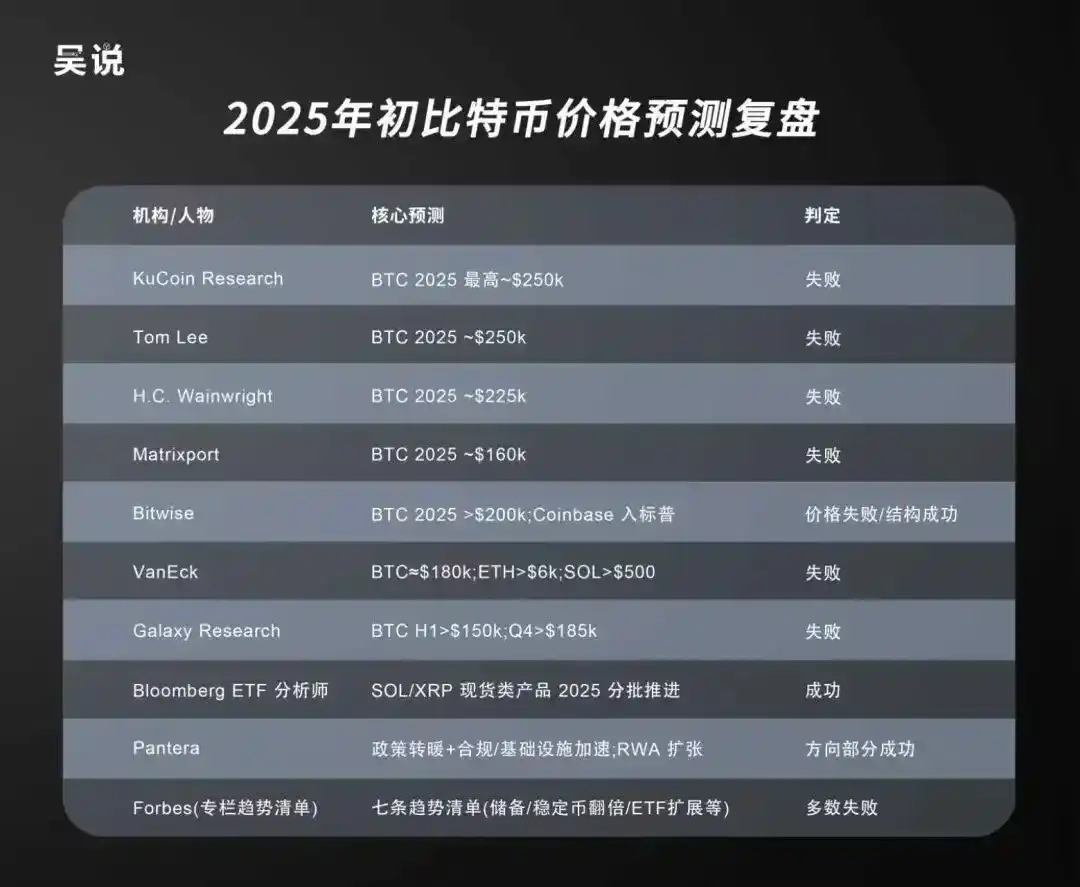
KuCoin Research

The core view of KuCoin Research's "2025 Crypto Market Outlook" was that based on "post-halving historical trends + institutionalization/ETF push," BTC could test a high of around $250,000 in 2025, and it also predicted that the overall crypto market cap (excluding BTC) would reach about $3.4 trillion by the end of 2025, entering a stronger altcoin season; at the regulatory and product level, it expected more crypto ETFs such as Solana and XRP to be approved/advanced in 2025; in terms of application and structural trends, it emphasized that RWA tokenization, AI Agents, and stablecoin scale expansion (exceeding $400B by the end of 2025) would become main themes.

In retrospect: failures were mainly concentrated in "price strength" — BTC's peak during the year was around $126,000+, and it fell back to ~$88,000 by the end of the year, significantly short of the $250,000 target. Success/partial success was more reflected in "structural and supply-side trends": compliant products for SOL/XRP did indeed see progress and trading launch in 2025 (e.g., BSOL started trading on 2025-10-28, XRPC started trading on 2025-11-13), which aligns more with their judgment of "ETF diffusion and increased product supply"; but targets like "stablecoin >$400B by year-end" were closer to not fully realized/possibly overly optimistic.

Tom Lee

Tom Lee mentioned in public in January 2025 that BTC could reach a target of $250,000, mainly citing reasons such as "regulatory tailwinds, market resilience, and capital improvement." The result: looking at the actual volatility path in 2025, this target was significantly missed.

H.C.Wainwright

H.C.Wainwright raised their year-end BTC target to $225,000 in January 2025. Their reasons included: historical cycle patterns, expectations of a more friendly regulatory environment, and increased institutional interest. In terms of results, this target was clearly not achieved. The reason is similar to Tom Lee and most of the "$200,000-level" predictions: they viewed the "favorable environment" as a linear upward driving force but underestimated the market's sensitivity to macro risks and leverage crowding at high levels — that is, once a pullback is triggered, the market tends to first go through "risk clearance" rather than continue to discount the narrative into higher远期 pricing.

Matrixport

Matrixport described 2025 as BTC's "breakthrough year" in their December 2024 view and gave a target price of $160,000, which was relatively "lower than the $200,000-$250,000 camp." Compared to $225,000/$250,000, this target had a lower "threshold" and seemed more like a reasonable upper limit based on improved sentiment and capital conditions, but compared to the final performance in 2025, it still was not achieved.

Bitwise

In Bitwise's "Top 10 Predictions for 2025" in December 2024, the first one was very aggressive: they believed that BTC, ETH, and SOL would hit new all-time highs, and BTC would trade above $200,000 in 2025; they also bet on a set of judgments more偏向 "industry structure" — such as Coinbase entering the S&P 500, stablecoin and tokenized asset scale would expand significantly, and the crypto IPO market would reopen.

From the results, the "price point" was significantly missed: BTC did peak in October 2025 but was still significantly below its yearly high by the end of the year, let alone $200,000. On the other hand, the "mainstream landing" part was closer to reality: Coinbase was officially included in the S&P 500 in May 2025, and the IPO/listing wave also saw标志性 progress in 2025.

VanEck

VanEck's "Top 10 Predictions for 2025" not only gave price targets but also a very specific cycle path: they believed the bull market would reach a mid-term peak in Q1 and gave cycle peak targets: BTC around $180,000, ETH over $6,000, SOL over $500, SUI over $10;随后 they expected BTC could pull back 30%, while altcoins could see pullbacks of up to 60%, before regaining momentum by the end of the year.

Compared to the actual path in 2025, the framework of "there will be剧烈 pullbacks, high volatility" was not离谱, but the key hard points ($180,000/$6,000/$500/$10) were generally not achieved.

Galaxy Research

In their 2025预测 released at the end of 2024, Galaxy Research wrote the core logic for BTC very bluntly: adoption at the institutional, corporate, and national levels would push BTC to break through $150,000 in the first half of the year and test or exceed $185,000 in Q4; they also made a basket of industry predictions, including stablecoin growth, DeFi expansion, and increased institutional participation.

In terms of results, BTC did have a明显的 upward phase in 2025, but overall it did not approach their set targets of $150,000/$185,000. The possible reason: adoption is a "slow variable"; it can change long-term boundary conditions but is difficult to offset the "fast variables" brought by macro shocks, position crowding, and leverage liquidation. When significant pullbacks occur during the year, the market often first gives prices of risk contraction and deleveraging rather than continuing to discount the adoption narrative into higher远期 extremes.

Bloomberg

At the end of 2024, Bloomberg's ETF analysts (such as Eric Balchunas, etc.) discussed "the approval pace of altcoin spot ETFs" as an important variable for 2025 in public discussions: they believed that Solana and XRP spot ETFs were有望 to enter the practical path in 2025 but also clearly indicated that approvals would not "land集中 at the same time" and were more likely to show a节奏 stretched by regulatory processes and advanced in batches.

Looking back, this judgment can be considered overall命中 (direction and节奏 were both right): on October 28, 2025, Bitwise's Solana Staking ETF (BSOL) started trading;随后 on November 13, 2025, Canary XRP ETF (XRPC) also started trading on Nasdaq. The two indeed showed a pattern of "landing先后, not launching on the same day."

Pantera

The main line of Pantera's 2025 crypto outlook was "warming policy environment + accelerated industry compliance/infrastructure," and it emphasized structural trends such as the continued expansion of RWA/real-world asset tokenization.

Looking back, the successful part was mainly in "direction" — policy/regulatory pushes and industry structural progress明显 occurred during the year;而 the failed/underperforming part was mainly in "price strength" — Pantera itself admitted that the price performance in 2025 was lower than many people's expectations, and the market experienced stronger volatility and pullbacks after the surge.

Forbes

Some Forbes columns/opinion pieces also gave "Seven Major Trends in the Crypto Industry for 2025" judgments at the beginning of the year, including "major economies establishing strategic Bitcoin reserves," "stablecoin market cap doubling to $400 billion," "BTC DeFi growing rapidly with L2," "crypto ETFs expanding to Ethereum staking and Solana," etc.

In retrospect, some of the directional content in this type of "trend list" was closer to being realized (for example, discussions on ETF product lines and improved regulatory environment did see progress during the year), but predictions that assumed multiple激进 variables would "smoothly occur throughout the year" were overall optimistic — especially targets like "$8 trillion total market cap," "tech giants following Tesla's lead in increasing BTC holdings," "stablecoin doubling to $400 billion by year-end" were更难 to achieve to the target value in the same year,最终 presenting a result of "少数 partially confirmed,多数 falling short of expectations."

Conclusion

Overall, the wins and losses of these predictions at the beginning of 2025 are not complicated: the more they bet on a single price point and the more extreme the target ($200,000-$250,000), the easier it was to fail; the more they bet on regulatory processes, product supply, and industry structural changes, the easier it was to partially or directionally命中. The market in 2025 was more like a high-volatility path of "new highs — pullbacks — repricing": macro risks and leverage liquidation repeatedly interrupted the trend, making "logical correctness" not necessarily translate into "year-end point realization"; on the contrary, compliant product launches and increased mainstream institutional participation这类 "supply-side changes" were more verifiable, thus performing more steadily in the retrospective.

Original article link

Crypto di tendenza

Domande pertinenti

QWhat was the main reason why most institutional Bitcoin price predictions for 2025 failed?

AMost predictions failed because they were overly optimistic about price strength and linear growth, focusing on high single-point targets (e.g., $200k-$250k), while underestimating the market's sensitivity to macro risks, leverage crowding, and subsequent sharp corrections and deleveraging.

QWhich type of 2025 predictions were more likely to be at least partially correct, according to the article?

APredictions focused on regulatory progress, product supply expansion (like new ETFs), and industry structural changes (e.g., institutional adoption, compliance) were more likely to be partially or directionally correct.

QName one specific example of a structural/industry prediction that was successfully realized in 2025.

AThe prediction that Solana and XRP ETFs would be approved and launched was realized, with the Bitwise Solana Staking ETF (BSOL) starting trading on October 28, 2025, and the Canary XRP ETF (XRPC) on November 13, 2025.

QWhat was the actual peak price of Bitcoin in 2025, as mentioned in the article?

AThe actual peak price of Bitcoin in 2025 was approximately $126,000.

QWhich company's prediction included Bitcoin's inclusion in the S&P 500, and did this happen?

ABitwise predicted that Coinbase would enter the S&P 500. This prediction was successful, as Coinbase was officially included in the S&P 500 in May 2025.

Letture associate

STAR 50 Soars 10.73%, Why Did A-Shares Stage a "V-Shaped Reversal"?

After a prolonged decline, the Chinese A-share market staged a strong rally on July 21. The STAR 50 index surged 10.73%, its largest single-day gain in nearly a year, leading a broad-based "V-shaped" reversal. The Shanghai Composite Index rose 1.79%, the Shenzhen Component Index gained 4.81%, and the ChiNext Index jumped 7.05%. Total market turnover reached 2.97 trillion yuan, an increase of 256.1 billion yuan from the previous session, with over 3,100 stocks advancing. The semiconductor sector spearheaded the rebound, with related ETFs posting significant gains. Analysts attribute the surge to three converging factors. First, coordinated capital inflows from "national team" institutions, insurance funds, listed company buybacks, and fund house self-purchases have bolstered market liquidity and confidence. Second, supportive policy signals, including commitments from regulators to ensure stable market operations, provided a favorable backdrop. Third, a stabilization and recovery in overseas markets, notably South Korea, created a positive external environment. Institutions suggest the most severe panic selling phase for the tech sector has likely passed, following a significant digestion of crowded positions and leveraged funds. While short-term volatility may persist, the medium to long-term outlook remains underpinned by enduring trends like AI computing demand expansion and semiconductor localization. The market's focus now shifts to the sustainability of supportive fund flows, earnings reports, and upcoming catalysts from the global AI industry chain.

marsbit39 min fa

STAR 50 Soars 10.73%, Why Did A-Shares Stage a "V-Shaped Reversal"?

marsbit39 min fa

U.S. Tech Momentum Stocks Post Largest Single-Day Gain Ever, But Is the Plunge Over?

US tech momentum stocks staged a sharp rebound on Tuesday (July 21st). Morgan Stanley's TMT Momentum Factor surged over 12%, marking its largest single-day gain on record, exceeding even peaks from the 2000 dot-com bubble. Key momentum indices from Goldman Sachs also posted their strongest daily performances in years. The rally was led by semiconductors, with the Philadelphia Semiconductor Index jumping 4.6%. This rebound followed three consecutive down days and a cumulative 33% plunge in momentum stocks, one of the steepest drawdowns since the dot-com era. Analysts attribute the surge largely to a short squeeze. Heavy selling had pushed high-beta momentum stocks into deeply oversold territory, forcing many short sellers, particularly in Asia, to cover their positions, creating a self-reinforcing buying spiral. However, the rebound's internals appear weak. Trading volume was notably low, and advancing stocks still lagged decliners on the S&P 500, indicating a narrow, concentrated rally rather than broad market participation. Diverging views emerge on the outlook. BTIG warns the bounce has hit key resistance and recommends selling into strength, citing extreme volatility and historical parallels to past market tops. Conversely, Goldman Sachs and UBS believe the momentum unwind is nearing its end, suggesting it may be time to gradually add exposure, as positioning has been significantly reduced. They caution, however, that high volatility warrants a measured approach, potentially using defined-risk strategies. The upcoming earnings season, particularly reports from major tech firms like Alphabet, is seen as a critical test for the rally's sustainability. Simultaneously, bond markets flashed a warning, with yields rising partly due to spiking oil prices. Analysts note that if long-term Treasury yields break decisively higher, it could pose a significant headwind for equities, especially growth stocks.

marsbit46 min fa

U.S. Tech Momentum Stocks Post Largest Single-Day Gain Ever, But Is the Plunge Over?

marsbit46 min fa

U.S. Tech Momentum Stocks Record Largest Single-Day Gain Ever, but Has the Rout Ended?

U.S. tech momentum stocks staged a dramatic rebound on Tuesday, July 21st. Key momentum indices like the Morgan Stanley TMT Momentum Factor and Goldman Sachs' High Beta Momentum Long Index posted historic or near-historic single-day gains, fueled largely by semiconductor stocks. This sharp rally followed a severe three-day sell-off that saw momentum stocks plunge 33%, marking one of the steepest pullbacks since the dot-com bubble. Analysts attribute the bounce primarily to a short squeeze, as forced covering from over-leveraged traders, particularly in Asia, created a buying spiral. However, the rally's health is questioned due to weak market breadth—overall trading volume was low, and decliners outnumbered advancers in the S&P 500 despite the index's gain—suggesting a narrow, concentrated surge rather than broad recovery. Opinions on the sustainability diverge. BTIG strategists warn the rebound has hit key resistance levels, citing extreme volatility and historic stock dispersion as signs of an ongoing broader correction, and recommend selling into strength. Conversely, Goldman Sachs and UBS view the aggressive momentum unwinding as nearing its end, noting reduced positioning and a lack of new fundamental catalysts. They suggest the sell-off presents a selective opportunity to add exposure, albeit cautiously and gradually using defined-risk strategies. The immediate trajectory hinges on the ongoing earnings season, with market focus on Alphabet's capital expenditure guidance for AI investment clarity. Meanwhile, bond markets present a risk, with rising Treasury yields—potentially heading toward 5.5%—and widening credit spreads for mega-cap tech companies posing a threat to equity valuations. The combination of technical factors, earnings results, and macro conditions leaves the durability of the rebound in doubt.

链捕手48 min fa

U.S. Tech Momentum Stocks Record Largest Single-Day Gain Ever, but Has the Rout Ended?

链捕手48 min fa

Long-Divided Must Unite, Long-United Must Divide: When L1 Becomes Its Own Rollup, What Is Ethereum's Endgame?

"The Inevitable Cycle: When L1 Becomes Its Own Rollup – What is Ethereum's Endgame?" For years, the Ethereum community grappled with concerns that L2s were fragmenting the ecosystem and eroding L1's value. While L2s provided cheaper execution, they also splintered liquidity and the unified user experience of a single chain. This has prompted a fundamental reassessment of the relationship between L1 and L2. Ethereum's roadmap is evolving. The "Scale" initiative merges L1 and L2 expansion into a holistic framework. L1 itself is advancing with higher gas limits, statelessness, and zkEVM verification, no longer content to be just a low-throughput settlement layer. Consequently, the primary value proposition of L2s is shifting from merely providing cheap blockspace to offering L1 cannot easily provide: application-specific optimizations, privacy features, and flexible governance models. L2s are becoming a spectrum of execution environments with varying degrees of security inheritance from Ethereum. A critical challenge in this multi-chain future is interoperability. The vision is to make Ethereum "feel like one chain again." This relies on advancements in native account abstraction (like EIP-7702) and intent-based architectures (Open Intents Framework), where users declare desired outcomes, and solvers handle the complex cross-chain execution. Furthermore, shortening Ethereum's finality time from minutes to seconds is crucial, as it underpins trust between chains for bridges, stablecoins, and cross-chain applications. Perhaps the most provocative idea is that Ethereum L1 itself could become a form of "its own Rollup." As zkEVM and proof systems mature, high-performance nodes could execute transactions and generate validity proofs. Regular validators would then verify these proofs instead of re-executing all transactions. This blurs the traditional L1/L2 hierarchy, making "Rollup" more of a general execution-verification architecture. Native Rollup aims to integrate L2 validation more directly into the Ethereum protocol, allowing L2s to inherit L1's security more fully and move away from reliance on security councils. In the end, L2s are not destined to replace L1 or be made obsolete by it. The likely future is a unified system where diverse execution environments—each optimized for specific use cases like DeFi, gaming, or privacy—coexist. They will share a common foundation of security, liquidity, and verifiable state, seamlessly connected to restore a cohesive user experience. The next phase for Ethereum is not just about scaling through separation, but about intelligently reintegrating what was separated back into a coherent whole.

链捕手1 h fa

Long-Divided Must Unite, Long-United Must Divide: When L1 Becomes Its Own Rollup, What Is Ethereum's Endgame?

链捕手1 h fa

Trading

Spot

Articoli Popolari

Cosa è BITCOIN

Comprendere HarryPotterObamaSonic10Inu (ERC-20) e la sua posizione nel mondo delle criptovalute Negli ultimi anni, il mercato delle criptovalute ha assistito a un aumento della popolarità delle meme coin, catturando l'interesse non solo dei trader, ma anche di coloro che cercano coinvolgimento comunitario e valore di intrattenimento. Tra questi token unici c'è HarryPotterObamaSonic10Inu (ERC-20), un progetto intrigante che mescola riferimenti culturali nel tessuto delle criptovalute. Questo articolo esplora gli aspetti chiave di HarryPotterObamaSonic10Inu, analizzando i suoi meccanismi, l'etica guidata dalla comunità e il suo coinvolgimento con il panorama crittografico più ampio. Che cos'è HarryPotterObamaSonic10Inu (ERC-20)? Come suggerisce il suo nome, HarryPotterObamaSonic10Inu è una meme coin costruita sulla blockchain di Ethereum, classificata secondo lo standard ERC-20. A differenza delle criptovalute tradizionali che possono enfatizzare l'utilità pratica o il potenziale investimento, questo token prospera grazie al valore di intrattenimento e alla forza della sua comunità. Il progetto mira a creare un ambiente in cui gli utenti coinvolti possono riunirsi, condividere idee e partecipare ad attività ispirate a diversi fenomeni culturali. Una caratteristica notevole di HarryPotterObamaSonic10Inu è la zero tassa sulle transazioni. Questo elemento allettante tende a incoraggiare il trading e il coinvolgimento della comunità, privo di costi aggiuntivi che possono scoraggiare i trader di piccole dimensioni. L'offerta totale della moneta è fissata a un miliardo di token, un numero che segna la sua intenzione di mantenere una circolazione sostanziale all'interno della comunità. Creatore di HarryPotterObamaSonic10Inu (ERC-20) Le origini di HarryPotterObamaSonic10Inu sono avvolte in un certo mistero; i dettagli sul creatore rimangono sconosciuti. Lo sviluppo di questo token non presenta un team identificabile o un piano esplicito, cosa non rara nel settore delle meme coin. Invece, il progetto è emerso organicamente, con il suo progresso fortemente dipendente dall'entusiasmo e dalla partecipazione della sua comunità. Investitori di HarryPotterObamaSonic10Inu (ERC-20) Per quanto riguarda investimenti esterni e finanziamenti, HarryPotterObamaSonic10Inu rimane ambiguo. Il token non elenca alcuna fondazione di investimento conosciuta o un sostegno organizzativo significativo. Invece, la linfa vitale del progetto è la sua comunità di base, che informa la sua crescita e sostenibilità attraverso azioni collettive e coinvolgimento nello spazio crittografico. Come funziona HarryPotterObamaSonic10Inu (ERC-20)? In quanto meme coin, HarryPotterObamaSonic10Inu opera principalmente al di fuori delle strutture tradizionali che governano spesso il valore degli asset. Ci sono diversi aspetti distintivi che definiscono il funzionamento del progetto: Transazioni senza tasse: Senza costi fiscali sulle transazioni, gli utenti possono comprare e vendere liberamente il token senza preoccuparsi di costi nascosti. Coinvolgimento della comunità: Il progetto prospera sull'interazione della comunità, sfruttando le piattaforme social per creare entusiasmo e facilitare il coinvolgimento. Discussioni, condivisione di contenuti e coinvolgimento sono elementi cruciali che aiutano ad espandere la sua portata e a favorire la lealtà tra i sostenitori. Nessuna utilità pratica: Va notato che HarryPotterObamaSonic10Inu non offre un'utilità concreta all'interno dell'ecosistema finanziario. Piuttosto, è classificato come un token principalmente per attività di intrattenimento e comunitarie. Riferimento culturale: Il token incorpora astutamente elementi della cultura pop per attirare interesse, collegandosi a appassionati di meme e seguaci delle criptovalute. HarryPotterObamaSonic10Inu esemplifica come le meme coin operino in modo diverso rispetto ai progetti di criptovalute più tradizionali, entrando nel mercato come costrutti sociali innovativi piuttosto che come asset utilitari. Cronologia di HarryPotterObamaSonic10Inu (ERC-20) La storia di HarryPotterObamaSonic10Inu è segnata da diversi traguardi notevoli: Creazione: Il token è emerso da un meme virale, catturando l'immaginazione di molti appassionati di criptovalute. Le date di creazione specifiche non sono disponibili, sottolineando la sua crescita organica. Inserimento negli scambi: HarryPotterObamaSonic10Inu ha fatto il suo ingresso in vari scambi, consentendo un accesso e un trading più facili da parte della comunità. Iniziative di coinvolgimento della comunità: Attività in corso volte a migliorare l'interazione della comunità, comprese gare, campagne sui social media e generazione di contenuti da parte di fan e sostenitori. Piani di espansione futura: La tabella di marcia del progetto include il lancio di una collezione NFT, merchandising e un sito di eCommerce relativo ai suoi temi culturali, coinvolgendo ulteriormente la comunità e cercando di aggiungere più dimensioni al suo ecosistema. Punti chiave su HarryPotterObamaSonic10Inu (ERC-20) Natura guidata dalla comunità: Il progetto dà priorità al contributo collettivo e alla creatività, garantendo che il coinvolgimento degli utenti sia al centro del suo sviluppo. Classificazione come meme coin: Rappresenta l'epitome delle criptovalute basate sull'intrattenimento, distinguendosi dai veicoli d'investimento tradizionali. Nessuna affiliazione diretta con Bitcoin: Nonostante la somiglianza nel nome del ticker, HarryPotterObamaSonic10Inu è distintivo e non ha alcuna relazione con Bitcoin o altre criptovalute consolidate. Focus sulla collaborazione: HarryPotterObamaSonic10Inu è progettato per creare uno spazio per la collaborazione e la condivisione di storie tra i suoi detentori, fornendo un canale per la creatività e il legame comunitario. Prospettive future: L'ambizione di espandersi oltre il suo presupposto iniziale verso NFT e merchandising delinea un percorso per il progetto per potenzialmente entrare in strade più mainstream all'interno della cultura digitale. Poiché le meme coin continuano a catturare l'immaginazione della comunità crittografica, HarryPotterObamaSonic10Inu (ERC-20) si distingue per i suoi legami culturali e il suo approccio centrato sulla comunità. Anche se potrebbe non adattarsi al modello tipico di un token orientato all'utilità, la sua essenza risiede nella gioia e nella camaraderia coltivate tra i suoi sostenitori, evidenziando la natura in evoluzione delle criptovalute in un'epoca sempre più digitale. Con la continuazione dello sviluppo del progetto, sarà importante osservare come le dinamiche della comunità influenzano la sua traiettoria nel panorama in continuo cambiamento della tecnologia blockchain.

1.8k Totale visualizzazioniPubblicato il 2024.04.01Aggiornato il 2024.12.03

Cosa è BITCOIN

Come comprare BTC

Benvenuto in HTX.com! Abbiamo reso l'acquisto di Bitcoin (BTC) semplice e conveniente. Segui la nostra guida passo passo per intraprendere il tuo viaggio nel mondo delle criptovalute.Step 1: Crea il tuo Account HTXUsa la tua email o numero di telefono per registrarti il tuo account gratuito su HTX. Vivi un'esperienza facile e sblocca tutte le funzionalità,Crea il mio accountStep 2: Vai in Acquista crypto e seleziona il tuo metodo di pagamentoCarta di credito/debito: utilizza la tua Visa o Mastercard per acquistare immediatamente BitcoinBTC.Bilancio: Usa i fondi dal bilancio del tuo account HTX per fare trading senza problemi.Terze parti: abbiamo aggiunto metodi di pagamento molto utilizzati come Google Pay e Apple Pay per maggiore comodità.P2P: Fai trading direttamente con altri utenti HTX.Over-the-Counter (OTC): Offriamo servizi su misura e tassi di cambio competitivi per i trader.Step 3: Conserva Bitcoin (BTC)Dopo aver acquistato Bitcoin (BTC), conserva nel tuo account HTX. In alternativa, puoi inviare tramite trasferimento blockchain o scambiare per altre criptovalute.Step 4: Scambia Bitcoin (BTC)Scambia facilmente Bitcoin (BTC) nel mercato spot di HTX. Accedi al tuo account, seleziona la tua coppia di trading, esegui le tue operazioni e monitora in tempo reale. Offriamo un'esperienza user-friendly sia per chi ha appena iniziato che per i trader più esperti.

4.1k Totale visualizzazioniPubblicato il 2024.12.12Aggiornato il 2026.06.02

Come comprare BTC

Cosa è $BITCOIN

ORO DIGITALE ($BITCOIN): Un'Analisi Completa Introduzione all'ORO DIGITALE ($BITCOIN) L'ORO DIGITALE ($BITCOIN) è un progetto basato su blockchain che opera sulla rete Solana, con l'obiettivo di combinare le caratteristiche dei metalli preziosi tradizionali con l'innovazione delle tecnologie decentralizzate. Sebbene condivida un nome con Bitcoin, spesso definito “oro digitale” a causa della sua percezione come riserva di valore, l'ORO DIGITALE è un token separato progettato per creare un ecosistema unico all'interno del panorama Web3. Il suo obiettivo è posizionarsi come un asset digitale alternativo valido, anche se i dettagli riguardanti le sue applicazioni e funzionalità sono ancora in fase di sviluppo. Cos'è l'ORO DIGITALE ($BITCOIN)? L'ORO DIGITALE ($BITCOIN) è un token di criptovaluta esplicitamente progettato per l'uso sulla blockchain di Solana. A differenza di Bitcoin, che fornisce un ruolo di stoccaggio di valore ampiamente riconosciuto, questo token sembra concentrarsi su applicazioni e caratteristiche più ampie. Aspetti notevoli includono: Infrastruttura Blockchain: Il token è costruito sulla blockchain di Solana, nota per la sua capacità di gestire transazioni ad alta velocità e a basso costo. Dinamiche di Offerta: L'ORO DIGITALE ha un'offerta massima fissata a 100 quadrilioni di token (100P $BITCOIN), sebbene i dettagli riguardanti la sua offerta circolante siano attualmente non divulgati. Utilità: Sebbene le funzionalità precise non siano esplicitamente delineate, ci sono indicazioni che il token potrebbe essere utilizzato per varie applicazioni, potenzialmente coinvolgendo applicazioni decentralizzate (dApp) o strategie di tokenizzazione degli asset. Chi è il Creatore dell'ORO DIGITALE ($BITCOIN)? Attualmente, l'identità dei creatori e del team di sviluppo dietro l'ORO DIGITALE ($BITCOIN) rimane sconosciuta. Questa situazione è tipica tra molti progetti innovativi nel settore blockchain, in particolare quelli allineati con la finanza decentralizzata e i fenomeni delle meme coin. Sebbene tale anonimato possa favorire una cultura guidata dalla comunità, intensifica le preoccupazioni riguardo alla governance e alla responsabilità. Chi sono gli Investitori dell'ORO DIGITALE ($BITCOIN)? Le informazioni disponibili indicano che l'ORO DIGITALE ($BITCOIN) non ha alcun sostenitore istituzionale noto o investimenti di venture capital prominenti. Il progetto sembra operare su un modello peer-to-peer incentrato sul supporto e sull'adozione della comunità piuttosto che su percorsi di finanziamento tradizionali. La sua attività e liquidità si trovano principalmente su exchange decentralizzati (DEX), come PumpSwap, piuttosto che su piattaforme di trading centralizzate consolidate, evidenziando ulteriormente il suo approccio di base. Come Funziona l'ORO DIGITALE ($BITCOIN) Le meccaniche operative dell'ORO DIGITALE ($BITCOIN) possono essere elaborate in base al suo design blockchain e alle caratteristiche della rete: Meccanismo di Consenso: Sfruttando il proof-of-history (PoH) unico di Solana combinato con un modello di proof-of-stake (PoS), il progetto garantisce una validazione efficiente delle transazioni contribuendo all'alta performance della rete. Tokenomics: Sebbene meccanismi deflazionistici specifici non siano stati dettagliati ampiamente, l'ampia offerta massima di token implica che potrebbe soddisfare microtransazioni o casi d'uso di nicchia che devono ancora essere definiti. Interoperabilità: Esiste il potenziale per l'integrazione con l'ecosistema più ampio di Solana, inclusi vari piattaforme di finanza decentralizzata (DeFi). Tuttavia, i dettagli riguardanti integrazioni specifiche rimangono non specificati. Cronologia degli Eventi Chiave Ecco una cronologia che evidenzia traguardi significativi riguardanti l'ORO DIGITALE ($BITCOIN): 2023: Il dispiegamento iniziale del token avviene sulla blockchain di Solana, contrassegnato dal suo indirizzo di contratto. 2024: L'ORO DIGITALE guadagna visibilità poiché diventa disponibile per il trading su exchange decentralizzati come PumpSwap, consentendo agli utenti di scambiarlo contro SOL. 2025: Il progetto assiste a un'attività di trading sporadica e a un potenziale interesse per impegni guidati dalla comunità, sebbene non siano state documentate partnership significative o avanzamenti tecnici fino ad ora. Analisi Critica Punti di Forza Scalabilità: L'infrastruttura sottostante di Solana supporta alti volumi di transazioni, il che potrebbe migliorare l'utilità di $BITCOIN in vari scenari di transazione. Accessibilità: Il potenziale basso prezzo di trading per token potrebbe attrarre investitori al dettaglio, facilitando una partecipazione più ampia grazie a opportunità di proprietà frazionata. Rischi Mancanza di Trasparenza: L'assenza di sostenitori, sviluppatori o di un processo di audit pubblicamente noti potrebbe generare scetticismo riguardo alla sostenibilità e all'affidabilità del progetto. Volatilità del Mercato: L'attività di trading è fortemente dipendente dal comportamento speculativo, il che può comportare una significativa volatilità dei prezzi e incertezze per gli investitori. Conclusione L'ORO DIGITALE ($BITCOIN) emerge come un progetto intrigante ma ambiguo all'interno dell'evolvente ecosistema di Solana. Sebbene tenti di sfruttare la narrativa dell'“oro digitale”, la sua partenza dal ruolo consolidato di Bitcoin come riserva di valore sottolinea la necessità di una chiara differenziazione della sua utilità e struttura di governance. L'accettazione e l'adozione future dipenderanno probabilmente dall'affrontare l'attuale opacità e dalla definizione più esplicita delle sue strategie operative ed economiche. Nota: Questo rapporto comprende informazioni sintetizzate disponibili a ottobre 2023, e potrebbero essersi verificati sviluppi oltre il periodo di ricerca.

154 Totale visualizzazioniPubblicato il 2025.05.13Aggiornato il 2025.05.13

Cosa è $BITCOIN

Discussioni

Benvenuto nella Community HTX. Qui puoi rimanere informato sugli ultimi sviluppi della piattaforma e accedere ad approfondimenti esperti sul mercato. Le opinioni degli utenti sul prezzo di BTC BTC sono presentate come di seguito.

活动图片














