Reviewing Arthur Hayes' 2025: All Hype Calls Ultimately Lead to Cashing Out

marsbitPubblicato 2026-01-29Pubblicato ultima volta 2026-01-29

Introduzione

Arthur Hayes, the founder of BitMEX and a prominent crypto influencer, had a highly profitable yet controversial 2025. While his public calls, such as predicting "$1 million Bitcoin" and "$10,000 ETH," attracted retail traders, his on-chain actions often contradicted his bullish narratives, resulting in gains for him and losses for followers. His strategies fell into three main categories: 1. **"Pump and Dump" of VC Coins**: Hayes frequently promoted tokens like Hyperliquid (HYPE), where he held early, low-cost shares. He would build hype with ambitious predictions, then sell near peaks. For instance, he sold HYPE just before a price drop, citing "unlock risks," only to buy back months later. 2. **Failed Revival of "Old Narratives"**: Attempts to boost outdated sectors like DeSci (e.g., BIO) and metaverse projects (e.g., WILD) largely failed. His investments in these areas saw significant losses, with some tokens dropping over 85%. 3. **The ZEC "Smokescreen"**: Hayes aggressively promoted Zcash (ZEC), claiming a "$10,000 target," while simultaneously selling ETH and other assets to fund ZEC purchases. This move allowed him to shift transparent assets (ETH) into privacy-focused ZEC, obscuring his true position. He later sold ETH again to reinvest in other areas, using ZEC’s volatility to divert market attention. Hayes operates as a pragmatic trader, not a steadfast "HODLer." His public analyses are valuable for macro insights, but his on-chain activity reveals a pattern o...

Original author: angelilu, Foresight News

Looking back at 2025, Arthur Hayes remains the big winner who is both loved and hated.

As the founder of BitMEX and the KOL in the crypto circle who is best at writing "essays," every "hype call" he made in 2025 could stir up retail trading enthusiasm. But looking back at 2025, you will suddenly realize that if you got on board every time he made a call, the result would be that he made money, and you lost.
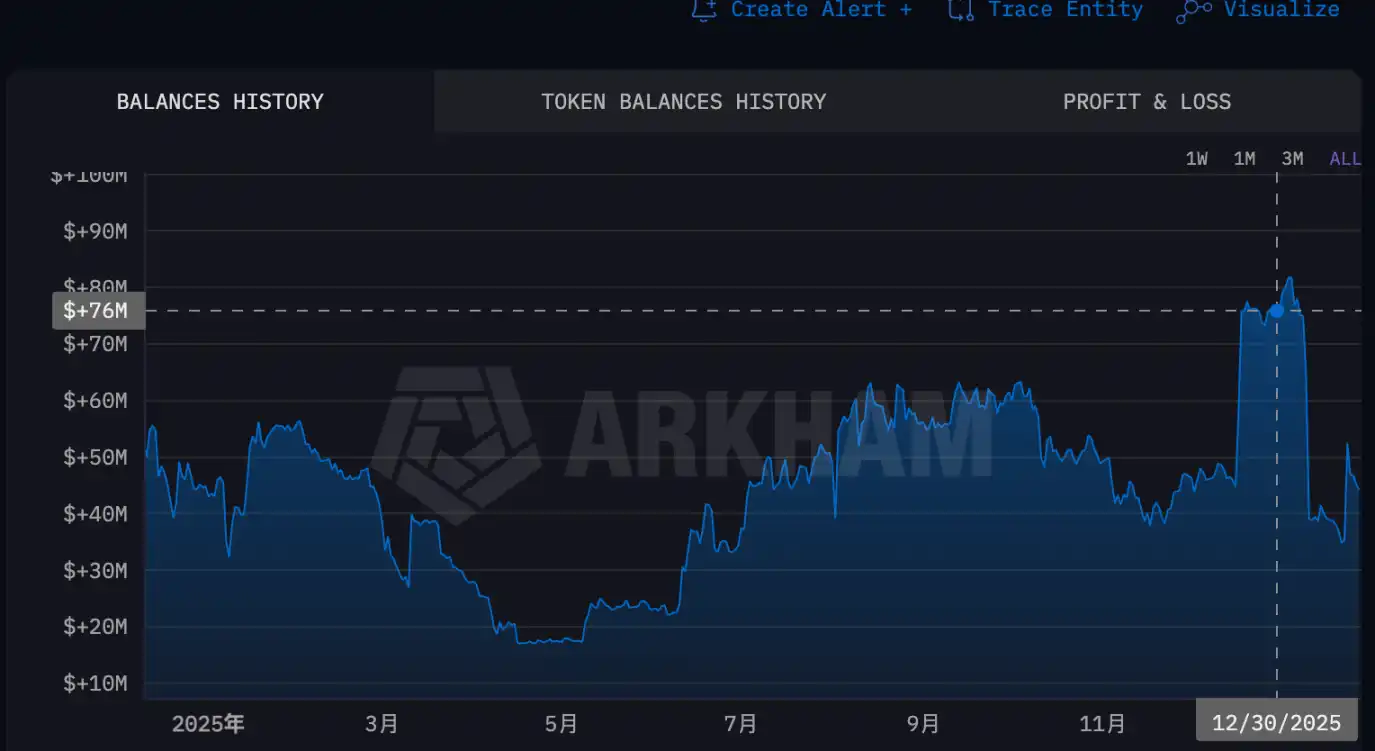
He shouted "Bitcoin to one million dollars" and "ETH to $10,000" on Twitter, but on-chain, Arthur Hayes would always inadvertently sell the assets he once favored. If we lay out all his operations from last year, you will find an extremely calm, even冷酷 (cold-blooded), trading record of a top trader.

We can break down his operations into three categories.

VC Coins: "Publicly Hype, Privately Dump"

Hayes' most controversial operations usually occur with projects where he obtained early筹码 (chips/allocations). This is actually a completely asymmetrical game: perhaps he made 10x when selling at $50, while your losses were just beginning when buying at $60.

The most typical script happened with Hyperliquid (HYPE). As an early investor who obtained extremely low-cost筹码 (chips), his operating logic is very simple and crude:

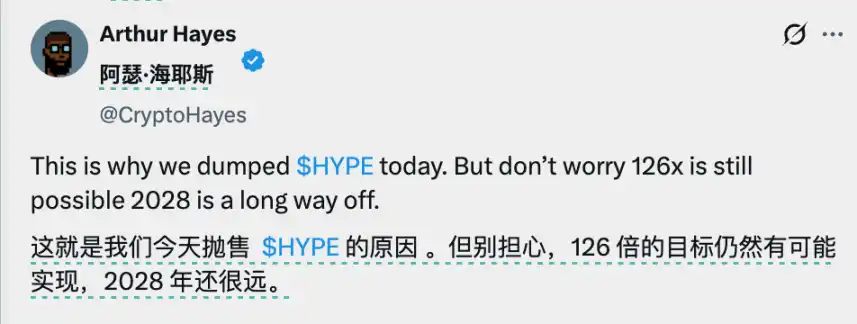
Step one: Use influence to hype at high prices, building grand narratives (e.g., "HYPE 100x in three years");

Step two: Wait until the token unlocks or liquidity is sufficient, then decisively clear the position.
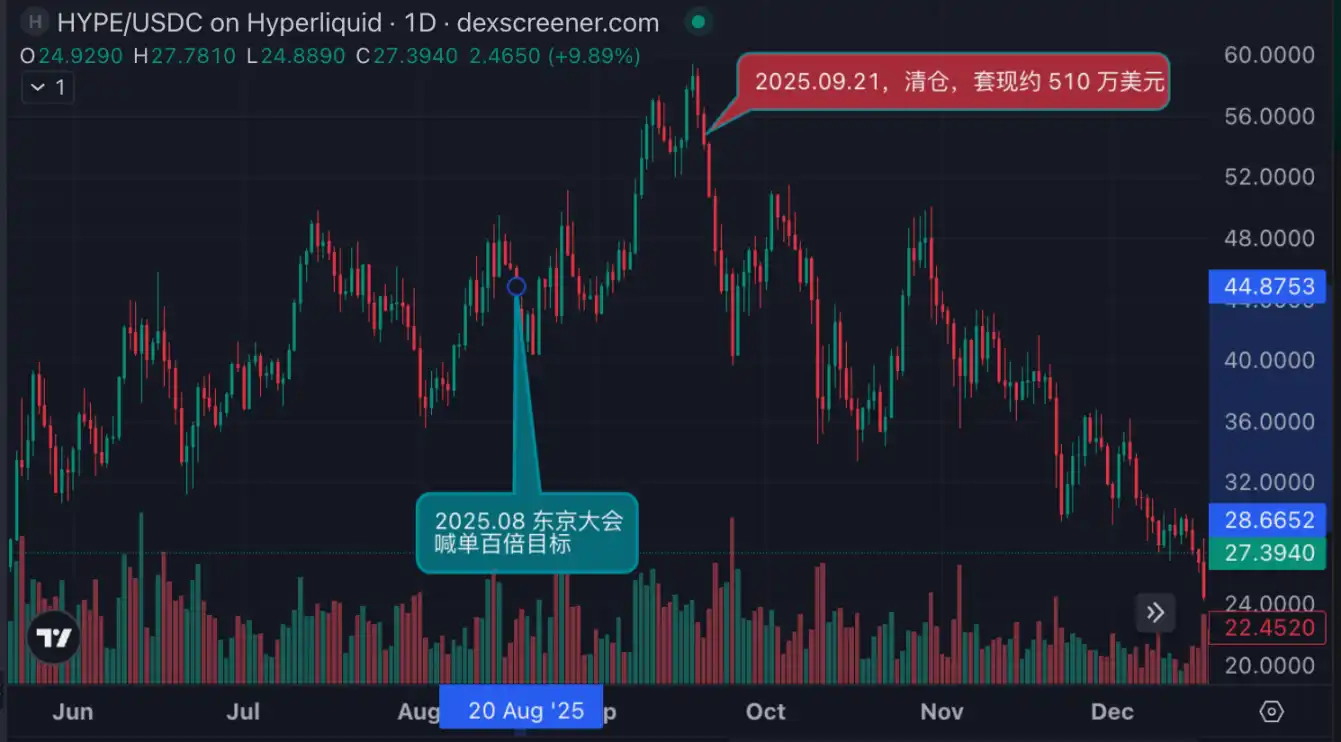
For example, last August, Hayes predicted at a conference in Tokyo that HYPE would have hundred-fold growth and高调 (high-profile) bought in. Just one month later, he cleared his position before HYPE fell and made millions of dollars in profit, giving the reason "to avoid unlocking risks."
But HYPE was not completely abandoned by him. In mid-January 2026, Hayes bought about $499,000 worth of HYPE again after three months.

The same story happened repeatedly, including with ETHFI, ATH, etc., all experiencing similar scripts.

But imagine, if you were Arthur Hayes, what would you do? To achieve profit with large capital, this seems to be the standard playbook: first, put forward market analysis that is足以自圆其说 (sufficient to justify itself),征服 (conquering) the audience with logic; when believers flock in, the market will naturally confirm his prophecy.

And for whales, the only window to quietly exit is when the crowd is bustling and liquidity is most abundant.

The "Old Narratives" That Couldn't Be Hype

After reviewing Hayes' successful hype narratives, we found that Hayes also had times when he failed. Especially when he tried to "revive" some old or niche sectors.

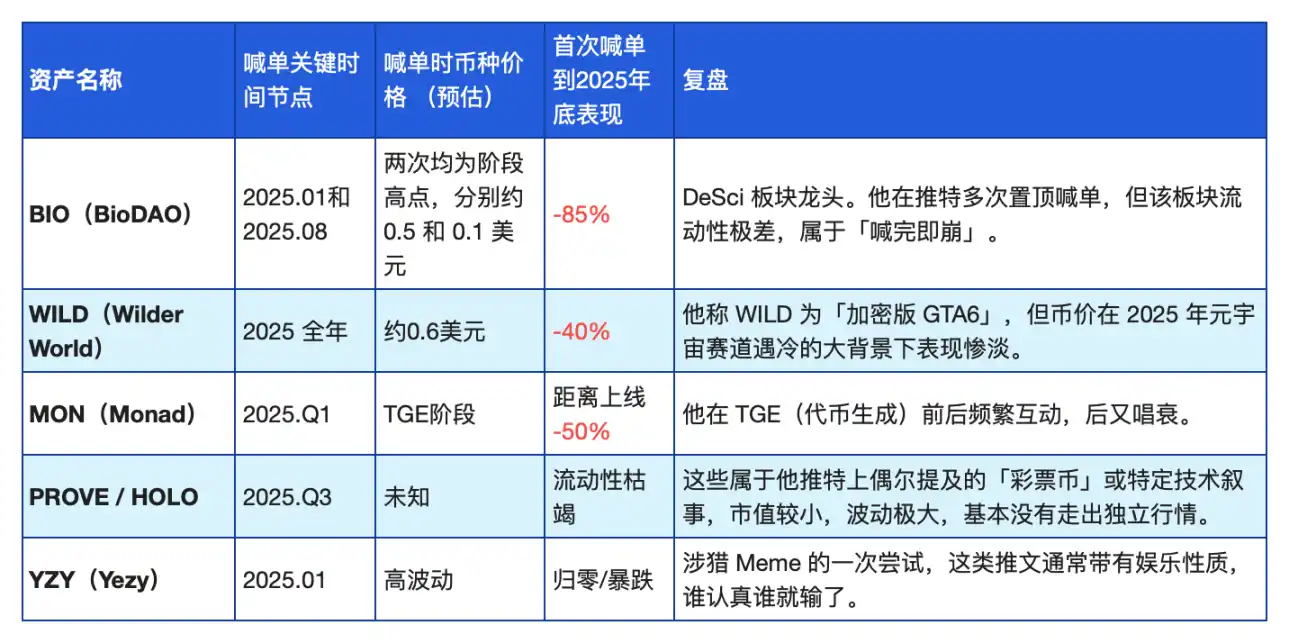
In early 2025, his family fund Maelstrom wrote a long and profound article "Degen DeSci," strongly bullish on the DeSci (Decentralized Science) sector. He listed a bunch of coins, BIO, GROW...

The result is clear for all to see: the DeSci sector almost全军覆没 (was completely wiped out), with many tokens falling more than 85% from their highs. Hayes built a position of $1.1 million worth of BIO again in August and finally deposited 7.66 million BIO into Binance in late November, with a potential loss of $640,000 (-58%).

Then there's Wilder World (WILD), which he called the "Crypto version of GTA6." He hyped it for a whole year, and finally the price sank along with the metaverse concept.
Most of the tokens Hayes hyped had热度 (heat/hype) at specific stages. A summary is shown in the chart:
ZEC's "Smoke Screen"

This might be Hayes' most brilliant and intriguing operation in 2025.

On the surface, Hayes疯狂 (crazily) hyped Zcash (ZEC), stating that he initially bought millions of dollars worth after hearing the suggestion from Silicon Valley big shot Naval at a private dinner during Token 2049. In November last year, he shouted the slogan "target $10,000."

Hayes even initiated a withdrawal movement, calling on everyone to withdraw their coins to the chain to lock up liquidity.
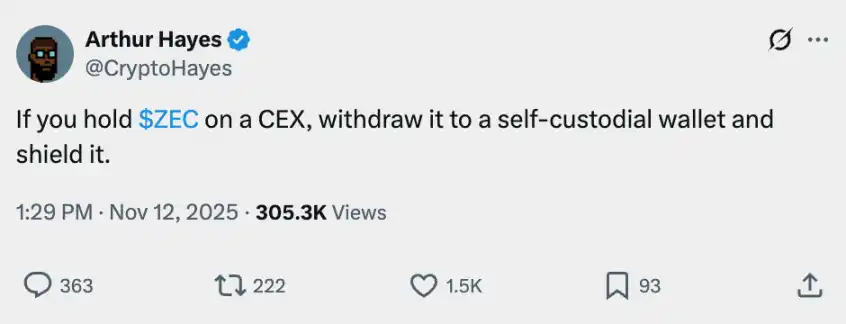
Many people watched his wallet to see if he was secretly selling ZEC. The result: he didn't sell; he was even adding to his position.

Perhaps the real purpose of Hayes creating this ZEC frenzy was: to sell ETH and exchange it for anything that was rising fast at the time.

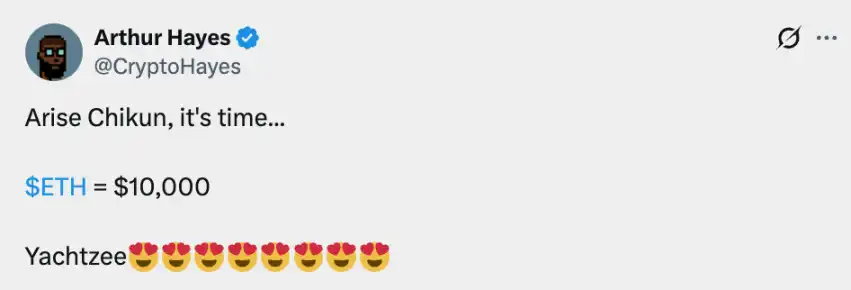
Hayes had actually already taken a "knife" to ETH several times before this. Although he高喊 (shouted loudly) in 2025 that ETH would rise to $10,000, he experienced several "反复横跳" (back-and-forth jumps). He sold about $13.34 million worth of ETH and other tokens on August 2nd but expressed regret on August 9th for taking profits and had to buy back.
By November 15, 2025, just when he was vigorously hyping ZEC, Lookonchain monitored him transferring millions of dollars worth of ETH and ENA to Binance. On the same day, Hayes publicly declared on Twitter that he had "Aped more ZEC." On-chain analyst EmberCN also分析指出 (analyzed and pointed out) that this selling was极大概率 (most likely) to supply "ammunition" for adding to the ZEC position.
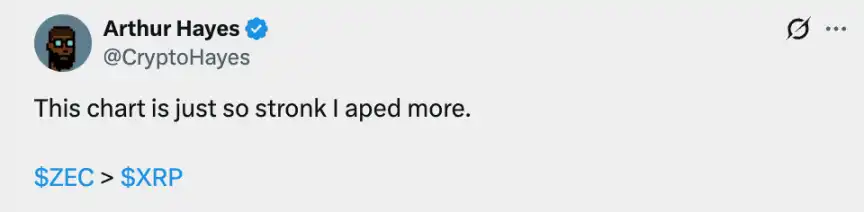
Due to ZEC's privacy features, his transparent ETH was sold and exchanged for opaque assets. On the chain, we can only see him "exiting" (selling ETH) but cannot quantify the scale of his "entering" (buying ZEC).

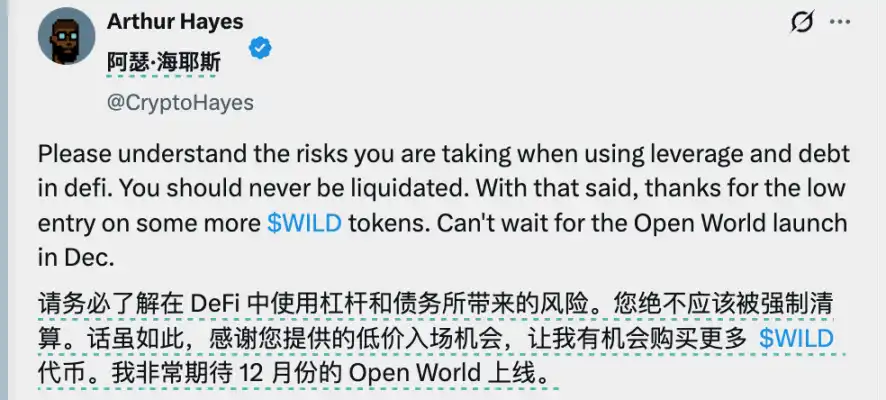
But in the last two weeks of 2025, Hayes sold another 1,871 ETH (about $5.53 million) and went back to buy the DeFi assets he had abandoned a month earlier.

This is a very冷酷 (cold) signal: in his logic, Ethereum is the "cash reserve" in his investment组合 (portfolio). He sells it when he needs money to buy new narratives (ZEC), and he still sells it when he needs money to bottom-fish old sectors (DeFi).

In the end, you will find that he used ZEC's price increase to attract the attention of the entire market, and then quietly completed his position rotation while everyone was discussing the "privacy renaissance." It wasn't until early 2026, when ZEC plummeted due to internal team strife, that everyone realized that although Hayes's holdings had shrunk, he successfully exited the top of ETH, which performed even worse during that phase.

How to Understand Arthur Hayes?

After reviewing this year, you will find that Hayes,正如 (just as) written in his X background picture, is not a "believer" HODLer but an extremely精明 (shrewd) businessman.
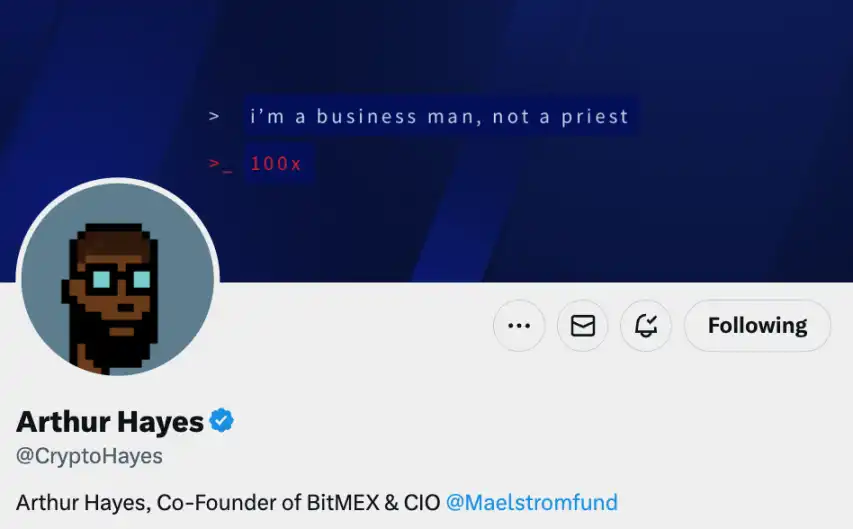
He uses words to build dreams to attract liquidity; he uses on-chain operations to harvest profits to avoid risks; he dares to quickly admit mistakes when he is wrong (e.g., abandoning ETH) to preserve capital.

So, his articles are still worth reading because his macro judgments have been verified. But before you press the "buy" button, please take one more step: don't listen to what he says, go see what his on-chain wallet is doing.

After all, in this残酷 (cruel) market, his loyalty to "volatility" is far higher than his belief in any single project. And volatility is precisely the money transferred from the pockets of retail traders to the pockets of traders.


Domande pertinenti

QWhat was the main criticism of Arthur Hayes' actions in 2025 according to the article?

AThe main criticism was that Hayes' public endorsements ('calling orders') were often a strategy to create market hype and liquidity, allowing him to profitably sell his positions at high prices, while retail investors who followed his advice frequently ended up losing money.

QDescribe Hayes' typical strategy with VC coins like Hyperliquid (HYPE).

AHis strategy involved two steps: first, using his influence to endorse the coin at high prices and build a grand narrative (e.g., 'HYPE will grow 100x in three years'); second, liquidating his position for substantial profits once the token was unlocked or liquidity was sufficient, often just before a price drop.

QWhich investment narrative promoted by Hayes in 2025 failed significantly, and what was the result?

AHis promotion of the DeSci (Decentralized Science) narrative failed significantly. Coins in this sector, such as BIO, plummeted by over 85% from their highs. Hayes' investment in BIO resulted in a loss of approximately $640,000, a 58% decrease.

QWhat was the suspected real purpose behind Hayes' strong public endorsement of Zcash (ZEC)?

AThe suspected real purpose was to create a market frenzy around ZEC to attract attention and liquidity, which allowed him to discreetly sell his transparent assets like ETH and convert them into the more opaque ZEC. This move helped him rotate his portfolio away from underperforming assets like ETH.

QHow does the article suggest investors should interpret Hayes' public statements and actions?

AThe article advises investors to read his macro analyses but to verify his on-chain wallet activities before making investment decisions. It emphasizes that his loyalty is to 'volatility' and profit, not to any specific project's long-term success, making his actions more those of a shrewd trader than a faithful holder.

Letture associate

Within Strategy's Framework, STRC's Dividend Yield Remains at 12% as Share Price Stays Below Par Value

Michael Saylor, Executive Chairman of Strategy (MSTR), confirmed that the dividend rate for its STRC perpetual preferred shares will remain at 12.00% through August 2026. The rate has increased from 9% at its July 2025 launch to the current high via a "ratchet" mechanism, which permanently raises the rate by 0.5% whenever the share price falls below $95. This mechanism is intended to push the price back toward its $100 par value and support Strategy's "at-the-market" (ATM) program for issuing new shares to fund Bitcoin purchases. However, the mechanism has not worked as intended. STRC shares closed at $89.46 on July 31, remaining about 10-11% below par value despite the record-high dividend. Competition from rival Strive's higher-yielding SATA securities has pressured demand. The persistent discount has forced Strategy to suspend new STRC issuances via its ATM program, limiting this funding channel for Bitcoin acquisitions. STRC's struggles reflect Bitcoin's own volatility, as the preferred shares historically move in tandem. Analysts have warned the ratchet structure carries long-term, one-way risk. A law firm is investigating Strategy's ability to maintain dividend payments if Bitcoin's price stays low. Retail investors own roughly 83% of outstanding STRC shares, a group seen as prone to panic selling during downturns. In response, Strategy has established financial reserves, including a liquidity cushion covering about 26 months of dividend/interest obligations, and a $2 billion share buyback program alongside a Bitcoin monetization framework, though the company emphasized it is not obligated to sell any Bitcoin.

cryptonews.ru22 min fa

Within Strategy's Framework, STRC's Dividend Yield Remains at 12% as Share Price Stays Below Par Value

cryptonews.ru22 min fa

Analyst: Bitcoin's Price Will Drop to $60k in August, Then Rebound to $70k

Financial analyst Andrey Poroshin has provided a new forecast for Bitcoin's price dynamics in August. Poroshin, an analyst at the Bitbanker exchange, expects the cryptocurrency market to experience a downturn this month, with prices retesting the $60,000 level due to a lack of supportive macroeconomic catalysts. He noted that the recent US Federal Reserve decision to hold interest rates did not significantly impact the market, while inflation remains above the 2% target. Poroshin stated that Bitcoin is ending July under pressure from moderate volatility and a lack of new macroeconomic stimuli, leading to continued market caution. According to his base scenario, Bitcoin will drop to a range of $60,000 to $62,000 before recovering to $70,000. He pointed out that even $70,000 remains below the cost of mining in the US, which has prompted some miners to shift towards AI data center operations. Poroshin cited the winding down of BitMEX's operations as a potential catalyst for a price rebound, suggesting the exit of weaker players often coincides with market reversals and reduced short-term selling pressure. He believes Bitcoin is currently less susceptible to geopolitical shocks, such as the Iran-US conflict, and does not expect significant market changes in August related to the pending CLARITY Act. Looking ahead, Poroshin forecasts that September will bring more active price fluctuations driven by potential Fed rate decisions and possible discussions or approval of the CLARITY Act.

cryptonews.ru22 min fa

Analyst: Bitcoin's Price Will Drop to $60k in August, Then Rebound to $70k

cryptonews.ru22 min fa

Trading

Spot
活动图片




