‘Resilient after crashing 40%’ – Why Bitcoin held steady during U.S.-Iran tensions

ambcryptoPubblicato 2026-04-08Pubblicato ultima volta 2026-04-08

Introduzione

The article examines Bitcoin's resilience during heightened U.S.-Iran tensions in early 2026. Despite a significant 40% drop from its mid-January high of $96,000 to $65,000 by late February, Bitcoin held relatively steady compared to traditional assets after U.S. President Donald Trump made nuclear threats against Iran. While the threats initially caused market shock and pushed the Crypto Fear and Greed Index into "Extreme Fear," analysts noted Bitcoin's stickiness and a lack of forced sellers. The situation de-escalated following an announcement of an immediate ceasefire, which prompted a market rebound. At press time, the global crypto market cap rose 4.42% and Bitcoin traded at $71,884. The article also notes that Polymarket odds of Trump's impeachment reached 65% due to the event.

‘Operation Epic Fury,’ which began on the 27th of February under U.S. President Donald Trump, has since then shaken the crypto market.

After witnessing the New Year optimism in January 2026, the crypto market derailed with BTC dropping from a high of $96,000 in mid-January to $65,000 by the 28th of February.

This downward trend continued, and even after multiple attempts, Bitcoin was unable to reclaim the $75,000 mark.

President Donald Trump’s threat jitters nations worldwide

Needless to say, this high level of volatility persisted until U.S. President Donald Trump made nuclear threats directed towards Iran.

Taking to his social media platform – ​Truth ​Social, Trump warned,

A whole civilization will die tonight, never to ​be brought back ​again. I don’t want that ‌to ⁠happen, but it probably will.

This sent shockwaves through the nation and even the crypto world, which had turned bearish after modest bullish signs just a day before.

Digital assets class vs the traditional asset class

However, if we compare Bitcoin [BTC] and the broader crypto market to the S&P 500, gold, and other traditional asset classes, then it stood strong. In fact, as per a recent report by Polymarket, Iran was also accepting crypto payments as tolls from ships passing through the Strait of Hormuz.

Remarking on the same, Anthony Scaramucci, Financier and former White House Communications Director, in a recent podcast with Galaxy Digital’s CEO Michael Novogratz, said,

One thing that is sticky and seems resilient after crashing 40% is Bitcoin.

Echoing similar sentiments, but with a pinch of uncertainty, Novogratz added,

We’re stuck between some sellers and some buyers. And volumes are way down. It’s a lot less exciting. But there’s no force sellers anymore.

Yet, despite this optimism, the Crypto Fear and Greed Index was in the “Extreme Fear” zone at press time. Mostly swinging between “Fear” and “Extreme Fear” zones amidst geopolitical turmoil, the crypto market has only reflected cautious investor sentiment.
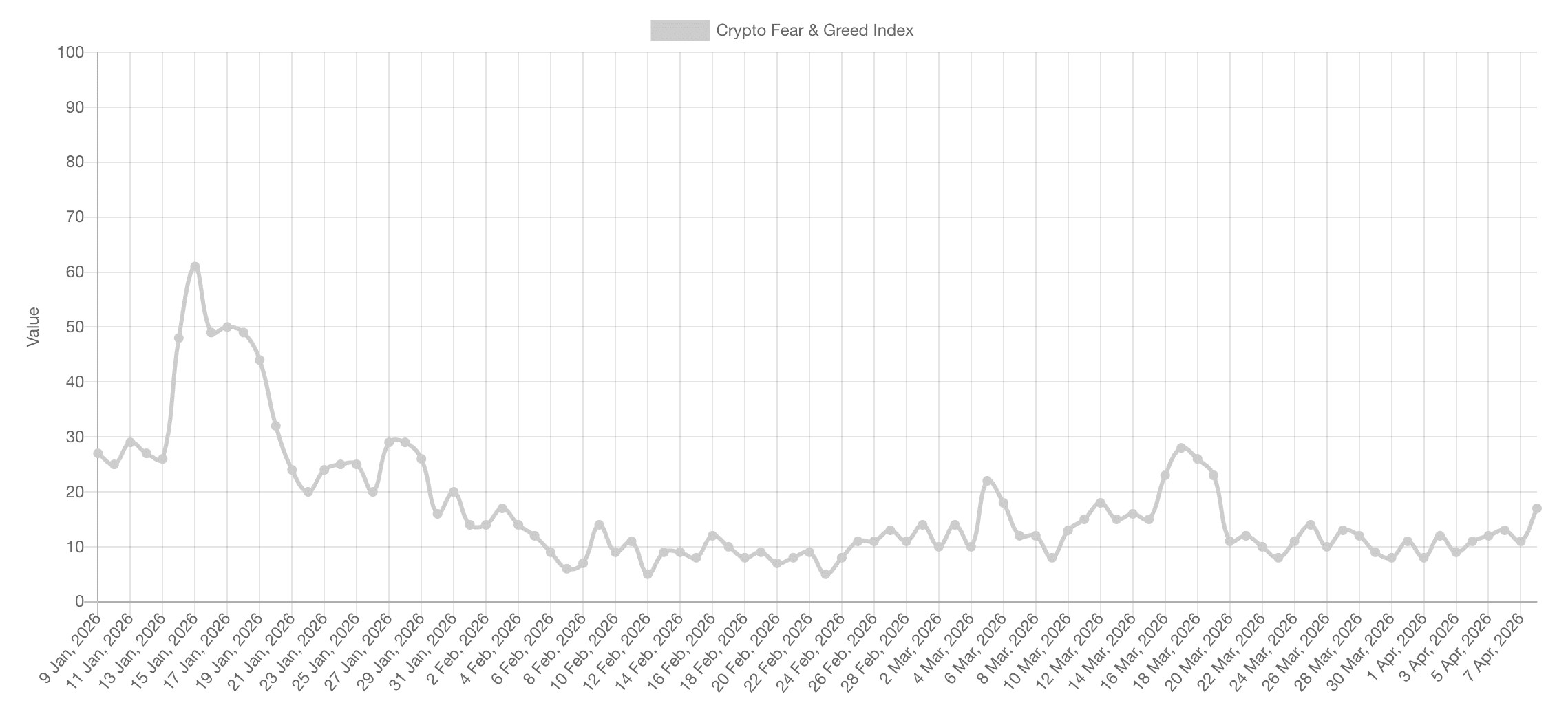
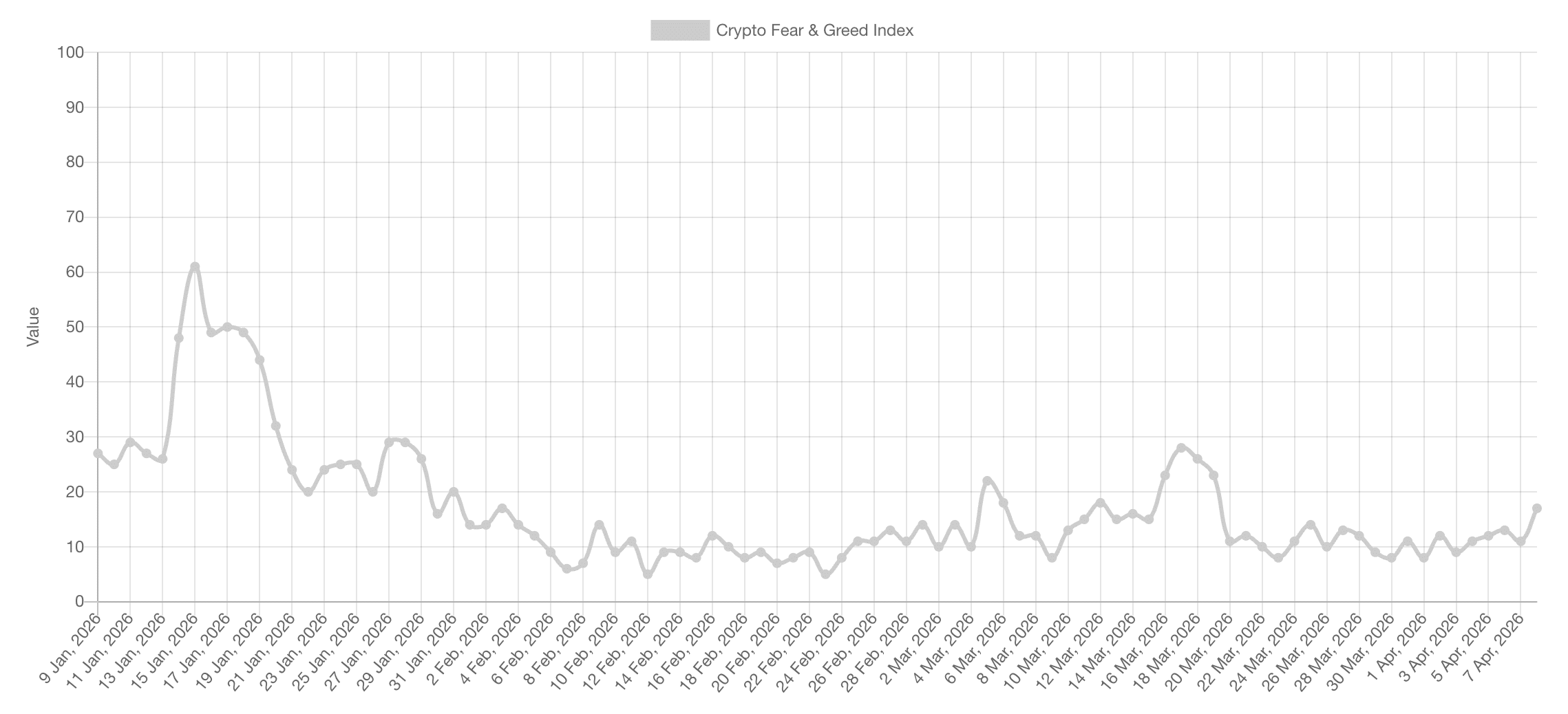
Source: Alternative

Is Trump’s impeachment around the corner?

Needless to say, the recent threat by Trump had pushed many to call for U.S. President Trump’s impeachment under the 25th Amendment.
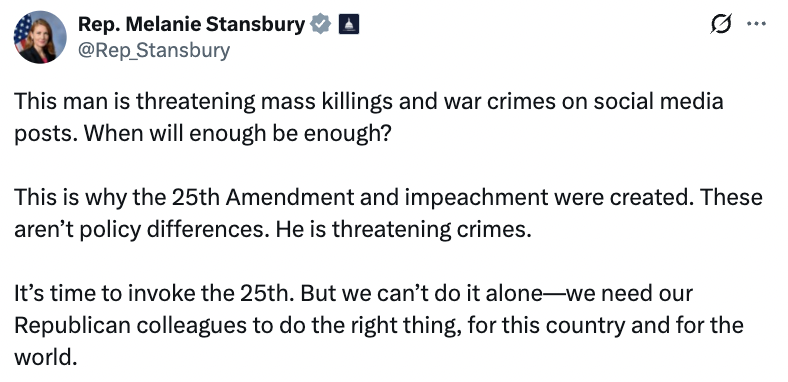
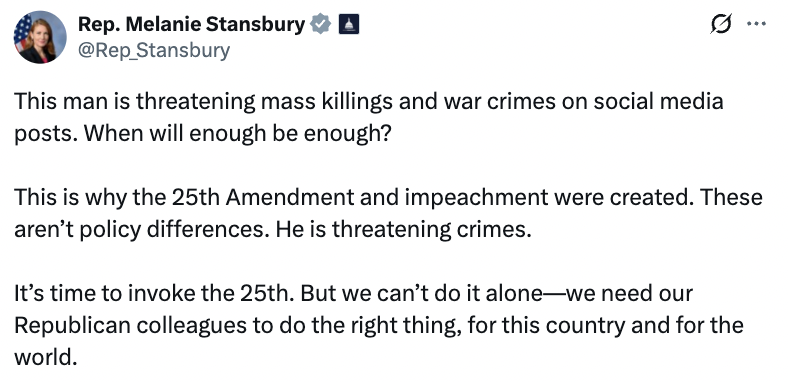
Source: Rep. Melanie Stansbury/X

That said, the Polymarket odds of Trump’s impeachment before his term ends also stood at 65% at the time of reporting.
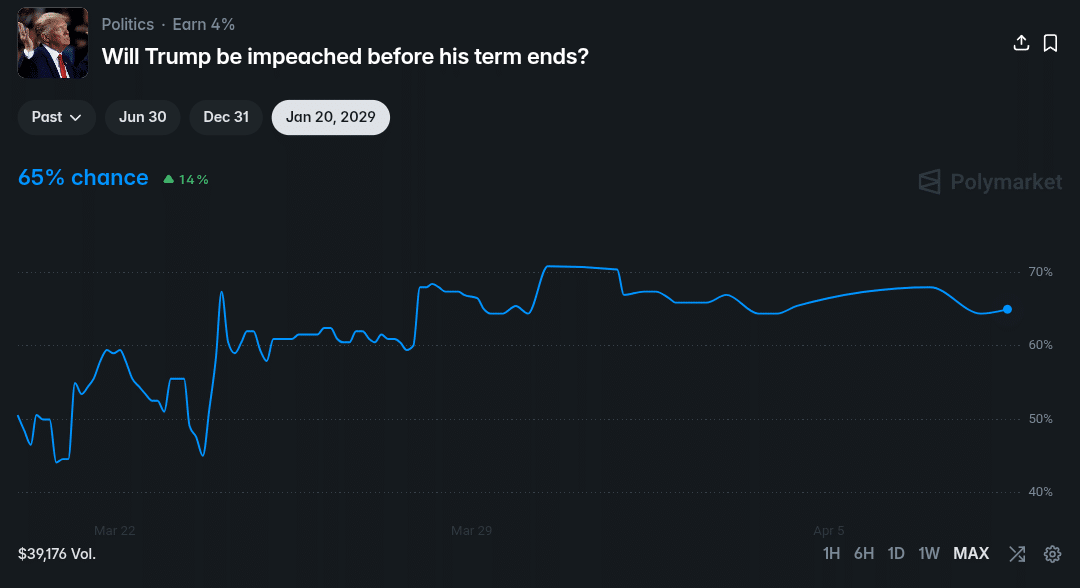
Source: Polymarket

Taken together, this shows how Trump’s pro-crypto policies and plans post-becoming the 47th President of the U.S. now seem debatable.

Peter Schiff takes a different route

However, while the entire world was crippling with this news, Peter Schiff, Chief Economist & Global Strategist at Europac, called this threat a bluff as he said,

If they believed there was a reasonable probability that Trump would actually kill Iranian civilization tonight, stocks would be a lot lower and oil a lot higher.

Schiff argued,

If investors don’t believe Trump, why would the Iranian leadership?

Ceasefire and its impact on the crypto market

However, as of the 8th of April, 5:20 AM IST, Prime Minister of the Islamic Republic of Pakistan, Shehbaz Sharif, injected a breath of fresh air globally when he noted,


Source: Shehbaz Sharif/X

Now, with an agreement on an immediate ceasefire from both ends, the crypto market turned green.

At press time, the global crypto market cap stood at $2.45 trillion, up 4.42% over the last 24 hours. At the same time, Bitcoin was changing hands at $71,884.44 after surging by 5.04% during the same period.


Final Summary

  • The escalating U.S.-Iran tensions had sent the crypto market into the hands of sellers.
  • The immediate ceasefire announcement shifted the market from bearish to bullish, but fear remains.


Domande pertinenti

QWhat was the name of the U.S. military operation that began on February 27th and shook the crypto market?

AOperation Epic Fury.

QAccording to the article, what was the primary reason cited for Bitcoin's resilience during the geopolitical turmoil?

AThe article quotes Anthony Scaramucci stating that Bitcoin is 'sticky and seems resilient after crashing 40%' and also notes that Iran was accepting crypto payments for tolls, which may have contributed to its strength.

QWhat was the status of the Crypto Fear and Greed Index at the time the article was written?

AIt was in the 'Extreme Fear' zone.

QWhat event on April 8th caused the crypto market to turn green and Bitcoin's price to surge?

AAn agreement on an immediate ceasefire between the U.S. and Iran, as announced by Pakistan's Prime Minister Shehbaz Sharif.

QWhat were the Polymarket odds of President Trump's impeachment before his term ended, according to the report?

A65%.

Letture associate

Google and Amazon Simultaneously Invest Heavily in a Competitor: The Most Absurd Business Logic of the AI Era Is Becoming Reality

In a span of four days, Amazon announced an additional $25 billion investment, and Google pledged up to $40 billion—both direct competitors pouring over $65 billion into the same AI startup, Anthropic. Rather than a typical venture capital move, this signals the latest escalation in the cloud wars. The core of the deal is not equity but compute pre-orders: Anthropic must spend the majority of these funds on AWS and Google Cloud services and chips, effectively locking in massive future compute consumption. This reflects a shift in cloud market dynamics—enterprises now choose cloud providers based on which hosts the best AI models, not just price or stability. With OpenAI deeply tied to Microsoft, Anthropic’s Claude has become the only viable strategic asset for Google and Amazon to remain competitive. Anthropic’s annualized revenue has surged to $30 billion, and it is expanding into verticals like biotech, positioning itself as a cross-industry AI infrastructure layer. However, this funding comes with constraints: Anthropic’s independence is challenged as it balances two rival investors, its safety-first narrative faces pressure from regulatory scrutiny, and its path to IPO introduces new financial pressures. Globally, this accelerates a "tri-polar" closed-loop structure in AI infrastructure, with Microsoft-OpenAI, Google-Anthropic, and Amazon-Anthropic forming exclusive model-cloud alliances. In contrast, China’s landscape differs—investments like Alibaba and Tencent backing open-source model firm DeepSeek reflect a more decoupled approach, though closed-source models from major cloud providers still dominate. The $65 billion bet is ultimately about securing a seat at the table in an AI-defined future—where missing the model layer means losing the cloud war.

marsbit1 h fa

Google and Amazon Simultaneously Invest Heavily in a Competitor: The Most Absurd Business Logic of the AI Era Is Becoming Reality

marsbit1 h fa

Computing Power Constrained, Why Did DeepSeek-V4 Open Source?

DeepSeek-V4 has been released as a preview open-source model, featuring 1 million tokens of context length as a baseline capability—previously a premium feature locked behind enterprise paywalls by major overseas AI firms. The official announcement, however, openly acknowledges computational constraints, particularly limited service throughput for the high-end DeepSeek-V4-Pro version due to restricted high-end computing power. Rather than competing on pure scale, DeepSeek adopts a pragmatic approach that balances algorithmic innovation with hardware realities in China’s AI ecosystem. The V4-Pro model uses a highly sparse architecture with 1.6T total parameters but only activates 49B during inference. It performs strongly in agentic coding, knowledge-intensive tasks, and STEM reasoning, competing closely with top-tier closed models like Gemini Pro 3.1 and Claude Opus 4.6 in certain scenarios. A key strategic product is the Flash edition, with 284B total parameters but only 13B activated—making it cost-effective and accessible for mid- and low-tier hardware, including domestic AI chips from Huawei (Ascend), Cambricon, and Hygon. This design supports broader adoption across developers and SMEs while stimulating China's domestic semiconductor ecosystem. Despite facing talent outflow and intense competition in user traffic—with rivals like Doubao and Qianwen leading in monthly active users—DeepSeek has maintained technical momentum. The release also comes amid reports of a new funding round targeting a valuation exceeding $10 billion, potentially setting a new record in China’s LLM sector. Ultimately, DeepSeek-V4 represents a shift toward open yet realistic infrastructure development in the constrained compute landscape of Chinese AI, emphasizing engineering efficiency and domestic hardware compatibility over pure model scale.

marsbit2 h fa

Computing Power Constrained, Why Did DeepSeek-V4 Open Source?

marsbit2 h fa

Trading

Spot
Futures
活动图片




