Research Report Analysis: Is Intel Making a Comeback with Apple? Bernstein's Calculations Show the Right Direction, but the Price Is Already Overvalued

marsbitPubblicato 2026-06-22Pubblicato ultima volta 2026-06-22

Introduzione

Bernstein analyst Stacy A. Rasgon published a report on June 18 regarding Intel, assessing the potential impact of recent political support for a US-based PC chip design and manufacturing collaboration between Apple and Intel. The report views this as a significant signal for the foundry landscape shift but concludes the initial financial contribution would be minimal. Key conclusions: 1) An Apple deal is seen as a small-scale "proof of concept." Even if Intel wins 40% of Apple's premium notebook chip orders (~5 million units/year), Bernstein estimates it would generate only about $500M in annual revenue and ~$0.03 EPS, negligible against Intel's ~$55B revenue. 2) Political encouragement is not equivalent to enforceable mandates. Winning orders ultimately depends on Intel demonstrating competitive technology (like its 18A node), cost, and reliable supply. 3) The path from validation to large-scale production involves significant challenges, capital investment, and time. Due to these uncertainties, Bernstein maintains a Market-Perform (Hold) rating with a $100 price target, implying potential downside from the ~$121.10 price at the report date. The analysis highlights the tension between near-term validation value—serving as a crucial trust signal for Intel's foundry ambitions and US supply chain resilience—and the long-term opportunity to attract larger cloud and AI chip customers. The investment thesis hinges on successful 18A execution and sustained policy support, not on...

Author: Tide Research

By: Rita

Tide Research Guide

Bernstein analyst Stacy A. Rasgon released a research report on Intel on June 18, assessing Trump's recent statements supporting Apple and Intel collaborating on PC chip design and manufacturing in the U.S. The report views this as a turning point signal for the chip manufacturing landscape, but with limited initial scale—more a proof-of-concept than an immediate profit opportunity. Bernstein maintains its "Market-Perform" rating and $100 price target for Intel, signaling a positive direction but insufficient momentum for further stock price gains. This report is suitable for investors focusing on U.S. chip manufacturing policy trends, Intel's capacity layout, and government subsidy policies.

Three Key Conclusions

1. Apple's Entry into Intel's Foundry is a "Small-scale Trial," with Negligible Short-term Revenue Contribution

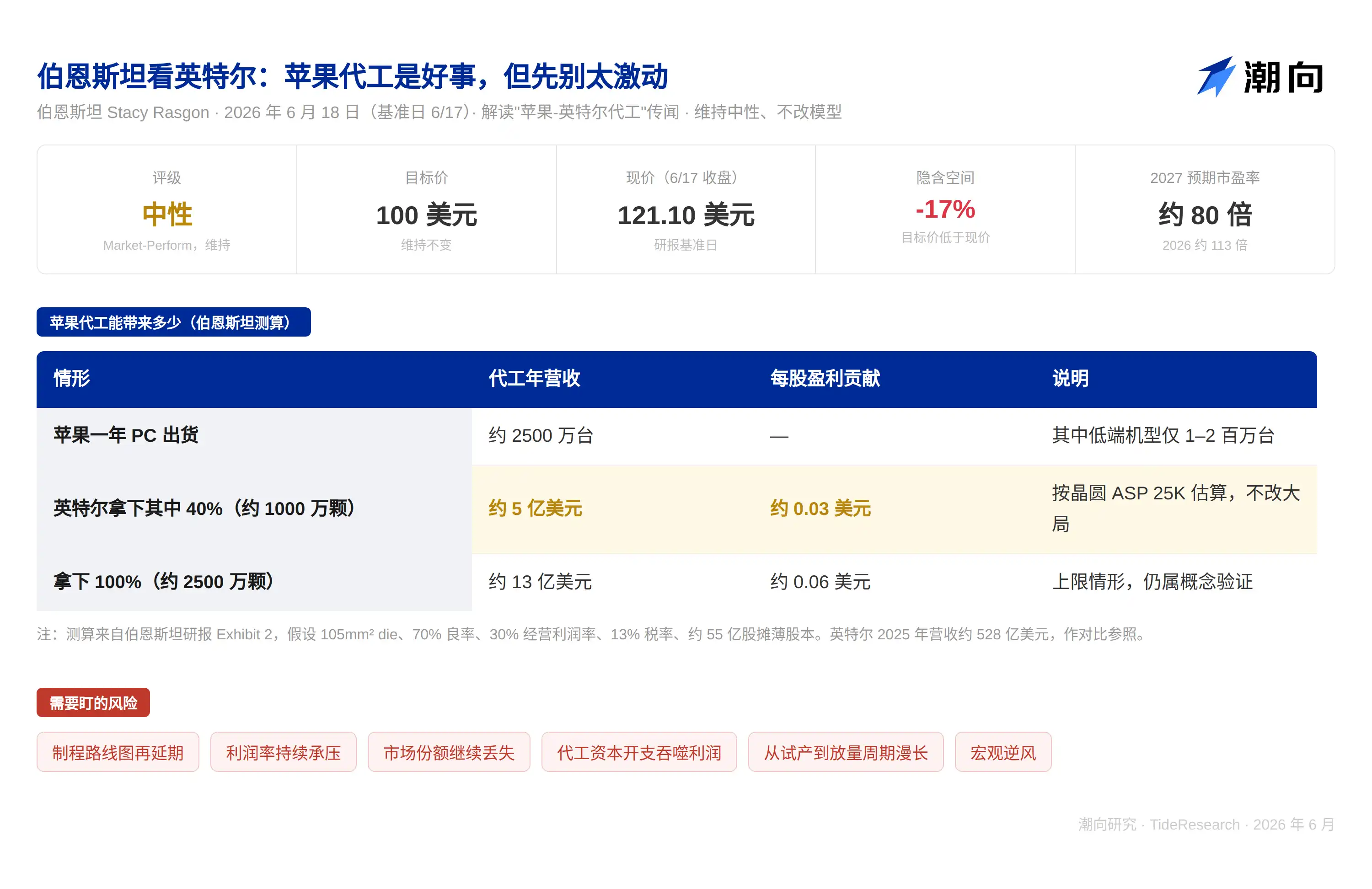
According to Bernstein's data, Apple shipped approximately 23.68 million laptops in the past 12 months, with high-end models (priced above $700) accounting for about 22.15 million units. If Intel ultimately wins 40% of these orders as an initial target, the corresponding annual PC chip foundry volume would be around 5 million sets. Based on Bernstein's assumptions, if the average selling price per wafer is $25,000, this business would generate only about $500 million in annual revenue, contributing roughly $0.03 per share in earnings.

Compared to Intel's annual revenue of approximately $55 billion and annual EPS of about $1.50, this potential contract is almost negligible at the financial level.

The report emphasizes that the value of this order lies not in its current revenue scale but in the endorsement it represents—U.S. client trust in Intel's manufacturing capabilities.

2. The Temperature of Trump's Promoted Policy Needs a Question Mark

Trump recently publicly encouraged Apple and Intel to design and manufacture chips in the U.S., but Bernstein notes that this encouragement is not "enforcement." The analysis suggests that clients will not be "forced" to adopt a particular supplier unless the supplier can prove three conditions: the ability to produce according to specifications, a competitive cost structure, and stable, reliable supply. Intel is currently in the risk production stage for its 18A process, demonstrating credible technological progress, but mature capacity and cost competitiveness still require observation.

In other words, policy encouragement is a plus but cannot replace market competitiveness.

3. The "Transition Challenge" from Proof-of-Concept to Mass Production Persists, Bernstein Does Not Upgrade Rating Accordingly

Bernstein's report repeatedly emphasizes "there is still a lot of wood to chop here," meaning that moving from small-scale proof-of-concept to large-scale mass production still requires significant work, considerable time, and substantial capital investment.

In other words, for Intel to truly cross this stage, it must simultaneously address several issues: investing tens of billions of dollars to expand capacity, passing complex and rigorous customer qualification processes, and proving its cost and yield advantages in the intense foundry price competition.

Precisely due to this uncertainty, while Bernstein acknowledges the positive significance of this collaboration, it maintains a Market-Perform (Hold) rating and does not upgrade to Outperform (Outperform). Its given target price is approximately $100, implying some downside potential compared to the stock price of about $121.10 (as of the report's base date).
The Geopolitical Logic Behind Chip Supply Diversification

Apple has long adopted a supplier diversification strategy to reduce reliance on any single foundry. Historically, this diversification was mainly reflected in choices among different foundry systems and process nodes like TSMC, Samsung, and Intel.

However, in recent years, geopolitical factors have become a new core variable. The U.S. government, through the CHIPS and Science Act, has invested massive subsidies to promote the reshoring of critical chip manufacturing. In this context, Apple shifting some of its high-end PC chip orders to Intel's U.S. factories not only aligns with policy direction but also helps enhance supply chain resilience and mitigate over-reliance risks on a single region (especially Taiwan).

For Intel, this collaboration is more like a crucial market confidence test. Having previously lost Apple's foundry trust due to lagging process technology, re-entering Apple's supply chain for design collaboration and manufacturing cooperation now inherently signifies that its 18A process has reached a certain level of usability. This signal may also have spillover effects on other potential clients (such as data center CPU or AI accelerator manufacturers).

The Tension Between Short-Term Validation and Long-Term Vision

The core of Bernstein's analysis is to reveal a structural contradiction: the vast gap between short-term scale and the long-term narrative.

In the model assumptions, even if Intel secures about 40% of Apple's PC chip orders, the annual shipment volume would only be around 100,000 to 150,000 sets. Within Intel's overall foundry business plan, this still falls under the "pilot validation" or "proof-of-concept" stage, with very limited revenue contribution—only equivalent to a few hundred million dollars—impacting EPS by mere cents, insufficient to materially alter the company's overall growth trajectory.

However, in the long term, this "small-scale entry" holds significant path-dependent value. If Intel can leverage the Apple order to prove its process stability and delivery capabilities, it may subsequently compete for larger-scale foundry orders in areas like cloud computing chips, AI accelerators, and communication chips. The total market size for these segments far exceeds that of PC chips, offering substantial long-term expansion potential.

Bernstein's report does not quantify this "option-like long-term value" but merely notes its existence, while emphasizing that realizing it remains highly dependent on subsequent customer acquisition and continuous process improvement.

Investment Thesis: What to Bet On? What Not to Bet On? What to Watch?

Bet On:

  • Intel's 18A process progress not falling significantly below market expectations
  • Continuity of U.S. policy support for semiconductor manufacturing localization

Do Not Bet On:

  • The Apple collaboration significantly improving Intel's financial performance in the short term
  • Government subsidies directly and rapidly boosting Intel's overall profit margins

Key Signals to Monitor:

  • Revenue recognition and gross margin changes for Intel's foundry business in the next quarterly earnings report
  • The pace of yield improvement and cost reduction curve for the 18A process
  • Whether other major clients besides Apple formally adopt Intel's foundry services
  • The actual fulfillment pace and scale of CHIPS Act-related subsidies
This article is Tide Research's compilation and interpretation of a third-party brokerage research report. The cited ratings, target prices, earnings forecasts, and related judgments are the views of that brokerage analyst, representing only the stance of their institution. They do not represent Tide Research's views and do not constitute any investment advice.

When reading, please note three points: First, target prices are analysts' expectations for approximately the next 12 months—they are forecasts, not promises, and are subject to repeated adjustments based on performance and market conditions. Second, sell-side research reports are inherently bullish, and some covered companies may have business relationships with the brokerage. Third, the value of research reports lies in their core logic and underlying assumptions, not just a single target price. Focus on the logic, not just the price.

The market carries risks; decisions should be made independently. This article should not serve as the basis for trading any securities.

Data Source: Bernstein Research Report (Stacy Rasgon, June 18, 2026) · Intel Historical Financial Data (SEC)

Tide Research · TideResearch · June 2026

Domande pertinenti

QWhat are the three key conclusions from Bernstein's report on Intel and Apple's potential cooperation?

A1. Apple entering Intel's foundry is a 'small test' with minimal short-term revenue contribution. Bernstein estimates it would only add about $0.03 to EPS. 2. The political encouragement from the Trump administration is not a mandate; market competitiveness in technology, cost, and supply reliability remains key for Intel. 3. There is a significant 'transition gap' from proof-of-concept to mass production, requiring substantial time and capital. Hence, Bernstein maintains a 'Market-Perform' rating and a $100 price target, seeing positive direction but insufficient for a higher rating.

QAccording to Bernstein's analysis, why is the potential Apple-Intel deal significant despite its small initial financial impact?

AThe significance lies not in immediate financials but in the strategic validation it provides. It represents a key vote of confidence from a major US customer (Apple) in Intel's manufacturing capabilities, specifically its 18A process. This endorsement could help Intel rebuild market trust and potentially attract other large customers like data center CPU or AI accelerator manufacturers, serving as a crucial step in its foundry business strategy.

QWhat is Bernstein's rating and price target for Intel, and how does it compare to the current stock price mentioned in the report?

ABernstein maintains a 'Market-Perform' (Hold) rating for Intel with a price target of $100. This target price implies a potential downside from the reported current price of approximately $121.10 (as of the report's baseline date), suggesting the analyst sees the stock as somewhat overvalued based on the current prospects.

QWhat major challenge does Bernstein identify for Intel in transitioning the Apple collaboration from concept to large-scale production?

ABernstein highlights the 'transition gap' or 'a lot of wood to chop.' The major challenge is scaling from small proof-of-concept volumes to cost-competitive, high-yield mass production. This requires hundreds of billions in capital investment for capacity expansion, navigating complex customer qualification processes, and proving cost and yield advantages in the fiercely competitive foundry market.

QFrom an investment perspective, what are the key signals investors should watch regarding Intel's foundry business, according to the article's summary of the report?

AInvestors should focus on: 1. Revenue recognition and gross margin changes for the foundry business in Intel's quarterly earnings. 2. The pace of yield improvement and cost reduction for the 18A process. 3. Whether other major clients besides Apple formally adopt Intel's foundry services. 4. The actual disbursement pace and scale of subsidies related to the CHIPS Act.

Letture associate

Conversation with Co-founder of Hyperdash: Why is Hyperliquid Still Severely Undervalued?

Interview Summary with Hanson Birringer, Co-founder of Hyperdash: Why Hyperliquid Remains Undervalued In an interview on *The Rollup*, Hanson Birringer, Co-founder and Chief Revenue Officer of Hyperdash—a trading data analytics platform for Hyperliquid—shared his investment thesis on the Hyperliquid ecosystem. He described Hyperliquid as a pure play on three key crypto super-trends: perpetual contracts, real-world assets (RWAs), and stablecoins. The platform is an open-source, decentralized, and high-performance financial system uniquely positioned to bridge traditional institutional capital with decentralized finance. Birringer highlighted Hyperliquid's leadership in perpetual DEX trading and its recent innovation of RWA perpetual contracts. He emphasized the significance of USDC becoming a core quoting asset, which, by allocating 90% of its backend yield from assets like US treasuries to a protocol buyback fund, creates substantial, programmatic buy pressure for the Hype token. He addressed regulatory challenges, noting that Hyperliquid's policy team is actively engaging with US regulators like the CFTC to establish clear rules for decentralized venues. Once achieved, regulated brokers could route orders directly to Hyperliquid's backend, tapping into its low-cost liquidity layer. Regarding revenue, Birringer was optimistic, citing the immense size of traditional financial markets. Even capturing a small fraction of global trading volume in products like RWA perpetuals could lead to exponential growth for the protocol. The recently launched Grayscale Hyperliquid ETF, seeded by their SPV (Hyper Holdings Global), provides a compliant on-ramp for institutional investors drawn to the clear "cash flow + token buyback" model. Finally, he discussed Hyperdash's acquisition of Imperator, enhancing its data and node infrastructure to serve both retail traders and traditional asset managers. His bullish case rests on Hyperliquid's potential to provide unprecedented global access to dollar-based capital markets. He struggled to articulate a bear case, seeing the long-term trends of internet adoption and financial inclusion as powerful tailwinds.

marsbit47 min fa

Conversation with Co-founder of Hyperdash: Why is Hyperliquid Still Severely Undervalued?

marsbit47 min fa

DeepSeek V4 'Full-Blooded Edition' Leaked, Could Be Released As Early As Tomorrow

The highly anticipated full release of DeepSeek V4 is imminent, expected to launch as early as tomorrow after nearly three months of waiting. A select group has already received access to the GA (General Availability) beta, which includes two versions: DeepSeek V4 Flash and DeepSeek V4 Pro. Early testers report that V4's overall performance is close to the level of Opus 4.8, with coding capabilities rivaling GPT-5.6 Sol. Its agent abilities are significantly enhanced, and 3D/SVG generation has improved notably. While it may not surpass the recently released Kimi K3 in performance, its expected price point is significantly lower. The official release will introduce a new "peak/off-peak" pricing model for its API. For example, deepseek-v4-pro will cost $0.87 per million output tokens during standard times and $1.74 during peak hours. The flash version is even more aggressive at $0.28/$0.56 per million tokens, with cached input tokens priced extremely low at $0.0028. This makes V4 a strong contender in terms of cost-effectiveness, potentially offering Opus-level capabilities at a fraction of the cost, continuing DeepSeek's reputation as a "price disruptor" in the AI market. Initial demos showcasing V4's capabilities have begun circulating, including generated 3D simulation games, HTML games blending elements of Minecraft and No Man's Sky, and classic games like a "Cut the Rope" clone. The final GA version is set to replace the older deepseek-chat and deepseek-reasoner models, which will be retired on July 24th.

marsbit56 min fa

DeepSeek V4 'Full-Blooded Edition' Leaked, Could Be Released As Early As Tomorrow

marsbit56 min fa

WEEX Labs Weekly Observation: The 'Power Restructuring' of AI Infrastructure and the 'Deep Dive Movement' into the Real Economy

WEEX Labs Weekly Review: AI Infrastructure's "Power Restructuring" and the "Deep Dive" into the Real Economy Mid-July 2026 marks a pivotal shift in the global AI industry. The allocation of computing power is transferring from cloud giants to compute resource owners, while the core value of AI is solidifying around its penetration into physical industry, moving beyond the race for model parameters. The era of fragmented model development is over, replaced by a capital-intensive, integrated chain driven by hard tech. Key developments this week include Meta's planned entry into the cloud computing market with "MetaCompute." This move by social media giants with massive GPU clusters challenges traditional cloud providers like AWS, integrating compute, models, and data into one-stop services, which will squeeze smaller rental providers and shift enterprise focus towards underlying model ecosystems. Chinese foundational models like DeepSeek-V4 and Tencent's Hy-3 are pushing towards "utility" status through open-source releases and extreme cost reductions via MoE architectures. This lowers entry barriers for enterprises, allowing them to focus resources on private deployment and deep business integration. Embodied intelligence, particularly humanoid robots, is transitioning from lab demos to real-world factory applications, driven by policies promoting large-scale, practical deployment in logistics and manufacturing. The value focus is shifting from spectacle to stable industrial data and real operational efficiency. Global governance, through forums like WAIC, is evolving from theoretical ethics to practical operational frameworks for "Sovereign AI," raising geopolitical compliance barriers and making auditability and data sovereignty core design requirements from the outset. WEEX Labs Insights: The current transformation shows AI's prosperity is deeply embedding into the fabric of global manufacturing. Strategic recommendations include: 1) leveraging open-source models for private, proprietary knowledge bases; 2) maintaining cloud provider diversity to avoid vendor lock-in from integrated model ecosystems; and 3) seeking opportunities in the "embodied infrastructure" supporting robots, such as data collection, industrial simulation, and factory AI adaptation services.

marsbit1 h fa

WEEX Labs Weekly Observation: The 'Power Restructuring' of AI Infrastructure and the 'Deep Dive Movement' into the Real Economy

marsbit1 h fa

Is WEEX TradFi Reliable? What You Should Know Before Your First Trade of U.S. Stock Tokens

In recent years, cryptocurrency users have expanded their focus beyond Bitcoin and Ethereum to include popular traditional financial (TradFi) assets like Nvidia, Apple, and Tesla stocks. This shift raises key questions: What do these TradFi assets represent on crypto trading platforms? How do they differ from traditional stock ownership? And how can users assess the reliability of platforms offering such products? TradFi products, such as those offered by WEEX TradFi (including NVDA, MSFT, AAPL, TSLA, and QQQ tokens), are blurring the lines between crypto and traditional markets. They allow users to trade based on the price movements of traditional assets within a familiar digital asset trading environment. However, it's crucial to understand that trading a "stock token" is not equivalent to owning the actual stock. Users are participating in price speculation, not gaining shareholder rights like dividends or voting. A key feature of these products is 7x24 trading, offering flexibility beyond traditional market hours. While convenient, this also introduces unique risks, such as potential liquidity gaps and volatility when underlying markets are closed. For users evaluating TradFi products, reliability hinges on transparency and risk management. Critical factors include understanding the product mechanism, how prices track the underlying assets, and the associated risks—especially when using leverage. Popular stocks and indices are still subject to company performance, macroeconomic shifts, and sector trends. Ultimately, TradFi represents a new gateway connecting crypto users to global markets. The future points toward integrated trading environments where the distinction between "crypto investor" and "traditional investor" fades. For newcomers, a platform's reliability stems not from promises, but from a clear understanding of the product, a comprehensive view of risks, and informed judgment of the platform's capabilities.

marsbit1 h fa

Is WEEX TradFi Reliable? What You Should Know Before Your First Trade of U.S. Stock Tokens

marsbit1 h fa

Trading

Spot
活动图片