Research Debunks AI Layoff Myth: 80% of Companies Cut Jobs, None Made Money From It

marsbitPubblicato 2026-05-13Pubblicato ultima volta 2026-05-13

Introduzione

Research Debunks AI Layoff Myth: 80% of Firms That Cut Jobs Saw No Financial Gain A Gartner survey of 350 large enterprises (revenue >$10B) found 80% that deployed AI/automation conducted layoffs, but found no positive correlation between the scale of layoffs and financial return. Companies that cut more jobs did not outperform those that cut fewer. The highest returns were achieved by "human-amplified" businesses using AI to augment employee productivity rather than replace them. Meanwhile, nearly 50,000 U.S. jobs were cut due to AI in the first four months of 2026, with tech sector layoffs hitting a three-year high. The report suggests that current AI-driven layoffs may often be small-scale experiments or "AI washing"—using AI as a pretext for cuts driven by other economic pressures. Short-term challenges are significant, with over 40% of AI agent projects predicted to be cancelled by 2027 due to cost and value issues. However, Gartner forecasts AI will become a net job creator by 2028-2029, creating new roles that AI cannot fulfill. Despite high project failure rates, AI software spending is projected to grow rapidly, from $86.4B in 2025 to $376.3B in 2027.

Author: Claude, Shenchao TechFlow

Shenchao Introduction: A Gartner survey of 350 companies with annual revenues exceeding $1 billion shows that 80% of firms that have deployed AI or automation technologies have implemented layoffs, but there is no positive correlation between the layoff rate and return on investment—companies that cut more jobs aren't earning more than those that cut fewer.

Companies achieving high returns are actually those using AI to amplify employee output rather than replace employees. Meanwhile, in the first four months of 2026, nearly 50,000 positions have been cut due to AI, and tech industry layoffs have hit a new high since 2023.

The logic of companies using AI to replace employees is being contradicted by data.

According to a Fortune report on May 11, a survey by research and advisory firm Gartner of 350 global corporate executives found that companies conducting major layoffs in the name of AI have not gained better financial returns as a result. The surveyed companies all have annual revenues exceeding $1 billion and are already piloting or deploying AI agents, intelligent automation, or autonomous technologies.

Helen Poitevin, Vice President Analyst at Gartner and lead researcher for the study, told Fortune: "Focusing solely on layoffs to extract value from AI is a short-sighted move. Purely chasing returns by cutting headcount is likely to lead most companies down a dead-end with limited gains."

This survey was completed in Q3 2025. Its conclusion is bluntly glaring: Layoffs create budgetary space, not return on investment.
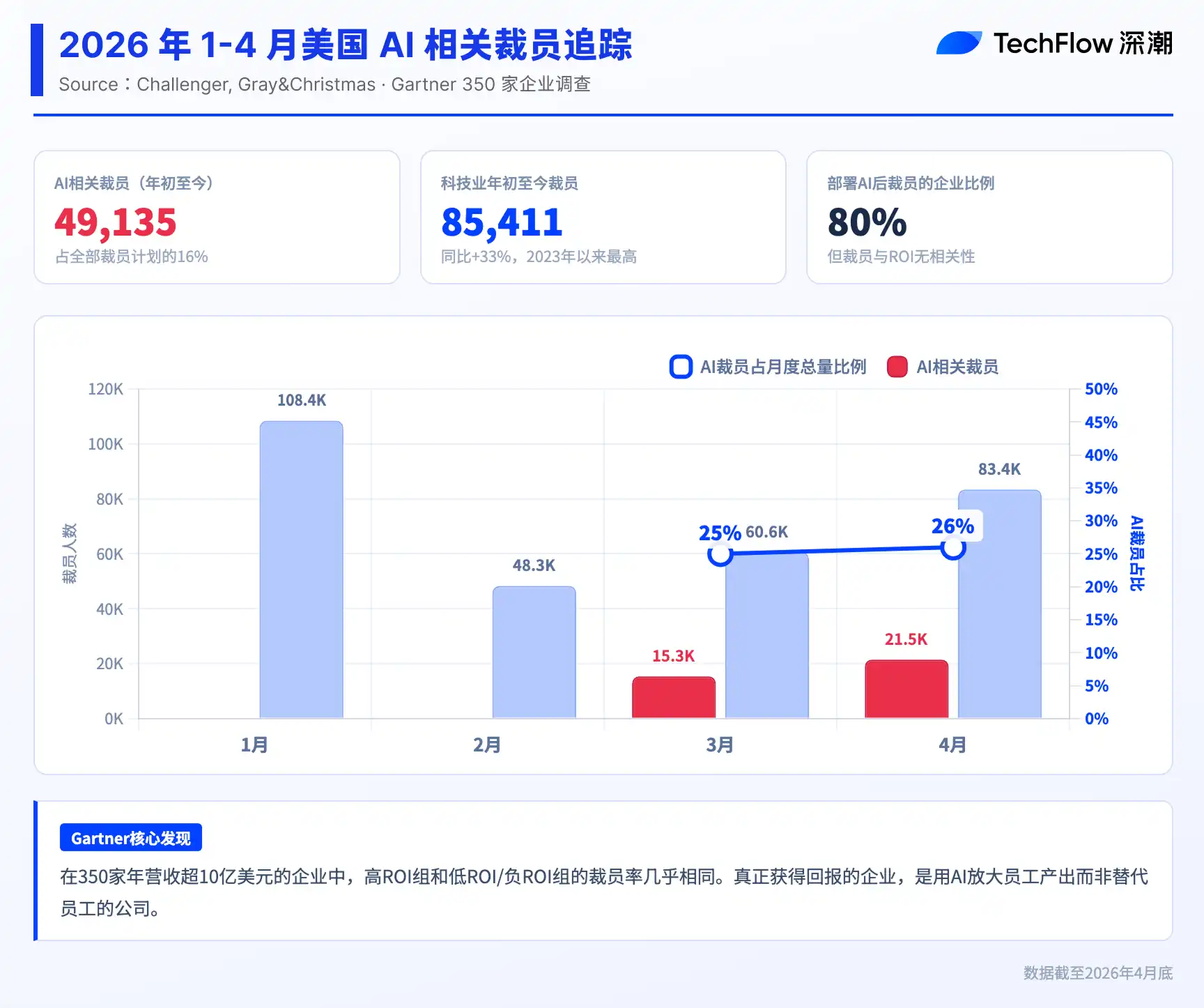
80% of Companies Cut Jobs, But Those Cutting More Aren't Earning More Than Those Cutting Less

Gartner's core finding is: Among companies that have deployed autonomous business capabilities, about 80% reported layoff actions. However, there is almost no difference in the proportion of layoffs between high-return companies and low-return (or even performance-deteriorating) companies.

In other words, from a statistical perspective, there is no discernible causal relationship between cutting jobs and making money.

The survey shows that companies achieving the highest returns are taking an opposite path. They position AI as "people amplification," using technology to enhance the output efficiency of existing employees rather than directly replacing human labor. Poitevin calls this model the "human-amplified business," where AI empowers humans rather than replaces them.

In another independent Gartner survey targeting CEOs, about one-third of executives expect AI to assist humans in decision-making but not make independent decisions, while another 27% expect AI to operate autonomously with minimal or no human intervention. The divergence between these two approaches is deepening.

Nearly 50,000 Jobs Cut Due to AI in First Four Months of This Year, Tech Industry Layoffs Hit Three-Year High

Gartner's research conclusions sharply contrast with the current reality of the job market.

According to the latest report released in May by outplacement firm Challenger, Gray & Christmas, AI has been the primary reason for U.S. corporate layoffs for two consecutive months. In April 2026, 21,490 positions were cut due to AI, accounting for 26% of the total layoffs of 83,387 that month. Cumulatively for the first four months of 2026, positions cut due to AI reached 49,135, representing about 16% of the year's total layoffs so far, up from 13% at the end of March.

Andy Challenger, Chief Revenue Officer at Challenger, summarized it pointedly: "Whether individual roles are truly being replaced by AI or not, the budget for those roles is being taken by AI."

By industry, the tech sector is the hardest hit. The tech industry cut 33,361 jobs in April, with a year-to-date total of 85,411, a 33% increase year-over-year, the highest for the period since 2023. Cognizant plans to cut 12,000 to 15,000 jobs globally, Cloudflare is laying off about 1,100 employees (approximately 20% of its workforce), Coinbase is cutting 14% of its staff, and Snap is eliminating 1,000 positions—all citing AI as a core driver.

Contrasting with the layoff wave is a sharp contraction in hiring. In April, companies announced only 10,049 new hiring plans, a staggering 69% decrease month-over-month and a 38% drop year-over-year.

"AI Washing" Layoffs: How Many Layoffs Are Really Due to AI?

A recurring question is raised: How many of the layoffs implemented by companies in the name of AI are genuinely driven by AI?

OpenAI CEO Sam Altman directly raised this question in an interview this past February. He acknowledged the existence of so-called "AI washing" phenomena: companies packaging layoffs they would have conducted anyway as AI-driven structural adjustments. "I don't know the exact percentage, but there is certainly some AI washing, where people attribute layoffs they were going to do anyway to AI," Altman said.

Deutsche Bank analysts also noted in a recent research report that "AI redundancy washing will be a prominent feature of 2026," with large companies using AI as a rhetorical shield for layoffs, while actual drivers may be tariffs, economic uncertainty, or other cost pressures.

Gartner's Poitevin leans towards a milder interpretation: current AI-related layoffs are more like companies "testing the waters" rather than genuine structural resets. "In our view, this looks more like a one-off, small-scale experiment for many companies, not something that translates into full return on AI investment."

Long-term Forecast: AI to Become a Net Job Creator by 2028-2029

Gartner's stance is distinctly two-sided.

Short-term data is not optimistic. Previous Gartner research shows that AI agents successfully complete standard office tasks about 30% to 35% of the time. Gartner also predicts that over 40% of AI agent projects will be canceled by the end of 2027 due to cost overruns, unclear business value, and insufficient risk management.

But Gartner offers an optimistic long-term forecast: autonomous business will begin to become a net job creator between 2028 and 2029, when new types of jobs that AI cannot perform will emerge. Poitevin emphasizes: "In the long term, autonomous business will create more work for humans, not less. Structural factors like demographic decline and high-trust consumption scenarios will ensure that human capital remains central to operating, governing, and scaling autonomous systems."

On the spending front, Gartner expects AI agent software spending to grow from $86.4 billion in 2025 to $206.5 billion in 2026, and to $376.3 billion in 2027. Even with most projects failing, capital is still accelerating its influx.

This creates an absurd yet real situation: corporate layoffs have not brought returns, AI project failure rates remain high, but no one is willing to get off the ride.


Domande pertinenti

QWhat was the main finding of the Gartner study regarding AI-driven layoffs and financial performance?

AThe study found that while 80% of companies deploying AI reported layoffs, there was no positive correlation between the rate of layoffs and the company's return on investment. Companies that laid off more people did not see better financial returns than those that laid off fewer.

QAccording to the article, what is the 'human-amplified business' model, and how does it relate to AI investment success?

AThe 'human-amplified business' model uses AI to enhance and amplify the output of existing employees rather than to directly replace them. The study found that companies adopting this approach were the ones achieving the highest returns on their AI investments.

QWhat does the term 'AI washing' refer to in the context of corporate layoffs?

A'AI washing' refers to the practice where companies blame layoffs on AI-driven structural changes when, in reality, the layoffs were planned or driven by other factors like economic uncertainty or cost pressures, using AI as a rhetorical shield.

QWhat were the key statistics about AI-related job losses in the first four months of 2026, according to the article?

AIn the first four months of 2026, 49,135 jobs were cut due to AI, accounting for about 16% of total layoffs in that period. In April 2026 alone, 21,490 jobs (26% of the month's total) were attributed to AI.

QWhat is Gartner's long-term prediction regarding AI's impact on employment by 2028-2029?

AGartner predicts that autonomous business powered by AI will become a net creator of jobs by 2028-2029. New types of work that AI cannot perform are expected to emerge, and human capital will remain central to operating and governing these systems.

Letture associate

Annual Salary of Millions Competing for Electricians, Meta Rushes to Open Its Own Technical School

The AI boom is facing an unexpected bottleneck: a severe shortage of skilled construction workers and electricians. As tech giants like Meta, OpenAI, and Alphabet race to build massive data centers—such as OpenAI's $16 billion "Stargate" project—they are hitting a critical labor wall. The U.S. needs an estimated 130,000 more electricians, 240,000 construction workers, and 150,000 supervisors by 2030 for AI infrastructure alone, but tens of thousands of electrician jobs go unfilled each year. While AI companies offer high premiums, with electricians earning up to $280,000 annually, worker scarcity still causes massive losses—delays on a single project can cost $14.2 million per month. The complexity of building AI data centers, which require immense power (equivalent to powering hundreds of thousands of homes), sophisticated electrical systems, and advanced liquid cooling solutions, demands highly skilled technicians who are in short supply. To combat this, companies are investing heavily in training. Meta has committed $115 million to a free training school offering tuition, housing, and stipends, targeting 5,000 new workers. OpenAI is partnering with unions to secure skilled labor. These efforts are paying off, with a significant rise in Gen Z interest in trade schools over college. However, the power demands are staggering. AI data centers are driving a rapid surge in electricity consumption, projected to account for up to 12% of U.S. power use by 2028 and raising costs for consumers. Furthermore, the construction boom is project-based, leading to a potential future glut of trained workers once building peaks, which could depress wages industry-wide. The race for AI supremacy now depends as much on skilled hands as on advanced chips.

marsbit57 min fa

Annual Salary of Millions Competing for Electricians, Meta Rushes to Open Its Own Technical School

marsbit57 min fa

OpenAI No Longer Sells Its Most Expensive Model for Profit

OpenAI is shifting its business strategy away from promoting its most expensive, flagship models for every task. Recent price cuts—80% for GPT-5.6 Luna and 20% for Terra—signal a deeper change: the company now actively advises users that many tasks don't require the most powerful model. Instead, OpenAI recommends a tiered approach: use the high-end GPT-5.6 Sol for complex planning and analysis, then delegate execution to cheaper models like Luna. This mirrors moves by Anthropic, which recently launched Claude Opus 5 at half the price of its top model, Fable 5. Both companies are de-emphasizing flagship models as primary revenue drivers, using them instead for brand prestige and technological showcases. The industry is entering a "mass-market" phase, similar to automotive, where high-volume, cost-effective models handle daily operations and drive scale. OpenAI's price reductions are partly enabled by AI models themselves optimizing underlying code and infrastructure, creating a self-reinforcing cycle of efficiency gains and cost reduction. Competition is shifting from "who is smartest" to "who offers the best value." The goal is no longer selling individual models but fostering widespread API adoption and ecosystem lock-in. By making AI calls cheap and ubiquitous, companies like OpenAI aim to become the indispensable, utility-like infrastructure powering automated workflows—the "water and electricity" of software, quietly embedded everywhere.

marsbit57 min fa

OpenAI No Longer Sells Its Most Expensive Model for Profit

marsbit57 min fa

Will the Fed Definitely Raise Interest Rates in September? How Will Crypto and U.S. Stocks Withstand the Pressure?

The market's expectation for a September Fed rate hike surged dramatically in early August, jumping from under 50% to over 80% within a week. This shift followed a contentious July FOMC meeting, where a 9-3 vote to hold rates revealed growing dissent from hawkish members advocating for an immediate hike to combat persistent inflation. The primary catalyst for this repricing is rising oil prices, driven by renewed geopolitical tensions around the Strait of Hormuz, which threaten global supply. Energy costs directly influence inflation metrics, making the upcoming July CPI report (due August 12th) a critical data point. If it shows inflation reaccelerating, the probability of a September hike will solidify. For Bitcoin and crypto assets, this is typically bearish news. Bitcoin continues to behave as a high-beta, liquidity-sensitive risk asset. A rate hike raises the opportunity cost of holding non-yielding assets and could drive capital toward money markets, pressuring crypto prices in the short term. However, historical patterns suggest that if a hike is perceived as the end of a tightening cycle rather than the start, any negative price impact may be brief. U.S. stocks, particularly crypto-linked equities like Coinbase and growth-oriented tech stocks, are also vulnerable. Higher rates increase discount rates in valuation models, putting pressure on high-multiple companies. This coincides with a pivotal tech earnings season where investor focus has shifted from massive AI capital expenditure to tangible revenue and cash flow generation. Companies with negative cash flow and weak growth narratives could face heightened volatility if borrowing costs rise in September. In summary, a September Fed hike has evolved into a mainstream market scenario. Key factors to watch are oil prices, the July CPI report, and Fed communications, which will determine the final decision and its impact on volatile crypto and equity markets.

marsbit1 h fa

Will the Fed Definitely Raise Interest Rates in September? How Will Crypto and U.S. Stocks Withstand the Pressure?

marsbit1 h fa

Trading

Spot
活动图片




