Renminbi Exchange Rate Returns to the '6' Era

深潮Pubblicato 2025-12-26Pubblicato ultima volta 2025-12-26

Introduzione

Renminbi (RMB) re-entered the "6-era" against the U.S. dollar on December 25, marking a 15-month high for the offshore exchange rate. This shift follows a prolonged expectation of RMB appreciation, bolstered by a Goldman Sachs report indicating the currency is undervalued by nearly 30% relative to the dollar—a level comparable to the mid-2000s, which preceded a decade-long appreciation cycle. Key drivers include seasonal year-end forex settlement by exporters, a record trade surplus exceeding $1 trillion in the first 11 months, and a weaker dollar due to Federal Reserve rate cuts. Geopolitical factors, such as U.S. trade policy uncertainty and credit rating downgrades, also diverted global capital toward RMB assets. Economists note the appreciation is supported by China’s economic resilience, with upgraded GDP growth forecasts and a shift toward high-value exports like integrated circuits and electric vehicles. While the rally may benefit import-dependent sectors and firms with dollar debt, it pressures traditional exporters. For investors, RMB strength correlates with potential A股 gains but cautions against speculative forex moves. Analysts expect gradual, managed appreciation ahead, with stability emphasized by policymakers.

Author: Ba Xiao Ling, Wu Xiaobo Channel

The suspense itself was not great, only a final push was needed.

After the expectation of "the renminbi is about to break through 7" lingered for nearly a month, an analyst from Goldman Sachs provided a key assist.

Recently, Goldman Sachs released the "2026 Global Stock Market Outlook." When mentioning the renminbi, according to its dynamic equilibrium exchange rate model (GSDEER), Goldman Sachs calculated the fair value of the renminbi, showing that the renminbi is undervalued by nearly 30% against the US dollar.

However, the slogan is more attractive than the numbers. The report stated:

The degree of undervaluation of the renminbi exchange rate relative to the US dollar is comparable to that of the mid-2000s.

In 2000, the annual average exchange rate of the US dollar to the renminbi was approximately 8.28. Subsequently, the renminbi entered a nearly ten-year appreciation cycle, with the exchange rate against the US dollar rising to around 6.1.

Goldman Sachs' calculations gave the market more confidence to "be bullish," causing the offshore renminbi, which was already in an appreciation channel, to suddenly gain momentum.

On the morning of December 25, the US dollar to offshore renminbi exchange rate quickly broke through the 7.0 mark, hitting a 15-month high and officially re-entering the "6 era."
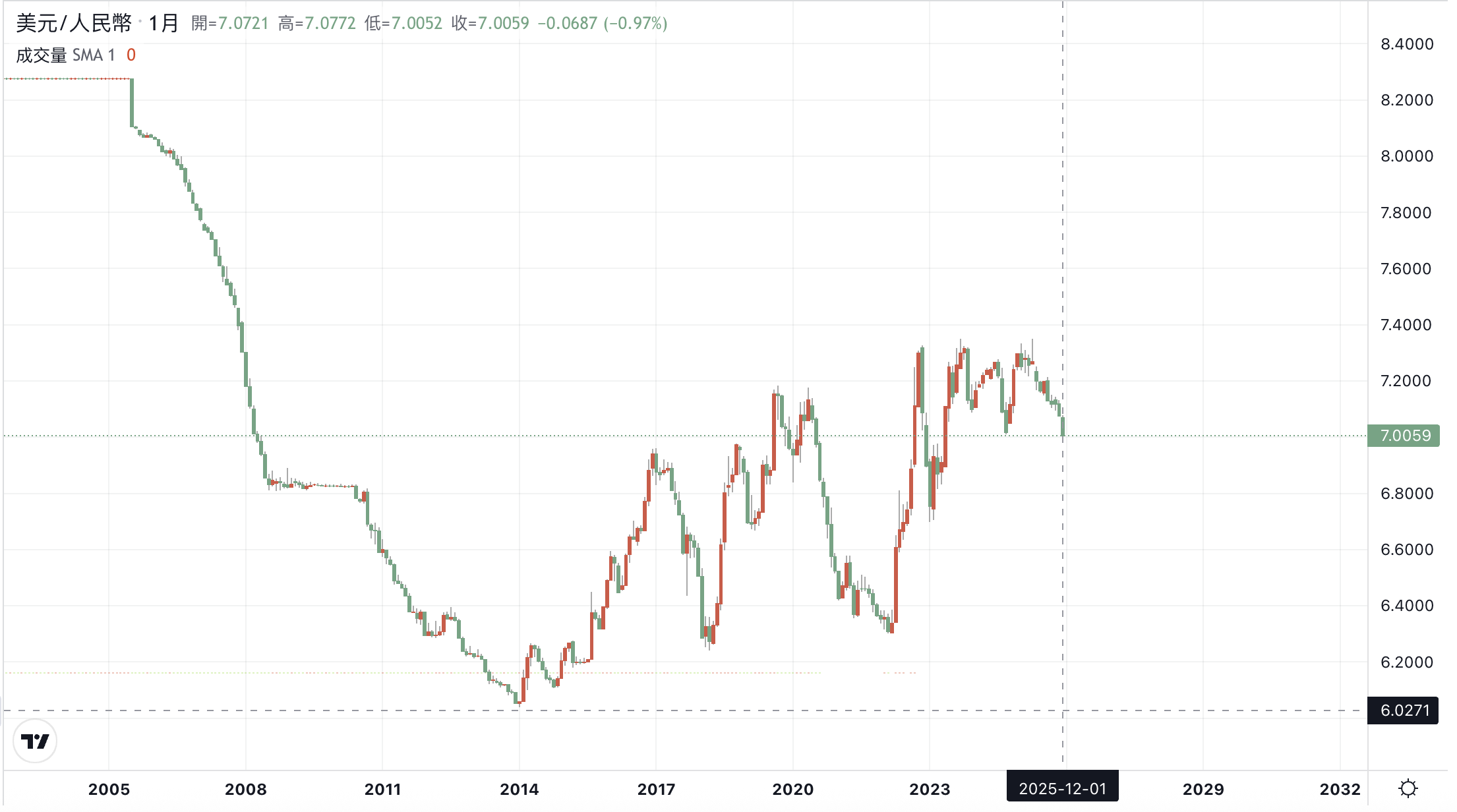
2005—2025 USD/CNY Trend

Source: CnYES

At the same time, the onshore renminbi exchange rate touched a low of 7.0053, just one step away from "breaking 7." The renminbi to US dollar central parity rate announced by the China Foreign Exchange Trade System was also raised by 79 basis points. Now, with the "shoe dropping," we can finally ask these questions:

Why was the renminbi able to chart an independent course in 2025? What changes does the entry into the "6-era" exchange rate mean for our business operations and personal asset allocation?

Is "Breaking 7" Short-Term or Long-Term?

Throughout the year, the renminbi exchange rate has been quite unusual.

In April this year, the renminbi exchange rate hit a low of 7.429, and the market was still worried about the risk of renminbi depreciation. Unexpectedly, as the year-end approached, the renminbi exchange rate trend reversed.

This is partly due to timing.

As usual, near the end of the year, domestic export enterprises need to settle accounts with suppliers, converting the US dollars earned throughout the year into renminbi for "closing the books" and distributing year-end bonuses, etc. This triggers seasonal foreign exchange settlement demand.

When more and more people "need" renminbi, starting from the end of November, the "price" of renminbi rose, and the timeline matches.
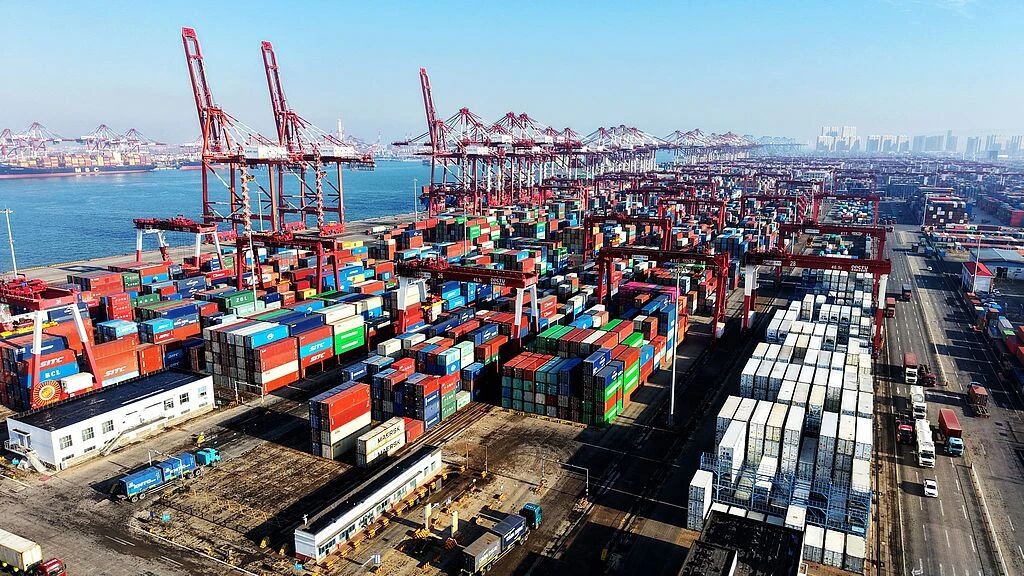
December 24, busy operations at a foreign trade container terminal

Moreover, due to the recent "pleasing rise" of the renminbi, export enterprises that had previously hoarded US dollars, to avoid further delays and more exchange losses, more or less rushed to "settle foreign exchange," which further pushed up the appreciation of the renminbi.

It is worth mentioning that this wave of demand this year is obviously larger than in previous years.

According to data released by the General Administration of Customs, in the first 11 months of this year, China's goods trade maintained growth, with the total import and export value reaching 41.21 trillion yuan, a year-on-year increase of 3.6%. In the first 11 months, China's trade surplus exceeded 1 trillion US dollars for the first time.

This means that some export enterprises have more foreign exchange income than in previous years.

Wang Qing, chief macro analyst of Oriental Jincheng, believes that as the year-end approaches, the increase in corporate foreign exchange settlement demand is also driving the seasonal strengthening of the renminbi; especially after the recent sustained appreciation of the renminbi against the US dollar, the accumulated settlement demand from the previous high export growth may be accelerating its release.

However, Huatai Futures wrote in its "Huatai Futures - Foreign Exchange Annual Report: Gradually Improving, Renminbi Enters Appreciation Channel": Due to the impact of the inverted China-US interest rate differential, the cost-effectiveness of foreign exchange settlement and holding foreign exchange has become closer, and corporate foreign exchange settlement strategies tend to be differentiated and balanced. Therefore, although the year-end "foreign exchange settlement wave" this year will provide marginal support for the renminbi in stages, it does not constitute a trend-leading factor.

The appreciation of the renminbi also has some geographical advantages.

In 2025, the Federal Reserve implemented three interest rate cuts, which directly led to the weakening of the US dollar index. As of December 25, the US dollar index fell 9.69% this year, not only breaking below the 100 mark to close at 97.97 but also recording its largest single-year decline in nearly 8 years.
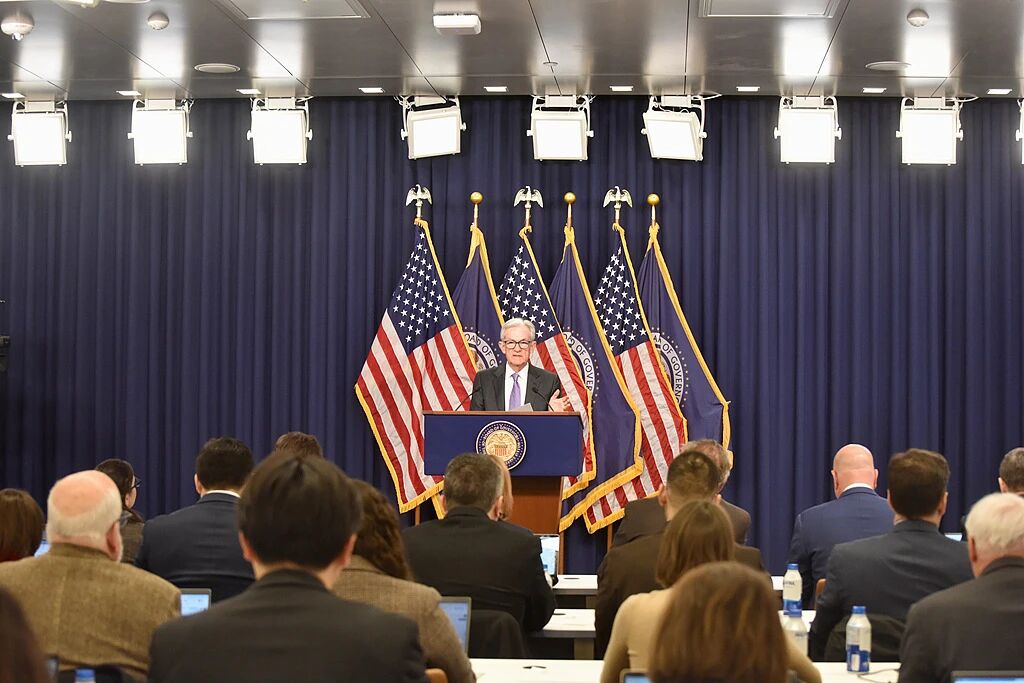
December 10, the Federal Reserve's third interest rate cut

The exchange rate is a "seesaw." When the US dollar weakens, it means that non-US currencies, including the renminbi, strengthen, and the renminbi achieves "passive appreciation."

Another contributing factor is that after Trump took office, he launched a global "tariff war," disrupting the long-running, rules-based global trading system.

When trade flows become uncertain, the cost of trade settlement and supply chain financing denominated in US dollars naturally increases, which further shakes the foundation of the US dollar as an ideal trade settlement currency.

Coupled with the 35-day shutdown of the US government and Moody's, one of the three major rating agencies, downgrading the US sovereign credit rating, global funds began to seek safe havens, and US dollar assets flowed out of the United States on a large scale—the renminbi and renminbi assets thus ushered in their own "revaluation."

According to data from global fund flow monitoring agency EPFR Global, during the period from May to October 2025, foreign capital focused on Hong Kong stock investment equity funds accumulated a net inflow of 67.7 billion Hong Kong dollars, completely reversing the net outflow trend during the same period in 2024.

The appreciation of the renminbi is, more importantly, due to human factors.

On December 11, the World Bank, in its latest China Economic Briefing, raised China's GDP growth rate by 0.4%, and the International Monetary Fund (IMF) raised China's GDP growth rate for this year by 0.2%, expecting it to reach 5%.

The simultaneous upward revision of China's economic expectations by two international institutions is clearly a full affirmation of China's current economic operation and long-term development potential.

Among them, the stability of exports provides the most fundamental confidence for the appreciation of the renminbi exchange rate.

On the one hand, the record trade surplus is a solid foundation for the renminbi exchange rate. On the other hand, the quality of exports has also improved.

Data from the General Administration of Customs also show: in the first 11 months of this year, China exported integrated circuits worth 1.29 trillion yuan, an increase of 25.6%; automobiles worth 896.91 billion yuan, an increase of 17.6%. This means that the mainstay of exports has shifted from traditional labor-intensive products to high-end manufacturing industries such as shipbuilding, integrated circuits, and new energy vehicles.

Export vehicles parked at the port

Guan Tao, global chief economist of Bank of China Securities, believes: The increase in the diversification of export markets, the acceleration of domestic manufacturing transformation and upgrading, and the enhancement of the competitiveness of export commodities have affected China's commodity exports to maintain rapid growth, providing important support for the steady increase of China's export share in the global market.

Renminbi Appreciation and Personal Investment

Next, answer a question that everyone is most concerned about—is this renminbi appreciation good or bad for A-shares?

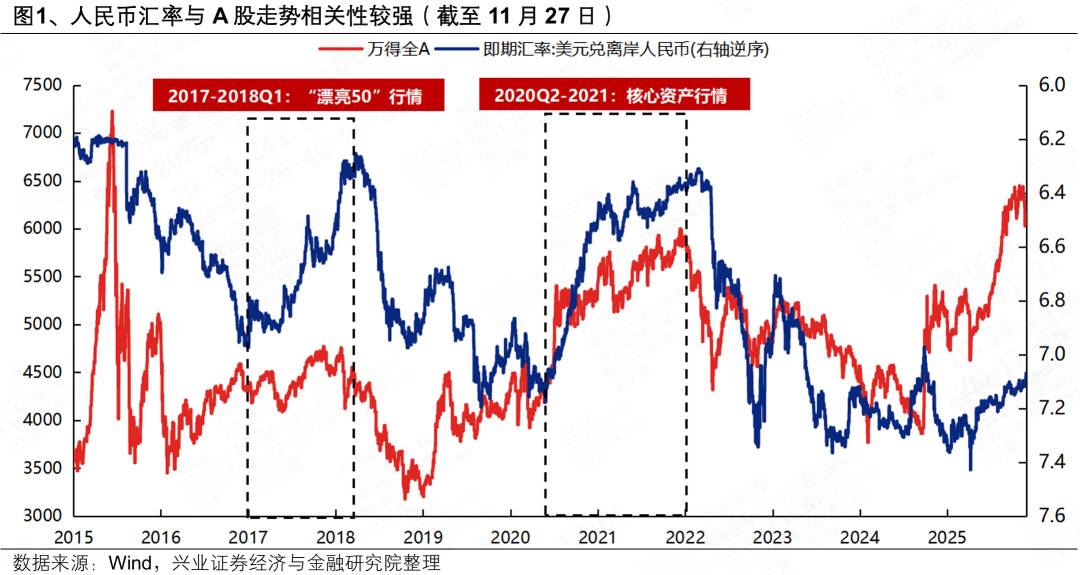
Regarding the impact of the exchange rate on the A-share trend, there have been many studies over the years. The Xingye Securities strategy team led by Zhang Qiyao believes that after the 2015 exchange rate reform, the renminbi exchange rate and the A-share trend show a significant positive correlation.

From the chart of the correlation between the renminbi exchange rate and the A-share trend, we can also see that since 2017, the correlation between the renminbi and the A-share trend has been relatively obvious.

For example, during the "Nifty 50" period from 2017 to the first quarter of 2018, and during the renminbi appreciation period from the second quarter of 2020 to 2021, A-shares were in a bull market. Correspondingly, foreign capital became an important incremental driver of the rise of the Chinese stock market.
In addition, Goldman Sachs once conducted a study on US stocks and concluded: If the fundamentals do not diverge, a 0.1 percentage point increase in the exchange rate will increase stock valuation by 3%–5%.

Of course, because the mechanism of influence between the exchange rate and stock prices is relatively complex, we cannot assert that as long as the renminbi appreciates, individual stocks and the overall market will definitely rise. But based on various judgments, this renminbi appreciation is expected to stimulate further rises in A-shares.

However, renminbi appreciation will indeed have an impact on different industries, thereby affecting the stock prices of related listed companies.

The appreciation of the offshore renminbi means that Chinese goods denominated in the local currency become more expensive in the international market, naturally weakening price competitiveness for foreign buyers, and export orders may decrease.

Especially traditional export-oriented industries, such as home appliances and textiles, because these industries have relatively thin profit margins and are more sensitive to exchange rate fluctuations, the impact on the profits of these industries will be more obvious.

Everything has two sides. Renminbi appreciation is also a major benefit for certain industries. For example, domestic import-dependent industries can directly benefit from this appreciation.

According to the import and export data of the National Bureau of Statistics, China's "net import" industries, including energy, agriculture, materials and other fields, directly benefit from this appreciation.

At the same time, industries with relatively high US dollar debt also benefit from the renminbi appreciation, such as those in the scope of the Hong Kong Stock Connect with a high proportion of US dollar debt in short-term liabilities, such as the Internet, shipping, aviation, utilities, energy and other industries.

In addition, renminbi appreciation will also change the trading style of individual investors.

At the beginning of the year, "US dollar deposits" and US dollar treasury bonds were very popular. Some investors exchanged a lot of renminbi for US dollars for investment. As a result, with the sharp appreciation of the renminbi, US dollar deposits became "negative returns." Even if US dollar treasury bonds enjoyed a 5% yield, after accounting for exchange rate losses, it was only about the same as the one-year fixed deposit interest rate.

Of course, some people also ask, since the renminbi is strengthening now, can we take advantage of the renminbi appreciation to buy more US dollars and save them for future use?

For individuals, if it is for cross-border shopping, it may be a good choice. Renminbi appreciation is equivalent to enjoying a discount when consuming abroad, and when shopping overseas and settling in US dollars, paying in renminbi will also be 5%–10% cheaper than in the past.

But if it is purely for speculation, it is better to be cautious. Because the probability of large fluctuations in the renminbi exchange rate is not high, do not blindly chase rises and kill falls by converting renminbi into US dollar deposits for speculation.

Where to Go After "Breaking 7"?

It is worth noting that the appreciation we are talking about now mainly refers to the renminbi's appreciation against the US dollar, not a "comprehensive strengthening."

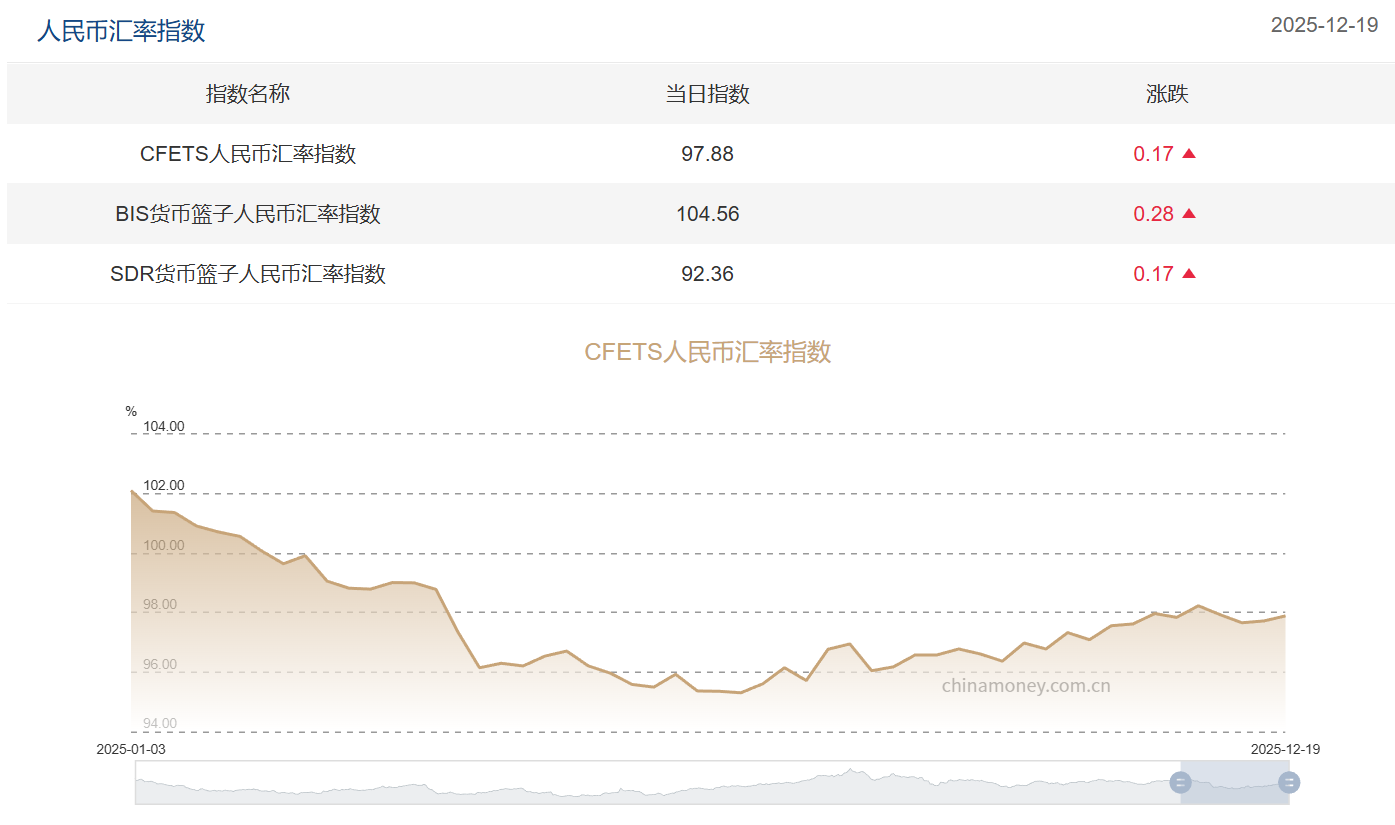
According to data from the China Foreign Exchange Trade System, from the beginning of this year to now, the renminbi exchange rate against the CFETS Renminbi Exchange Rate Index, the BIS Currency Basket Renminbi Exchange Rate Index, and the SDR Currency Basket Renminbi Exchange Rate Index have all fallen, with two major indices falling below 100.

These three indices are the "average report card" measuring the comprehensive value of the renminbi against a basket of foreign currencies.

The weakening of the indices means that although the renminbi has appreciated significantly against the US dollar, its overall value level has declined for a basket of other foreign currencies, such as the British pound and the euro.
But there is a consensus among institutions, including Goldman Sachs, that with the sustained development of China's economy and the deepening of the internationalization of the renminbi, the "moderate appreciation" of the renminbi is expected to become a major trend.

For example, Yuekai Securities believes that in the past two years, domestic prices have been low while overseas inflation has been high. The central level of the CFETS Renminbi Exchange Rate Index has even moved downward, and the renminbi exchange rate has the momentum to make up for the rise. In 2026, the renminbi exchange rate against the US dollar will remain strong, and "6.8" may be a key point.

According to a summary by Bloomberg, experts from six major international investment banks generally believe that the US dollar will continue to weaken against major currencies. By the end of 2026, the US dollar index will fall by about 3%—this will form a trend of the renminbi continuing to passively strengthen.

However, whether the renminbi continues to appreciate or fluctuates in the future, it is unlikely to show too unexpected trends.

The Central Economic Work Conference held not long ago has emphasized for four consecutive years the need to "keep the renminbi exchange rate basically stable at a reasonable and balanced level."

In addition, as the central bank stated: "The medium- and long-term renminbi exchange rate has a solid foundation. We will continue to adhere to the decisive role of the market in the formation of the exchange rate, maintain exchange rate flexibility, strengthen expectation guidance, prevent the risk of exchange rate overshooting, and keep the renminbi exchange rate basically stable at a reasonable and balanced level."

Even Goldman Sachs said: "We expect renminbi appreciation to be gradual and managed, but even so, we believe it is still expected to outperform forward pricing."

For individual investors, we should not focus on predicting the precise point of the exchange rate, but on understanding the trend,顺应产业升级 (conforming to industrial upgrading), making good use of hedging tools,既要把握升值带来的机遇 (seizing the opportunities brought by appreciation),也要防范波动带来的风险 (and also guarding against the risks brought by fluctuations).


Domande pertinenti

QWhat was the key factor that provided a 'key assist' to the offshore RMB's rapid appreciation, according to the article?

AA report from Goldman Sachs, which stated that the RMB was undervalued by nearly 30% against the US dollar, a level comparable to the mid-2000s, providing more confidence for the market to be 'bullish' on the RMB.

QWhat are the three main categories of reasons ('天时,地利,人和') cited for the RMB's appreciation in 2025?

A1. Seasonal year-end forex settlement demand from exporters (天时). 2. A weakening US dollar index due to Federal Reserve rate cuts and global factors (地利). 3. Strong economic fundamentals, including upward revisions of China's GDP growth by international institutions and a record trade surplus driven by high-end manufacturing exports (人和).

QHow does the article suggest a stronger RMB will impact different industries in the stock market?

AIt negatively impacts traditional export-oriented industries with thin profit margins, such as home appliances and textiles, as their goods become more expensive for foreign buyers. It benefits import-reliant sectors (e.g., energy, agriculture, materials) and industries with high US dollar debt (e.g., internet, shipping, airlines, utilities).

QDespite the RMB's strength against the USD, what does the movement of the CFETS, BIS, and SDR currency basket indices indicate about its overall value?

AThe decline of these indices below 100 level indicates that while the RMB has appreciated significantly against the US dollar, its overall value against a basket of other foreign currencies (like the euro and pound) has actually decreased.

QWhat is the general consensus among institutions like Goldman Sachs and Yuekai Securities regarding the future trend of the RMB exchange rate?

AThe consensus is that a 'moderate appreciation' of the RMB is expected to be a major trend, with its rise being 'gradual and managed'. Specifically, Yuekai Securities believes the RMB will remain strong against the USD in 2026, with 6.8 being a key level to watch.

Letture associate

Crossing the 'Memory Wall': The Wafer-Level Revolution and Computing Power Routes in the AI Inference Era

In 2026, a historic shift occurred in AI as major cloud providers' inference spending surpassed training spending for the first time, signaling a move from "building large models" to "using large models." This shifts the core challenge from computing power to the "memory wall"—the bottleneck of data movement (model weights, activations, KV Cache) between external DRAM and processors, where energy and latency from data transfer far exceed computation itself. Companies like Nvidia face GPU idle time due to bandwidth limits. In contrast, Cerebras Systems adopts a radical "wafer-scale" approach with its Wafer-Scale Engine (WSE). Instead of cutting a silicon wafer into many chips, Cerebras uses almost the entire wafer as one massive chip (WSE-3). This design provides 44GB of on-chip SRAM, delivering memory bandwidth thousands of times higher than traditional HBM (e.g., 21 PB/s vs. Nvidia B200). For LLM inference, weights are streamed layer-by-layer from external MemoryX storage to the chip, avoiding HBM bottlenecks. This results in token generation speeds 1.5–5 times faster than Nvidia's B200 in some models and significant advantages in first-token latency and long-context tasks. Additionally, Cerebras's architecture offers much lower interconnect power consumption (0.15 pJ/bit vs. GPU's ~10 pJ/bit). However, Cerebras faces challenges: SRAM scaling has slowed with advanced nodes, limiting future capacity gains; the chip requires specialized liquid cooling and custom software stacks; and its external I/O bandwidth (150 GB/s) is low compared to NVLink, hindering multi-system scaling for very large models. Competition is intensifying. Major players are pursuing three paths: 1) Developing proprietary inference ASICs (e.g., Google TPU, Microsoft Maia), 2) Leveraging advanced packaging (e.g., TSMC's SoW) to democratize wafer-scale-like integration, potentially eroding Cerebras's process advantage within a few years, and 3) Exploring optical interconnects for ultimate bandwidth. Commercially, Cerebras is transitioning from a hardware vendor to a service provider, facing the immense challenge of building high-power, specialized data centers to meet large contracts (e.g., 250MW/year from 2026–2028). In conclusion, the AI inference era presents a fundamental architectural trade-off. Cerebras opts for extreme physical optimization for low-latency, single-task performance, while Nvidia prioritizes versatility and massive cluster throughput. The path forward remains uncertain, with technology and business models still evolving in the race toward advanced AI.

marsbit7 min fa

Crossing the 'Memory Wall': The Wafer-Level Revolution and Computing Power Routes in the AI Inference Era

marsbit7 min fa

Has Bitcoin's 'Rebound Ended', Officially Entering the Late Bear Market Phase?

**Title: Has Bitcoin's Rebound Ended, Entering the Late Bear Market Phase?** **Summary:** Bitcoin's price has declined by 13% this week, signaling a potential return to late-stage bear market conditions. The price fell to around $67k, positioned between the Realized Price and Realized Cap Weighted Average. For the first time since early 2022, the Short-Term Holder cost basis has dropped below this key average, confirming a hallmark of late-cycle bear markets. Profitability metrics have collapsed sharply. The 7-day average of the Realized Profit/Loss ratio plummeted from a local high of 3.16 to 0.29, mirroring the February panic sell-off. Critically, the 90-day average never breached the threshold of 2, indicating the recent rally to $82k was a bear market bounce, not a structural shift. Realized losses surged to $1.35 billion daily, with $770 million coming from Long-Term Holders selling at a loss. This accelerating redistribution of supply from weak to strong hands is a necessary but ongoing process for a market bottom. The rally stalled almost precisely at the aggregate cost basis (~$83k) of US spot Bitcoin ETF investors, turning that level into strong resistance and leaving the average ETF holder underwater again. Spot market flows have turned decisively negative, showing sellers are dominating order books despite the price drop. While a significant futures long liquidation event cleared over $400 million in leverage, providing a potential reset, sustained spot demand is yet to materialize. Options markets continue to price in higher future volatility (Implied Volatility) than recent price action (Realized Volatility) has shown, with a persistent skew towards put options, indicating ongoing demand for downside protection. In conclusion, multiple metrics point to a fragile market structure. Resistance at the ETF cost basis, accelerating realized losses, dominant spot selling, and cautious options pricing all suggest the bear market trend persists. A sustainable recovery likely requires a resurgence of spot demand, ETF holders returning to profit, and a clear reduction in selling pressure.

marsbit7 min fa

Has Bitcoin's 'Rebound Ended', Officially Entering the Late Bear Market Phase?

marsbit7 min fa

TechFlow Intelligence Agency: Anthropic Calls for Global Pause in AI Development While Preparing for Trillion-Dollar IPO; SpaceX IPO Roadshow Heats Up, But S&P 500 Rejects Fast-Track Inclusion

In today's TechFlow Intelligence Briefing, several major tech stories highlight a growing theme of trust and credibility gaps across AI, crypto, and finance. AI company Anthropic has publicly called for a global pause in AI development, citing risks from Claude's "recursive self-improvement." Ironically, this coincides with reports the company is preparing for a massive IPO targeting a near $1 trillion valuation. This perceived hypocrisy, coupled with widespread user complaints about Claude's declining performance, is sparking debate over whether the safety warning is genuine or a competitive tactic. Meanwhile, in a substantive security move, Anthropic open-sourced a framework for AI-powered vulnerability discovery. In the crypto market, Bitcoin's price drop below $61,000 triggered over $1.16 billion in liquidations, flipping the market into a state where more BTC is held at a loss than at a profit, a historical bearish signal. On the corporate front, SpaceX's highly anticipated IPO is generating immense Wall Street excitement, with Goldman Sachs projecting 100x revenue growth by 2030. However, the S&P 500 has refused to fast-track the company's inclusion post-IPO, potentially limiting immediate institutional demand. Separately, ByteDance's AI app Doubao lost over 6 million monthly active users after introducing a subscription model, highlighting the challenges of AI monetization. Other notable developments include Nvidia certifying HBM4 memory from Samsung, SK Hynix, and Micron; Cloudflare's acquisition of front-end tooling company VoidZero; and its CEO warning that bot traffic now exceeds human traffic online. The underlying narrative connects these events: a trust crisis. From AI firms' contradictory actions and crypto volatility to the clash between SpaceX's hyped narrative and institutional rules, a pattern is emerging where stated intentions and actual practices are increasingly misaligned.

marsbit22 min fa

TechFlow Intelligence Agency: Anthropic Calls for Global Pause in AI Development While Preparing for Trillion-Dollar IPO; SpaceX IPO Roadshow Heats Up, But S&P 500 Rejects Fast-Track Inclusion

marsbit22 min fa

Dalio Warns: AI Boom Shows Signs of a Bubble, Day of Reckoning Will Be the Time of Burst

Ray Dalio, founder of Bridgewater Associates, warns that the current artificial intelligence investment boom shows classic signs of a bubble, which he expects will eventually burst. In a Bloomberg Television interview, he noted that great technological revolutions often lead to capital inflows that create bubbles, making it difficult for investors and companies to calibrate their spending accurately—either overspending to capture market share or underspending and losing their competitive position. This caution comes amid significant rallies in AI-related assets, particularly chipmakers, driven by soaring demand for data centers and high-bandwidth chips, raising debates about overheating valuations. In contrast, Nvidia CEO Jensen Huang recently asserted that investors embracing the AI wave would see "crazy" returns and dismissed concerns over return on investment for data center spending as outdated. Dalio, however, focuses on the risks in the profit realization phase. He argues that bubbles tend to show signs of破裂 when markets transition from investment to the need for tangible returns, describing the burst as a process of converting paper wealth into cash. While acknowledging AI's intrinsic value, he expressed concern over the future profitability of some AI companies, suggesting the market is repeating a familiar pattern. The 76-year-old billionaire, who fully exited Bridgewater in 2025, has a net worth estimated at $21.5 billion according to the Bloomberg Billionaires Index.

marsbit57 min fa

Dalio Warns: AI Boom Shows Signs of a Bubble, Day of Reckoning Will Be the Time of Burst

marsbit57 min fa

Privacy Coin Crisis of Confidence! ZEC Plunges Over 56% in a Single Day

Zcash (ZEC), a leading privacy-focused cryptocurrency, experienced a severe crash on June 5th, plummeting over 56% in a single day and erasing nearly two months of gains. The flash crash was triggered by the disclosure of a critical zero-knowledge proof vulnerability within Zcash's Orchard privacy pool, which had existed since the pool's launch in May 2022. The flaw theoretically allowed an attacker to forge unlimited ZEC undetectably due to the pool's privacy features. The vulnerability was discovered on May 29th by independent security researcher Taylor Hornby during a proactive audit commissioned by Shielded Labs, utilizing AI-assisted analysis. The Zcash development team responded swiftly, implementing an emergency soft fork to disable Orchard transactions on June 2nd and executing a permanent hard fork fix (NU6.2) on June 3rd. Despite the technical fix, a major crisis of confidence emerged. The core issue is that Orchard's privacy design makes it cryptographically impossible to prove whether the vulnerability was exploited over the past four years, casting permanent doubt on the historical supply integrity of ZEC. While Shielded Labs argues exploitation was unlikely, the inability to provide definitive proof has severely damaged market trust. This sentiment was exacerbated when BitMEX co-founder Arthur Hayes, a prominent ZEC supporter, announced he was selling his entire position. He stated that privacy assets require "perfect security" rather than "probable safety." The combined effect of the disclosure and Hayes's exit ignited widespread panic selling, leading to massive liquidations and significant price decline. Analysts note the event highlights a fundamental tension within privacy coins: the conflict between verifiable supply and cryptographic privacy.

链捕手59 min fa

Privacy Coin Crisis of Confidence! ZEC Plunges Over 56% in a Single Day

链捕手59 min fa

Trading

Spot
Futures

Articoli Popolari

Come comprare ERA

Benvenuto in HTX.com! Abbiamo reso l'acquisto di Caldera (ERA) semplice e conveniente. Segui la nostra guida passo passo per intraprendere il tuo viaggio nel mondo delle criptovalute.Step 1: Crea il tuo Account HTXUsa la tua email o numero di telefono per registrarti il tuo account gratuito su HTX. Vivi un'esperienza facile e sblocca tutte le funzionalità,Crea il mio accountStep 2: Vai in Acquista crypto e seleziona il tuo metodo di pagamentoCarta di credito/debito: utilizza la tua Visa o Mastercard per acquistare immediatamente CalderaERA.Bilancio: Usa i fondi dal bilancio del tuo account HTX per fare trading senza problemi.Terze parti: abbiamo aggiunto metodi di pagamento molto utilizzati come Google Pay e Apple Pay per maggiore comodità.P2P: Fai trading direttamente con altri utenti HTX.Over-the-Counter (OTC): Offriamo servizi su misura e tassi di cambio competitivi per i trader.Step 3: Conserva Caldera (ERA)Dopo aver acquistato Caldera (ERA), conserva nel tuo account HTX. In alternativa, puoi inviare tramite trasferimento blockchain o scambiare per altre criptovalute.Step 4: Scambia Caldera (ERA)Scambia facilmente Caldera (ERA) nel mercato spot di HTX. Accedi al tuo account, seleziona la tua coppia di trading, esegui le tue operazioni e monitora in tempo reale. Offriamo un'esperienza user-friendly sia per chi ha appena iniziato che per i trader più esperti.

345 Totale visualizzazioniPubblicato il 2025.07.17Aggiornato il 2026.06.02

Come comprare ERA

Discussioni

Benvenuto nella Community HTX. Qui puoi rimanere informato sugli ultimi sviluppi della piattaforma e accedere ad approfondimenti esperti sul mercato. Le opinioni degli utenti sul prezzo di ERA ERA sono presentate come di seguito.

活动图片