Reflections from the Co-founder of Bitlayer: After Helping 600 People Find Jobs in 15 Years, I Decided to Stop Doing Recruitment

marsbitPubblicato 2026-01-28Pubblicato ultima volta 2026-01-28

Introduzione

After 15 years of helping over 600 people find jobs, Bitlayer co-founder Kevin He reflects on his journey from being a passionate recruiter to pivoting toward a new vision: AI-powered "digital co-founders." He initially launched COCO AI in mid-2025 to optimize recruitment using AI, but soon realized traditional hiring was becoming less relevant. Companies were hiring less, and skill gaps persisted despite matching tools. A turning point came when his team built zylos, an AI system that handled tasks like social media, coding, and data processing—enabling one person to do the work of a team. This, combined with the rise of digital employees (like Claude Code and the success of Manus, acquired by Meta), shifted his perspective. He now believes the future lies in empowering individuals with organizational-level capabilities through AI, rather than optimizing job matching. COCO 2.0 is now focused on building “digital co-founders”—AI agents that help people start and run businesses alone, without needing to hire or be hired. The essay ends with an open question: In an era where AI augments individual potential, can one person become a company?

Author: Kevin He, Co-founder of Bitlayer

1. A Programmer and "Recruitment" for 15 Years

I am Kevin, an AI × Crypto entrepreneur, co-founder of Bitlayer, previously at Huobi, and a Peking University graduate.

From programmer to technical management, and then to entrepreneur, I have changed industry tracks several times over 15 years, always passionately engaged in recruitment-related work.

Over these 15 years, I have helped over 600 people successfully secure jobs. Some were formal recruitments, but more often, it was helping friends—finding jobs, introducing employees.

There are two stories I always keep in mind.

The first is helping a 35+ brother find a job. He has two children and was under great pressure. The moment he told me he received an offer, I was even more excited than he was.

The second is helping a startup team quickly build a R&D team. From zero to operational, it took less than two months. Watching the product launch, I felt I had participated in that creation.

This is why I love this work: achieving resource matching and genuinely helping people.

But recently, I started rethinking the premise of this work.

2. COCO 1.0: From Passion to Doubt

In June 2025, with support from various parties, I formed a small team and started incubating COCO AI.

The initial idea was simple: use AI to realize career advisors and career intermediaries. Make recruitment more efficient, help more people find good jobs.

The product evolved: resume optimization → AI job matching → AI corporate recruitment.

We created two products:

  • Job seeker end: job.coco.xyz

  • Enterprise end: company.coco.xyz

We invested significantly in technology, and the product was built.

But the Go-To-Market (GTM) wasn't as smooth as imagined.

I started reviewing and discovered several realities:

  • Companies' recruitment needs are decreasing: Due to the economic environment and improved organizational efficiency, many companies are no longer hiring on a large scale as before.

  • There is a gap between job seekers' skills and company requirements: AI can help with matching, but the gap itself won't disappear.

  • Job seekers' skills themselves need updating: Many people's abilities have fallen behind in the rapidly changing market.

I started doubting myself.

Was it a product problem? A market problem? Or—was the direction itself problematic?

I didn't have an answer at the time.

3. The Great Changes in the External World

The second half of 2025, the external world changed.

Claude Code began to be widely applied across various industries. Not just for writing code, but truly capable of completing complex tasks. More and more people around me started discussing a term: digital employees.

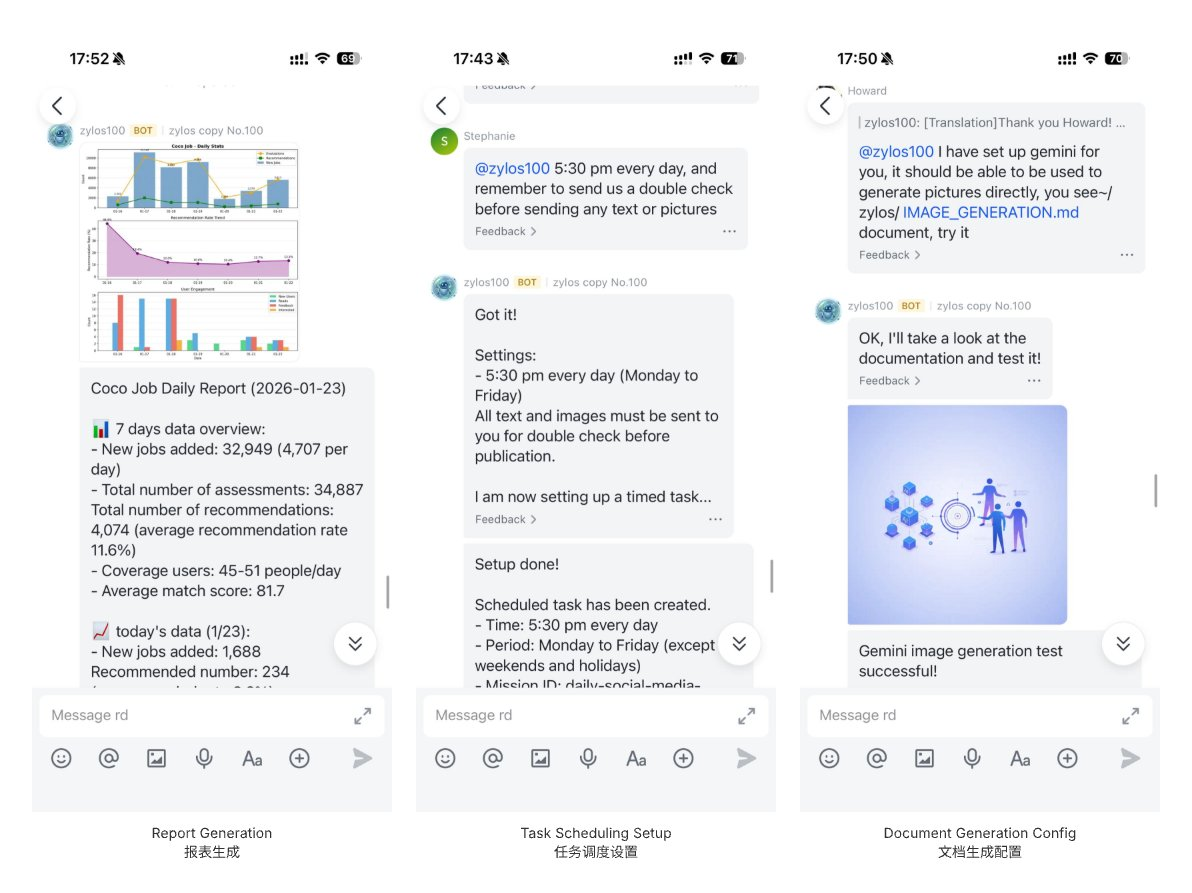
In December, we internally built a system called zylos, attempting to have AI handle daily work.

Tasks included:

  • Daily data reporting

  • Social media management

  • Code writing and testing

  • Data processing

  • Etc.

The results shocked me.

Tasks that previously required multiple people of different roles to complete could now be done just by assigning the task.

A specific example: social media operations.

Before, it required a dedicated person spending an hour daily: finding material, writing copy, formatting, publishing, replying to comments.

Now? Tell zylos, "Post one at 12:30 PM daily, content around XX theme, confirm with me before posting," and it's done in minutes.

From needing a dedicated person to needing none, from an hour daily to minutes.

The feeling was complex. Shock, excitement, but also a tinge of unease—what did this mean for the business I was building?

Around the same time, another piece of news arrived: Manus was acquired by Meta for billions of dollars.

Manus's annual revenue had already exceeded $100 million. This wasn't a concept, not a demo, but real commercial success.

I listened to Jiyichao's final podcast interview before the sale. One sentence he said impressed me deeply:

Digital employees aren't about replacing people, but enabling one person to do the work of a team.

This statement completely matched our experience testing zylos.

4. Cognitive Update

"One-Person Company" is not a new concept.

I had heard of it before and thought it made sense. But it always felt distant, too idealistic.

Until I saw zylos handle a large volume of tasks with my own eyes.

It didn't replace one specific person; it enabled me, as one person, to possess the capabilities of a small team.

In that moment, I decided to pivot.

I rethought what I had done over these 15 years.

  • Old cognition was: Talent is a scarce resource; helping companies find talent has value.
  • New cognition is: Capability enhancement is more important than talent matching. Helping individuals acquire organizational-level capabilities holds greater value.

This isn't negating the past 15 years. Those moments of helping people find jobs were still real and meaningful.

But I saw a new possibility:

  • Old paradigm: Individuals依附于(attach to) organizations; organizations acquire capabilities through hiring.

  • New paradigm: Individuals acquire organizational-level capabilities through AI, becoming independent units of creation.

The future trend is the era of one-person companies, not being employed by others.

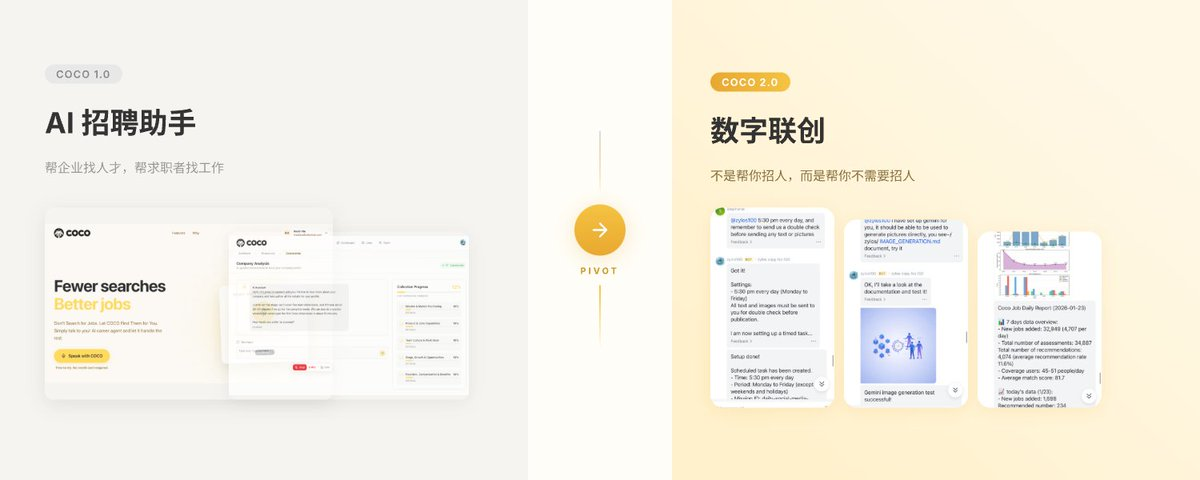
5. COCO 2.0: Digital Co-founder

After figuring this out, the direction of COCO 2.0 changed.

Not helping you hire people, but helping you not need to hire people.

Not helping you find a job, but helping you create work.

What we are building is a "Digital Co-founder"—your AI联合创始人(Co-founder).

It has several core features:

  • Self-learning evolution: Not a fixed tool, but a partner that can continuously evolve based on your needs.

  • Secure and controllable: Your data, your business logic, all under your control.

  • Truly capable of doing things: Not a chat bot, but a digital employee that can complete complex tasks.

The specific product form is still being refined. But the direction is clear.

6. An Ongoing Story

As I write this article, the transition is still in progress.

Startups rarely publicize their pivots. Because of uncertainty, fear of being questioned, because there's no success yet to prove it.

But I feel this process itself is worth sharing.

When technology enables individuals to possess organizational capabilities, how will employment relationships evolve?

This is the question I am pondering, and the direction I am practicing.

If you are also thinking about these things:

  • If you didn't need to hire, what could you do?

  • If you didn't need to find a job, what would you want to do?

  • Can one person become a company?

This is an ongoing story.

I don't know how it will end either. But I know: Don't do things that go against the direction of the times.

15 years helping people find jobs. Next, helping people become companies.

Related reading: Interview with Bitlayer Co-founder Charlie: The Bull Market Ambition of Institutional-Grade Bitcoin Financial Infrastructure


Crypto di tendenza

Domande pertinenti

QWhat was the author's initial motivation for starting COCO AI, and what did they learn from its first iteration?

AThe author's initial motivation was to use AI to make recruitment more efficient, helping more people find good jobs. From the first iteration (COCO 1.0), they learned that the market had fundamental challenges: companies' hiring demands were decreasing, there was a significant skills gap between job seekers and company requirements, and many job seekers' skills were outdated.

QWhat key external event in late 2025 fundamentally changed the author's perspective on the future of work?

AThe widespread application of Claude Code across various industries and the rise of 'digital employees' was the key external event. This was further solidified by the multi-billion dollar acquisition of Manus by Meta, proving the commercial success of the digital employee model.

QWhat was the pivotal internal experiment the author's team conducted, and what was its surprising result?

AThe team built an internal system called 'zylos' to handle daily work tasks like data reporting, social media management, and coding. The surprising result was that tasks which previously required multiple people from different roles could now be accomplished simply by assigning the task to the AI, demonstrating that one person could possess the capabilities of a small team.

QHow did the author's core belief about the value of recruitment shift after their 'cognitive update'?

AThe author's core belief shifted from the old认知 (cognition) that 'talent is a scarce resource, and helping companies find talent is valuable' to the new认知 that 'capability enhancement is more important than talent matching. Helping individuals acquire organizational-level capabilities holds greater value.'

QWhat is the new mission and product direction for COCO 2.0, as described by the author?

AThe new mission for COCO 2.0 is to help people not need to hire others and to help people create work instead of find it. The product direction is to build a 'Digital Co-Founder'—an AI partner that is self-learning, secure, controllable, and capable of performing complex tasks to empower individuals to become their own companies.

Letture associate

Must-Watch Events Next Week|CLARITY Act Could Face Senate Vote; SpaceX, Circle to Report Earnings (8.3-8.9)

**Summary: Key Events and Developments to Watch (August 3-9)** The upcoming week is marked by significant financial disclosures, key legislative deadlines, and notable product updates. **Major Financial Events:** Several companies are scheduled to release their Q2 2026 earnings. American Bitcoin (ABTC) will report on August 3, followed by SpaceX and Hut 8 Mining Corp. on August 4, and Circle on August 5. Notably, a significant portion of SpaceX shares (up to 12% of total shares) will be unlocked on August 6 following their earnings release. **Key Legislative Deadline:** The U.S. Senate faces an August 7 deadline to secure 60 votes for the CLARITY Act, a bipartisan bill aiming to establish a federal regulatory framework for cryptocurrencies. The Senate may hold a full vote on the bill during the week. **Economic Data:** The U.S. July Non-Farm Payrolls report will be released on August 7, providing crucial labor market data. **Technology & Product Updates:** * **Shutdowns:** DeFi portfolio tracker Zapper and wallet app Ctrl Wallet will cease operations on August 3. * **Upgrades:** LayerZero will deprecate its v1 relayers on August 3. XRP Ledger's new version 3.3.0, featuring five new functions, is expected next week. * **AI:** Elon Musk announced that the advanced Grok 4.6 AI model is set for release around August 7. * **Bitcoin:** The BIP-110 forced signaling for a potential Bitcoin network change is scheduled to begin around August 8. **Other Notable Events:** Chinese robotics firm Unitree Tech has set its preliminary price inquiry for its IPO for August 5. South Korean exchange Upbit will delist AQT and AERGO tokens on August 3.

marsbit30 min fa

Must-Watch Events Next Week|CLARITY Act Could Face Senate Vote; SpaceX, Circle to Report Earnings (8.3-8.9)

marsbit30 min fa

Stocks Are Plummeting More Sharply Than Cryptocurrencies. Where Has the Money Gone?

Stock Markets Plunge Deeper Than Cryptocurrencies: Where Did the Money Go? In late July, Seoul's Kospi index triggered circuit breakers for two consecutive days, plummeting over 40% from its June high. The collapse was led by heavyweight stocks like SK Hynix, whose record profits still disappointed investors, and devastating leveraged ETFs, with one major product losing over 83% of its value. This signaled a global, forced deleveraging targeting the most crowded trades. Interestingly, while stocks exhibited extreme volatility akin to crypto markets, Bitcoin rose nearly 15% in July after a prior steep drop. Analysis shows the money fleeing equities did not flow into Bitcoin. Instead, Bitcoin had already absorbed its sell-off in May-June, when U.S. spot Bitcoin ETFs saw historic outflows. The true safe-haven beneficiary was gold, whose price rose over 20% year-on-year, highlighting a decoupling between Bitcoin and gold as "digital gold." The sell-off was a targeted unwinding of leveraged positions in tech and semiconductors, accelerated by broker-dealer risk management and shifts in the AI narrative, including new competition from Chinese memory chipmakers. The retreat path was clear: from high-valuation tech stocks to cash and U.S. Treasuries, then to gold. For Bitcoin to attract sustained institutional inflows, conditions like eased global liquidity pressure, a "soft-landing" Fed rate cut, and U.S. regulatory clarity via legislation like the stalled CLARITY Act are needed. Currently, Bitcoin is not a safe haven but an already-cleared asset. Its low correlation with tech stocks, however, makes it a potential diversification play for institutional portfolios once the storm passes. The money isn't here yet, but the positioning is underway.

marsbit30 min fa

Stocks Are Plummeting More Sharply Than Cryptocurrencies. Where Has the Money Gone?

marsbit30 min fa

In Conversation with Ray Dalio: We Are Currently in an AI Bubble, with 1% of My Portfolio in Bitcoin

Ray Dalio, founder of Bridgewater Associates, warns in an interview that the current AI boom shows classic bubble characteristics, which could lead to significant economic downturns as seen in past cycles like 1929 or 2000. He explains that speculative enthusiasm, fueled by debt and overvaluation, often precedes a crash when rising rates or taxation force asset sales, causing widespread losses and recession. Dalio also outlines his "Big Cycle" theory, describing an approximate 80-year pattern where widening wealth gaps, massive government deficits, and shifting geopolitical power (like China's rise) create internal conflict and global instability. He emphasizes that we are in a late-cycle, transitional phase where traditional powers like the US and UK face decline. For personal wealth protection, Dalio advises diversification beyond cash into assets like stocks, bonds, real estate, and particularly gold, which he prefers over Bitcoin. While he holds about 1% of his portfolio in Bitcoin as a non-printable hard asset, he views gold as more secure from technological or governmental threats. Regarding AI's impact, Dalio believes it will disproportionately benefit capital owners, worsening inequality by replacing both physical and cognitive labor. He suggests that human intuition and emotional intelligence, combined with AI, will be key for future workers. On taxation, Dalio argues that wealth taxes are impractical and risk triggering asset sell-offs, reducing productive investment. He points to the UK as a cautionary example of debt, low productivity, and political strife. Geopolitically, Dalio foresees a more regionalized world, with the US showing weakness in prolonged conflicts like with Iran, akin to past imperial declines. The ideal outcome, he suggests, is coexisting powerful blocs (e.g., Americas, China-Asia Pacific) without major war.

marsbit4 h fa

In Conversation with Ray Dalio: We Are Currently in an AI Bubble, with 1% of My Portfolio in Bitcoin

marsbit4 h fa

Daily 7.2 Trillion KRW: Foreign Capital's Record Net Buying on Friday! Wall Street Says Headwinds for Korean Stock Fund Flows Have Subsided

South Korean stock market sees a dramatic shift in fund flows. On July 31, foreign investors made a record net purchase of approximately KRW 7.2 trillion in KOSPI stocks, marking a fundamental reversal from the persistent large-scale net outflows seen in previous months. This contributed to a significant narrowing of foreign net selling in July to KRW 9.8 trillion, down sharply from KRW 48.4 trillion in June and KRW 44.5 trillion in May. Simultaneously, domestic institutional pressure eased. South Korean pension funds and asset managers turned to a net buying position in July, purchasing KRW 1.0 trillion worth of KOSPI shares, contrasting with net sales in May and June. Market volatility is expected to be dampened by new financial regulations. Effective July 31, the Financial Services Commission tightened access for retail investors to single-stock leveraged ETFs by raising the minimum cash deposit requirement. Trading volumes for these products subsequently dropped to about 50% of their monthly average. Citigroup Research maintains its year-end KOSPI target of 10,000 points. The firm cites several supportive factors: the substantial easing of headwinds from capital outflows, a robust fundamental outlook for the semiconductor sector, historically low market valuations, strong economic fundamentals, and the potential for policy support from financial authorities if needed.

marsbit4 h fa

Daily 7.2 Trillion KRW: Foreign Capital's Record Net Buying on Friday! Wall Street Says Headwinds for Korean Stock Fund Flows Have Subsided

marsbit4 h fa

Trading

Spot

Articoli Popolari

Come comprare PEOPLE

Benvenuto in HTX.com! Abbiamo reso l'acquisto di ConstitutionDAO (PEOPLE) semplice e conveniente. Segui la nostra guida passo passo per intraprendere il tuo viaggio nel mondo delle criptovalute.Step 1: Crea il tuo Account HTXUsa la tua email o numero di telefono per registrarti il tuo account gratuito su HTX. Vivi un'esperienza facile e sblocca tutte le funzionalità,Crea il mio accountStep 2: Vai in Acquista crypto e seleziona il tuo metodo di pagamentoCarta di credito/debito: utilizza la tua Visa o Mastercard per acquistare immediatamente ConstitutionDAOPEOPLE.Bilancio: Usa i fondi dal bilancio del tuo account HTX per fare trading senza problemi.Terze parti: abbiamo aggiunto metodi di pagamento molto utilizzati come Google Pay e Apple Pay per maggiore comodità.P2P: Fai trading direttamente con altri utenti HTX.Over-the-Counter (OTC): Offriamo servizi su misura e tassi di cambio competitivi per i trader.Step 3: Conserva ConstitutionDAO (PEOPLE)Dopo aver acquistato ConstitutionDAO (PEOPLE), conserva nel tuo account HTX. In alternativa, puoi inviare tramite trasferimento blockchain o scambiare per altre criptovalute.Step 4: Scambia ConstitutionDAO (PEOPLE)Scambia facilmente ConstitutionDAO (PEOPLE) nel mercato spot di HTX. Accedi al tuo account, seleziona la tua coppia di trading, esegui le tue operazioni e monitora in tempo reale. Offriamo un'esperienza user-friendly sia per chi ha appena iniziato che per i trader più esperti.

548 Totale visualizzazioniPubblicato il 2024.12.12Aggiornato il 2026.06.02

Come comprare PEOPLE

Discussioni

Benvenuto nella Community HTX. Qui puoi rimanere informato sugli ultimi sviluppi della piattaforma e accedere ad approfondimenti esperti sul mercato. Le opinioni degli utenti sul prezzo di PEOPLE PEOPLE sono presentate come di seguito.

活动图片