Reddit Crypto Discussion: Tech Stocks Surge for 8 Months, Is the Crypto Community Starting to 'Accept Fate'?

marsbitPubblicato 2026-06-02Pubblicato ultima volta 2026-06-02

Introduzione

Reddit Crypto Discussion: Has the Community 'Given Up' as Tech Stocks Soar? A recent post on Reddit's r/CryptoMarkets asking if the crypto market feels "dead" compared to surging tech stocks has sparked intense debate. The discussion highlights a community grappling with underperformance: Bitcoin is down ~44% from its October 2025 high and ~20% YTD in 2026, while the S&P 500 and Nasdaq 100 have gained significantly. The debate features classic opposing views. Some users, citing Bitcoin's history, are "cycle believers" who anticipate a return to form, arguing it has "died" many times before. Others counter that crypto's narratives keep shifting without delivering a stable, compelling real-world use case beyond speculation. A prevalent third view pinpoints AI as the core issue: the tech sector's transformative boom is absorbing all attention and capital, while crypto lacks a comparable, impactful utility. Data supports the pessimistic mood. Bitcoin spot ETFs saw their largest monthly net outflow in May 2026 (~$2.3B), indicating institutional de-risking. The Crypto Fear & Greed Index has fallen to "Fear" levels. When asked about the timing of a potential market rotation back to crypto, answers are uncertain. A key practical point raised is the current high-interest-rate environment, which makes stable yields from cash and bonds attractive, reducing incentive to move into volatile assets like crypto. The underlying anxiety, as one user summarized, is "opportunity cost"—the w...

Recently, a post on the Reddit subreddit r/CryptoMarkets quietly gained popularity. The poster, harukasweet, asked only one question:

"The crypto market feels lifeless. Compared to tech stocks, the crypto market has been dormant over the past year. Will the capital rotation happen again? Or have people given up on crypto?"

This post, tinged with expectation and pathos, sparked over a hundred replies. It becomes clear that not only is the Chinese crypto community discussing this issue; the reality that only crypto isn't rising is now stimulating the sentiment of the entire crypto community indiscriminately, regardless of language.

The intensity of the debate isn't due to someone presenting new evidence, but because each side is using the other's failure to prove their own correctness. This atmosphere of mutual criticism in the discussion is itself a microcosm of the current crypto community's sentiment.

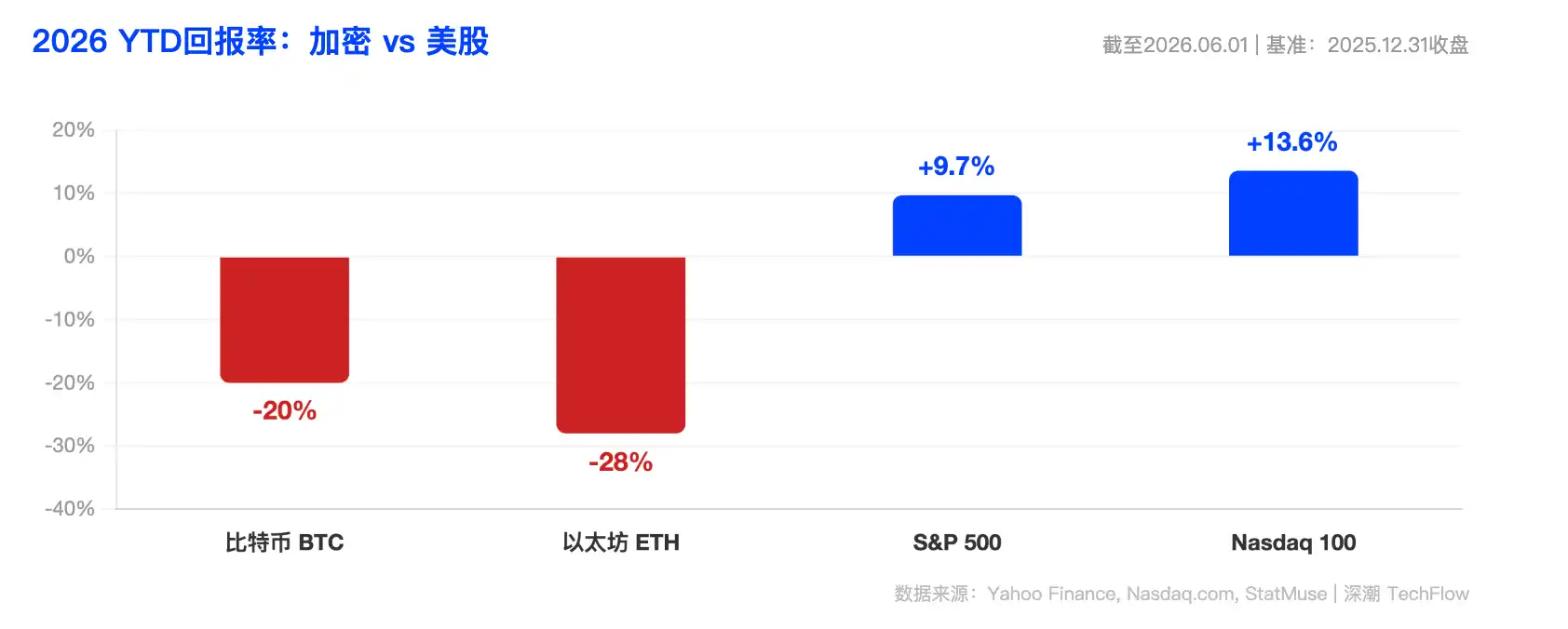
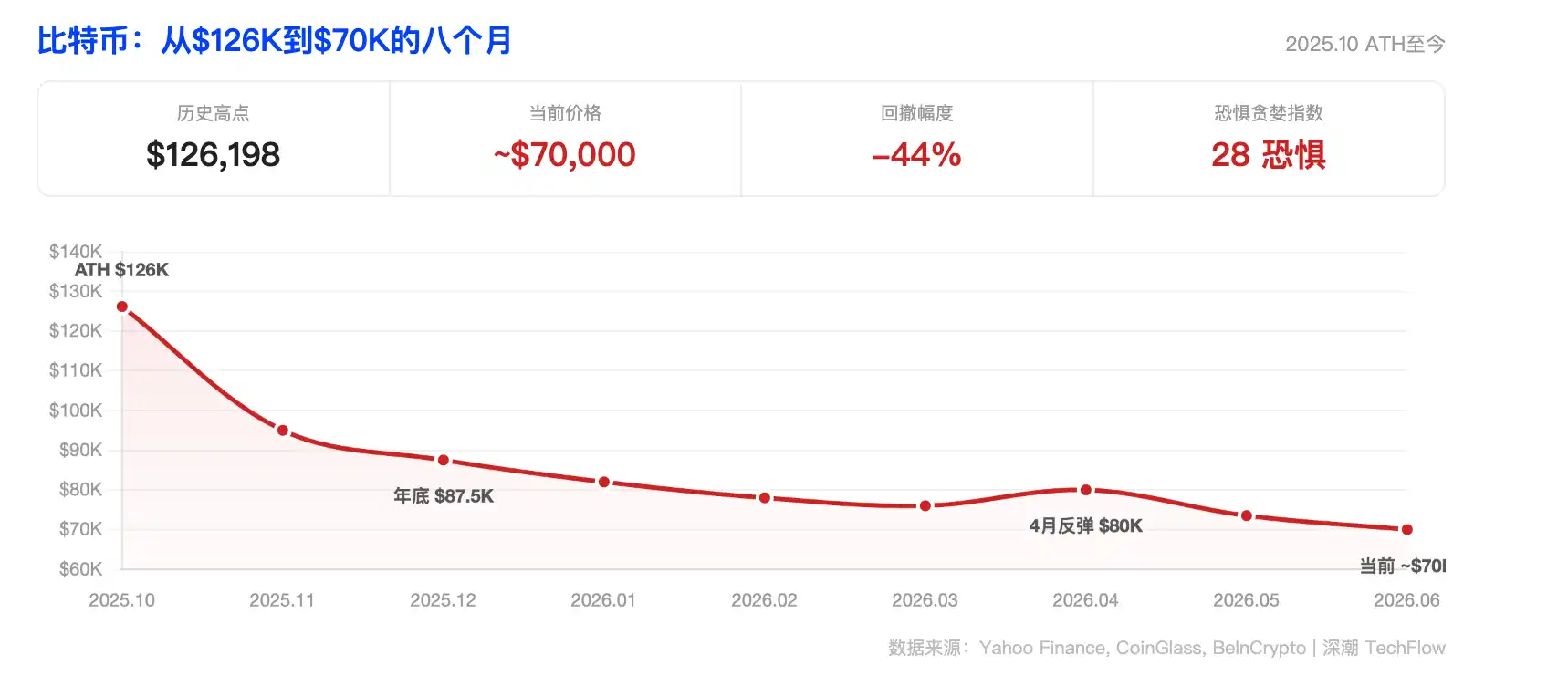
Bitcoin has retreated from its October 2025 all-time high of $126,198 to around $70,000 currently, a drop of about 44%; its Year-to-Date (YTD) decline for 2026 is about 20%. During the same period, the S&P 500 is up about 9.7% YTD. The Nasdaq 100 is up about 13.6%.

With one line rising and the other falling, the gap between them can no longer be described as merely "underperforming."
"Bitcoin Has Died Over 800 Times" vs "The Narrative Really Can't Hold Up This Time"

The most tense exchange in the Reddit discussion occurred between users Giordano86 and think_harder_plz.

Giordano86 is a classic cycle believer: "Be greedy when others are fearful. Markets have cycles. People will soon rotate back into Bitcoin." When someone rebutted, he directly threw out data: "Go look at Bitcoin's 17-year history and tell me you haven't seen cycles. Bitcoin has 'died' over 800 times, it's fine."

Another user, Powerful_Respect_400, was more direct: "I've been here since 2017. The 2017 bull run, the 2021 bull run, 2025... every four years. We might have to wait until 2029."

think_harder_plz's counterattack was equally sharp: Bitcoin's narrative has been constantly "upgrading," from peer-to-peer electronic cash, to digital gold, to an inflation hedge, to an institutional reserve asset. "Every time an old narrative fails, a new one is swapped in." His conclusion: "Cryptocurrency hasn't existed long enough to make such confident assertions. This is the beginning of the end."

Interestingly, another user, keepitcasualbrah, accurately pinpointed the self-contradiction in this statement:

You say in the first part "hasn't existed long enough to conclude," and in the latter part conclude "this is the beginning of the end." This rebuttal gained considerable agreement.
AI Stole the Attention, But What Crypto Truly Lost Was 'Use Cases'

If it were just the old tunes of cycle theory versus end-of-theory, this post wouldn't have triggered so many replies. What truly hit the nerve was the third type of voice: the crypto market is losing not to a bear market, but to AI.

The comment by user optifree1 was heavily cited: "The tech industry is experiencing a once-in-decades productivity revolution, AI is genuinely changing how people work and live. This wave of enthusiasm has sucked away attention from all other markets, and cryptocurrency hasn't yet found any use case with influence close to that of the AI boom."

Crypto's structural issues are indeed evident. Several users corroborated the same judgment from different angles:

The crypto market lacks real use cases for support. User i_am_13th_panic pointed out that despite crypto companies' efforts to expand applications, the only solid use for most cryptocurrencies is "to speculate with it, use it to speculate, or stake it."

User Usually_Sunny raised a sharper paradox: For a currency to be "useful," its value must be relatively stable, but Bitcoin's core investment logic is precisely built on price volatility.

The poster harukasweet also admitted: "Yes, only stablecoins are somewhat useful, DeFi maybe has some use, but too many hacks."

Data Perspective: Institutions Are Pulling Out, Not Just Retail

The Reddit discussion is emotional, but capital flows provide colder validation.

According to BeInCrypto data, Bitcoin spot ETFs recorded approximately $2.3 billion in net outflows in May 2026, the largest monthly outflow for the year and the largest since November 2025. The preceding April and March saw net inflows of about $1.97 billion and $1.32 billion, respectively. Cumulative net ETF inflows have dropped from $58.09 billion in April to $55.79 billion.
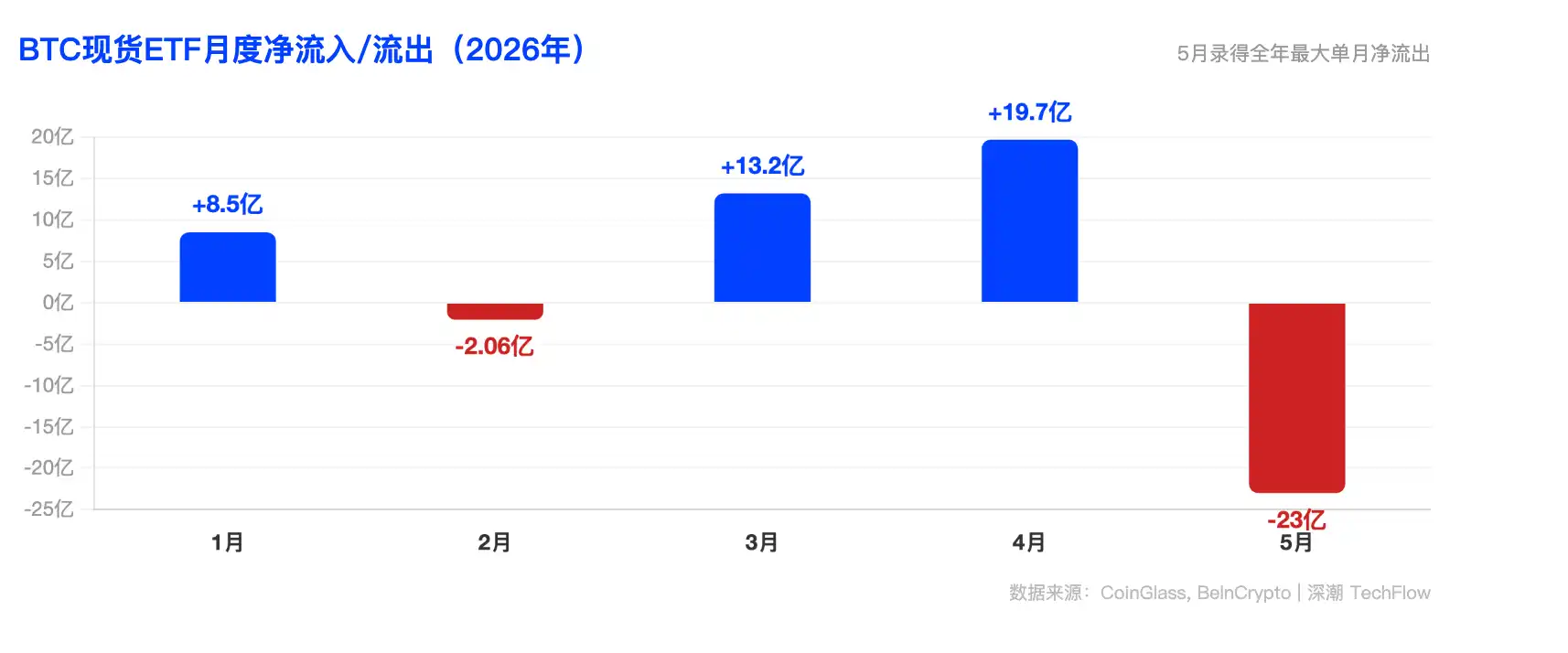
In May, BTC fell only about 3.7%, but the ETF outflow scale was over 10 times the $206 million net redemption in February. Institutions' speed of de-risking is noticeably faster than what the price decline itself suggests.

Meanwhile, the Fear & Greed Index dropped to 28 (Fear), with market sentiment at its lowest level in 2026.

So When Is the Next Rotation Coming?

This is the question the poster harukasweet repeatedly pressed. The answers varied widely, but the honesty was surprisingly high.

User only_linear_joseph's analysis was more pragmatic: Cash and bond yields are now very competitive, which was rare before. As long as the high-interest-rate environment persists, capital has no incentive to flow from fixed income to high-volatility assets. After discussing with the poster, he even self-corrected a contradiction: If inflation remains high, the Fed won't cut rates, and crypto will continue to be left out in the cold.

No one gave a definitive answer. But one comment in the thread perhaps summarizes most people's true state of mind: When asked "what's the hurry," user harukasweet replied with two words: "Opportunity cost."

Every day money isn't in the crypto market is money making gains elsewhere. This is the real source of anxiety in the current crypto community—not "will it come back," but "what am I missing while waiting for it to come back."

Data as of June 2, 2026. This article is an observation of sentiment and does not constitute investment advice.


Domande pertinenti

QWhat are the two main opposing viewpoints regarding Bitcoin's future as discussed in the Reddit thread?

AThe two main opposing viewpoints are the cyclical believers and the 'endgame' believers. Cyclical believers, like user Giordano86, argue that Bitcoin operates on predictable multi-year cycles and will recover as it has in the past. 'Endgame' believers, like user think_harder_plz, argue that Bitcoin's narrative keeps shifting as old use cases fail and that this period might mark the beginning of its decline, citing its relatively short history.

QAccording to the article, what major technological trend is currently diverting attention and capital away from the cryptocurrency market?

AAccording to the article and user comments, the major trend is the Artificial Intelligence (AI) revolution. Users like optifree1 argue that AI is a once-in-a-decades productivity revolution with real-world impact, drawing attention and capital away from cryptocurrencies, which are seen as lacking comparable widespread, practical use cases.

QWhat key structural problem with cryptocurrencies is highlighted by the Reddit users?

AThe key structural problem highlighted is the lack of real-world, practical use cases. Users point out that most cryptocurrencies primarily serve purposes like speculation, trading, or staking. A paradox is noted: for a currency to be broadly 'useful,' it needs price stability, but Bitcoin's core investment thesis is built on price volatility. Only stablecoins are acknowledged as having consistent utility.

QWhat does the data on Bitcoin ETF flows in May 2026 indicate about institutional sentiment?

AThe data indicates a significant shift to negative institutional sentiment. In May 2026, Bitcoin spot ETFs recorded approximately $2.3 billion in net outflows, the largest single-month outflow for the year and the largest since November 2025. This outflow was over 10 times larger than the net redemptions in February, suggesting institutions are de-risking at a pace faster than the modest 3.7% price decline that month would imply.

QWhat does the user 'harukasweet' identify as the true source of anxiety for the current crypto community?

AUser harukasweet identifies 'opportunity cost' as the true source of anxiety. The concern is not just whether cryptocurrency prices will recover, but what potential gains in other markets (like the surging tech stocks) are being missed while waiting for a crypto market revival. This fear of missing out on better-performing assets is the core driver of current community frustration.

Letture associate

7 Months After the Collapse of Huiwang, Southeast Asia's Escrow Platforms Undergo a Major Reshuffle

Following the collapse of Huione Pay—dubbed the "Alipay of Southeast Asia"—seven months ago, the region's underground financial guarantee platform sector is undergoing a significant reshuffle. This power vacuum has been swiftly filled by emerging platforms such as XinBi, Tiger/Navigator, JinBei (renamed JinBo), Dali/Tiancheng, and FullyLight. These platforms, operating largely via Telegram and offering services like escrow for illicit transactions, have absorbed the vast user base and markets left behind by Huione. While positioning themselves as "trust intermediaries," their primary clientele consists of networks involved in online scams, money laundering, illegal gambling, and even human trafficking. For instance, the Tiger/Navigator platform explicitly provides "escrow" services for kidnapping-for-ransom operations ("强押车交易"). Data underscores the immense scale: Huione alone processed over $103 billion in cryptocurrency payments and facilitated over $31 billion through its escrow market before its downfall, linking it to Cambodia's notorious Prince Group. Since its collapse, competitors have seen explosive growth. For example, the XinBi platform has accumulated over $1.6 billion in total USDT revenue, while platforms like NewPay, OkPay (under Dali), and FullyLight Wallet collectively processed over $4.8 billion in USDT in a single year. This ecosystem thrives in regions like Cambodia and Myanmar, where regulatory gaps allow these platforms to act as critical financial infrastructure for sprawling cybercrime industries, from scam compounds to online casinos. The article concludes that the moniker "Southeast Asian Alipay" is a misnomer, obscuring the platforms' fundamental role in enabling serious criminal enterprises rather than representing legitimate financial innovation.

Odaily星球日报1 min fa

7 Months After the Collapse of Huiwang, Southeast Asia's Escrow Platforms Undergo a Major Reshuffle

Odaily星球日报1 min fa

The Changing Landscape: What Are Crypto VCs Experiencing?

Title: The Shifting Landscape of Crypto Venture Capital The era of dedicated crypto venture capital funds is undergoing a significant transformation. Once essential for navigating the sector's complexity and high risk, these specialized funds are now facing an identity crisis as the market matures. This shift mirrors historical patterns in other specialized investment classes like cleantech and SPACs, where initial information advantages dissipate as technologies become mainstream and integrated into existing industry frameworks. The article argues that crypto is reaching a critical inflection point, transitioning from a "building phase" to an "integration phase." Major players like Stripe, BlackRock, and Visa now engage with crypto not for its novel mechanics but as a foundational financial infrastructure. Their needs—regulatory compliance, banking partnerships, distribution channels—align with traditional fintech, a domain easily understood by large, generalist funds like Sequoia and Founders Fund. This evolution creates a "barbell effect" within the VC landscape. On one end are massive, diversified platforms that can incorporate crypto as one vertical among many. On the other are small, nimble funds focused on niche, experimental projects. The middle ground—medium-sized dedicated crypto funds—is being squeezed out. Their typical fund size makes it impossible to generate sufficient returns solely from early-stage crypto bets, yet they cannot compete with giants for later-stage deals. Consequently, leading crypto-native firms like Paradigm and Framework Ventures are expanding into AI, robotics, and other sectors, driven partly by LP pressure for better returns amid a broader VC DPI crisis. Others, like Dragonfly and a16z, have narrowed their crypto focus predominantly to financial infrastructure like stablecoins, reframing the sector's core narrative. For crypto entrepreneurs, this consolidation presents challenges. While generalist funds offer larger checks and broader resources, crypto projects now compete fiercely with AI for attention and capital within these firms. Furthermore, the long-term, non-commercial foundational work that built the ecosystem—funded by dedicated crypto VCs—is less likely to attract generalist capital focused on direct returns. The conclusion is that "crypto investor" as a standalone category is becoming obsolete, akin to "internet investor." Crypto is becoming a baseline infrastructure layer. The future will see a barbell structure: large-scale growth financing handled by generalist funds, while pioneering, speculative projects are funded by small, specialized vehicles. The dedicated crypto funds of the 2017-2021 boom, which incubated core infrastructure, are giving way to this new, bifurcated reality.

Foresight News18 min fa

The Changing Landscape: What Are Crypto VCs Experiencing?

Foresight News18 min fa

As Consensus Accelerates, What Are Young Investors Betting On?

Title: As Consensus Forms Faster, What Are Young Investors Betting On? In the rapid evolution of tech investment, a new generation of young investors is navigating a landscape where AI, robotics, commercial aerospace, and quantum computing are advancing simultaneously. Traditional investment logic based on financial models is giving way to a need for deep technical understanding and the ability to act before industry consensus forms. An analysis of trends from the "WAIC FUTURE TECH" list of young investment leaders reveals key shifts in focus. The first major trend is the movement of AI from the digital screen into the physical world. Investment is shifting from large language models and chatbots towards embodied AI, robotics, AI hardware, and edge computing. While demonstrations generate excitement, the real challenge lies in achieving scalable, reliable, and cost-effective delivery in complex real-world environments like factories and logistics. Success depends not just on algorithms but on the integration of sensors, actuators, and control systems. Second, the competitive focus for large models is moving beyond raw capability toward building an "intelligence flywheel." The goal is to create self-reinforcing systems where user interaction generates data, improving the model, which in turn enhances the user experience and attracts more engagement. Companies that successfully embed AI into workflows to create these closed-loop systems can build lasting value that isn't easily erased by the next model upgrade. Third, facing a potential bottleneck in high-quality human-generated data, investors are looking at new underlying technologies. Reinforcement learning and self-play, as demonstrated by AlphaGo Zero, offer paths for AI to generate its own experience. Scientific foundation models, which aim to build general AI capabilities for fields like life sciences and materials discovery, represent a non-consensus direction that could unlock new frontiers of knowledge and data. Finally, in deep-tech areas like quantum computing, commercial aerospace, and space-based infrastructure, patient capital is essential. These fields have long, uncertain development and validation cycles involving complex engineering, supply chains, and regulations. Investment here requires a long-term view, focusing on foundational team capabilities and the eventual emergence of market demand, even if commercial returns are distant. Collectively, these trends illustrate how young investors are adapting to a new era. They are learning to make earlier, technically-informed judgments, balance hype with real-world viability, and provide the patient capital needed to build the deep-tech foundations of the future.

marsbit46 min fa

As Consensus Accelerates, What Are Young Investors Betting On?

marsbit46 min fa

Trading

Spot
活动图片




