Red Alert: Bank of Japan's 25bp Rate Hike Imminent, Are US Stocks and Crypto Set for a Repeat of the 2024 Flash Crash?

marsbitPubblicato 2026-06-11Pubblicato ultima volta 2026-06-11

Introduzione

Japanese central bank likely to raise interest rates by 25 basis points to 1.0% in June, its highest level since 1995, with market probability at 98%. This move, driven by persistent inflation risks from energy costs and a weak yen, risks triggering a "carry trade" unwind. Investors who borrowed cheap yen to invest in higher-yield assets like US stocks and crypto may be forced to sell, potentially causing significant volatility. An estimated $500 billion in yen-funded positions remains vulnerable. This could mirror the August 2024 flash crash, where a yen surge triggered a global stock sell-off and a sharp Bitcoin drop. High-valuation AI and tech stocks are particularly sensitive to tighter global liquidity and rising energy costs. Cryptocurrencies, as high-beta assets, face amplified risk from higher leverage costs and competing for scarcer market liquidity. Analysts warn of short-term pressure on risk assets, advising caution regarding leverage amid heightened volatility.

Original | Odaily Planet Daily (@OdailyChina)

Author | Qin Xiaofeng (@QinXiaofeng 888 )

According to Nikkei News, the Bank of Japan (BoJ) is expected to raise its short-term policy rate from 0.75% to 1.0% during the monetary policy meeting on June 15-16, which would be the highest policy rate level since 1995. Currently, market pricing for a rate hike is extremely high, with the probability of a "25bp (basis point) hike" on PolyMarket surging from 25% in early April to 98%.
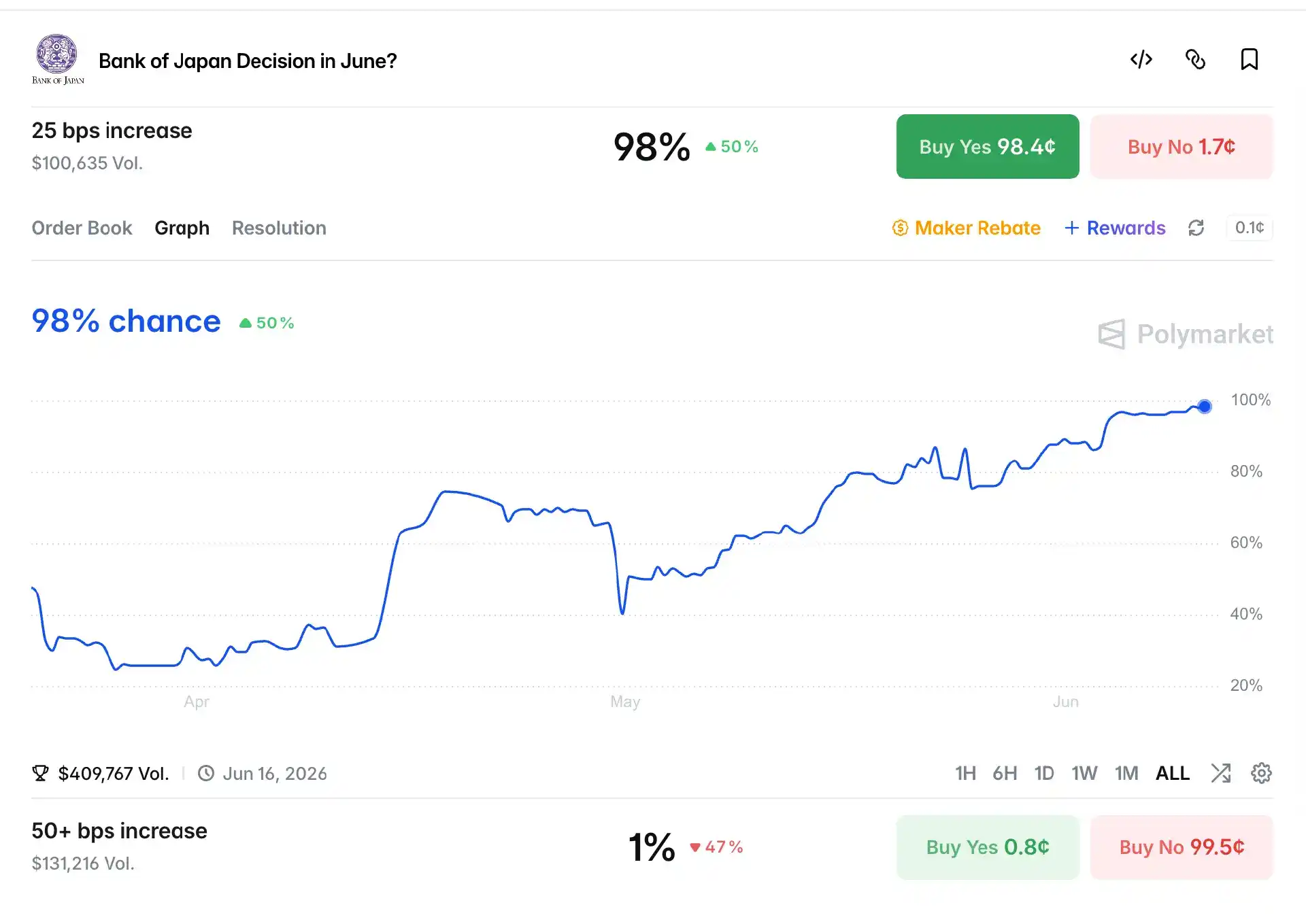
With a BoJ rate hike imminent, a large number of investors engaged in yen carry trades may be forced to sell overseas assets, convert back to yen, and repay loans, triggering a chain reaction and amplifying volatility in global risk assets—the flash crash in August 2024 serves as a classic example, where a sharp yen appreciation led to a short-term plunge in global stock markets, with Bitcoin plummeting nearly $20,000 in a single day, a maximum drop of 15%.

Odaily Planet Daily will analyze the macro backdrop and transmission mechanism of the BoJ rate hike, and focus on assessing the risk impact on AI tech stocks and cryptocurrencies for readers' reference.

1. Inflation Risks Drive BoJ Rate Hike

Over the past two years, hawkish voices within the BoJ have grown increasingly strong, culminating in the end of a 17-year negative interest rate policy in March 2024, raising the policy rate from -0.1% to a range of 0% to 0.1%, marking the first rate hike in this cycle. In July 2024, the BoJ hiked rates again by 15bp to 0.25% and announced a gradual balance sheet reduction; in January and December 2025, it raised rates by 25bp each, bringing the rate to 0.75%; rates remained unchanged in the first three meetings of 2026. The following outlines the BoJ's rate hikes in several meetings:
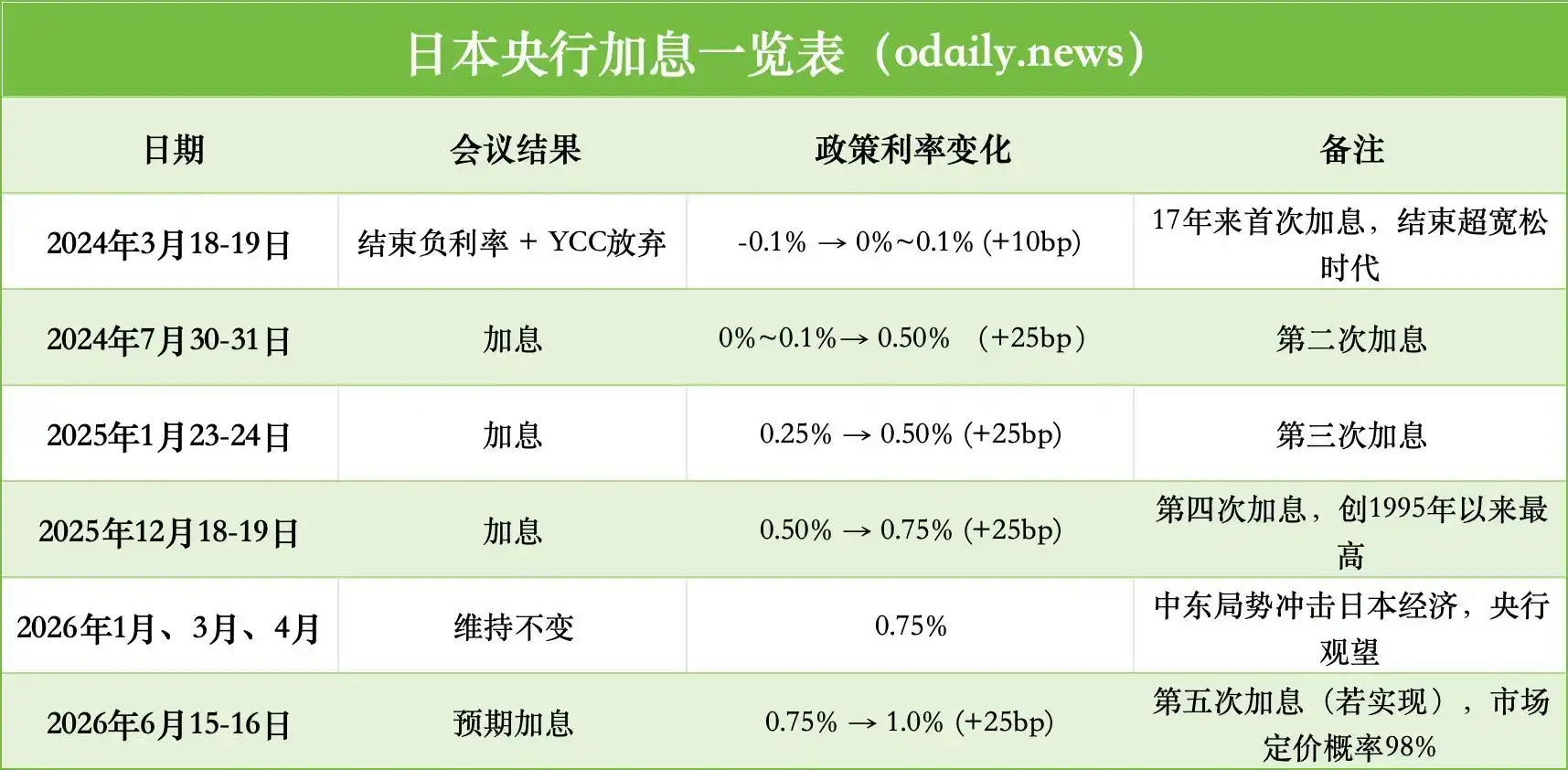
After keeping rates unchanged for half a year, why is the BoJ now eager to embark on a new round of rate hikes? This hike primarily stems from two aspects.

First, energy shocks and imported inflation pressure. As oil price volatility occurred due to Middle East conflicts in the first half of the year, Japan, highly dependent on imported energy, saw a significant rise in import costs. The Corporate Goods Price Index (CGPI) rose 6.3% year-on-year in May, the fastest pace since 2023, with petroleum products up 9.6% and utilities up 8.5%. The BoJ expects core CPI for fiscal 2026 to rise to 2.5-3.0%, far above the established 2% target.

Second, a weak yen exacerbates imported inflation. The current USD/JPY exchange rate continues to hover around the 158-160 high, nearing historically extreme weakness. The sharp depreciation of the yen directly weakens the import purchasing power of Japanese companies, leading to a significant increase in import costs for commodities such as energy and raw materials, further pushing up domestic prices. Although Japan's Ministry of Finance has repeatedly intervened in the foreign exchange market, the effects have been limited and unsustainable. This situation is forcing the BoJ to tighten monetary policy (i.e., raise rates) at the June meeting to avoid runaway inflation expectations.

In a speech on June 3, BoJ Governor Kazuo Ueda explicitly shifted the narrative towards fighting inflation, emphasizing that if upside risks to prices outweigh downside risks to the economy, the pros and cons of a rate hike must be discussed.

Reuters, citing three informed sources, reported that unless the Middle East conflict escalates sharply, the BoJ will raise rates in June and may slow the pace of bond portfolio reduction to maintain market stability. Bloomberg and institutions like ING maintain similar judgments and expect the BoJ to hike a total of 50bp in 2026.

This series of changes marks Japan's shift from the "world's last lender" to a normalizing central bank, posing a direct challenge to global assets reliant on cheap yen financing.

2. Unwinding Yen Carry Trades, Sustained Liquidity Tightening

The Bank of Japan's prolonged maintenance of ultra-loose monetary policy has made yen carry trades a key component of global liquidity over the past decade. Investors borrow yen at near-zero interest rates and invest in high-yielding assets like US stocks, tech stocks, emerging markets, and cryptocurrencies to earn interest differentials and capital gains.

The BoJ's upcoming rate hike will directly increase yen financing costs and could trigger yen appreciation (USD/JPY decline), forcing leveraged investors to unwind positions, creating a positive feedback loop: yen appreciation leads to expanding exchange rate losses → rising financing costs → forced investor deleveraging → large-scale selling of risk assets → further decline in asset prices → triggering more stop-losses → intensifying unwinding pressure.

Historically, every BoJ policy tightening signal has triggered severe market volatility.

On July 31, 2024, the BoJ hiked rates by 15bp to 0.25% and announced gradual balance sheet reduction, coupled with weak US employment data, triggering severe global market turbulence. At that time, South Korea's two major stock indices (KOSPI and KOSDAQ) plunged simultaneously, triggering circuit breakers; Japanese stocks crashed, with the Nikkei 225 plummeting 12.4% in a single day, accumulating a weekly loss of over 20%, the worst performance since 1987; global stock markets fell in tandem, with US stocks and tech stocks adjusting synchronously, and the VIX fear index soaring. Crypto also suffered heavy losses, with Bitcoin and ETH plunging over 30% in just a week, and leveraged liquidations surging.

According to Morgan Stanley estimates, although a significant number of positions have been gradually unwound since 2024, there are still approximately $500 billion in outstanding yen-funded positions in the market. Although the market has priced in some risks in advance, these positions still pose a significant hidden danger. Morgan Stanley warns that a rapid yen appreciation could trigger chain unwinding during periods of thin liquidity, especially impacting high-leverage assets severely.

J.P. Morgan's Global Head of Market Strategy, Dubravko Lakos-Bujas, and FX strategist Meera Chandan both pointed out that the policy divergence between the BoJ and the Federal Reserve will increase the instability of carry trade unwinding, potentially leading to a valuation reassessment of global risk assets.

3. Global Risk Assets Take a Hit, US Stocks and Crypto Not Spared

The AI-driven tech frenzy was the main theme for US stocks in the first half of 2026, with chip stocks like Nvidia and Broadcom and hyperscale cloud service providers leading the Nasdaq to repeatedly hit new highs.

However, entering June, significant rotation and pullbacks emerged in the market, particularly on June 5, when US stocks experienced their most severe single-day pullback of 2026 so far. The Nasdaq plunged 4.18%, marking its largest single-day drop since April 2025; the S&P 500 fell 2.64%, ending a nine-week winning streak; the Dow fell 1.35%, the Philadelphia Semiconductor Index plummeted over 10%, with core AI stocks like Nvidia, Broadcom, Micron, and Marvell leading the declines. (Recommended reading: "Nasdaq Drops 4.2% in a Day, Did 'Black Friday' Puncture the US Stock Bubble?")

The US stock market pullback is due to macro factors like geopolitical tensions and Fed policy uncertainty, but an undeniable factor is also the potential impact of the BoJ's impending rate hike.

First, liquidity tightening will directly hit high-valuation growth stocks. AI companies have massive capital expenditure scales and are highly dependent on cheap financing. Unwinding yen carry trades will reduce inflows of global risk-seeking capital, with high-beta tech stocks bearing the brunt. Semiconductor leaders like Nvidia and Broadcom, as well as hyperscalers like Meta and Microsoft, have extremely high valuation sensitivity and are highly susceptible to selling. Investing.com analysis points out that high-valuation growth sectors are most sensitive to changes in global liquidity; once carry trade unwinding begins, rapid deleveraging often occurs.

Second, rising energy costs will significantly compress AI profit margins. Middle East conflicts pushing up oil prices lead to a sharp increase in data center power and cooling costs, forming a "stagflationary" macro environment alongside BoJ rate hikes, severely testing the sustainability of the AI business model.

BitMex founder Arthur Hayes explicitly warned in his latest article "Reality Test": "The energy reality is testing the market's current 'dreaming' state." High oil prices not only raise operating costs but may also slow the growth of corporate token usage, further dampening AI-related revenue expectations.

Lastly, mega IPO supply shocks and political regulatory risks. Giants like SpaceX, Anthropic, and OpenAI plan to list intensively in the second half of 2026, with valuations often at hundreds of times sales; lock-up expirations will bring massive supply pressure. Meanwhile, Trump may shift to an anti-AI stance for midterm elections, increasing regulatory uncertainty.

As the highest-beta global risk asset, cryptocurrencies are even more precarious. On one hand, the BoJ rate hike brings rising global financing costs, directly increasing the cost of leveraged crypto trading, forcing large-scale liquidation of crypto leveraged positions; on the other hand, in competing for liquidity with AI, AI capital expenditure has already absorbed substantial market funds, leaving crypto lagging behind, and BoJ action will further tighten marginal liquidity.

Yahoo Finance analyst Lockridge Okoth stated that the 98% probability of a rate hike could trigger the next liquidity shock for Bitcoin. Investing.com analysis points out that yen appreciation and BTC weakness often move in high synchrony, a typical signal of rising global risk aversion.

Arthur Hayes has also emphasized in multiple analyses that the dynamics of yen carry trades remain one of the key variables affecting Bitcoin liquidity, reminding investors to pay attention to short-term liquidity shocks triggered by policy signals. In recent articles, Arthur Hayes emphasized the need to be wary of the combined impact of short-term energy costs and monetary policy risks; BTC/ETH may adjust alongside risk assets in the short term, with the long-term outlook depending on liquidity restarting.

Conclusion:

The rekindled concerns over a BoJ rate hike are not an isolated event but a signal of marginal tightening in global liquidity. Particularly with the current Middle East geopolitical conflict pushing oil prices higher, AI capital expenditure consuming liquidity, and multiple factors like Fed policy uncertainty superimposed, the buffer space is further compressed.

For investors, global risk assets—especially high-leverage, high-valuation sectors (AI tech stocks and cryptocurrencies)—may face significant downward pressure in the short term, with volatility set to rise noticeably. It is crucial to remain highly vigilant and mindful of leverage risks.


Domande pertinenti

QWhat is the main reason the Bank of Japan (BOJ) is expected to raise interest rates by 25 basis points in June 2026?

AThe main reason is to combat inflation. Two key factors are driving this: energy price shocks and input inflation due to rising oil prices from Middle East conflicts, and a persistently weak Yen (USD/JPY near 158-160), which increases import costs for energy and raw materials, further pushing up domestic prices. The BOJ's inflation forecast for fiscal 2026 has risen above its 2% target.

QHow does the Bank of Japan's potential interest rate hike pose a risk to global risk assets, particularly AI tech stocks and cryptocurrencies?

AThe rate hike increases the cost of Yen funding, potentially triggering the unwinding of the massive Yen carry trade. Investors who borrowed cheap Yen to invest in higher-yielding assets like US tech stocks and crypto may be forced to sell those assets to repay loans, especially if the Yen appreciates. This creates a vicious cycle of selling pressure, reduced global liquidity, and heightened volatility, directly impacting high-valuation, high-beta assets like AI stocks and cryptocurrencies.

QWhat historical event from 2024 is mentioned as a precedent for the market impact of BOJ policy tightening?

AThe article references the market flash crash in August 2024. Following a sharp appreciation of the Yen, global stock markets experienced a short but severe downturn. Bitcoin, as a prime example, plummeted by nearly $20,000 in a single day, recording a maximum intraday drop of 15%.

QAccording to the article, what are the estimated size of the remaining Yen carry trade positions and which financial institution provided this estimate?

AAccording to estimates from Morgan Stanley, there are still approximately $500 billion in outstanding Yen-funded positions in the market. The article warns that a rapid appreciation of the Yen could trigger chain-liquidations of these positions, especially in thin liquidity periods.

QBesides the BOJ rate hike, what other factors are mentioned as contributing to the potential pressure on AI tech stocks?

AThree additional factors are cited: 1) Rising energy costs from Middle East conflicts increasing data center power and cooling expenses, squeezing AI profit margins. 2) A looming supply shock from massive IPOs of companies like SpaceX, Anthropic, and OpenAI in H2 2026. 3) Increased political and regulatory uncertainty, with the possibility of the Trump administration adopting anti-AI rhetoric ahead of midterm elections.

Letture associate

I Built Myself an Investment Workbench Using AI

For the past two weeks, I've been immersed in Vibe Coding—using AI to write code from natural language descriptions. This process has enabled me to quickly build functional tools that address long-standing personal ideas. Previously, I had many concepts but found execution too cumbersome. Key ideas included a unified dashboard for assets across US stocks, Crypto, HK stocks, and A-shares; a real-time alert system for price movements; an investment map visualizing sector relationships; and a tool to correlate prediction market bets with news and market data. Traditional development hurdles meant these often remained unrealized. Using AI (Codex, Claude Code, and DeepSeek API), I built four initial tools: 1. A **Cross-Market Asset Dashboard** showing total assets, daily P&L, and holdings by market, with added features for alerts and sector mapping. It's deployed locally for privacy. 2. A **Prediction Market (PM) Monitor** tracking bets on events (e.g., company valuations) and correlating probability shifts with news and market movements. I categorize bets by conviction to filter noise. 3. A **Simple Operations Backend** for managing my writing workflow (topics, progress, publishing). It's cloud-deployed for mobile access. 4. A **One-Click Formatting Tool** that automates converting drafts into various platform-specific formats, saving manual effort. While these tools are basic, they represent a significant shift: AI lowers the barrier to creating personalized systems. I believe individual investors can now feasibly build core systems for: * **Asset Observation** (tracking holdings and changes) * **Signal Monitoring** (watching for key market shifts) * **Sector Mapping** (understanding network relationships within a sector) * **Performance Review** (documenting rationale and outcomes) The power of Vibe Coding is its fast feedback loop. Ideas can be implemented, tested, and iterated on rapidly, turning "want-to-do" into "done." This marks the start of my new phase, where I'll share investment thoughts, tool tests, on-chain operations, and educational Web3 content.

marsbit4 min fa

I Built Myself an Investment Workbench Using AI

marsbit4 min fa

After Tokenization of Assets, How to Exit?

Title: How to Exit After Asset Tokenization? Author: Symbiotic Compiled by: Hu Tao, ChainCatcher Summary: Tokenization addresses how assets go on-chain but largely leaves the redemption question unresolved. While tokenized assets can settle instantly, the underlying redemption for assets like treasuries, private credit, or real estate can take from T+1 to 180 days. This gap hinders DeFi adoption of Real World Assets (RWAs). Three emerging models aim to provide instant exit liquidity, differing primarily in their capital structure and efficiency: 1. **Balance Sheet Model (e.g., Grove Basin):** A single entity (like Sky) provides immediate liquidity from its balance sheet, acting as a bridge during the settlement period. It offers simplicity and deep initial liquidity but is constrained by a single entity's capacity and risk appetite. 2. **Asset-Specific Vault Model (e.g., Upshift Clear):** Independent liquidity providers fund dedicated vaults for each supported asset, earning fees. It decentralizes capital sources but isolates liquidity and capital per asset, leading to potential fragmentation. 3. **Shared Liquidity Layer Model (e.g., Symbiotic Liquid Lane):** A shared capital pool supports multiple RWA types simultaneously. Funds remain productive between redemptions (e.g., earning yield in lending markets). Exits are settled via a competitive RFQ market. This model aims for higher capital efficiency, scalability across assets, and serves longer-duration assets like private credit. Key differentiators are: 1) Source of capital and risk bearer, 2) Redemption pricing mechanism, 3) Capital efficiency, 4) Scalability to new asset types, and 5) Composability. The shared liquidity layer model represents a move from piecemeal solutions toward scalable infrastructure, enabling T+0 exits by pooling capital, maintaining yield, and using competitive pricing, thus enhancing RWA utility in DeFi.

marsbit17 min fa

After Tokenization of Assets, How to Exit?

marsbit17 min fa

After Tokenizing Assets, How to Exit?

After tokenization, a key unresolved issue is providing holders with a reliable exit mechanism, as underlying asset settlement (taking days to months) lags far behind on-chain token settlement. Three primary models for instant liquidity have emerged, differing in their capital structure and efficiency: 1. **Balance Sheet Model (e.g., Grove Basin):** A single, well-capitalized entity (like Sky) provides immediate liquidity from its own reserves. This offers simplicity and deep initial liquidity but is constrained by that single balance sheet's capacity and risk appetite, limiting scalability. 2. **Dedicated Vault Model (e.g., Upshift Clear):** Independent liquidity providers (LPs) fund separate vaults for each supported asset. This decentralizes capital sources but isolates liquidity and capital, which becomes inefficient as the number of tokenized assets grows. 3. **Shared Liquidity Layer Model (Symbiotic Liquid Lane):** Independent capital providers fund shared vaults that can support multiple tokenized assets simultaneously. Capital remains productive between redemptions (e.g., earning yield in DeFi markets). Exits are settled via a competitive RFQ market where market makers bid. The article argues that the shared layer model offers superior capital efficiency and scalability. It transforms exit liquidity from an asset-specific patch into shared market infrastructure, allowing liquidity capacity to grow with overall market participation rather than being fragmented per asset. This is particularly valuable for longer-duration assets like private credit, where reliable T+0 exits can significantly enhance their utility in DeFi.

链捕手31 min fa

After Tokenizing Assets, How to Exit?

链捕手31 min fa

Anthropic's Triple Moment: Code Leak, Government Confrontation, and Weaponization

This article analyzes Anthropic's recent conflicts and strategic moves following the U.S. government's emergency halt of its new Fable model, citing national security concerns over potential "jailbreaks." The author argues this incident reveals deeper tensions between AI labs, governments, and the software industry. While critics view Anthropic's safety-focused rhetoric as marketing fear, the author suggests it serves as a commercial moat masking the company's core economic imperative: moving closer to end-users and their valuable data to avoid being commoditized. The piece outlines a coming clash between frontier AI labs like Anthropic and established software companies. Labs need real-world usage data for model improvement via reinforcement learning, creating a cycle where better products attract more users and more data. This threatens software firms who, as Microsoft's Satya Nadella warns, risk having their value captured by a few dominant models. Anthropic's controversial policy changes—initially secretly degrading Fable's performance for LLM development and expanding data retention—are framed as assertions of control, justified by its safety narrative. The company's foundational belief that it alone is sufficiently concerned about superintelligent AI dangers legitimizes its actions, from resisting government demands to shaping usage policies. The author concludes that this alignment of mission, talent, and business strategy is powerful but concerning, as it concentrates immense potential power in the hands of those convinced of their own righteous understanding.

marsbit41 min fa

Anthropic's Triple Moment: Code Leak, Government Confrontation, and Weaponization

marsbit41 min fa

Trading

Spot
Futures

Articoli Popolari

Cosa è $BANK

Banca AI: Un Passo Rivoluzionario nel Futuro della Banca Introduzione In un'era caratterizzata da rapidi progressi tecnologici, Banca AI si trova all'incrocio tra intelligenza artificiale (AI) e servizi bancari. Questo progetto innovativo mira a ridefinire il panorama finanziario, migliorando l'efficienza operativa, le misure di sicurezza e le esperienze dei clienti attraverso il potere dell'AI. Mentre ci impegniamo in questa esplorazione di Banca AI, esamineremo cosa comporta il progetto, le sue dinamiche operative, il suo contesto storico e i traguardi significativi. Cos'è Banca AI? Alla sua essenza, Banca AI rappresenta un'iniziativa trasformativa volta a integrare l'intelligenza artificiale in varie operazioni bancarie. Questo progetto sfrutta le capacità dell'AI per automatizzare processi, migliorare i protocolli di gestione del rischio e potenziare l'interazione con i clienti attraverso servizi personalizzati. Gli obiettivi principali di Banca AI includono: Automazione delle Funzioni Bancarie: Sfruttando le tecnologie AI, Banca AI mira ad automatizzare compiti di routine, riducendo il carico sulle risorse umane e aumentando l'efficienza. Miglioramento della Gestione del Rischio: Il progetto utilizza algoritmi AI per prevedere e identificare i rischi, rafforzando così le misure di sicurezza contro le frodi e altre minacce. Personalizzazione dei Servizi Bancari: Banca AI si concentra sull'offrire prodotti e servizi finanziari su misura analizzando i dati e i comportamenti dei clienti. Miglioramento dell'Esperienza del Cliente: L'implementazione di soluzioni guidate dall'AI, come chatbot e assistenti virtuali, mira a fornire agli utenti interazioni più umane, rivoluzionando il modo in cui i clienti si relazionano con le banche. Con questi obiettivi, Banca AI si posiziona come un attore cruciale nel rendere la banca più efficiente, sicura e centrata sull'utente. Chi è il Creatore di Banca AI? I dettagli riguardanti il creatore di Banca AI rimangono sconosciuti. Pertanto, non è stata identificata alcuna persona o organizzazione specifica nelle informazioni disponibili. L'anonimato che circonda la nascita del progetto solleva domande, ma non sminuisce la sua ambiziosa visione e obiettivi. Chi sono gli Investitori di Banca AI? Simile al creatore del progetto, informazioni specifiche riguardo gli investitori o le organizzazioni di supporto di Banca AI non sono state divulgate. Senza queste informazioni, è difficile delineare il sostegno finanziario e istituzionale che potrebbe spingere il progetto in avanti. Tuttavia, l'importanza di avere una solida base di investimento è fondamentale per sostenere lo sviluppo in un campo così innovativo. Come Funziona Banca AI? Banca AI opera su più fronti innovativi, concentrandosi su fattori unici che la differenziano dai framework bancari tradizionali. Di seguito sono riportate le caratteristiche operative chiave: Automazione: Applicando algoritmi di machine learning, Banca AI automatizza vari processi manuali all'interno delle banche. Ciò si traduce in una riduzione dei costi operativi e consente ai lavoratori umani di reindirizzare i propri sforzi verso attività più strategiche. Gestione Avanzata del Rischio: L'integrazione dell'AI nelle pratiche di gestione del rischio fornisce alle banche strumenti per prevedere con precisione potenziali minacce come le frodi, garantendo che le informazioni e i beni dei clienti rimangano al sicuro. Raccomandazioni Finanziarie Personalizzate: Attraverso l'apprendimento continuo dalle interazioni con i clienti, i sistemi AI sviluppano una comprensione sfumata delle esigenze degli utenti, consentendo loro di offrire consigli su misura per le decisioni finanziarie. Interazioni Migliorate con i Clienti: Utilizzando chatbot e assistenti virtuali alimentati dall'AI, Banca AI consente un'esperienza cliente più coinvolgente, permettendo agli utenti di risolvere rapidamente le loro richieste, riducendo così i tempi di attesa e migliorando i livelli di soddisfazione. Tutte queste caratteristiche operative posizionano Banca AI come un pioniere nel settore bancario, stabilendo nuovi standard per la fornitura di servizi e l'eccellenza operativa. Timeline di Banca AI Comprendere la traiettoria di Banca AI richiede uno sguardo al suo contesto storico. Di seguito è riportata una timeline che evidenzia traguardi e sviluppi importanti: Inizio 2010: La concettualizzazione dell'integrazione dell'AI nei servizi bancari ha cominciato a guadagnare attenzione mentre le istituzioni bancarie riconoscevano i potenziali benefici. 2018: Si è verificato un aumento significativo nell'implementazione delle tecnologie AI quando le banche hanno iniziato a utilizzare strumenti AI come i chatbot per servizi clienti di base e sistemi di gestione del rischio per migliorare la sicurezza. 2023: La sofisticazione dell'AI ha continuato ad avanzare, con l'introduzione dell'AI generativa per compiti più complessi come l'elaborazione di documenti e l'analisi degli investimenti in tempo reale. Quest'anno ha segnato un significativo salto nelle capacità offerte alle banche dalla tecnologia AI. 2024-Stato Attuale: A partire da quest'anno, Banca AI è su una traiettoria ascendente, con ricerche e sviluppi in corso pronti a migliorare ulteriormente le capacità nelle operazioni bancarie. L'esplorazione continua delle applicazioni AI suggerisce sviluppi entusiasmanti in arrivo. Punti Chiave su Banca AI Integrazione dell'AI nella Banca: Banca AI si concentra sull'adozione dell'intelligenza artificiale per snellire i processi bancari e migliorare le esperienze degli utenti. Focus su Automazione e Gestione del Rischio: Il progetto enfatizza fortemente queste aree, mirando a spostare il carico di compiti di routine mentre migliora le strutture di sicurezza attraverso analisi predittive. Soluzioni Bancarie Personalizzate: Sfruttando i dati dei clienti, Banca AI consente servizi bancari su misura che si adattano alle esigenze individuali degli utenti. Impegno per lo Sviluppo: Banca AI rimane impegnata in sforzi di ricerca e sviluppo continuativi, garantendo la sua adattabilità e rilevanza continua man mano che la tecnologia continua a evolversi. Conclusione In sintesi, Banca AI rappresenta un passo cruciale in avanti nell'industria bancaria, sfruttando l'intelligenza artificiale per rimodellare i paradigmi operativi, migliorare la sicurezza e promuovere la soddisfazione del cliente. Nonostante le lacune nelle informazioni riguardo il creatore e gli investitori, gli obiettivi chiari e i meccanismi funzionali di Banca AI forniscono una solida base per la sua continua evoluzione. Mentre la tecnologia AI continua ad avanzare e fondersi con il settore bancario, Banca AI è ben posizionata per avere un impatto significativo sul futuro dei servizi finanziari, migliorando il modo in cui comprendiamo e interagiamo con la banca.

107 Totale visualizzazioniPubblicato il 2024.04.06Aggiornato il 2024.12.03

Cosa è $BANK

Come comprare BANK

Benvenuto in HTX.com! Abbiamo reso l'acquisto di Lorenzo Protocol (BANK) semplice e conveniente. Segui la nostra guida passo passo per intraprendere il tuo viaggio nel mondo delle criptovalute.Step 1: Crea il tuo Account HTXUsa la tua email o numero di telefono per registrarti il tuo account gratuito su HTX. Vivi un'esperienza facile e sblocca tutte le funzionalità,Crea il mio accountStep 2: Vai in Acquista crypto e seleziona il tuo metodo di pagamentoCarta di credito/debito: utilizza la tua Visa o Mastercard per acquistare immediatamente Lorenzo ProtocolBANK.Bilancio: Usa i fondi dal bilancio del tuo account HTX per fare trading senza problemi.Terze parti: abbiamo aggiunto metodi di pagamento molto utilizzati come Google Pay e Apple Pay per maggiore comodità.P2P: Fai trading direttamente con altri utenti HTX.Over-the-Counter (OTC): Offriamo servizi su misura e tassi di cambio competitivi per i trader.Step 3: Conserva Lorenzo Protocol (BANK)Dopo aver acquistato Lorenzo Protocol (BANK), conserva nel tuo account HTX. In alternativa, puoi inviare tramite trasferimento blockchain o scambiare per altre criptovalute.Step 4: Scambia Lorenzo Protocol (BANK)Scambia facilmente Lorenzo Protocol (BANK) nel mercato spot di HTX. Accedi al tuo account, seleziona la tua coppia di trading, esegui le tue operazioni e monitora in tempo reale. Offriamo un'esperienza user-friendly sia per chi ha appena iniziato che per i trader più esperti.

689 Totale visualizzazioniPubblicato il 2025.05.09Aggiornato il 2026.06.02

Come comprare BANK

Discussioni

Benvenuto nella Community HTX. Qui puoi rimanere informato sugli ultimi sviluppi della piattaforma e accedere ad approfondimenti esperti sul mercato. Le opinioni degli utenti sul prezzo di BANK BANK sono presentate come di seguito.

活动图片