Recruiting Veterans from Polymarket, Coinbase Dives into the Deep End of Prediction Markets

marsbitPubblicato 2025-12-23Pubblicato ultima volta 2025-12-23

Introduzione

On December 22, Coinbase announced its agreement to acquire The Clearing Company, a move expected to close in January. The deal, involving both cash and stock, marks a strategic shift from distribution partnerships to deeper integration of technology and talent in the prediction market space. The Clearing Company’s team includes former executives and engineers from leading prediction platforms Polymarket and Kalshi, bringing significant expertise. Despite being an early-stage startup, it raised a $15 million seed round—nearly four times Polymarket’s seed funding—reflecting high market expectations. This acquisition follows Coinbase’s recent partnership with CFTC-regulated Kalshi, allowing user access to prediction markets via Coinbase. The company is expanding into stock trading, prediction markets, and other asset classes, positioning itself as a comprehensive trading platform. It has also co-founded the Coalition for Prediction Markets to advocate for regulated, transparent market access. The move is part of Coinbase’s broader M&A strategy in 2025, which includes several other acquisitions. By internalizing key prediction market capabilities, Coinbase aims to compete in the next phase of regulated, institutional-grade prediction markets.

On December 22, Coinbase announced it had reached an agreement to acquire The Clearing Company, with the transaction expected to be completed in January. The team from The Clearing Company will join Coinbase to assist in expanding its product offerings. A spokesperson declined to disclose the transaction amount, calling it "immaterial," and confirmed the deal includes a combination of cash and Coinbase stock.

Although the specific financial terms of this acquisition have not been disclosed, it marks Coinbase's shift from simple distribution partnerships to a deep integration of technology and talent in the growing prediction market sector.

Just one week before this deal was announced, Coinbase had just launched a partnership with the CFTC-regulated prediction platform Kalshi, allowing its users to access Kalshi's markets through the Coinbase interface. This acquisition of The Clearing Company is seen by the market as a further move by Coinbase to own the underlying technology stack and strengthen its internal product development capabilities.

The "Hybrid DNA" of Polymarket and Kalshi

In August 2025, The Clearing Company completed a $15 million seed funding round led by Union Square Ventures, with participation from Haun Ventures, Variant, Coinbase Ventures, Compound, Rubik, Earl Grey, Cursor Capital, and Asylum. The company has not yet announced a platform launch timeline but emphasized a focus on designing products that balance simplicity and compliance.

Although it is an early-stage startup, its team composition holds significant background advantages in the prediction market space.
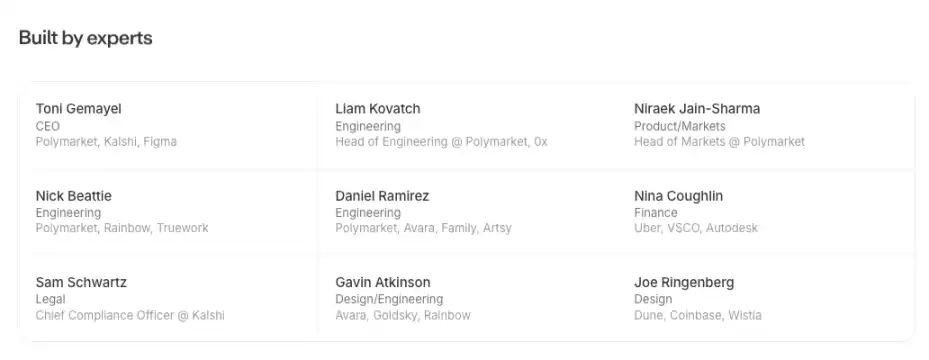
According to information on its official website, The Clearing Company's core team consists of several former executives and technical leads from Polymarket and Kalshi. The company's founder and CEO, Toni Gemayel, is a seasoned operator in the prediction market space. His resume shows he previously worked at both Polymarket and Kalshi as Head of Growth. Additionally, he has a work background at the design unicorn Figma.

Beyond this, The Clearing Company's core engineering team is primarily composed of early employees from Polymarket, while also incorporating some operations personnel from Kalshi.

· Liam Kovatch (Engineering): Former Head of Engineering at Polymarket;

· Niraek Jain-Sharma (Product/Markets): Former Head of Markets at Polymarket;

· Sam Schwartz: Former Chief Compliance Officer at Kalshi;

· Nick Beattie and Daniel Ramirez: These two engineers also hail from the Polymarket team and have experience in development at Raibow and Avara, among others.

A Coinbase spokesperson told The Block that the startup has about 10 employees, and nearly the entire team will join Coinbase as part of the deal.

Relatively speaking, although The Clearing Company is a latecomer, its starting capital far exceeds that of Polymarket and Kalshi in their early days. Comparing the seed round funding data of the three companies clearly shows the leap in the prediction market sector's valuation system over the past five years.
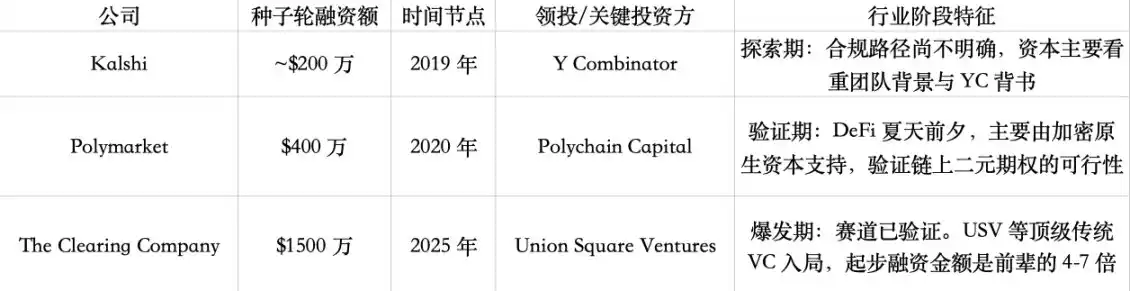
The Clearing Company completed a $15 million seed round led by Union Square Ventures even before its product launched. This amount is almost four times that of Polymarket's seed round at the time. This indicates that even before the Coinbase acquisition, the primary market had already tagged this hybrid-genes team with extremely high expectations.

Coinbase Launches Stock Trading and Prediction Market Services

At its System Update launch event on December 18, Coinbase announced a significant expansion of the range of assets tradable on its platform, including stock trading, prediction markets, new cryptocurrencies, and perpetual futures, among other new services, aiming to solidify its market positioning as an "all-in-one trading platform."

Coinbase will first launch trading services for hundreds of stocks based on market capitalization and trading volume, with plans to add thousands more stocks and ETFs in the coming months. Users can enjoy zero-commission trading, unrestricted by traditional market hours, available 24 hours a day, five days a week. Additionally, Coinbase has partnered with the $11 billion prediction market provider Kalshi, allowing users to trade on the outcomes of real-world events like elections, sports, collectibles, and economic indicators.

Simultaneously, Coinbase also launched the AI-driven wealth management tool Coinbase Advisor and the Coinbase Business service for startups, further expanding its business scope. Company executives stated that these new features will be supported by the Coinbase Tokenize platform, an end-to-end institutional-grade platform designed for tokenizing real-world assets.

Recently, Coinbase, Kalshi, Crypto.com, Robinhood, and Underdog jointly formed the Prediction Market Alliance (the Coalition for Prediction Markets). This national organization is dedicated to maintaining a safe, transparent, and federally regulated access environment for prediction markets.

Coinbase is gradually downplaying its label as a mere cryptocurrency trading platform. As Robinhood and Interactive Brokers venture into prediction markets, Coinbase must defend its territory. Having a native prediction product will complete its product matrix of spot, futures, and prediction markets, enabling users to perform a full suite of operations from buying Bitcoin to hedging macroeconomic risks within a single account.

The Next Stage of Competition in Prediction Markets

The acquisition of The Clearing Company is Coinbase's tenth announced acquisition in 2025. Deals completed earlier this year include Roam, Spindl, Iron Fish, Deribit, Opyn Markets, Liquifi, Sensible, Echo, and Vector.fun.

From the distribution partnership with Kalshi to acquiring the team and technology of The Clearing Company, Coinbase's path in the prediction market has become clear. First, validate demand and product form through partnerships, then internalize key capabilities through mergers and acquisitions, ultimately forming scalable long-term business lines.

Competition in prediction markets is shifting from who launches first to who can run compliantly and sustainably in the long term. By bringing people and technology into its system, Coinbase is clearly positioning itself early for the next stage of licensed, institutionalized competition.


Domande pertinenti

QWhat did Coinbase announce on December 22nd, and what is the expected timeline for the deal?

ACoinbase announced it has reached an agreement to acquire The Clearing Company, with the transaction expected to be completed in January.

QWhich two major prediction market platforms do the core team members of The Clearing Company come from?

AThe core team members of The Clearing Company come from Polymarket and Kalshi.

QWhat was the amount of The Clearing Company's seed funding round, and which firm led it?

AThe Clearing Company completed a $15 million seed funding round led by Union Square Ventures.

QWhat new types of trading did Coinbase announce in its System Update on December 18th?

ACoinbase announced it would expand its platform to include stock trading, prediction markets, new cryptocurrencies, and perpetual futures.

QWhat is the name of the coalition formed by Coinbase, Kalshi, and others to advocate for prediction markets?

AThe coalition is named the Coalition for Prediction Markets.

Letture associate

Has the 'Digital Gold' Narrative for BTC Failed?

**Title: Has the "Digital Gold" Narrative for Bitcoin Failed?** The article argues that Bitcoin's "digital gold" narrative remains valid despite a recent sharp price decline (from a peak near $126k in Oct 2025 to briefly under $61k in Feb 2026). It presents a long-term investment framework based on three core points: **1. Viewing Bitcoin as an Asset:** Bitcoin is presented as a superior potential store of value compared to gold. Key arguments are its absolute scarcity (21 million cap), superior portability, and transparent auditability via its public ledger. While acknowledging its current use in early, volatile stages (~3-4% global adoption), the author draws parallels to the early, disruptive phases of the internet and e-commerce. **2. Understanding the Recent Downturn:** The current ~50% correction is framed as a predictable, consensus-driven cycle following its post-halving peak (the 2024 halving preceded the Oct 2025 high). A crucial factor is a historic "changing of hands": the influx of new institutional buyers via ETFs allowed early, low-cost holders (miners, OG believers) to take profits. The author notes that while severe, Bitcoin's historical drawdowns (e.g., 93% in 2011, 77% in 2021-22) have been progressively smaller, suggesting maturing holder structure and decreasing volatility over time. **3. The Long-Term Perspective:** The long-term thesis hinges on Bitcoin capturing a portion of gold's market value. With Bitcoin's market cap at ~$1.4 trillion (at $70k) versus gold's ~$20 trillion, significant upside potential exists if the "digital gold" narrative is partially realized. However, the author strongly cautions that short-term risks remain, the bottom is unpredictable, and high volatility is inherent. The real risk is not Bitcoin failing but poor personal position management (over-leverage, wrong capital) and a lack of deep understanding, which can force investors out during severe downturns. The conclusion uses Amazon's 95% crash post-2000 dot-com bubble and subsequent 42x recovery as an analogy. The ultimate question is not if Bitcoin's price will rise, but if an investor's strategy and conviction can withstand the volatility to see the long-term play out. The recent divergence (gold up, Bitcoin down) is posed not as a narrative failure, but as potential evidence of this ongoing, painful transition from a speculative asset to a mainstream allocation.

marsbit6 h fa

Has the 'Digital Gold' Narrative for BTC Failed?

marsbit6 h fa

Has BTC's 'Digital Gold' Narrative Failed?

The article discusses Bitcoin's "digital gold" narrative, its recent price drop, and long-term outlook through the perspective of "Jason". It argues the narrative is not a failure but that Bitcoin represents a superior, new asset class due to its fixed supply (21 million), portability, and auditability. The piece compares its current ~3-4% global adoption rate to early internet/e-commerce, suggesting significant growth potential. Regarding the 2025-2026 price decline (from ~$126k to briefly under $61k), the author views it as a predictable, consensus-driven sell-off within Bitcoin's ~4-year cycle post-halving, exacerbated by a major "handover" from early, low-cost holders to new institutional buyers via ETFs. A key observation is that historical peak-to-trough drawdowns have lessened over time (e.g., 93% in 2011 to ~50% in 2026), indicating maturing volatility as holder structure changes. For the long term, the author uses a simple framework: Bitcoin's total market cap (~$1.4T at $70k) is only about 7% of gold's (~$20T). Even capturing 30-50% of gold's value would imply substantial upside. However, the article strongly cautions against viewing this as investment advice, emphasizing extreme volatility and the critical importance of risk management, position sizing, and deep fundamental understanding to survive severe drawdowns. It concludes by drawing a parallel to Amazon's 95% crash in 2000 and subsequent 42x recovery, stressing that the key is surviving market cycles to realize long-term potential.

链捕手6 h fa

Has BTC's 'Digital Gold' Narrative Failed?

链捕手6 h fa

From Code to Cognition: A Ten-Thousand-Word Guide to the Evolution of the Robot Brain

"From Code to Cognition: The Evolution of Robot Brains" The journey of robotic intelligence has shifted dramatically from manually coded systems to AI-driven brains. For decades, robots relied on layered software stacks—perception, state estimation, planning, control—each handcrafted. While predictable, they lacked adaptability. The 2010s saw deep learning revolutionize perception (e.g., object detection) and control (via reinforcement learning), but learned skills remained narrow. The arrival of Large Language Models (LLMs) marked a turning point. LLMs acted as high-level planners, interpreting natural language instructions and generating sequences of actions for traditional robotic systems to execute. However, true integration came with Visual-Language-Action (VLA) models, which fused vision, language, and motion prediction into a single network. Pioneered by models like RT-2 and open-source projects like OpenVLA, VLAs enable robots to reason and act directly from visual input and commands. The most advanced humanoid robots now employ a "dual-brain" architecture: a slow-thinking, large VLA (System 2) for reasoning and planning, and a fast-reacting, small network (System 1) for high-frequency motion control, sometimes with an even lower-level System 0 for balance. This split balances cognition with the physics of real-time movement. Computation is split between onboard hardware (e.g., NVIDIA Jetson) for safety-critical control loops and cloud/edge servers for non-critical tasks like learning and interfaces. A crucial driver is the open-source ecosystem—models like GR00T and OpenVLA allow startups to build upon pre-trained brains and fine-tune them with their own data, accelerating development. Despite progress, current systems struggle with recovery from errors, sample inefficiency, and long-horizon tasks. This has spurred the rise of **World Models**—neural networks that predict the consequences of actions. By simulating possible futures before acting (like NVIDIA Cosmos or Meta V-JEPA), robots can plan, recover, and generalize better. This represents the next frontier: shifting intelligence from learned reactions to an internal model of physics and cause-and-effect. The field is rapidly evolving. While not yet at its "ChatGPT moment," the convergence of cheaper hardware, scalable simulation, and world models points toward robots that are increasingly capable, adaptive, and useful. The question is shifting from "what can robots do?" to "what *should* they do?"

marsbit7 h fa

From Code to Cognition: A Ten-Thousand-Word Guide to the Evolution of the Robot Brain

marsbit7 h fa

Trading

Spot
Futures
活动图片




