Read 500 Pages of Reports from Five Institutions for You, This One Article is Enough for the Crypto Annual Outlook

marsbitPubblicato 2025-12-25Pubblicato ultima volta 2025-12-25

Introduzione

This comprehensive analysis synthesizes key insights from leading crypto research reports (Delphi Digital, Messari, Four Pillars, Coinbase, a16z) for the 2026 outlook. A consensus emerges: the era of pure 4-year speculative cycles is ending, replaced by structural maturation driven by liquidity convergence, infrastructure development, and regulatory clarity. Major themes include: 1. **Agentic Finance:** AI agents will become primary economic actors, managing capital and executing complex DeFi strategies autonomously, necessitating new "Know Your Agent" (KYA) identity protocols and machine-native settlement layers. 2. **Super-App Integration:** User-friendly "super-apps" will bundle complex crypto experiences (payments, investing, lending) into simple interfaces, hiding technical complexities to drive mass adoption, often powered by stablecoins. 3. **Ownership & Utility Shift:** Value will accrue to "Ownership Coins" with revenue-sharing models and real-world utility, moving beyond pure governance tokens. This includes tokenized real-world assets (RWA) and protocols finding product-market fit, like DePIN for AI computational needs. 4. **Privacy Renaissance:** Privacy-focused technologies and assets (e.g., Zcash) are predicted for a resurgence as essential hedges against surveillance and for enabling competitive advantages and sophisticated on-chain wealth management. 5. **Institutional & Regulatory Formalization:** With clearer US regulation (e.g., anticipated legislatio...

Author:Eli5DeFi

Compiled by: Deep Tide TechFlow

As the crypto industry moves towards 2026, leading research institutions are gradually reaching a consensus:

"The era of purely speculative cycles is fading away."

It is being replaced by structural maturity driven by liquidity convergence, infrastructure development, and industry consolidation, rather than short-term narrative-driven market fluctuations.

Here are the core viewpoints of major crypto research institutions on the 2026 outlook (saving you the time of reading hundreds of pages of reports):

Core Summary:

  • "Death of the Cycle": Research institutions unanimously agree that the traditional 4-year halving speculative cycle is gradually fading. The future will be dominated by structural maturity, with value increasingly focused on "Ownership Coins" with revenue-sharing models and projects with real-world applications, rather than short-term speculative narratives.

  • The Rise of "Agentic Finance": Major institutions (such as Delphi Digital, a16z, Coinbase) predict that AI Agents will become major economic participants. This will drive the development of "Know Your Agent" (KYA) identity protocols and machine-native settlement layers, technologies that go beyond human manual capabilities.

  • Super-App Consolidation: As US regulation gradually becomes clearer (research from Four Pillars, Messari, etc.), complex crypto experiences will be integrated into user-friendly "Super-Apps" and privacy-supporting blockchains. These technologies will hide technical details, driving mass adoption.

Delphi Digital's View: Infrastructure, Applications, and Markets

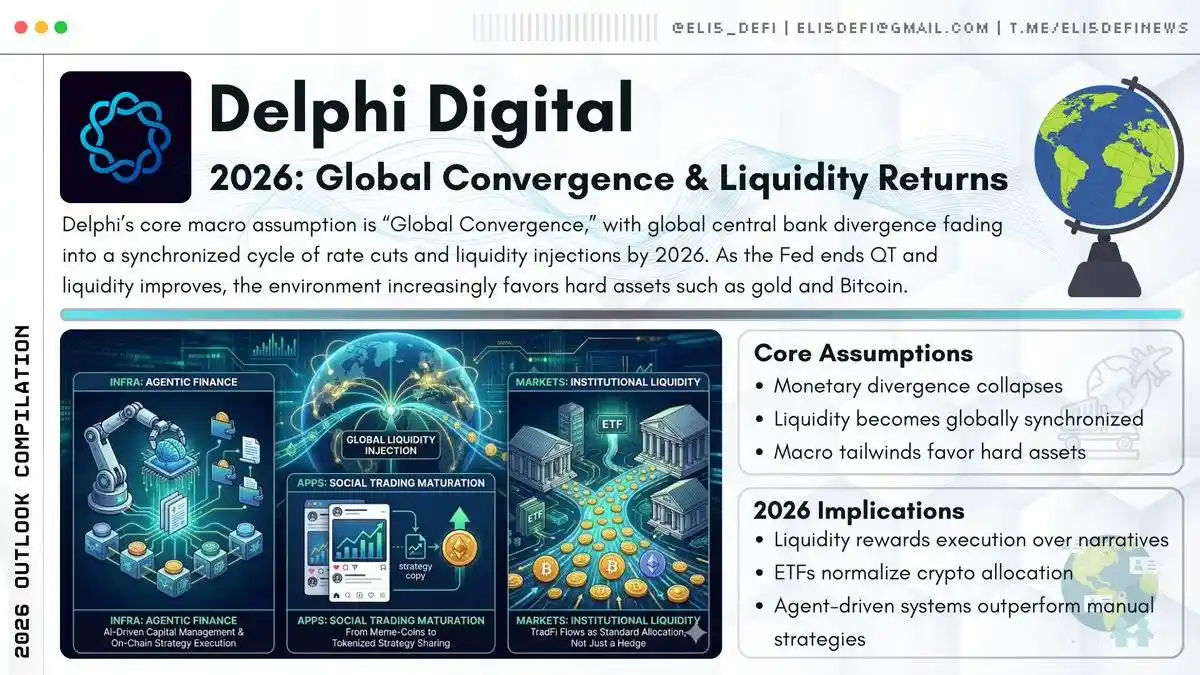
Delphi Digital's macro hypothesis is based on "Global Convergence." They predict that by 2026, the divergence in monetary policies of global central banks will end, shifting towards a unified cycle of interest rate cuts and liquidity injection. After the Federal Reserve ends quantitative tightening (QT), improved global liquidity will benefit hard assets like gold and Bitcoin.
2026 Outlook:

  1. Agentic Finance

A major expansion in infrastructure is reflected in the rise of "Agentic Finance." AI agents will no longer be just chatbots but will actively manage capital, execute complex decentralized finance (DeFi) strategies, and optimize yields on-chain without human intervention.

  1. Social Trading and the "Pump" Economy

On the consumer application side, Delphi highlighted the stickiness of platforms like @Pumpfun and predicted the maturation of "Social Trading." The trend will shift from simple meme coin speculation to more complex copy-trading hierarchies, with strategy sharing becoming a tokenized product.

  1. Institutional Liquidity

Market structure will change with the further adoption of Exchange Traded Funds (ETFs). Traditional finance (TradFi) liquidity will enter the crypto market, not just as a hedging tool but as a standard portfolio allocation driven by macro liquidity easing.

Click to view the full report:

  • Infrastructure 2026 Outlook

  • Applications 2026 Outlook

  • Markets 2026 Outlook

Messari: 2026 Crypto Industry Outlook - Market Structure and the Rise of Utility

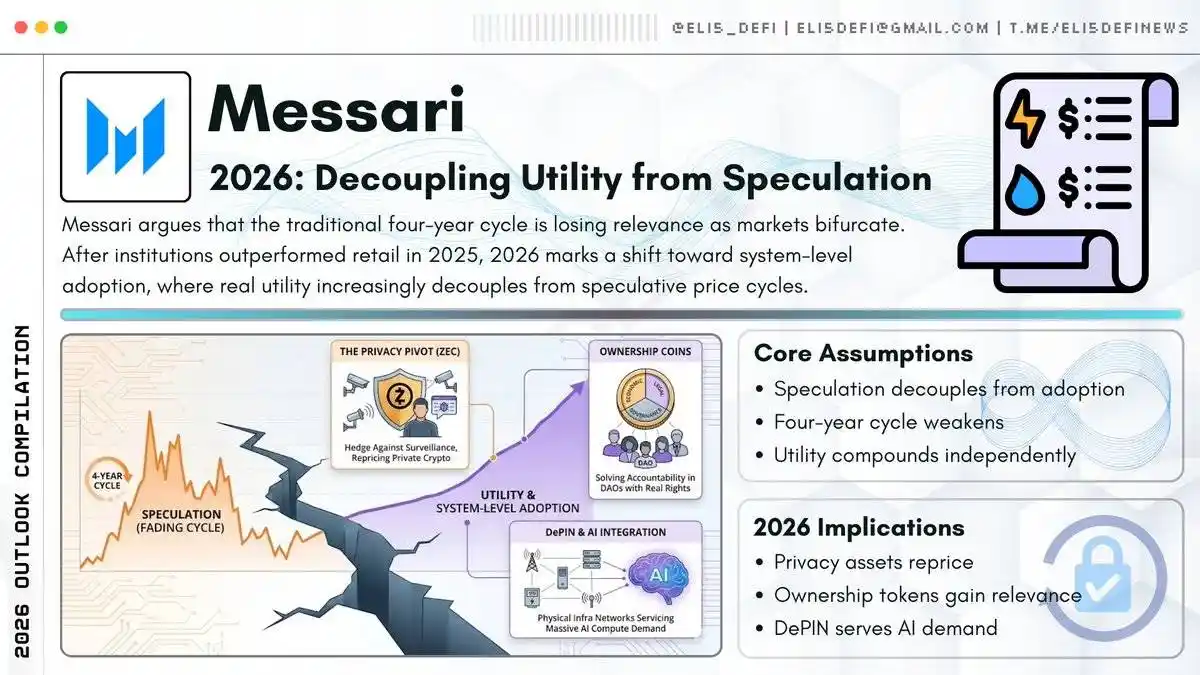
Messari's core argument is "The Separation of Utility and Speculation." They believe the traditional "four-year cycle" model is gradually losing relevance, and the market is moving towards differentiation. They hypothesize that 2025 was a year where institutional investors prevailed and retail investors were frustrated, while 2026 will become the era of "system-level applications," not just speculative games of asset prices.
2026 Outlook:

  1. Privacy Shift ($ZEC)

Messari presents a contrarian growth view: the revival of the privacy sector. They specifically mention assets like @Zcash (ZEC), not just as "privacy coins" but as necessary hedges against increasing surveillance and corporate control, predicting a repricing opportunity for "privacy cryptocurrencies."

  1. Ownership Coins

2026 will see a new token classification—"Ownership Coins." These tokens combine economic, legal, and governance rights. Messari believes these tokens have the potential to solve the accountability crisis in Decentralized Autonomous Organizations (DAOs) and may spawn the first projects with market capitalizations reaching billions of dollars.

  1. DePIN and AI Integration

The research also delves into the potential of DePIN (Decentralized Physical Infrastructure Networks), expecting these protocols to find market fit in the real world by meeting the massive demand for computing and data in the AI field.

Read the full report: 2026 Crypto Industry Report

Four Pillars: Regulatory Restructuring and Super-Apps

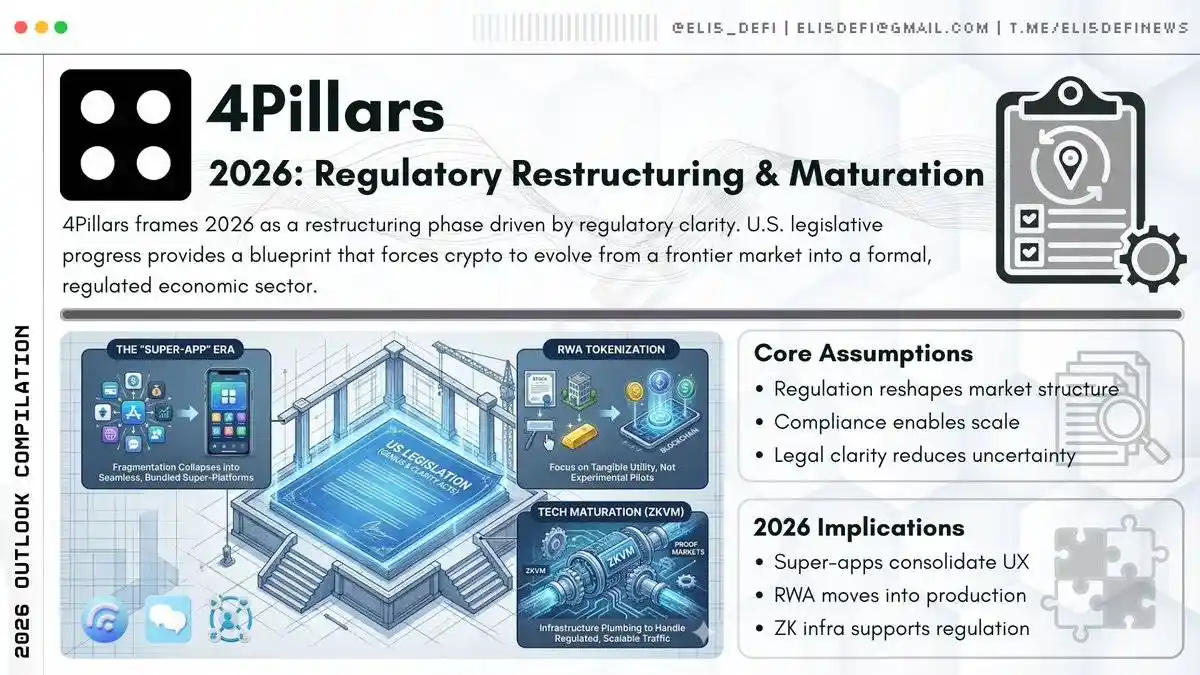
Four Pillars' 2026 outlook revolves around "Regulatory Restructuring." Their core assumption is that US legislative actions (specifically mentioning the GENIUS and CLARITY acts) will become the blueprint for driving comprehensive market reform.

This regulatory clarity will act as a catalyst, transforming the market from a "wild west" state into a formal economic sector.
Four Pillars' 2026 Outlook

  1. The Era of Super-Apps

Four Pillars predict that the current fragmented crypto application ecosystem will gradually consolidate into "Super-Apps." These platforms, driven by stablecoins, will integrate payment, investment, and lending functions, completely simplifying blockchain complexity and enhancing user experience.

  1. RWA Tokenization

As the market restructures, the tokenization of stocks and traditional assets will become a trend, but the focus will be on actual utility rather than experimental projects.

  1. Technological Maturation

On the technical front, the report emphasizes the importance of Zero-Knowledge Virtual Machines (ZKVM) and Proof Markets on Ethereum. They are seen as critical technological infrastructure to handle the traffic scale of emerging regulatory bodies.

Read the full report: 2026 Outlook: Restructuring and a Century-Long Perspective

Coinbase: 2026 Crypto Market Outlook - Markets, Regulation, and Adoption

Coinbase's report presents the view of "Death of the Cycle." They explicitly state that 2026 will mark the end of the traditional Bitcoin halving cycle theory. Future markets will be driven by structural factors: including macro demand for alternative stores of value and the formalization of the crypto industry as a medium-sized alternative asset class.

2026 Outlook:

  1. Tokenomics 2.0

A shift from "governance-only" tokens to "revenue-linked" models. Protocols will gradually introduce token buyback-and-burn or fee-sharing mechanisms (complying with new regulations) to better align token holder interests with platform success.

  1. Digital Asset Trading 2.0 (DAT 2.0)

The crypto market will move towards more professionalized trading models, particularly the procurement and trading of "sovereign block space." Block space will be regarded as a critical resource in the digital economy.

  1. Intersection of AI and Crypto

Coinbase predicts that AI agents will heavily utilize crypto payment channels, driving demand for "crypto-native settlement layers." These layers can support continuous micro-transactions between machines, a need that traditional payment systems cannot meet.

Read the full report: 2026 Crypto Market Outlook

a16z Crypto: 2026 Outlook - The Future of Internet-Native Finance and AI

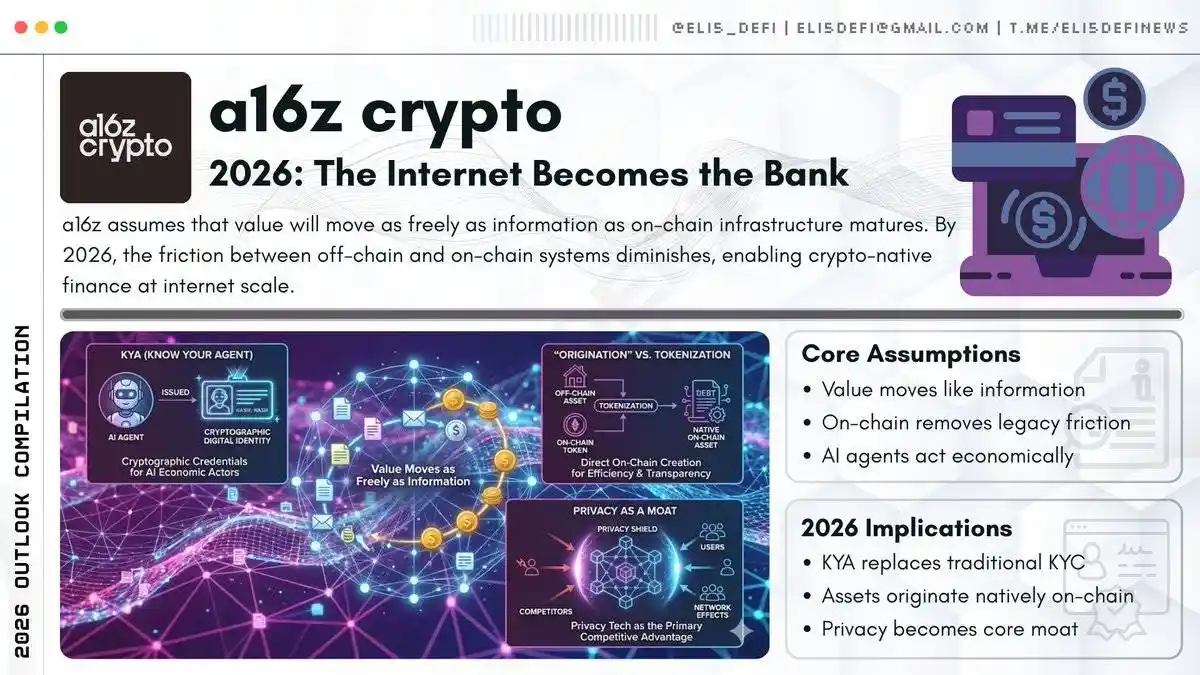
a16z Crypto's outlook is based on a core hypothesis: "The internet becomes the bank." They believe that the flow of value will become as free as the flow of information. The current friction between the on-chain and off-chain worlds is the main bottleneck, and 2026 will be the year this barrier is eliminated through better infrastructure.
a16z Crypto's 2026 Outlook

  1. KYA (Know Your Agent)

As AI Agents become major economic participants, identity verification will shift from traditional KYC (Know Your Customer) to KYA (Know Your Agent). AI agents will require cryptographically signed credentials to conduct transactions, giving rise to a whole new layer of identity infrastructure.

  1. "Asset Origination" VS "Asset Tokenization"

a16z predicts the market will gradually shift from tokenizing off-chain assets (e.g., buying treasury bonds and putting them on-chain) to generating debt and assets directly on-chain. This shift can not only reduce service costs but also greatly enhance transparency.

  1. Privacy as a Moat

In a world of prevalent open-source code, a16z emphasizes that privacy technology (especially the ability to maintain state privacy) will become the most important competitive advantage for blockchains. This will create strong network effects for privacy-supporting blockchains.

  1. Wealth Management for All

The combination of AI and crypto payment channels will democratize complex wealth management (such as asset rebalancing, tax-loss harvesting), making services previously available only to high-net-worth individuals accessible to ordinary users.

Read the full report: Major Trends in Crypto for 2026

Summary

The 2026 crypto industry outlook shows that structural maturity will replace speculative cycles, driven by liquidity convergence, regulatory clarity, and infrastructure.

Major research institutions unanimously agree that value will concentrate on settlement layers, aggregation platforms, and systems capable of attracting real users and capital.

Future opportunities will shift from chasing cycles to understanding capital flows. 2026 will reward projects that quietly build infrastructure, distribution capabilities, and trust at scale.


Crypto di tendenza

Domande pertinenti

QWhat is the consensus view among leading research institutions regarding the future of crypto speculation cycles?

ALeading research institutions agree that the era of pure speculative cycles is fading. The future will be driven by structural maturity, including liquidity convergence, infrastructure development, and industry consolidation, rather than short-term narrative-driven market volatility.

QWhat is 'Agentic Finance' and why is it considered a major trend for 2026?

A'Agentic Finance' refers to the rise of AI Agents as primary economic actors. These agents will autonomously manage capital, execute complex DeFi strategies, and optimize yields on-chain without human intervention. This trend is expected to drive the development of 'Know Your Agent' (KYA) identity protocols and machine-native settlement layers.

QHow do reports predict the role of 'Super-Apps' in the crypto space by 2026?

AReports predict that fragmented crypto applications will consolidate into user-friendly 'Super-Apps.' These platforms, often privacy-focused and driven by stablecoins, will integrate payments, investments, and lending, simplifying blockchain complexity and driving mass adoption by hiding technical details.

QWhat are 'Ownership Coins' and how do they differ from traditional tokens?

A'Ownership Coins' are a new token classification that combines economic, legal, and governance rights. They are designed to address accountability crises in DAOs and focus on revenue-sharing models and real-world utility, moving beyond mere governance tokens to better align token holder interests with platform success.

QWhy is privacy highlighted as a critical area of growth and competition in the 2026 crypto outlook?

APrivacy is emphasized as a key competitive advantage and growth area due to increasing surveillance and corporate control. Technologies like zero-knowledge proofs and privacy-focused blockchains (e.g., Zcash) are expected to see renewed interest, offering essential hedging tools and enabling state privacy, which will create strong network effects.

Letture associate

Can Generative Models Finally Be Trained End-to-End? The Core Is a For Loop

This article introduces a novel training paradigm for generative models called Explorative Modeling (XM), which enables true end-to-end training. Traditionally, powerful generative models like autoregressive and diffusion models are not trained end-to-end. They are trained to predict a single small step but require iterative multi-step sampling for inference. This "exposure bias" leads to error accumulation and limits performance. The core challenge XM addresses is "mode blurring." In generative tasks, a single input (e.g., "generate a dog") corresponds to many valid outputs (multiple modes). Standard training objectives like reconstruction loss force the model to average these modes, producing unrealistic, blurry outputs. To avoid this, existing models break generation into many small, almost deterministic steps, sacrificing end-to-end training. XM tackles this by restructuring the training loop itself. Its key insight is to amplify "generative expressivity." For each training input, instead of generating one sample, the model generates K candidate outputs. Only the candidate closest to the real data is used for computing the loss and updating the model via backpropagation. This simple "best-of-K" mechanism is implemented as a short for-loop. By exploring multiple possibilities, the model learns to distribute its guesses across different modes rather than collapsing to their uninformative average. The paper demonstrates that "exploration" acts as a new, powerful scaling axis. Gains from XM increase with model size, data scale, and compute. Experiments show improvements in FID scores for image generation and significant efficiency gains, sometimes outperforming larger models without exploration. When pushed to the limit, XM enables fully single-step, end-to-end generative models. In robotics tasks, an "Explorative Policy" matched the performance of a 100-step Diffusion Policy with a single forward pass, drastically improving inference speed. While the best-of-K concept is not entirely new, the authors' contribution lies in formally understanding it as a direct method to boost generative expressivity without fragmenting the generation process. This work suggests that as models scale, enhancing exploration during training may become crucial for overcoming fundamental performance bottlenecks.

marsbit48 min fa

Can Generative Models Finally Be Trained End-to-End? The Core Is a For Loop

marsbit48 min fa

Annual Salary of Millions Competing for Electricians, Meta Rushes to Open Its Own Technical School

The AI boom is facing an unexpected bottleneck: a severe shortage of skilled construction workers and electricians. As tech giants like Meta, OpenAI, and Alphabet race to build massive data centers—such as OpenAI's $16 billion "Stargate" project—they are hitting a critical labor wall. The U.S. needs an estimated 130,000 more electricians, 240,000 construction workers, and 150,000 supervisors by 2030 for AI infrastructure alone, but tens of thousands of electrician jobs go unfilled each year. While AI companies offer high premiums, with electricians earning up to $280,000 annually, worker scarcity still causes massive losses—delays on a single project can cost $14.2 million per month. The complexity of building AI data centers, which require immense power (equivalent to powering hundreds of thousands of homes), sophisticated electrical systems, and advanced liquid cooling solutions, demands highly skilled technicians who are in short supply. To combat this, companies are investing heavily in training. Meta has committed $115 million to a free training school offering tuition, housing, and stipends, targeting 5,000 new workers. OpenAI is partnering with unions to secure skilled labor. These efforts are paying off, with a significant rise in Gen Z interest in trade schools over college. However, the power demands are staggering. AI data centers are driving a rapid surge in electricity consumption, projected to account for up to 12% of U.S. power use by 2028 and raising costs for consumers. Furthermore, the construction boom is project-based, leading to a potential future glut of trained workers once building peaks, which could depress wages industry-wide. The race for AI supremacy now depends as much on skilled hands as on advanced chips.

marsbit2 h fa

Annual Salary of Millions Competing for Electricians, Meta Rushes to Open Its Own Technical School

marsbit2 h fa

Trading

Spot

Articoli Popolari

Come comprare ONE

Benvenuto in HTX.com! Abbiamo reso l'acquisto di Harmony (ONE) semplice e conveniente. Segui la nostra guida passo passo per intraprendere il tuo viaggio nel mondo delle criptovalute.Step 1: Crea il tuo Account HTXUsa la tua email o numero di telefono per registrarti il tuo account gratuito su HTX. Vivi un'esperienza facile e sblocca tutte le funzionalità,Crea il mio accountStep 2: Vai in Acquista crypto e seleziona il tuo metodo di pagamentoCarta di credito/debito: utilizza la tua Visa o Mastercard per acquistare immediatamente HarmonyONE.Bilancio: Usa i fondi dal bilancio del tuo account HTX per fare trading senza problemi.Terze parti: abbiamo aggiunto metodi di pagamento molto utilizzati come Google Pay e Apple Pay per maggiore comodità.P2P: Fai trading direttamente con altri utenti HTX.Over-the-Counter (OTC): Offriamo servizi su misura e tassi di cambio competitivi per i trader.Step 3: Conserva Harmony (ONE)Dopo aver acquistato Harmony (ONE), conserva nel tuo account HTX. In alternativa, puoi inviare tramite trasferimento blockchain o scambiare per altre criptovalute.Step 4: Scambia Harmony (ONE)Scambia facilmente Harmony (ONE) nel mercato spot di HTX. Accedi al tuo account, seleziona la tua coppia di trading, esegui le tue operazioni e monitora in tempo reale. Offriamo un'esperienza user-friendly sia per chi ha appena iniziato che per i trader più esperti.

430 Totale visualizzazioniPubblicato il 2024.12.12Aggiornato il 2026.06.02

Come comprare ONE

Discussioni

Benvenuto nella Community HTX. Qui puoi rimanere informato sugli ultimi sviluppi della piattaforma e accedere ad approfondimenti esperti sul mercato. Le opinioni degli utenti sul prezzo di ONE ONE sono presentate come di seguito.

活动图片