Ransomware Crooks Are Busier Than Ever — But Making Less Money, Researchers Say

bitcoinistPubblicato 2026-02-27Pubblicato ultima volta 2026-02-27

Introduzione

According to a Chainalysis report, ransomware attacks increased by 50% in 2025, with nearly 8,000 incidents recorded. However, total ransom payments fell by 8% to $820 million. This decline is attributed to stricter regulations, improved law enforcement, and more companies refusing to pay. Attackers have shifted focus to small and medium-sized businesses, which pay faster but yield smaller sums. The cost of launching attacks has also decreased significantly, with access to victim systems on the dark web dropping from $1,427 in 2023 to $439 in early 2026. Despite the drop in ransomware revenue, broader crypto crime remains significant, with $370 million stolen in January 2026 alone, mostly through phishing attacks.

The cybercrime business is booming, at least on paper. According to a new report from blockchain analytics firm Chainalysis, the number of ransomware attacks jumped 50% in 2025, with nearly 8,000 separate incidents recorded throughout the year. Yet for all that hustle, hackers walked away with less cash than the year before.

Smaller Targets, Smaller Payouts

Total ransom payments collected in 2025 came in at $820 million — an 8% drop from 2024. Reports say the decline is tied to several factors: tougher rules from regulators, law enforcement cracking down on the networks criminals use to launder money, and a growing number of companies simply refusing to pay.

With big organizations shutting the door, attackers moved on to easier prey. Small and medium-sized businesses became the new focus. “Smaller victims pay faster,” said Corsin Camichel, founder of eCrime.ch, in the Chainalysis report.

But faster doesn’t mean bigger. Those smaller targets yield smaller sums, and that math is catching up with the criminals running these schemes.
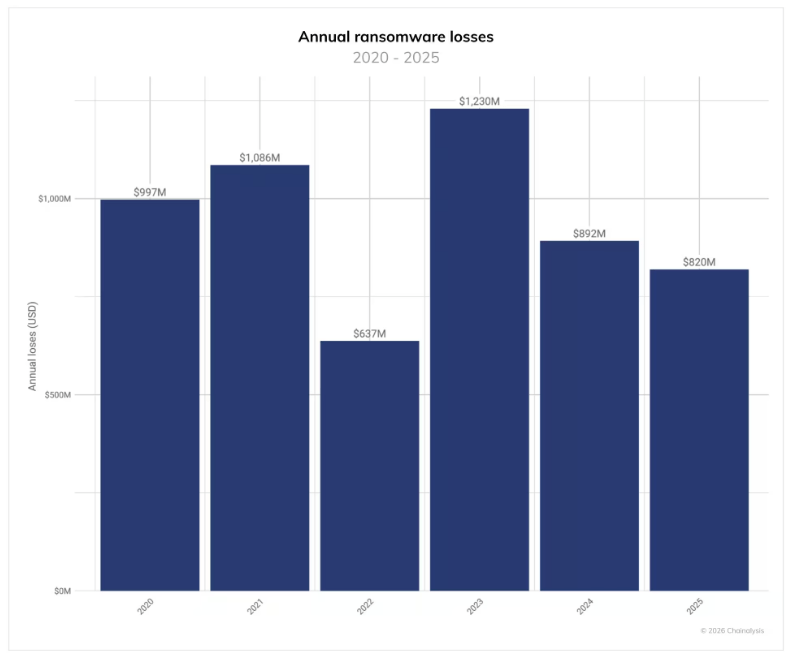
Source: Chainalysis

The gap between how many attacks are being claimed publicly and how much money is actually being collected tells its own story. Attackers are filing more claims than ever, yet the money flowing back to them keeps shrinking.

BTCUSD now trading at $67,800. Chart: TradingView

According to Chainalysis, that gap signals something important — the people running these operations are putting in more work for a worse result.
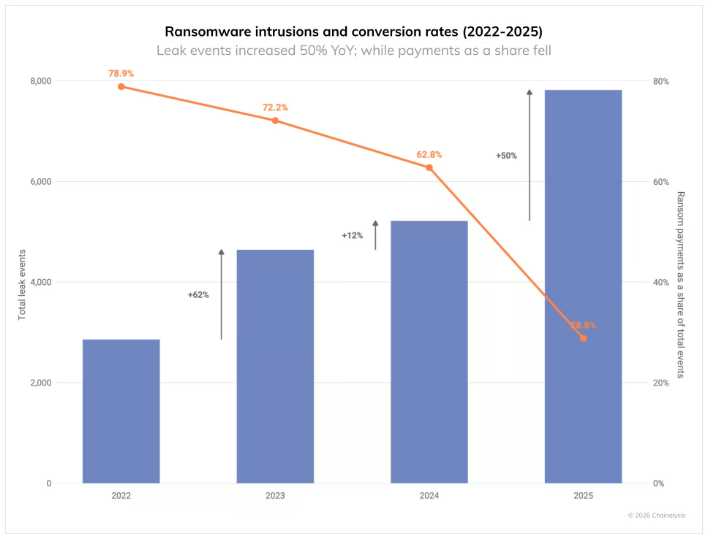
Source: Chainalysis

Ransomware: The Cost Of Breaking In Has Fallen Sharply

Part of what’s fueling the surge in attack numbers is how cheap it has become to launch one. Reports note that the average price for purchasing access to a victim’s system on the dark web fell from $1,427 in early 2023 to just $439 by early 2026.

Artificial intelligence tools and an oversupply of ready-made attack software have made it easier for more people to get into the ransomware game.

The result is a crowded field of attackers competing for the same pool of victims — and driving down their own profits in the process. It mirrors what happens in any flooded market. More sellers, same number of buyers, prices fall.

2026 Has Already Seen Major Crypto Losses

Even as ransomware payments trended downward last year, the broader picture of crypto-related crime remains grim. According to cybersecurity firm CertiK, $370 million in crypto was stolen in January 2026 alone through various exploits and scams.

Phishing attacks were responsible for the bulk of those losses, accounting for $311 million of the total. Ransomware may be generating less revenue for its operators, but the wider world of crypto theft is far from slowing down.

Featured image from Unsplash, chart from TradingView

Domande pertinenti

QAccording to the Chainalysis report, what was the percentage increase in ransomware attacks in 2025 and the total number of incidents?

AThe number of ransomware attacks jumped 50% in 2025, with nearly 8,000 separate incidents recorded.

QWhat was the total value of ransom payments collected in 2025 and how does it compare to the previous year?

ATotal ransom payments collected in 2025 came in at $820 million, which is an 8% drop from 2024.

QWhat are the three main factors cited for the decline in ransom payments?

AThe decline is tied to tougher rules from regulators, law enforcement cracking down on money laundering networks, and a growing number of companies refusing to pay.

QHow much did the average price for purchasing access to a victim's system on the dark web fall between early 2023 and early 2026?

AThe average price fell from $1,427 in early 2023 to just $439 by early 2026.

QHow much cryptocurrency was reported stolen in January 2026 by CertiK, and what type of attack was responsible for the majority of those losses?

A$370 million in crypto was stolen in January 2026, with phishing attacks accounting for the bulk of those losses at $311 million.

Letture associate

Market Trends in US Stocks (June 18): Walsh's Pivot Ignites Broad Sell-Off, SpaceX Suffers First Drop, Semiconductors Sole Safe Haven

**U.S. Market Trends (June 18): Wash Sparks Full-Scale Sell-off; SpaceX's First Drop, Semiconductors the Only Safe Haven** Markets plunged after the June FOMC meeting. The "dot plot" revealed a hawkish shift, with half the officials projecting at least one rate hike in 2024. New Fed Chair Wash, in his press conference, announced the abandonment of forward guidance, stating he "can't tell you what the next step will be." This policy uncertainty triggered a broad sell-off. All major indices fell over 1%, with the S&P 500 down 1.21%. The VIX volatility index jumped 12%. Treasury yields spiked, and the dollar surged to a two-month high, while gold erased its weekly gains. The sell-off was led by rate-sensitive sectors. Meta plunged over 5%, leading the Magnificent 7 lower. SpaceX closed down ~5%, marking its first decline since its IPO, as valuation pressure from higher rate expectations took hold. The sole market bright spot was semiconductors. The Philadelphia Semiconductor Index rose 1.38%, with Applied Materials, Lam Research, and Arm Holdings all posting significant gains. The narrative held that long-term AI computing demand remains intact, driving a rotation of funds from high-valuation software/internet stocks into infrastructure and equipment names. Retail sales data came in strong, and EIA crude inventories fell sharply, supporting the view of persistent inflation and limiting the Fed's scope for easing. Traders fully priced in a rate hike by October, with September seen as likely. In summary, Chair Wash's debut dismantled the market's traditional policy anchors, injecting new uncertainty. While the AI investment thesis provided pockets of resilience in semiconductors, the repricing of rate-sensitive, high-valuation technology stocks appears to have just begun under the new "hawkish reset" framework.

marsbit7 min fa

Market Trends in US Stocks (June 18): Walsh's Pivot Ignites Broad Sell-Off, SpaceX Suffers First Drop, Semiconductors Sole Safe Haven

marsbit7 min fa

3B Small Model's Programming Scores Rival Opus 4.5, Mysterious Model Sparks Heated Discussion, Turns Out to be Domestic

A 3B parameter dense reasoning model named VibeThinker-3B has gained significant attention for achieving performance comparable to leading models like Gemini 3 Pro, GPT-5 high, and Claude Opus 4.5 in verifiable reasoning tasks such as programming, mathematics, and STEM problem-solving, despite its significantly smaller size. Developed by Sina Weibo's team, the model is built upon Qwen2.5-Coder-3B. Its training employs an upgraded Spectrum-to-Signal pipeline, featuring a curriculum-based two-stage supervised fine-tuning (SFT), multi-domain reinforcement learning (RL) inspired by MGPO, offline self-distillation, and instruction RL to enhance controllability. A key innovation is the Claim-Level Reliability (CLR) assessment, a test-time scaling strategy that further boosts performance on math benchmarks. The model excels in specific, verifiable domains, scoring highly on tests like AIME26 (94.3/97.1 with CLR) and LiveCodeBench v6 (80.2 Pass@1). However, it performs less impressively in areas requiring broad general knowledge. The authors propose a "parameter compression coverage hypothesis," suggesting that verifiable reasoning abilities—reliant on multi-step logic and feedback—are highly compressible, while open-domain knowledge depends more on large-scale parameters. VibeThinker-3B demonstrates that small models, when specialized for tasks with clear verification signals, can reach frontier performance, offering a complementary research path to scaling model size. The model is publicly available for download and testing.

marsbit55 min fa

3B Small Model's Programming Scores Rival Opus 4.5, Mysterious Model Sparks Heated Discussion, Turns Out to be Domestic

marsbit55 min fa

Trading

Spot
Futures
活动图片





