Racing to Be the First Stock: The Substance, Capabilities, and Ambition of China's Largest Independent Model Company

marsbitPubblicato 2025-12-23Pubblicato ultima volta 2025-12-23

Introduzione

Zhipu AI, China's largest independent large language model (LLM) company by revenue, has passed its listing hearing on the Hong Kong Stock Exchange with a valuation of RMB 24.377 billion. Its IPO filing provides the first clear look at the financials of a major Chinese LLM player. From 2022 to 2024, Zhipu's revenue grew at a 130% CAGR, reaching RMB 310 million in 2024. Nearly 85% of its revenue comes from on-premise model deployments for enterprise clients, with the remainder from its MaaS (Model-as-a-Service) platform. Despite rapid revenue growth, the company reported significant adjusted net losses, driven overwhelmingly by R&D expenses which reached RMB 1.59 billion in H1 2025. A major portion of these costs is attributed to computing power, essential for training its flagship models. A key part of Zhipu's strategy is a "land and expand" approach: using strategic price cuts on its MaaS platform to attract a large user base (over 1.2 million enterprise developers) and then converting them into high-value on-premise clients. The release of its powerful open-source base model, GLM-4.5/4.6, which ranks among the top global models in several benchmarks, led to an exponential increase in API calls and token consumption. The company is betting that continued heavy R&D investment is necessary to stay at the forefront of the intensely competitive global AI market. Its leadership believes that possessing a superior base model is the ultimate product and the key to long-term grow...

24.377 billion yuan—this is the latest valuation confirmed by Zhipu in its prospectus made public on the 17th after passing the Hong Kong Stock Exchange's hearing. For the first time, people know exactly the valuation amount of a major Chinese large model company.

This is an opportune moment. Three years have passed since ChatGPT dropped a bombshell in the industry. After the frenzy of the "hundred-model battle," the remaining Chinese large model players, having proven that their innovation and technical capabilities are second to none, are now sprinting toward the capital markets.

During this critical transition period from "youth to adulthood," the market expects large model companies to demonstrate to everyone how "novel, tech-showcasing" model technology transitions into end-to-end落地 (landing/implementation) of "practical, adaptable" large models.

As the first company to successfully "come ashore" (go public/secure funding) from the hundred-model battle, Zhipu's answer is not entirely satisfactory. The scale of losses disclosed in the prospectus far exceeds revenue growth, and R&D expenses are still increasing significantly, showing no sign of stopping the "cash burn."

If this were a mature company, such a balance sheet would be quite unsatisfactory. But large models are special.

Zhipu is one of China's earliest independent large model companies, yet it is less than 6 years old. The reason the AI industry excites countless people is its revolutionary potential for the future, which is difficult to deduce directly from past history because change often happens suddenly and exponentially at a certain moment.

This is Zhipu's bet, or what could be called its vision. Before the arrival of the AGI future that many firmly believe in, Zhipu hopes to be as prepared as possible. This involves a series of complex trade-offs and also convincing the market to believe.

Making people believe—this is a gamble full of hope.

Core Data Summary

Zhipu's core commercial revenue primarily consists of localized deployment and cloud deployment. The former refers to providing large model privatization deployment for B-end customers, while the latter provides model API interfaces and token调用 (calling/invocation) services to users via its MaaS platform.

The prospectus shows that based on 2024 revenue, in the enterprise LLM field, Zhipu is already China's largest independent large model vendor and the second-largest large model vendor overall, surpassing Alibaba and SenseTime, with a market share of 6.6%.

From 2022 to 2024, Zhipu's revenues were RMB 60 million, RMB 120 million, and RMB 310 million, respectively, with a CAGR of 130%. Revenues for H1 2024 and H1 2025 were RMB 40 million and RMB 190 million, respectively, a year-on-year increase of over 300%;

Nearly 85% of Zhipu's revenue comes from the localized deployment business, primarily distributed across vertical industries such as internet technology, public services, telecommunications, traditional enterprises, consumer electronics, as well as retail, media, and consulting;

In H1 2025, Zhipu's overseas revenue proportion rapidly increased to nearly 12%, mainly from markets in Malaysia and Singapore. Under the "Belt and Road" strategy, Zhipu is helping overseas countries deploy sovereign large models, achieving a breakthrough of zero for the出海 (going global) of China's large model technology;

From 2022 to 2024 and H1 2025, Zhipu's gross margins were 54.6%, 64.6%, 56.3%, and 50.0%, respectively. For comparison, domestic software outsourcing company China Software typically has around 30%. Zhipu's gross margin for localized large model deployment business is not low;

Notably, the decline in gross margin is mainly due to price fluctuations in the MaaS platform business. Affected by market price wars, Zhipu increased price cuts to gain more customers and application scenarios;

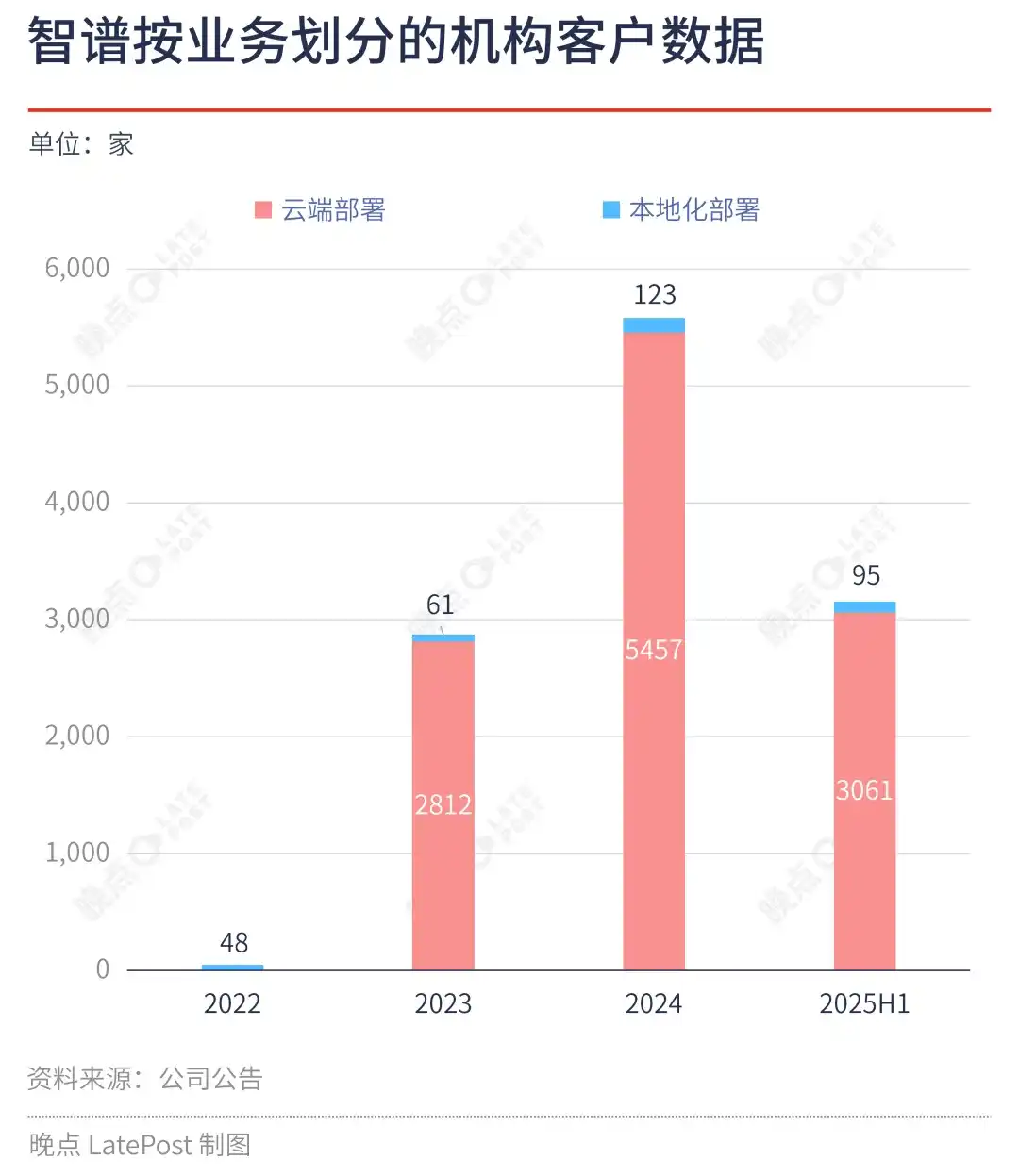
The result of this is that in H1 2025, Zhipu had 95 and 3061 institutional customers for localized and cloud deployment respectively, while the full-year 2024 figures were 123 and 5457 institutional customers. The price reduction in the MaaS business not only increased the number of cloud institutional customers but also had a significant引流 (diversion/traffic acquisition) effect on the localized deployment business;

As of Q3 2025, the company's models have empowered over 80 million end-user devices and more than 45 million developers, and it has over 12,000 institutional customers, a significant increase from the 8,000 customers in H1 2025.

Additionally, in November 2025, Zhipu's daily token consumption reached 4.2 trillion, compared to 500 million in 2022. This is the result of Zhipu releasing its new generation GLM 4.5/4.6 open-source base models and a direct reflection of user volume and调用量 (call volume).

Revenue is More Important Than Anything, But Revenue Requires Patience

In its prospectus, Zhipu introduces a "vertical and horizontal strategy" narrative for the growth prospects of commercial revenue.

Vertically, price reductions and capacity expansion in the MaaS platform business have attracted a wide range of users and application scenarios. Introducing more users will divert traffic to the localized deployment business. This "MaaS traffic acquisition + localized monetization" model will initially build a cycle of customers and commerce.

Horizontally, similar to OpenAI and Anthropic, Zhipu's MaaS platform is highly flexible and scalable. Unlike the traditional impression of heavy-delivery customization projects, Zhipu points out that the enterprise MaaS projects, which constitute the vast majority of revenue, deliver more general model capabilities, thus enabling faster scaling of token call volumes.

The vertical customer cycle model and the horizontal general solution capability scaling reinforce Zhipu's label as China's independent model company with the largest revenue volume. This is the commercial superposition effect Zhipu anticipates. The revenue scale of the MaaS platform business is highly likely to achieve超额增长 (supernormal growth). According to Zhipu's predictions, future revenue from localized deployment and cloud business will be split fifty-fifty. Zhipu is willing to sacrifice gross margin for this: unlike the high margins of localized projects, cloud business has lower gross margins because significant costs are spent on computing power procurement. This is also an inevitable result of the strategic price reduction in MaaS, a necessary compromise for short-term market share争夺 (competition).
The Model is the Product, the Product is Growth

A popular saying in the large model industry is "the model is the product." This reflects a very simple first principle: users pay for the strongest model, and the process of building the model itself is creating a highly competitive product.

This also constitutes the core growth logic of MaaS. In the second half of this year, Zhipu's latest release, the GLM 4.5/4.6 base model, was the first to natively integrate reasoning, coding, and agent capabilities within a single model. Particularly in coding, GLM ranks并列第一 (joint first) with models from Anthropic and OpenAI on Code Arena. After its release, call volume on its MaaS platform grew exponentially.

Similar to the "vertical and horizontal strategy" in the first part, powerful model products are expected to trigger a data flywheel effect, which would be the most ideal moat in large model competition. Zhipu's commercialization goals will be realized within a complete platform encompassing the latest models, APIs, and development tools. MaaS becomes an "operating system"-level infrastructure for the AI era, serving thousands of industries and organizations of all sizes—from individuals and small development teams to large enterprises. And on this complete platform, there is no交付 (delivery/customization), only product managers.

According to data in Zhipu's prospectus, MaaS has over 2.9 million enterprise and application developers, making it one of the most active large model API platforms in China. Currently, 9 out of the top 10 internet companies in China are using Zhipu's GLM large model. Among them, the GLM Coding package (a standardized large model product for developers with monthly subscription fees) gained over 150,000 paid developers within two months of launch, with annual recurring revenue quickly exceeding 100 million yuan.

The Cost of the Strongest Model

The代价 (cost/price) Zhipu paid for the judgment that "users pay for the strongest model" is fully revealed in the prospectus.

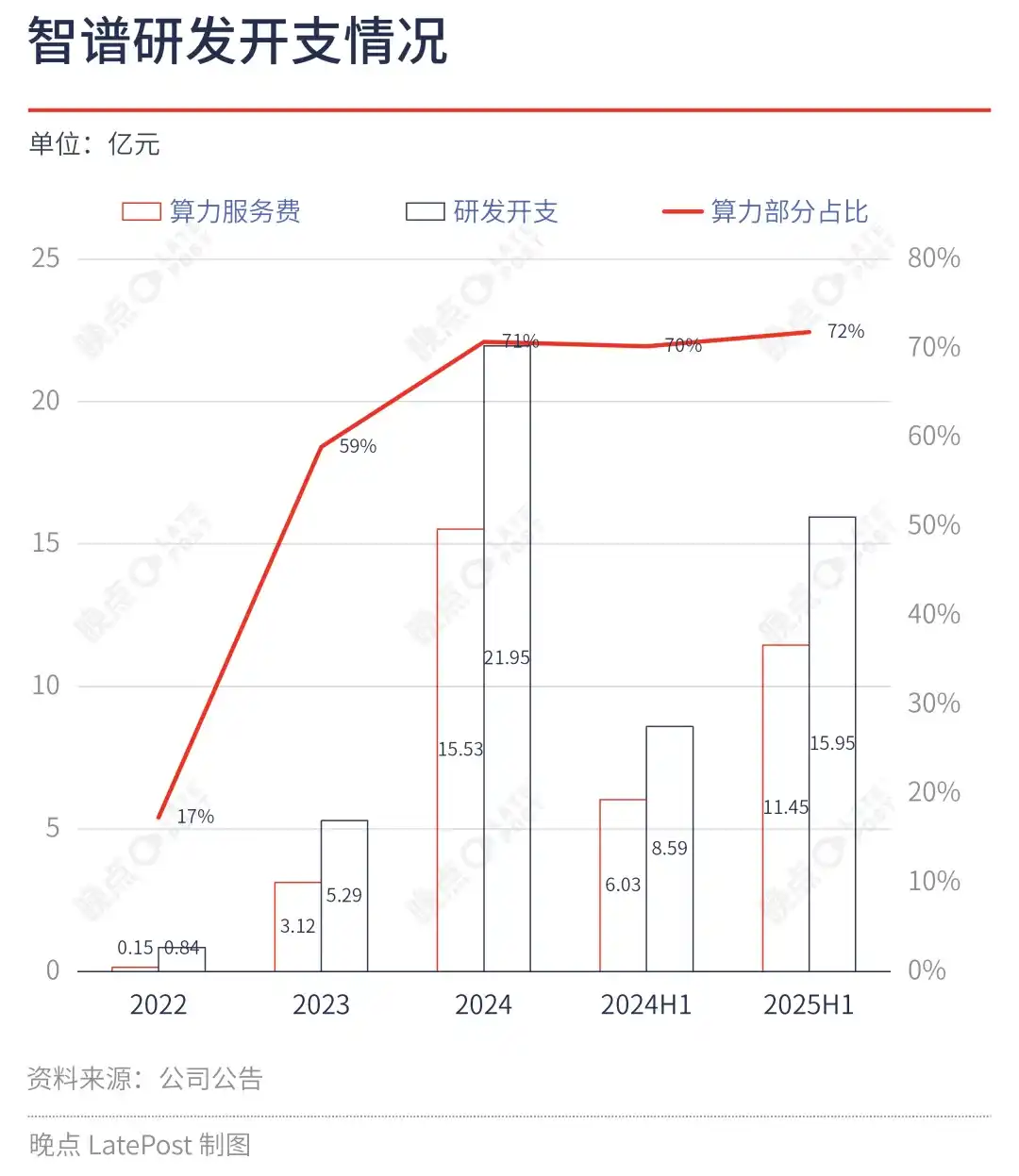
From 2022 to 2024, and the first half of this year, Zhipu's adjusted net losses were RMB 97 million, RMB 621 million, RMB 2.466 billion, and RMB 1.752 billion, respectively. R&D expenses were RMB 80 million, RMB 530 million, RMB 2.20 billion, and RMB 1.59 billion, constituting the vast majority.

Zhipu points out that computing service fees as a proportion of R&D expenses rapidly increased from an initial 17% to over 70%. This means a large part of R&D costs is used to purchase computing power,同步 (synchronizing) with the rapid growth in MaaS platform call volume.

On one hand, extremely high R&D investment is Zhipu's冷静的战略选择 (calm strategic choice). Pre-training base model capabilities themselves consume immense computing power. As AGI development progresses, it needs to衍生出 (derive/evolve) more application models to improve the comprehensive performance capabilities of agents, thereby solidifying its comparative advantage in underlying model capabilities and attracting more developers and customers;

On the other hand, in the foreseeable medium term, competition among large tech companies around large models will not cool down. This is a race with no end in sight in the short to medium term and extremely intense ranking competition. Only by始终维持 (consistently maintaining) a position in the top tier can one gain market recognition and attract capital.

Therefore, "边跑边补能" (refueling while running) is the only option.
Unlike the dot-com bubble around the year 2000, participants in the large model competition all know that although long-term cash burn is not a good commercial narrative, it is a market consensus. While model capabilities and market size are changing强烈快速 (strongly and rapidly), staying at the table is paramount. When people look forward to the systemic changes brought by AI, creating a market space worth trillions of dollars, Zhipu is betting that a larger market space will create more revenue growth opportunities and more significant scale effects. Powerful base model capabilities and the MaaS business model both suggest a higher monetary multiplier. This is an arithmetic problem everyone playing the AI game understands.

Burning cash attempts to ensure Zhipu has a place in the AI-dominated future.

Professionalism, Focus, and the Implied Price of Perseverance

AGI is a long tug-of-war. In the words of Zhipu CEO Zhang Peng, it's like "running a marathon at a sprint pace." This contradictory description explains both sides of Zhipu: it诠释了 (interprets/illustrates) Zhipu's technical perseverance and also explains the reason for choosing capitalization.

Born out of the Knowledge Engineering Laboratory of Tsinghua University's Computer Science Department, Zhipu was officially established in 2019. Starting from the underlying architecture of base large models, Zhipu has continuously率先推出 (taken the lead in launching) multiple domestic "first models," accumulating a set of domestically original model portfolios.

Taking the base model GLM-4.5 released in July this year as an example, according to data from Frost & Sullivan, GLM-4.5 achieved the following leading positions globally.

Based on the evaluation results of 12 industry-standard benchmark tests conducted in July 2025, GLM-4.5 ranked third globally, first in China, and top among global open-source models;

In September 2025, according to the LLM Hallucination Leaderboard in the field of Retrieval-Augmented Generation (RAG), GLM-4.5's hallucination rate was the second lowest globally and the lowest in China;

Since the release of GLM-4.5 until now, Zhipu's token consumption on OpenRouter has consistently ranked among the global top ten and the top three in China;

During the same period, Zhipu's paid API revenue on OpenRouter exceeded the sum of all domestic models.

In the second week of December, Zhipu open-sourced GLM multimodal and agent series models for five consecutive days. On the Hugging Face Trending list's top 10, Zhipu occupied 5 spots.
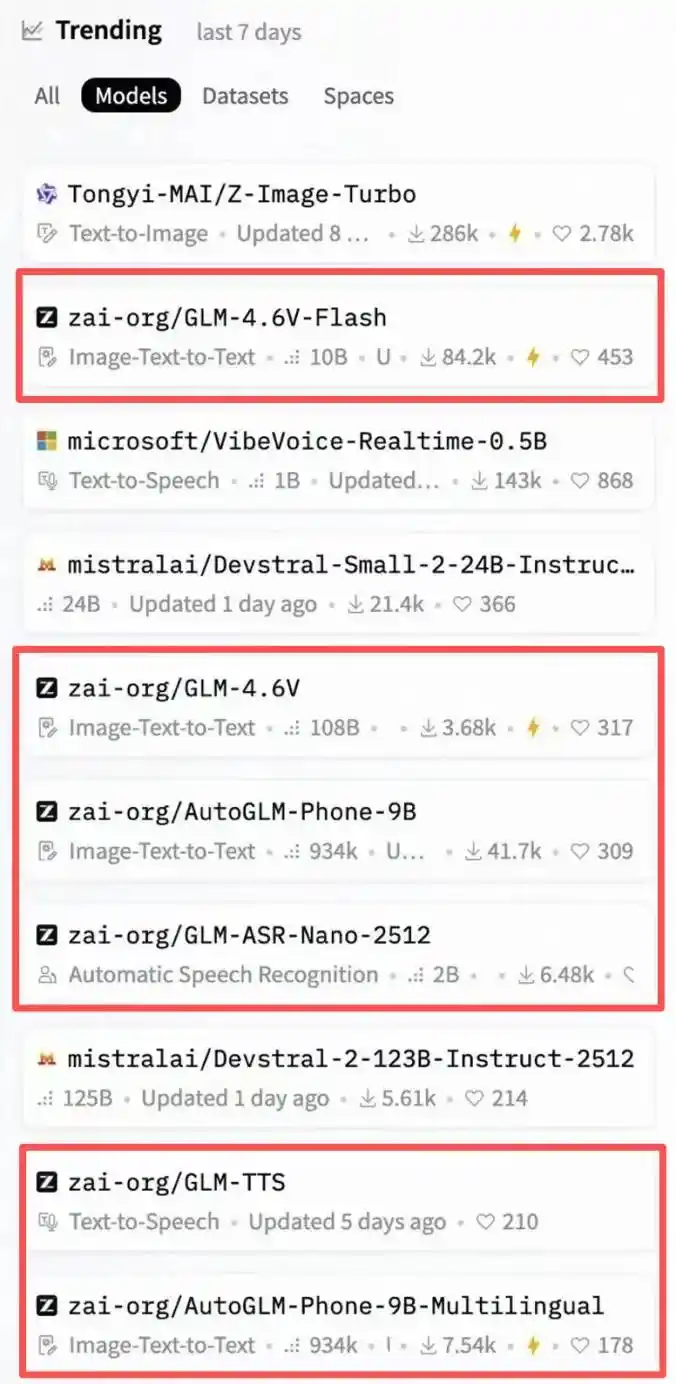
This included not only AutoGLM, which can operate mobile phones on behalf of users, but also the GLM-4.6V multimodal large model, the GLM-ASR series speech recognition models, the GLMTTS industrial-grade text-to-speech system, and core technological achievements in video generation. At first glance, this move seems almost contrary to the logic emphasizing commercialization and profitability. However, at this sensitive time before listing, Zhipu's open-source strategy显示出 (shows/displays) the strong vision of a technology-core AI company. Promoting the prosperity of the entire AI technology stack and open-source community knows no time节点 (node/moment), even during the critical stage when an AI company's growth phase shifts from technical competition to capital operation.

This气质 (temperament/character) is precisely why Zhipu was initially called the Chinese company "most like OpenAI."

As OpenAI recently suspended several non-core projects, including the Sora video generation model, and concentrated all resources within an eight-week period on improving the performance and user experience of its core product, ChatGPT, the two companies' model routes have once again converged: model capability itself is decisive, and other matters should give way to it.

The only major difference might be the huge disparity in valuations between Chinese and US AI companies. OpenAI's ultra-high valuation and continuous financing ensure it has a constant supply of ammunition for model R&D even without going public. Chinese large model enterprises, however, have valuations that are lower by more than an order of magnitude, even though Zhipu is one of the best performers among them. In its 6 years since founding, Zhipu has raised over 8 rounds of financing, with a cumulative financing scale exceeding RMB 8.3 billion.

Now, Zhipu needs a broader market to raise more sufficient ammunition. The capital market's reaction will confirm the substance of independent large model companies represented by Zhipu, thereby pricing the entire Chinese large model industry.

The Future Battle

There is not yet an independent large model company listed on the Chinese capital market for reference. Various doubts surrounding the fierce competition in large models still permeate (弥散) the market. During the growth stage of tech companies, measuring their fundamentals and growth potential using financial profitability indicators is basically无效的 (ineffective). What measures the commercial value or growth logic of such companies are often multiple complex dimensions such as revenue performance, product capability, market space, and business model, and most importantly, expectations for the future.

技术乐观主义者 (Techno-optimists) firmly believe in the future outlined by artificial intelligence. Two days after Zhipu publicly released its prospectus, another large model company, MiniMax, also disclosed its prospectus. Whoever ultimately succeeds in listing first will undoubtedly leave a profound mark on the history of artificial intelligence development.

AI is an infinite war of intelligence concerning productivity and social transformation. The battle has just begun.


Domande pertinenti

QWhat is the latest valuation of Zhipu AI as confirmed in its Hong Kong IPO filing, and why is this significant?

AZhipu AI's latest valuation is 24.377 billion yuan, as confirmed in its Hong Kong IPO filing. This is significant because it is the first time the exact valuation of a major Chinese large language model (LLM) company has been publicly disclosed.

QAccording to the article, what are the two main components of Zhipu AI's core commercial revenue?

AZhipu AI's core commercial revenue is primarily composed of revenue from localized deployment (providing private LLM deployment for B2B clients) and cloud deployment (providing model API interfaces and token call services through its MaaS platform).

QWhat strategic reason does the article give for Zhipu AI's decision to lower prices on its MaaS platform, despite the negative impact on毛利率 (gross margin)?

AZhipu AI strategically lowered prices on its MaaS platform to gain more customers and access more application scenarios. This 'MaaS引流 + 本地化变现' (MaaS traffic acquisition + localized monetization) model is intended to build a customer and commercial loop, sacrificing short-term毛利率 for long-term market share.

QWhat does the phrase '模型即产品' (the model is the product) imply about the growth logic of MaaS platforms like Zhipu's?

AThe phrase '模型即产品' implies that users pay for the most powerful model, and the process of building the model itself is equivalent to creating a highly competitive product. A strong model product can trigger a data flywheel effect, which is considered an ideal moat in LLM competition and is the core growth logic for MaaS.

QHow does the article characterize the difference in valuation and funding environment between Chinese AI companies like Zhipu and their U.S. counterparts like OpenAI?

AThe article characterizes the difference as a '巨大落差' (huge gap). U.S. AI companies like OpenAI have ultra-high valuations and continuous financing, ensuring ample resources for R&D even without an IPO. In contrast, Chinese LLM companies have valuations that are '低了不止一个数量级' (lower by more than an order of magnitude), meaning Zhipu, despite being a top performer, needs the public market to raise sufficient capital.

Letture associate

Trading

Spot
Futures

Articoli Popolari

Cosa è $S$

Comprendere SPERO: Una Panoramica Completa Introduzione a SPERO Mentre il panorama dell'innovazione continua a evolversi, l'emergere delle tecnologie web3 e dei progetti di criptovaluta gioca un ruolo fondamentale nel plasmare il futuro digitale. Un progetto che ha attirato l'attenzione in questo campo dinamico è SPERO, denotato come SPERO,$$s$. Questo articolo mira a raccogliere e presentare informazioni dettagliate su SPERO, per aiutare gli appassionati e gli investitori a comprendere le sue basi, obiettivi e innovazioni nei domini web3 e crypto. Che cos'è SPERO,$$s$? SPERO,$$s$ è un progetto unico all'interno dello spazio crypto che cerca di sfruttare i principi della decentralizzazione e della tecnologia blockchain per creare un ecosistema che promuove l'impegno, l'utilità e l'inclusione finanziaria. Il progetto è progettato per facilitare interazioni peer-to-peer in modi nuovi, fornendo agli utenti soluzioni e servizi finanziari innovativi. Al suo interno, SPERO,$$s$ mira a responsabilizzare gli individui fornendo strumenti e piattaforme che migliorano l'esperienza dell'utente nello spazio delle criptovalute. Questo include la possibilità di metodi di transazione più flessibili, la promozione di iniziative guidate dalla comunità e la creazione di percorsi per opportunità finanziarie attraverso applicazioni decentralizzate (dApps). La visione sottostante di SPERO,$$s$ ruota attorno all'inclusività, cercando di colmare le lacune all'interno della finanza tradizionale mentre sfrutta i vantaggi della tecnologia blockchain. Chi è il Creatore di SPERO,$$s$? L'identità del creatore di SPERO,$$s$ rimane piuttosto oscura, poiché ci sono risorse pubblicamente disponibili limitate che forniscono informazioni dettagliate sul suo fondatore o fondatori. Questa mancanza di trasparenza può derivare dall'impegno del progetto per la decentralizzazione—un ethos che molti progetti web3 condividono, dando priorità ai contributi collettivi rispetto al riconoscimento individuale. Centrando le discussioni attorno alla comunità e ai suoi obiettivi collettivi, SPERO,$$s$ incarna l'essenza dell'empowerment senza mettere in evidenza individui specifici. Pertanto, comprendere l'etica e la missione di SPERO rimane più importante che identificare un creatore singolo. Chi sono gli Investitori di SPERO,$$s$? SPERO,$$s$ è supportato da una varietà di investitori che vanno dai capitalisti di rischio agli investitori angelici dedicati a promuovere l'innovazione nel settore crypto. Il focus di questi investitori generalmente si allinea con la missione di SPERO—dando priorità a progetti che promettono avanzamenti tecnologici sociali, inclusività finanziaria e governance decentralizzata. Queste fondazioni di investitori sono tipicamente interessate a progetti che non solo offrono prodotti innovativi, ma contribuiscono anche positivamente alla comunità blockchain e ai suoi ecosistemi. Il supporto di questi investitori rafforza SPERO,$$s$ come un concorrente degno di nota nel dominio in rapida evoluzione dei progetti crypto. Come Funziona SPERO,$$s$? SPERO,$$s$ impiega un framework multifunzionale che lo distingue dai progetti di criptovaluta convenzionali. Ecco alcune delle caratteristiche chiave che sottolineano la sua unicità e innovazione: Governance Decentralizzata: SPERO,$$s$ integra modelli di governance decentralizzati, responsabilizzando gli utenti a partecipare attivamente ai processi decisionali riguardanti il futuro del progetto. Questo approccio favorisce un senso di proprietà e responsabilità tra i membri della comunità. Utilità del Token: SPERO,$$s$ utilizza il proprio token di criptovaluta, progettato per servire varie funzioni all'interno dell'ecosistema. Questi token abilitano transazioni, premi e la facilitazione dei servizi offerti sulla piattaforma, migliorando l'impegno e l'utilità complessivi. Architettura Stratificata: L'architettura tecnica di SPERO,$$s$ supporta la modularità e la scalabilità, consentendo un'integrazione fluida di funzionalità e applicazioni aggiuntive man mano che il progetto evolve. Questa adattabilità è fondamentale per mantenere la rilevanza nel panorama crypto in continua evoluzione. Coinvolgimento della Comunità: Il progetto enfatizza iniziative guidate dalla comunità, impiegando meccanismi che incentivano la collaborazione e il feedback. Nutrendo una comunità forte, SPERO,$$s$ può affrontare meglio le esigenze degli utenti e adattarsi alle tendenze di mercato. Focus sull'Inclusione: Offrendo basse commissioni di transazione e interfacce user-friendly, SPERO,$$s$ mira ad attrarre una base utenti diversificata, inclusi individui che potrebbero non aver precedentemente interagito nello spazio crypto. Questo impegno per l'inclusione si allinea con la sua missione generale di empowerment attraverso l'accessibilità. Cronologia di SPERO,$$s$ Comprendere la storia di un progetto fornisce preziose intuizioni sulla sua traiettoria di sviluppo e sui traguardi. Di seguito è riportata una cronologia suggerita che mappa eventi significativi nell'evoluzione di SPERO,$$s$: Fase di Concettualizzazione e Ideazione: Le idee iniziali che formano la base di SPERO,$$s$ sono state concepite, allineandosi strettamente con i principi di decentralizzazione e focus sulla comunità all'interno dell'industria blockchain. Lancio del Whitepaper del Progetto: Dopo la fase concettuale, è stato rilasciato un whitepaper completo che dettaglia la visione, gli obiettivi e l'infrastruttura tecnologica di SPERO,$$s$ per suscitare interesse e feedback dalla comunità. Costruzione della Comunità e Prime Interazioni: Sono stati effettuati sforzi attivi di outreach per costruire una comunità di early adopters e potenziali investitori, facilitando discussioni attorno agli obiettivi del progetto e ottenendo supporto. Evento di Generazione del Token: SPERO,$$s$ ha condotto un evento di generazione del token (TGE) per distribuire i propri token nativi ai primi sostenitori e stabilire una liquidità iniziale all'interno dell'ecosistema. Lancio della Prima dApp: La prima applicazione decentralizzata (dApp) associata a SPERO,$$s$ è stata attivata, consentendo agli utenti di interagire con le funzionalità principali della piattaforma. Sviluppo Continuo e Partnership: Aggiornamenti e miglioramenti continui alle offerte del progetto, inclusi partnership strategiche con altri attori nello spazio blockchain, hanno plasmato SPERO,$$s$ in un concorrente competitivo e in evoluzione nel mercato crypto. Conclusione SPERO,$$s$ rappresenta una testimonianza del potenziale del web3 e delle criptovalute di rivoluzionare i sistemi finanziari e responsabilizzare gli individui. Con un impegno per la governance decentralizzata, il coinvolgimento della comunità e funzionalità progettate in modo innovativo, apre la strada verso un panorama finanziario più inclusivo. Come per qualsiasi investimento nello spazio crypto in rapida evoluzione, si incoraggiano potenziali investitori e utenti a ricercare approfonditamente e a impegnarsi in modo riflessivo con gli sviluppi in corso all'interno di SPERO,$$s$. Il progetto mostra lo spirito innovativo dell'industria crypto, invitando a ulteriori esplorazioni delle sue innumerevoli possibilità. Mentre il percorso di SPERO,$$s$ è ancora in fase di sviluppo, i suoi principi fondamentali potrebbero effettivamente influenzare il futuro di come interagiamo con la tecnologia, la finanza e tra di noi in ecosistemi digitali interconnessi.

75 Totale visualizzazioniPubblicato il 2024.12.17Aggiornato il 2024.12.17

Cosa è $S$

Cosa è AGENT S

Agent S: Il Futuro dell'Interazione Autonoma in Web3 Introduzione Nel panorama in continua evoluzione di Web3 e criptovalute, le innovazioni stanno costantemente ridefinendo il modo in cui gli individui interagiscono con le piattaforme digitali. Uno di questi progetti pionieristici, Agent S, promette di rivoluzionare l'interazione uomo-computer attraverso il suo framework agentico aperto. Aprendo la strada a interazioni autonome, Agent S mira a semplificare compiti complessi, offrendo applicazioni trasformative nell'intelligenza artificiale (AI). Questa esplorazione dettagliata approfondirà le complessità del progetto, le sue caratteristiche uniche e le implicazioni per il dominio delle criptovalute. Cos'è Agent S? Agent S si presenta come un innovativo framework agentico aperto, progettato specificamente per affrontare tre sfide fondamentali nell'automazione dei compiti informatici: Acquisizione di Conoscenze Specifiche del Dominio: Il framework apprende in modo intelligente da varie fonti di conoscenza esterne ed esperienze interne. Questo approccio duale gli consente di costruire un ricco repository di conoscenze specifiche del dominio, migliorando le sue prestazioni nell'esecuzione dei compiti. Pianificazione su Lungo Orizzonte di Compiti: Agent S impiega una pianificazione gerarchica potenziata dall'esperienza, un approccio strategico che facilita la suddivisione e l'esecuzione efficiente di compiti complessi. Questa caratteristica migliora significativamente la sua capacità di gestire più sottocompiti in modo efficiente ed efficace. Gestione di Interfacce Dinamiche e Non Uniformi: Il progetto introduce l'Interfaccia Agente-Computer (ACI), una soluzione innovativa che migliora l'interazione tra agenti e utenti. Utilizzando Modelli Linguistici Multimodali di Grandi Dimensioni (MLLM), Agent S può navigare e manipolare senza sforzo diverse interfacce grafiche utente. Attraverso queste caratteristiche pionieristiche, Agent S fornisce un framework robusto che affronta le complessità coinvolte nell'automazione dell'interazione umana con le macchine, preparando il terreno per innumerevoli applicazioni nell'AI e oltre. Chi è il Creatore di Agent S? Sebbene il concetto di Agent S sia fondamentalmente innovativo, informazioni specifiche sul suo creatore rimangono elusive. Il creatore è attualmente sconosciuto, il che evidenzia sia la fase embrionale del progetto sia la scelta strategica di mantenere i membri fondatori sotto anonimato. Indipendentemente dall'anonimato, l'attenzione rimane sulle capacità e sul potenziale del framework. Chi sono gli Investitori di Agent S? Poiché Agent S è relativamente nuovo nell'ecosistema crittografico, informazioni dettagliate riguardanti i suoi investitori e sostenitori finanziari non sono documentate esplicitamente. La mancanza di approfondimenti pubblicamente disponibili sulle fondazioni di investimento o sulle organizzazioni che supportano il progetto solleva interrogativi sulla sua struttura di finanziamento e sulla roadmap di sviluppo. Comprendere il supporto è cruciale per valutare la sostenibilità del progetto e il suo potenziale impatto sul mercato. Come Funziona Agent S? Al centro di Agent S si trova una tecnologia all'avanguardia che gli consente di funzionare efficacemente in contesti diversi. Il suo modello operativo è costruito attorno a diverse caratteristiche chiave: Interazione Uomo-Computer Simile a Quella Umana: Il framework offre una pianificazione AI avanzata, cercando di rendere le interazioni con i computer più intuitive. Mimando il comportamento umano nell'esecuzione dei compiti, promette di elevare le esperienze degli utenti. Memoria Narrativa: Utilizzata per sfruttare esperienze di alto livello, Agent S utilizza la memoria narrativa per tenere traccia delle storie dei compiti, migliorando così i suoi processi decisionali. Memoria Episodica: Questa caratteristica fornisce agli utenti una guida passo-passo, consentendo al framework di offrire supporto contestuale mentre i compiti si sviluppano. Supporto per OpenACI: Con la capacità di funzionare localmente, Agent S consente agli utenti di mantenere il controllo sulle proprie interazioni e flussi di lavoro, allineandosi con l'etica decentralizzata di Web3. Facile Integrazione con API Esterne: La sua versatilità e compatibilità con varie piattaforme AI garantiscono che Agent S possa adattarsi senza problemi agli ecosistemi tecnologici esistenti, rendendolo una scelta attraente per sviluppatori e organizzazioni. Queste funzionalità contribuiscono collettivamente alla posizione unica di Agent S all'interno dello spazio crittografico, poiché automatizza compiti complessi e multi-fase con un intervento umano minimo. Man mano che il progetto evolve, le sue potenziali applicazioni in Web3 potrebbero ridefinire il modo in cui si svolgono le interazioni digitali. Cronologia di Agent S Lo sviluppo e le tappe di Agent S possono essere riassunti in una cronologia che evidenzia i suoi eventi significativi: 27 Settembre 2024: Il concetto di Agent S è stato lanciato in un documento di ricerca completo intitolato “Un Framework Agentico Aperto che Usa i Computer Come un Umano”, mostrando le basi per il progetto. 10 Ottobre 2024: Il documento di ricerca è stato reso pubblicamente disponibile su arXiv, offrendo un'esplorazione approfondita del framework e della sua valutazione delle prestazioni basata sul benchmark OSWorld. 12 Ottobre 2024: È stata rilasciata una presentazione video, fornendo un'idea visiva delle capacità e delle caratteristiche di Agent S, coinvolgendo ulteriormente potenziali utenti e investitori. Questi indicatori nella cronologia non solo illustrano i progressi di Agent S, ma indicano anche il suo impegno per la trasparenza e il coinvolgimento della comunità. Punti Chiave su Agent S Man mano che il framework Agent S continua a evolversi, diversi attributi chiave si distinguono, sottolineando la sua natura innovativa e il potenziale: Framework Innovativo: Progettato per fornire un uso intuitivo dei computer simile all'interazione umana, Agent S porta un approccio nuovo all'automazione dei compiti. Interazione Autonoma: La capacità di interagire autonomamente con i computer attraverso GUI segna un passo avanti verso soluzioni informatiche più intelligenti ed efficienti. Automazione di Compiti Complessi: Con la sua metodologia robusta, può automatizzare compiti complessi e multi-fase, rendendo i processi più veloci e meno soggetti a errori. Miglioramento Continuo: I meccanismi di apprendimento consentono ad Agent S di migliorare dalle esperienze passate, migliorando continuamente le sue prestazioni e la sua efficacia. Versatilità: La sua adattabilità attraverso diversi ambienti operativi come OSWorld e WindowsAgentArena garantisce che possa servire un'ampia gamma di applicazioni. Man mano che Agent S si posiziona nel panorama di Web3 e delle criptovalute, il suo potenziale per migliorare le capacità di interazione e automatizzare i processi segna un significativo avanzamento nelle tecnologie AI. Attraverso il suo framework innovativo, Agent S esemplifica il futuro delle interazioni digitali, promettendo un'esperienza più fluida ed efficiente per gli utenti in vari settori. Conclusione Agent S rappresenta un audace passo avanti nell'unione tra AI e Web3, con la capacità di ridefinire il modo in cui interagiamo con la tecnologia. Sebbene sia ancora nelle sue fasi iniziali, le possibilità per la sua applicazione sono vaste e coinvolgenti. Attraverso il suo framework completo che affronta sfide critiche, Agent S mira a portare le interazioni autonome al centro dell'esperienza digitale. Man mano che ci addentriamo nei regni delle criptovalute e della decentralizzazione, progetti come Agent S giocheranno senza dubbio un ruolo cruciale nel plasmare il futuro della tecnologia e della collaborazione uomo-computer.

408 Totale visualizzazioniPubblicato il 2025.01.14Aggiornato il 2025.01.14

Cosa è AGENT S

Come comprare S

Benvenuto in HTX.com! Abbiamo reso l'acquisto di Sonic (S) semplice e conveniente. Segui la nostra guida passo passo per intraprendere il tuo viaggio nel mondo delle criptovalute.Step 1: Crea il tuo Account HTXUsa la tua email o numero di telefono per registrarti il tuo account gratuito su HTX. Vivi un'esperienza facile e sblocca tutte le funzionalità,Crea il mio accountStep 2: Vai in Acquista crypto e seleziona il tuo metodo di pagamentoCarta di credito/debito: utilizza la tua Visa o Mastercard per acquistare immediatamente SonicS.Bilancio: Usa i fondi dal bilancio del tuo account HTX per fare trading senza problemi.Terze parti: abbiamo aggiunto metodi di pagamento molto utilizzati come Google Pay e Apple Pay per maggiore comodità.P2P: Fai trading direttamente con altri utenti HTX.Over-the-Counter (OTC): Offriamo servizi su misura e tassi di cambio competitivi per i trader.Step 3: Conserva Sonic (S)Dopo aver acquistato Sonic (S), conserva nel tuo account HTX. In alternativa, puoi inviare tramite trasferimento blockchain o scambiare per altre criptovalute.Step 4: Scambia Sonic (S)Scambia facilmente Sonic (S) nel mercato spot di HTX. Accedi al tuo account, seleziona la tua coppia di trading, esegui le tue operazioni e monitora in tempo reale. Offriamo un'esperienza user-friendly sia per chi ha appena iniziato che per i trader più esperti.

830 Totale visualizzazioniPubblicato il 2025.01.15Aggiornato il 2025.03.21

Come comprare S

Discussioni

Benvenuto nella Community HTX. Qui puoi rimanere informato sugli ultimi sviluppi della piattaforma e accedere ad approfondimenti esperti sul mercato. Le opinioni degli utenti sul prezzo di S S sono presentate come di seguito.

活动图片