‘Quietly rebuilding momentum’ – Scaramucci backs Polkadot despite low network activity

ambcryptoPubblicato 2026-03-22Pubblicato ultima volta 2026-03-22

Introduzione

Anthony Scaramucci, founder of SkyBridge, has turned bullish on Polkadot, citing key catalysts that are "quietly rebuilding momentum" for the blockchain. These include recent regulatory clarity from the SEC, which classified DOT as a digital commodity, and a major tokenomics update that hard-capped the supply at 2.1 billion tokens and cut annual emissions by 53%. The launch of the 21Shares Spot DOT ETF was also noted, though it has seen minimal inflows since debuting. Despite these developments, Polkadot's network activity has declined significantly over the past two years, with weekly active addresses dropping from 16,000 to 5,000. The tokenomics changes briefly boosted trader sentiment, leading to an 18% price rally, but positive momentum faded at the $1.65 resistance level. If macroeconomic uncertainty continues, DOT could retreat to $1.23. While Scaramucci highlights bullish factors, Polkadot's adoption remains weak, and it is unclear how quickly recent upgrades will reignite growth and lift the token's value.

Anthony Scaramucci, founder of venture capital firm SkiBridge, has flipped bullish on Polkadot.

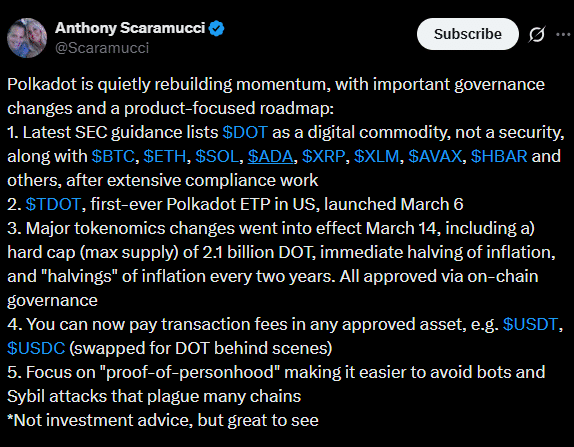
According to the crypto investor, the latest regulatory update and major tokenomics were some of the bullish catalysts that are ‘quietly rebuilding momentum’ for the chain.
Source: X

In the latest SEC guidance, DOT was categorized as a digital commodity like Bitcoin and Ethereum.

Beyond regulatory clarity, the recent tokenomics overhaul has hard-capped DOT supply at 2.1 billion. Additionally, the annual emissions were cut from 120 million DOT to 55 million DOT, marking a 53% cut.

The 21Shares Spot DOT ETF was another key catalyst, according to Scaramucci.

However, since the product debuted, it has only seen one day of inflow of $544.5K. For the rest of March, the Spot DOT ETF has seen zero flows, suggesting that the demand is not as strong as the analyst projected.

But the ETF demand isn’t the only thing lagging for DOT.

Polkadot network activity declining

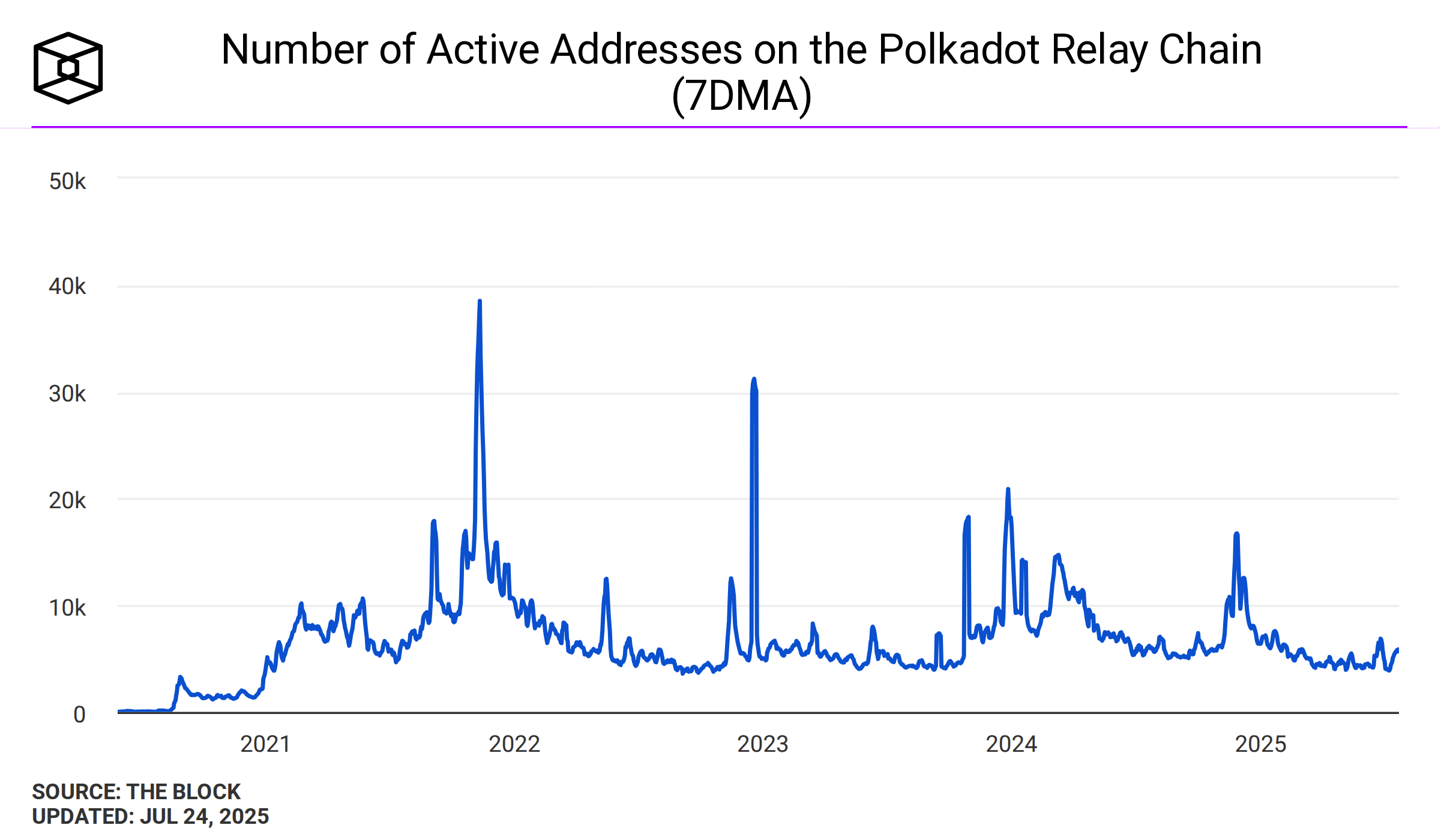
On the network activity and adoption, Polkadot has seen a significant loss in traction. Apart from the initial broader market hype and rally in late 2024, the chain’s adoption has been in a free fall.

This was illustrated by the drop in weekly average active addresses, slipping from 16K to 5K in the past two years.
Source: The Block

It remains to be seen whether the recent tokenomics overhaul will attract users again.

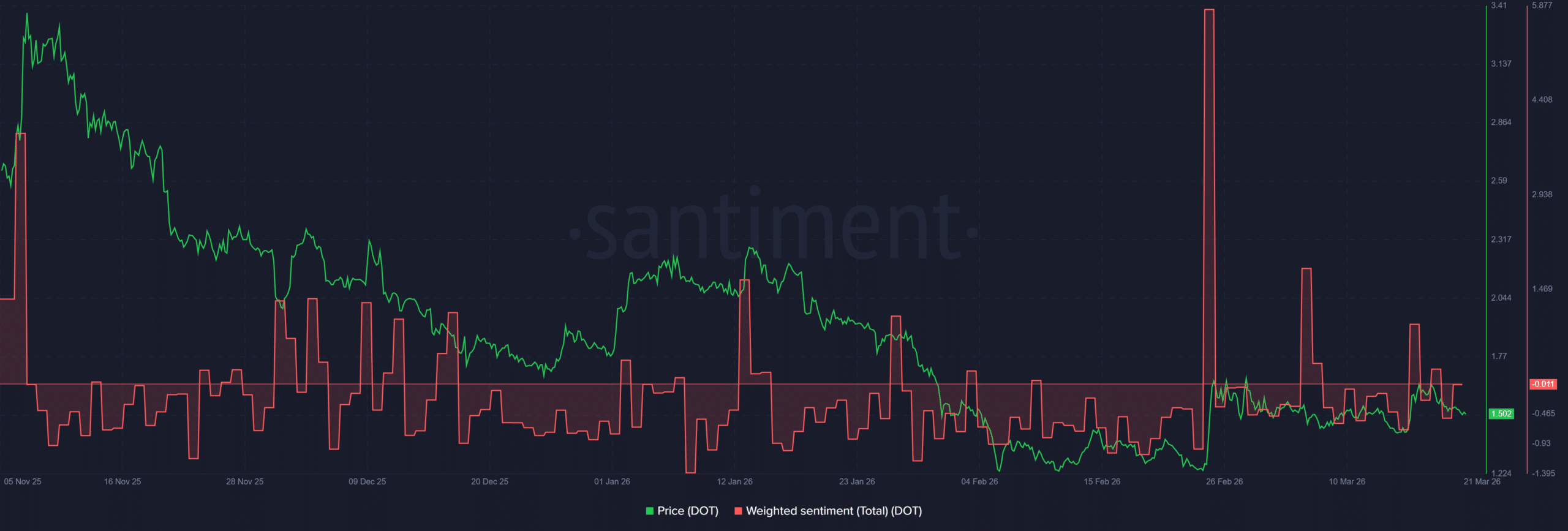
On market dynamics, DOT’s tokenomics and deflation push saw sentiment briefly flip positive before reverting to negative.
Source: Santiment

In other words, the changes temporarily tipped traders to go bullish on the altcoin. In fact, during the spike in positive sentiment, the altcoin rallied 18%. Put differently, the market welcomed the recent upgrades.

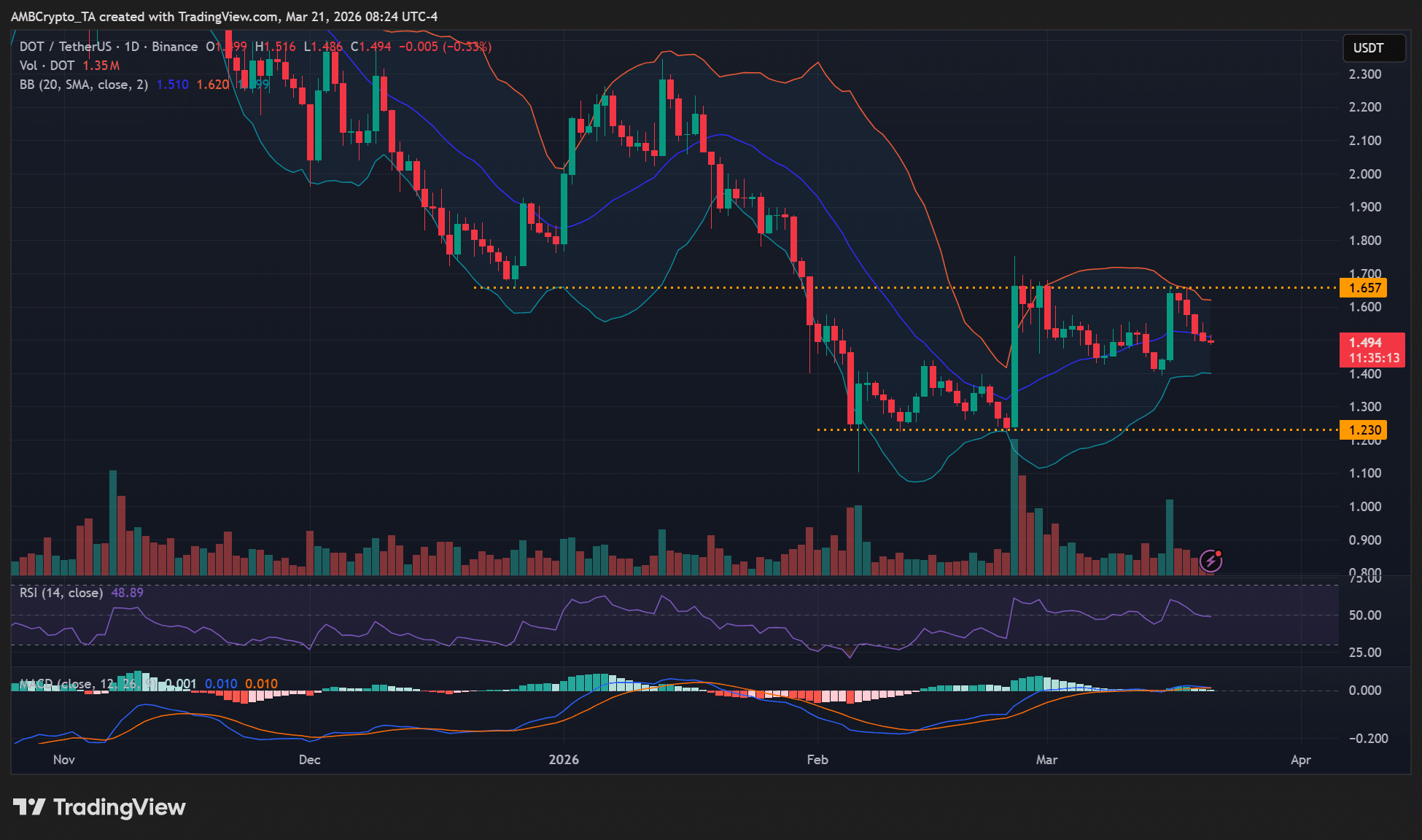
Meanwhile, the DOT rally faded at $1.65, a key roadblock in Q1 2026. If the ongoing macro uncertainty persists, DOT may extend the pullback to $1.23.
Source: DOT/USDT, TradingView

Overall, Scaramucci highlighted key bullish catalysts for the Polkadot chain and its native token. Even so, the chain’s traction has worsened in the past two years. It was unclear how fast the recent changes would reignite momentum and eventually lift DOT.


Final Summary

  • For SkiBridge’s Scaramucci, Polkadot’s bullish case was ‘quietly rebuilding momentum’ after recent upgrades.
  • The chain’s traction has declined in the past two years, but whether recent updates will help revive it remains to be seen.


Domande pertinenti

QWhat are the key bullish catalysts for Polkadot mentioned by Anthony Scaramucci?

AThe key bullish catalysts mentioned are the latest SEC guidance categorizing DOT as a digital commodity, the tokenomics overhaul that hard-capped DOT supply at 2.1 billion and cut annual emissions by 53%, and the launch of the 21Shares Spot DOT ETF.

QHow has Polkadot's network activity changed in the past two years according to the article?

APolkadot's network activity has significantly declined, with weekly average active addresses dropping from 16K to 5K over the past two years.

QWhat was the market reaction to Polkadot's recent tokenomics changes?

AThe tokenomics changes temporarily flipped market sentiment positive, resulting in an 18% price rally for DOT, though the positive sentiment eventually reverted to negative.

QWhat does the article say about the performance of the 21Shares Spot DOT ETF?

AThe ETF saw only one day of inflows totaling $544.5K since its debut and recorded zero flows for the rest of March, indicating weaker demand than projected.

QWhat are the key resistance and support levels mentioned for DOT's price?

AThe rally faded at the key resistance level of $1.65, and if macro uncertainty persists, DOT could extend its pullback to the support level of $1.23.

Letture associate

From Theft to Re-entry: How Was $292 Million "Laundered"?

A sophisticated crypto laundering operation was executed following the $292 million hack of Kelp DAO on April 18. The attack, attributed to the North Korean Lazarus group, began with anonymous infrastructure preparation using Tornado Cash to fund wallets untraceably. The hacker exploited a vulnerability in Kelp’s cross-chain bridge, stealing 116,500 rsETH. To avoid crashing the market, the attacker used Aave and Compound as laundering tools—depositing the stolen rsETH as collateral to borrow $190 million in clean, liquid ETH. This move triggered a bank run on Aave, causing an $8 billion drop in TVL. After consolidating funds, the attacker fragmented them across hundreds of wallets to evade detection. A major breakpoint was THORChain, where over $460 million in volume—30 times its usual activity—was processed in 24 hours, converting ETH into Bitcoin. This shift to Bitcoin’s UTXO model exponentially increased tracing complexity by shattering funds into countless untraceable fragments. The final destination was Tron-based USDT, the primary channel for illicit crypto flows. From there, funds were cashed out via OTC brokers in China and Southeast Asia, using unlicensed underground banks and UnionPay networks outside Western sanctions scope. Ultimately, the laundered money supports North Korea’s weapons programs, which rely heavily on crypto hacking for foreign currency. The incident underscores structural challenges in DeFi: its openness, composability, and lack of central control make such laundering not just possible, but inherently difficult to prevent.

marsbit3 h fa

From Theft to Re-entry: How Was $292 Million "Laundered"?

marsbit3 h fa

Trading

Spot
Futures
活动图片