Quid Pro Quo or Crypto? Congress Probes UAE Deal as LiquidChain Emerges as Secure Institutional Alternative

bitcoinistPubblicato 2026-02-05Pubblicato ultima volta 2026-02-05

Introduzione

High politics and decentralized finance collide as a U.S. congressional inquiry probes potential conflicts of interest involving World Liberty Financial (WLFI) and foreign entities, including UAE dealings and investments from figures like Justin Sun. Lawmakers question whether crypto projects are being used for political influence, highlighting vulnerabilities in personality-driven ventures. This scrutiny creates an institutional shift toward infrastructure-focused alternatives like LiquidChain ($LIQUID), a Layer 3 protocol that unifies Bitcoin, Ethereum, and Solana into a single execution layer. Emphasizing code over connections, LiquidChain offers a trustless, interoperable environment, attracting presale investment of over $526K as capital flees politically sensitive assets for verifiable, utility-driven solutions.

High politics and decentralized finance just collided in Washington, and lawmakers aren’t happy.

A formal inquiry into potential conflicts of interest surrounding World Liberty Financial (WLFI) has triggered alarm bells across the sector. At the center of the storm sits a letter from Rep. Jamie Raskin (D-MD) and Rep. Robert Garcia (D-CA), probing whether foreign entities, specifically those connected to recent UAE dealings and investments from figures like Justin Sun, are using crypto projects as a vehicle for political influence.
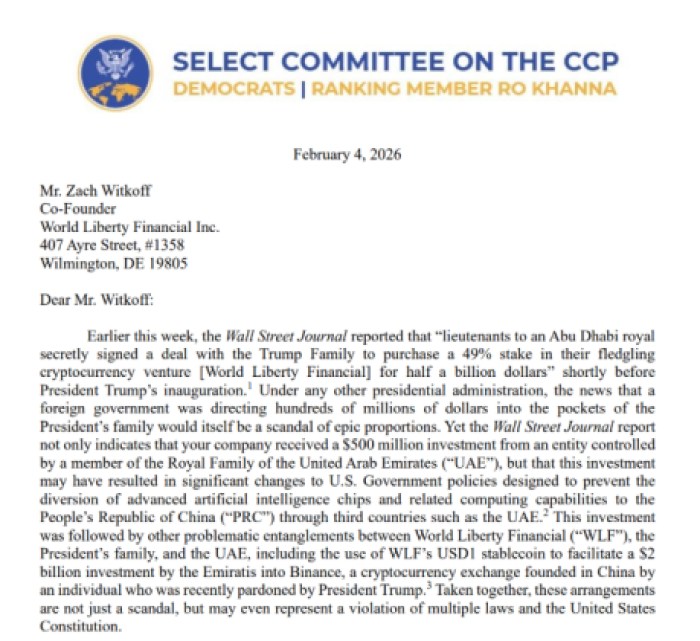

It’s not just about blockchain mechanics; the concern focuses on the ‘quid pro quo’ potential of opaque financial structures. When a project is tied intrinsically to a political figurehead, large foreign investments raise national security questions: are these purchases of tokens, or purchases of access?

The probe highlights a critical vulnerability in personality-driven crypto ventures. If the underlying value proposition relies on connections rather than code, the project becomes a lightning rod for regulatory enforcement.

This scrutiny creates a vacuum in the institutional DeFi sector. While D.C. dissects the tangled web of WLFI’s foreign ties, the market is quietly shifting capital toward infrastructure-heavy alternatives that prioritize code over connections.

The volatility of politically exposed assets is driving smart money toward verifiable, tech-first solutions. That flight to quality is evident in the rising interest surrounding LiquidChain ($LIQUID), a Layer 3 protocol designed to solve fragmentation without the geopolitical baggage.

Escaping Geopolitical Risk Through LiquidChain’s Unified Layer

The congressional probe into World Liberty Financial exposes a fatal flaw in centralized, personality-centric DeFi: counterparty risk. When a protocol relies on opaque dealings with foreign sovereign wealth funds or controversial crypto tycoons, ‘decentralization’ becomes little more than a marketing slogan.

In contrast, LiquidChain is capitalizing on the market’s demand for a trustless execution environment. Rather than relying on boardroom deals to move liquidity, LiquidChain utilizes a Layer 3 architecture to fuse Bitcoin, Ethereum, and Solana into a single execution layer.
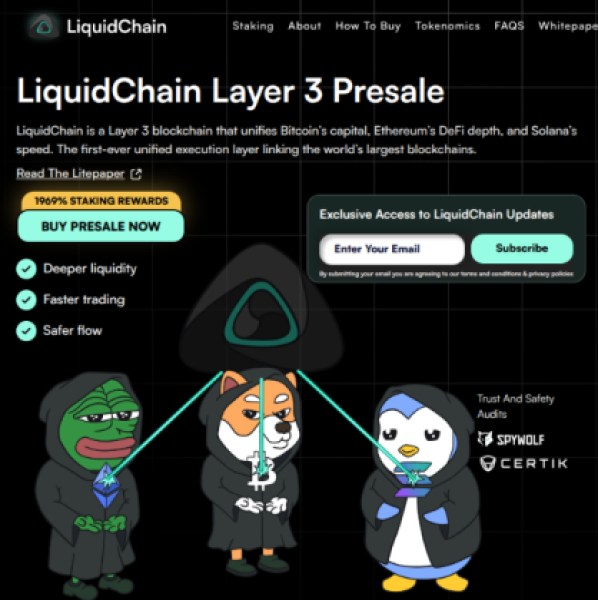
That distinction matters because institutions require certainty. They can’t allocate capital to platforms where the regulatory status hinges on the outcome of an election or a congressional hearing. LiquidChain’s ‘Deploy-Once’ architecture allows developers to build applications that access liquidity across all major chains simultaneously, removing the need for risky, fragmented bridges or politically sensitive partnerships.

By creating a Unified Liquidity Layer, the protocol offers the interoperability that WLFI promised, but delivers it through verifiable smart contracts rather than handshake deals in Dubai.

For the developer ecosystem, this represents a massive efficiency unlock. Instead of writing distinct code for the EVM (Ethereum) and SVM (Solana), LiquidChain’s Cross-Chain VM handles the translation.

As regulatory heat increases on projects like WLFI, infrastructure plays that solve the ‘wrapped asset risk’ problem. where assets are pegged and potentially manipulated, are becoming the preferred safe harbor for long-term capital.

EXPLORE LIQUIDCHAIN ON ITS PRESALE PAGE

$LIQUID Presale Gains Traction Amidst Regulatory Uncertainty

While headlines scream about subpoenas and congressional letters, on-chain data reveals a divergence in where retail and developer capital is actually flowing. The LiquidChain presale has quietly accelerated, with the project raising over $526K to date.

Unlike the hype-driven cycles of meme coins or political tokens, this capital injection suggests a methodical accumulation by investors betting on infrastructure over narrative.

At the current entry price of $0.0135, the market is pricing $LIQUID as an early-stage infrastructure bet. The tokenomics model positions $LIQUID not just as a governance token, but as the transaction fuel for the entire cross-chain environment. Every time a user swaps $SOL for $BTC or engages in DeFi activities across the unified layer, the protocol generates demand for the token.

This utility-driven demand contrasts sharply with the speculative nature of tokens currently under the congressional microscope. It’s easy to see why it could be one of the next crypto to explode.

The timing of this capital raise is notable. As investors rotate out of high-risk, politically sensitive assets, they’re seeking ‘picks and shovels’ plays, protocols that facilitate the industry’s growth regardless of which political party holds power.

With liquidity staking incentives encouraging long-term holding, LiquidChain is positioning itself to capture the volume that is fleeing from regulatory uncertainty.

BUY YOUR $LIQUID TODAY

This article is for informational purposes only and does not constitute financial advice. Cryptocurrency investments carry high risk, including the potential loss of principal. Always perform your own due diligence.


Domande pertinenti

QWhat is the main concern raised by the congressional inquiry into World Liberty Financial (WLFI)?

AThe main concern is whether foreign entities, particularly those linked to recent dealings with the UAE and investments from figures like Justin Sun, are using cryptocurrency projects as a vehicle for political influence, creating potential 'quid pro quo' situations and national security risks.

QHow does LiquidChain aim to address the vulnerabilities exposed by the WLFI probe?

ALiquidChain addresses these vulnerabilities by offering a trustless, tech-first solution with its Layer 3 architecture that unifies Bitcoin, Ethereum, and Solana into a single execution layer, prioritizing verifiable smart contracts and code over opaque political connections and partnerships.

QWhat key technological feature does LiquidChain use to solve the problem of blockchain fragmentation?

ALiquidChain uses its 'Deploy-Once' architecture and Cross-Chain VM, which allows developers to build applications that can access liquidity across all major chains simultaneously, eliminating the need for risky bridges and reducing fragmentation.

QWhat is the current status of the LiquidChain ($LIQUID) presale and what does it indicate about investor sentiment?

AThe LiquidChain presale has raised over $526K, indicating a methodical accumulation by investors who are betting on long-term infrastructure solutions rather than hype-driven or politically sensitive narrative tokens amidst regulatory uncertainty.

QHow does the utility of the $LIQUID token differ from the tokens under congressional scrutiny?

AThe $LIQUID token is designed as a utility token that serves as the governance and transaction fuel for the entire cross-chain environment, generating demand through actual platform use, in contrast to the speculative and politically exposed nature of the tokens under investigation.

Letture associate

The "Impossible Triad" Is Fundamentally a Pseudo-Problem

The article argues that blockchain's fundamental limitation is not the scalability trilemma (decentralization, scalability, security), which has been largely solved, but the lack of **privacy** and, until recently, clear **legitimacy**. Blockchain is described as a slow, expensive, globally shared computer whose core value is censorship resistance and verifiability. While ideal for native digital assets like money (e.g., stablecoins), its default transparency acts as a **tax**, exposing all transactions and enabling MEV extraction, which deters serious institutional capital. Simultaneously, its permissionless nature created regulatory ambiguity. The piece contends that **privacy** is the missing critical feature. It rejects the false choice between total transparency and complete anonymity. Modern cryptography (like zero-knowledge proofs) enables **compliant privacy**: users can prove facts (solvency, KYC status, compliance) without revealing the underlying sensitive data (specific holdings, identities). This preserves auditability for regulators and eliminates the leak of financial information. With recent regulatory progress (e.g., the GENIUS Act) addressing legitimacy, adding default, provably compliant privacy becomes a pure upgrade. It transforms blockchain from a costly, public ledger into a confidential settlement layer, finally bridging the gap to mainstream institutional and individual adoption of on-chain finance.

链捕手10 h fa

The "Impossible Triad" Is Fundamentally a Pseudo-Problem

链捕手10 h fa

Optical Chips: Collective Capacity Expansion

The global optical chip industry is experiencing a massive wave of expansion driven by surging AI data center demand. Major players across the US, Japan, Europe, and China are aggressively investing to ramp up production capacity. In the US, Coherent is expanding its 6-inch Indium Phosphide (InP) semiconductor fab in Texas, supported by CHIPS Act funding and a $2 billion strategic investment from NVIDIA. Lumentum is building a new factory for InP optical devices, and Nokia is scaling its advanced photonic chip packaging and testing capabilities. NVIDIA's investments aim to secure future supply of critical lasers and optical interconnect products for AI infrastructure. Japan's JX Advanced Metals, a leading InP substrate supplier, plans a multi-billion yen investment to increase its capacity 7-10 times, strengthening its grip on the crucial upstream materials market. In Europe, IQE and Tower Semiconductor settled a patent dispute and signed a multi-year InP epitaxial wafer supply agreement, highlighting that next-generation silicon photonics platforms will integrate high-performance InP components. STMicroelectronics and Sivers Semiconductors are also expanding silicon photonics production and partnerships. China is rapidly building out its domestic supply chain. Dongshan Precision's subsidiary, Source Photonics, announced a $12 billion project to expand optical chip and module production. Companies like Sanan Optoelectronics and Yunnan Germanium are scaling up InP chip manufacturing and substrate production, moving towards vertical integration from materials to modules. While debate continues around the exact future architecture—whether CPO (Co-Packaged Optics), NPO, or pluggables will dominate—analysts like Morgan Stanley argue the underlying driver is unchangeable: the explosive growth in bandwidth demand. This will inevitably increase the volume of optical engines, lasers, and related content per GPU, regardless of the final technical path. The competition for "more light" in the AI era has intensified into a global, full-chain capacity race.

marsbit12 h fa

Optical Chips: Collective Capacity Expansion

marsbit12 h fa

Stablecoins Finally Find Real Yield: An In-Depth Look at On-Chain Reinsurance Re | A Conversation with Re Founder Karan Saroya

Stablecoin Real Yield Found: A Deep Dive into On-Chain Reinsurance with Re's Karan Saroya As stablecoin supply exceeds $170 billion, the search for sustainable, non-speculative yield intensifies. Re, an on-chain reinsurance platform, provides an answer: connecting stablecoin capital to the trillion-dollar traditional reinsurance market. Re operates as a regulated reinsurer, accepting stablecoin deposits as collateral to back US insurance companies. These insurers pay premiums, generating yield that flows back to on-chain depositors. Currently supporting 35 insurers and underwriting $500 million, Re projects scaling to over $1 billion soon. Key insights from a Bankless podcast with founder Karan Saroya and investor Avichal of Electric Capital: 1. **Uncorrelated, Real-World Yield:** Re offers stablecoin holders access to reinsurance returns (targeting 12-14%+), an asset class entirely separate from crypto or equity markets. 2. **Operational Efficiency via Smart Contracts:** Re replaces traditional, labor-intensive capital fundraising with smart contracts, allowing a ~12-person team to compete with industry giants. 3. **Regulatory Leverage:** For every $1 of collateral, regulations allow backing $5-7 in written premiums. This leverage amplifies returns from the underlying risk-free rate. 4. **DeFi Integration:** Depositors receive receipt tokens, which can be used in protocols like Morpho for "looping," potentially pushing yields to 18-20%+. 5. **The "DeFi Mullet" Model:** A compliant front-end (regulated reinsurer) paired with a decentralized back-end (smart contracts, DeFi capital markets). 6. **RE Governance Token:** Modeled on Lloyd's of London, the token governs the central capital pool's allocation, counterparty acceptance, and parameters. 7. **Real Economic Impact:** Capital funds real-world productivity (factories, clinics, businesses) via insurance, moving beyond crypto's internal loops. The discussion highlights a pivotal moment: DeFi's supply-side infrastructure is now met by real demand for productive yield, potentially kickstarting a flywheel where vast on-chain stablecoin capital seeks these real-world returns.

链捕手14 h fa

Stablecoins Finally Find Real Yield: An In-Depth Look at On-Chain Reinsurance Re | A Conversation with Re Founder Karan Saroya

链捕手14 h fa

Trading

Spot
Futures
活动图片