Qubic Sets April 1 Start Date For Dogecoin Attack

bitcoinistPubblicato 2026-03-23Pubblicato ultima volta 2026-03-23

Introduzione

Qubic has announced it will launch its Dogecoin mining initiative on April 1, 2026, as part of a broader strategy to integrate external proof-of-work into its decentralized compute network. The project aims to use Dogecoin ASIC mining to strengthen QUBIC tokenomics by selling mined DOGE to buy and burn QUBIC, making it deflationary. The effort also serves as a real-world stress test for Qubic’s Oracle Machines, which validate mining shares through a Byzantine fault-tolerant system. This follows Qubic’s earlier controversial campaign against Monero, which was later reassessed as a 34% attack rather than a 51% takeover. Unlike the Monero operation, Dogecoin mining will run concurrently with Qubic’s AI training workloads, without displacing them.

Qubic says it will begin its Dogecoin push on April 1, marking the next phase of a mining strategy that first drew attention through its campaign against Monero. The big question is whether Qubic can turn Dogecoin mining into a live demonstration of its broader thesis: that external proof-of-work can be absorbed into a decentralized compute network and used to strengthen Qubic’s own token economics.

In a series of posts over the weekend, Qubic framed the rollout as both a product launch and a stress test. “Every Dogecoin share mined through the Qubic network gets validated by Oracle Machines: independent computors spread across the network who each verify the share separately. Up to 13 oracle commits per transaction. If the result passes the quorum’s Byzantine fault tolerance threshold (agreement from 451 of 676 computors), it’s validated on-chain.”

Qubic To Launch Dogecoin Mining Offensive On April 1

The team added that Oracle Machines went live on mainnet on February 11 and described Dogecoin mining as “the first real-world external use case built on top of this system.” Those claims line up with Qubic’s March technical updates, which said Dogecoin mining is on track for an April 1 mainnet launch and positioned it as a real-world stress test for the network’s outsourced-computing stack.

Dogecoin ASICs will be able to mine Qubic and receive higher rewards, while mined DOGE will be sold to buy QUBIC on the open market. Part of that purchased supply, it said, would be recycled into mining incentives, while “the rest will be burned,” with the explicit goal of making QUBIC deflationary. Qubic’s official Dogecoin mining explainer similarly says the community is still finalizing how mining revenue will be split between ASIC miners, computors, and broader network incentives.

That makes the April 1 launch more than a simple mining integration. Qubic has been arguing for months that Dogecoin changes its operating model because ASIC-based Scrypt mining can run in parallel with the network’s CPU- and GPU-based AI training, rather than alternating between workloads as it previously did with Monero.

“ASIC miners handle Dogecoin. CPUs and GPUs continue training Aigarth. Both contribute to the network. Neither displaces the other,” Qubic wrote in its March 3 explainer. “The same validation framework can serve price feeds, cross-chain data, and any external information that smart contracts need to act on.”

The backdrop is Qubic’s much more controversial Monero campaign. In August 2025, the project published a post titled “Qubic Performs 51% Monero Network Takeover Demonstration,” claiming it had reached majority hashrate and reorganized the chain. But that version did not hold up cleanly under later scrutiny.

Later independent analyses placed Qubic’s effective share closer to 28% to 35%. Even Sergey Ivancheglo ultimately conceded the operation “should be rebranded into ‘34% attack,’” a nod to the fact that the maneuver looked more like selfish mining than outright majority control.

Dogecoin was not a sudden pivot. By mid-August 2025, after the Monero episode, Qubic’s community had already chosen Dogecoin as its next target for “the following mining season,” with Ivancheglo indicating the transition would take months of development. Qubic’s January and March 2026 updates show that timeline now converging on launch: planning began in January, testing advanced through March, and the dispatcher is already live for test tasks.

At press time, DOGE traded at $0.09.
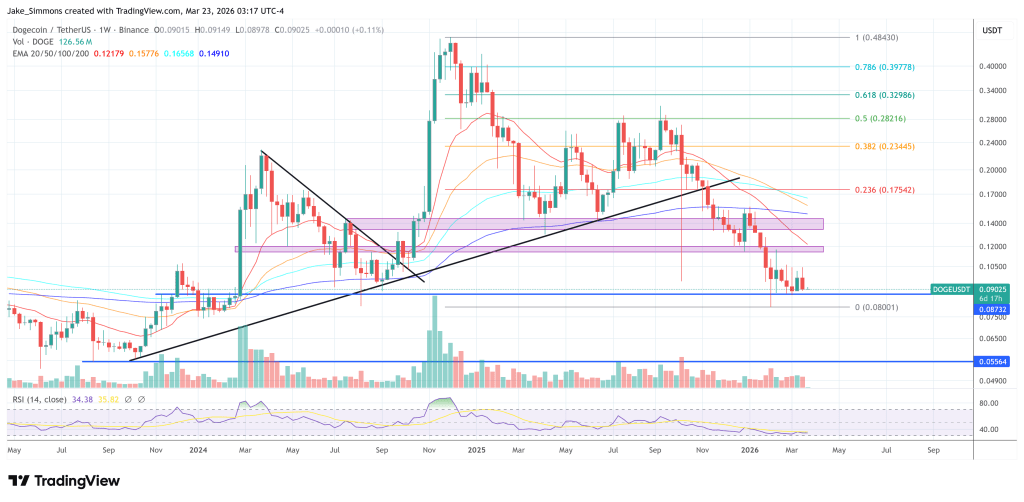
DOGE hovers above key support area, 1-week chart | Source: DOGEUSDT on TradingView.com

Domande pertinenti

QWhat is the start date for Qubic's Dogecoin mining initiative and what is the broader goal of this strategy?

AQubic will begin its Dogecoin push on April 1. The broader goal is to demonstrate that external proof-of-work can be absorbed into a decentralized compute network to strengthen Qubic's own token economics.

QHow does the Qubic network validate Dogecoin shares, and what is the threshold for validation?

ADogecoin shares are validated by Oracle Machines, which are independent computors spread across the network. Validation requires agreement from 451 out of 676 computors to meet the Byzantine fault tolerance threshold.

QWhat will happen to the Dogecoin (DOGE) mined through the Qubic network, and how does this relate to QUBIC tokens?

AMined DOGE will be sold to buy QUBIC on the open market. Part of the purchased QUBIC will be recycled into mining incentives, and the rest will be burned to make QUBIC deflationary.

QHow does Qubic's approach to Dogecoin mining differ from its previous campaign against Monero?

AUnlike the Monero campaign, which alternated workloads, Dogecoin mining with ASICs can run in parallel with Qubic's CPU- and GPU-based AI training, allowing both to contribute without displacing each other.

QWhat was the outcome of Qubic's Monero campaign, and how did independent analyses view it?

AQubic initially claimed a 51% network takeover, but independent analyses later placed its effective hashrate share at 28% to 35%, leading to it being rebranded as a '34% attack' rather than a majority control.

Letture associate

Now the Greatest Regret Is to My Family: Crypto Experts Took a Stumble in the Stock Market

Summary: This article examines the significant losses recently suffered by cryptocurrency traders and influencers who ventured into the stock market, specifically by heavily investing in AI-related and semiconductor storage stocks. The narrative centers on the dramatic reversal in the Korean and US equity markets in late July, with stocks like SK Hynix and related leveraged ETFs experiencing historic plunges, erasing massive gains. The analysis highlights several key factors behind the "flip." Traders, accustomed to crypto's high volatility and frustrated by a stagnant market, chased the apparent momentum in AI-themed equities. Many made fatal mistakes: applying high-leverage strategies common in crypto (e.g., 2x ETFs, on-chain perpetual contracts) to stocks, and failing to understand the distinct rules of different stock markets (like Korean pre-market trading). This led to widespread liquidations, especially when a thin Korean pre-market trade triggered a cascading flash crash on a decentralized exchange. Post-crash reflections from prominent figures reveal deep regret and self-criticism. They acknowledge misjudging their expertise, overestimating their edge against sophisticated institutional players, and the dangers of leverage. The article concludes that while such setbacks are part of trading, surviving long-term requires recognizing one's limitations and the inherent risks of cross-market strategies.

marsbit55 min fa

Now the Greatest Regret Is to My Family: Crypto Experts Took a Stumble in the Stock Market

marsbit55 min fa

US Senate Makes Important Amendments to "Conflict of Interest" Section of Cryptocurrency Bill

The U.S. Senate has taken a key step regarding the CLARITY Act, which could shape the future of the U.S. crypto market. On July 29, Senators Tom Tillis and Ruben Gallego finalized amendments to the bill's "conflict of interest" rules, one of its most contentious aspects. The bipartisan bill aims to tighten restrictions on high-level federal officials' ties to digital assets. The new text, crafted as an alternative to a White House-endorsed ethics code, is expected to impose stricter rules limiting officials' ability to issue or directly participate in digital asset projects. However, with Congress entering an August recess and the revised text not yet reviewed by much of the Senate, the bill's timeline is uncertain. Senate Majority Leader John Thune indicated a procedural vote could occur between July 29 and August 1 but expressed doubt the full bill could pass before the break. The House-approved CLARITY Act, passed in July 2025, has been under Senate negotiation for over a year. Key goals of the CLARITY Act include clarifying jurisdictional boundaries between the SEC and CFTC, setting rules for digital commodity spot markets, and addressing topics like stablecoin yields, DeFi, and illicit financing. The stablecoin yield provisions could significantly impact U.S.-based DeFi protocols, exchanges, and issuers, affecting their global competitiveness. The outcome is being closely watched by both the U.S. and global digital asset markets.

cryptonews.ru1 h fa

US Senate Makes Important Amendments to "Conflict of Interest" Section of Cryptocurrency Bill

cryptonews.ru1 h fa

Pavel Durov Designated as a Terrorist in Russia. What Does This Mean for Telegram Users?

Pavel Durov, the founder of Telegram, has been added to Russia's list of terrorists and extremists by Rosfinmonitoring, as published on July 30. The entry includes his name and date of birth. The designation follows an announcement by the Russian Federal Security Service (FSB) on July 29, which charged Durov with aiding terrorist activity. The FSB alleges that a Telegram dating bot named "DaiVinchik" was used to recruit 46 individuals for attacks on police and arson, orchestrated by Ukrainian special services. The FSB also accuses Telegram's administration of failing to remove channels and bots used by Ukrainian intelligence and extremist groups. Durov is reportedly subject to an international arrest warrant. Inclusion on the Rosfinmonitoring list leads to significant restrictions: the freezing of Durov's bank accounts and assets, severe limitations on financial transactions, and a ban on election participation, media interaction, and event organization. Transfers to his accounts may be considered terrorism financing. For ordinary Russian Telegram users, purchasing Telegram Premium is not classified as financing terrorism, according to an IT expert. General use of the messenger—messaging, managing channels—does not automatically make a user a participant in extremist activity. There has been no official decision to ban Telegram itself. It is noted that French authorities are also investigating Durov over allegations of inadequate measures against criminal activity on the platform and insufficient cooperation with law enforcement. Durov denies all charges.

cryptonews.ru1 h fa

Pavel Durov Designated as a Terrorist in Russia. What Does This Mean for Telegram Users?

cryptonews.ru1 h fa

Trading

Spot
活动图片