Qubic Sets April 1 Start Date For Dogecoin Attack

bitcoinistPubblicato 2026-03-23Pubblicato ultima volta 2026-03-23

Introduzione

Qubic has announced it will launch its Dogecoin mining initiative on April 1, 2026, as part of a broader strategy to integrate external proof-of-work into its decentralized compute network. The project aims to use Dogecoin ASIC mining to strengthen QUBIC tokenomics by selling mined DOGE to buy and burn QUBIC, making it deflationary. The effort also serves as a real-world stress test for Qubic’s Oracle Machines, which validate mining shares through a Byzantine fault-tolerant system. This follows Qubic’s earlier controversial campaign against Monero, which was later reassessed as a 34% attack rather than a 51% takeover. Unlike the Monero operation, Dogecoin mining will run concurrently with Qubic’s AI training workloads, without displacing them.

Qubic says it will begin its Dogecoin push on April 1, marking the next phase of a mining strategy that first drew attention through its campaign against Monero. The big question is whether Qubic can turn Dogecoin mining into a live demonstration of its broader thesis: that external proof-of-work can be absorbed into a decentralized compute network and used to strengthen Qubic’s own token economics.

In a series of posts over the weekend, Qubic framed the rollout as both a product launch and a stress test. “Every Dogecoin share mined through the Qubic network gets validated by Oracle Machines: independent computors spread across the network who each verify the share separately. Up to 13 oracle commits per transaction. If the result passes the quorum’s Byzantine fault tolerance threshold (agreement from 451 of 676 computors), it’s validated on-chain.”

Qubic To Launch Dogecoin Mining Offensive On April 1

The team added that Oracle Machines went live on mainnet on February 11 and described Dogecoin mining as “the first real-world external use case built on top of this system.” Those claims line up with Qubic’s March technical updates, which said Dogecoin mining is on track for an April 1 mainnet launch and positioned it as a real-world stress test for the network’s outsourced-computing stack.

Dogecoin ASICs will be able to mine Qubic and receive higher rewards, while mined DOGE will be sold to buy QUBIC on the open market. Part of that purchased supply, it said, would be recycled into mining incentives, while “the rest will be burned,” with the explicit goal of making QUBIC deflationary. Qubic’s official Dogecoin mining explainer similarly says the community is still finalizing how mining revenue will be split between ASIC miners, computors, and broader network incentives.

That makes the April 1 launch more than a simple mining integration. Qubic has been arguing for months that Dogecoin changes its operating model because ASIC-based Scrypt mining can run in parallel with the network’s CPU- and GPU-based AI training, rather than alternating between workloads as it previously did with Monero.

“ASIC miners handle Dogecoin. CPUs and GPUs continue training Aigarth. Both contribute to the network. Neither displaces the other,” Qubic wrote in its March 3 explainer. “The same validation framework can serve price feeds, cross-chain data, and any external information that smart contracts need to act on.”

The backdrop is Qubic’s much more controversial Monero campaign. In August 2025, the project published a post titled “Qubic Performs 51% Monero Network Takeover Demonstration,” claiming it had reached majority hashrate and reorganized the chain. But that version did not hold up cleanly under later scrutiny.

Later independent analyses placed Qubic’s effective share closer to 28% to 35%. Even Sergey Ivancheglo ultimately conceded the operation “should be rebranded into ‘34% attack,’” a nod to the fact that the maneuver looked more like selfish mining than outright majority control.

Dogecoin was not a sudden pivot. By mid-August 2025, after the Monero episode, Qubic’s community had already chosen Dogecoin as its next target for “the following mining season,” with Ivancheglo indicating the transition would take months of development. Qubic’s January and March 2026 updates show that timeline now converging on launch: planning began in January, testing advanced through March, and the dispatcher is already live for test tasks.

At press time, DOGE traded at $0.09.
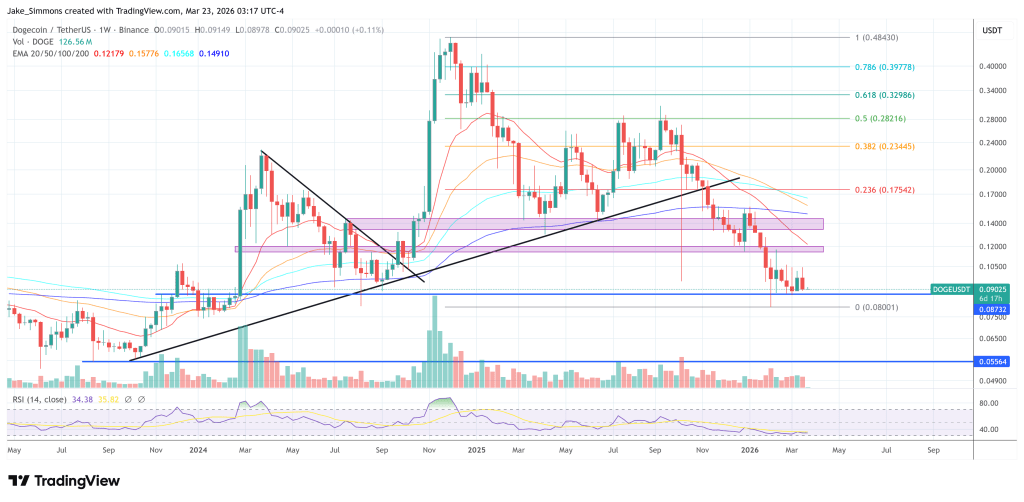
DOGE hovers above key support area, 1-week chart | Source: DOGEUSDT on TradingView.com

Domande pertinenti

QWhat is the start date for Qubic's Dogecoin mining initiative and what is the broader goal of this strategy?

AQubic will begin its Dogecoin push on April 1. The broader goal is to demonstrate that external proof-of-work can be absorbed into a decentralized compute network to strengthen Qubic's own token economics.

QHow does the Qubic network validate Dogecoin shares, and what is the threshold for validation?

ADogecoin shares are validated by Oracle Machines, which are independent computors spread across the network. Validation requires agreement from 451 out of 676 computors to meet the Byzantine fault tolerance threshold.

QWhat will happen to the Dogecoin (DOGE) mined through the Qubic network, and how does this relate to QUBIC tokens?

AMined DOGE will be sold to buy QUBIC on the open market. Part of the purchased QUBIC will be recycled into mining incentives, and the rest will be burned to make QUBIC deflationary.

QHow does Qubic's approach to Dogecoin mining differ from its previous campaign against Monero?

AUnlike the Monero campaign, which alternated workloads, Dogecoin mining with ASICs can run in parallel with Qubic's CPU- and GPU-based AI training, allowing both to contribute without displacing each other.

QWhat was the outcome of Qubic's Monero campaign, and how did independent analyses view it?

AQubic initially claimed a 51% network takeover, but independent analyses later placed its effective hashrate share at 28% to 35%, leading to it being rebranded as a '34% attack' rather than a majority control.

Letture associate

Polymarket's "2028 Presidential Election" Volume King Is... LeBron James???

An article from Odaily Planet Daily, authored by Azuma, discusses a peculiar phenomenon observed on the prediction market platform Polymarket regarding the "2028 US Presidential Election" event. Despite having a real-time probability of less than 1%, unlikely candidates such as NBA star LeBron James (with $48.41 million in trading volume), celebrity Kim Kardashian ($33.84 million), and even ineligible figures like Elon Musk ($23.14 million) and New York City Mayor Zohran Mamdani ($18.39 million) account for approximately 70% of the total trading volume. In contrast, high-probability candidates like Vice President JD Vance ($10.58 million), California Governor Gavin Newsom ($15.71 million), and Secretary of State Marco Rubio ($9.32 million) have significantly lower trading activity. The article explains that this counterintuitive trend is not driven by irrational speculation but by rational strategies. Polymarket offers a 4% annualized holding reward for certain markets, including the 2028 election, to maintain long-term pricing accuracy. This yield exceeds the current 5-year US Treasury rate (3.98%), attracting large investors ("whales") to hold "NO" shares on low-probability candidates for risk-free returns. Additionally, some users utilize a platform feature that allows converting a set of "NO" shares into corresponding "YES" shares for better liquidity or pricing efficiency, rather than directly buying "YES" shares for their preferred candidates. Thus, the seemingly absurd trading activity is strategically motivated.

marsbit44 min fa

Polymarket's "2028 Presidential Election" Volume King Is... LeBron James???

marsbit44 min fa

Dialogue with ViaBTC CEO Yang Haipo: Is the Essence of Blockchain a Libertarian Experiment?

"ViaBTC CEO Yang Haipo: Blockchain as a Hardcore Libertarian Experiment" In a deep-dive interview, ViaBTC CEO Yang Haipo reframes the essence of blockchain, arguing it is not merely a new technology or infrastructure but a hardcore libertarian experiment. This experiment, born from the 2008 financial crisis and decades of cypherpunk ideology, tests a fundamental question: to what extent can freedom and self-organization exist without centralized trust? The discussion highlights the experiment's verified outcomes. On one hand, it has proven its core value of censorship resistance, providing critical financial lifelines for entities like WikiLeaks and individuals in hyperinflationary or sanctioned countries via tools like stablecoins. However, Yang points out a key paradox: the most successful product, USDT, is itself a centralized compromise, showing users prioritize a less-controlled pipeline over pure decentralization. On the other hand, the experiment has exposed the severe costs of this freedom—a "dark forest" without safeguards. Events like the collapses of LUNA, Celsius, and FTX, resulting in massive wealth destruction and prison sentences for founders, underscore the system's fragility and the inherent risks of an unregulated environment. Yang observes that despite decentralized protocols, human nature inevitably recreates centralized power structures, speculative frenzies, and narrative-driven cycles (from ICOs to Meme coins), where emotion and belonging often trump technological substance. Looking forward, he believes blockchain's future is significant but niche. Its real value lies in serving specific, real-world needs for financial sovereignty and bypassing traditional controls, not as a universal infrastructure replacing all centralized systems. For the average participant, Yang's crucial advice is to cultivate independent judgment. True freedom is not holding a crypto wallet, but possessing a mind resilient to groupthink and narrative hype in a high-risk, often irrational market.

marsbit58 min fa

Dialogue with ViaBTC CEO Yang Haipo: Is the Essence of Blockchain a Libertarian Experiment?

marsbit58 min fa

Trading

Spot
Futures
活动图片