Qubic Says Dogecoin Mining Build Is Underway, Revives 51% Attack Fears

bitcoinistPubblicato 2026-01-23Pubblicato ultima volta 2026-01-23

Introduzione

Qubic has announced the development of a Dogecoin mining integration after a community vote selected DOGE. This move transitions the project from its previous "attention" narrative around Monero into implementation, raising renewed concerns about 51% attacks. Qubic emphasized that integrating ASIC hardware into its useful Proof-of-Work (uPoW) model requires significant engineering and protocol work, but could bring scale by incorporating Dogecoin's large mining economy. The announcement revisits security debates sparked in August 2025 when Qubic claimed a Monero "takeover demonstration" with over 51% hashrate dominance, though subsequent research found its control peaked at 23–34%. Unlike Monero's CPU-based mining, Dogecoin uses Scrypt and has merged mining with Litecoin, making a brute-force 51% attack economically challenging. Research firm 21Shares estimated it would cost billions in hardware and millions daily in electricity. A more plausible risk is Qubic incentivizing existing Scrypt miners to redirect hashpower through its system—a "vampire mining" approach.

Qubic says it is now building a Dogecoin mining integration, a step that moves the project’s post-Monero “attention” narrative into an implementation phase and reopens a familiar set of security questions around majority-hashrate risk.

In an X post shared Thursday, Qubic wrote: “The community didn’t hesitate. The vote was decisive: DOGE won with 301 votes. This isn’t a plug-and-play upgrade. Integrating ASIC hardware into uPoW requires real engineering, deep protocol work, and time to do it right. But the upside is significant. DOGE represents one of the largest and most established mining economies in crypto. Bringing it into Qubic’s useful Proof-of-Work model extends uPoW beyond theory, into scale. [...] Development is underway. This is just the beginning of what is to come.”

Could Dogecoin Suffer A 51% Attack?

The announcement lands with baggage. In August 2025, Qubic ran what it publicly described as a Monero “takeover demonstration,” claiming it had achieved “over 51% hashrate dominance” during parts of the experiment and reporting a brief chain disruption that included a six-block reorganization and orphaned blocks.
That episode became a lightning rod for the broader PoW security debate: how quickly external incentives can concentrate hashpower, and how markets react when “51%” enters the conversation.

Subsequent research challenged the strongest interpretation of those claims. A December 2025 paper reconstructing Qubic-attributed activity on Monero describes the operation as an advertised “selfish mining campaign,” finding Qubic’s hashrate share rising into the 23–34% range in detected intervals, while “sustained 51% control is never observed.”

Dogecoin’s mining economy is structurally unlike Monero’s CPU-oriented RandomX landscape. Dogecoin uses Scrypt and has, since 2014, supported merged mining alongside Litecoin, an architecture that has historically helped bolster its security budget by tapping into a broader Scrypt ASIC miner base.

That hardware reality is central to Qubic’s own messaging. The project said “integrating ASIC hardware into uPoW requires real engineering, deep protocol work, and time to do it right,” explicitly acknowledging that this is not a simple pool launch.

It is also where most of the immediate 51% attack fears run into friction. In an August 2025 research note, published when Qubic first began floating Dogecoin as the “next” network after Monero, 21Shares argued that a brute-force Dogecoin majority would be economically prohibitive, estimating that Qubic would need to match and then exceed roughly 2.78 PH/s, implying about $2.85 billion in hardware plus roughly $2.5 million per day in electricity (before logistics).

The more plausible risk vector, if any, is not Qubic buying its way to majority hashrate, but whether it can engineer incentives and integrations that convince existing Scrypt ASIC operators to route meaningful hashpower through a Qubic-mediated setup, an approach 21Shares characterized as “vampire mining.”

At press time, DOGE traded at $0.12521.
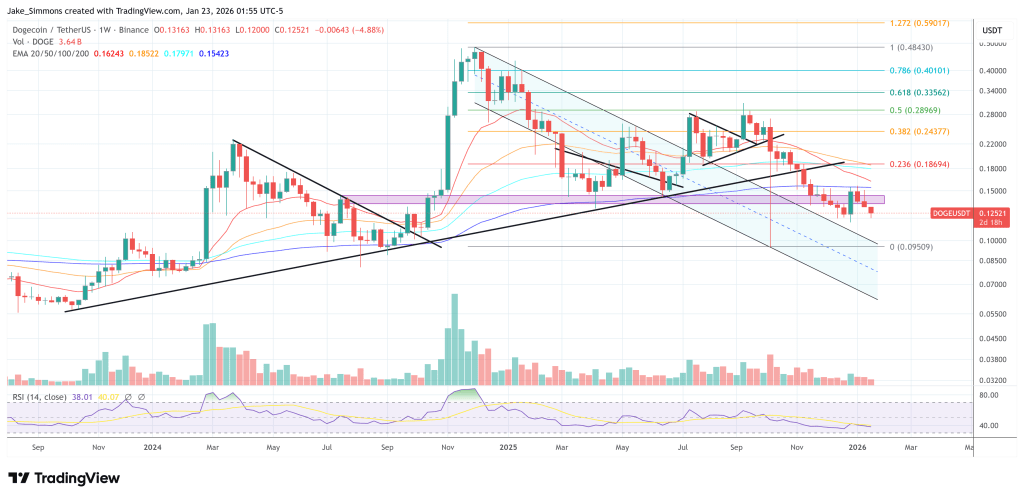
DOGE price, 1-week chart | Source: DOGEUSDT on TradingView.com

Domande pertinenti

QWhat is Qubic currently building and which cryptocurrency does it involve?

AQubic is currently building a Dogecoin mining integration.

QWhat security concern is reignited by Qubic's announcement of Dogecoin mining integration?

AThe announcement reignites fears of a potential 51% attack on the Dogecoin network.

QWhat was the outcome of Qubic's previous 'takeover demonstration' on the Monero network according to subsequent research?

ASubsequent research found that Qubic's hashrate share on Monero reached 23-34% in detected intervals, but sustained 51% control was never observed, challenging the strongest claims of the demonstration.

QWhy does 21Shares argue that a brute-force 51% attack on Dogecoin would be economically prohibitive for Qubic?

A21Shares argued it would be economically prohibitive because Qubic would need to acquire roughly $2.85 billion in hardware and spend about $2.5 million per day on electricity to match the required hashrate.

QWhat is the more plausible risk vector for a Dogecoin 51% attack, as opposed to a brute-force approach?

AThe more plausible risk vector is not a brute-force purchase of hardware, but rather Qubic engineering incentives to convince existing Scrypt ASIC operators to route their hashpower through a Qubic-mediated setup, an approach termed 'vampire mining'.

Letture associate

While Everyone Says NFTs Are 'Dead', the Art World is Quietly Completing an 'On-Chain Renaissance'

While many declare NFTs "dead" and dismiss them as overhyped JPEGs, a significant institutional shift is quietly underway within the art world, signaling a "on-chain renaissance." Traditional art, a ~$60B market, is stagnant, aging, and highly concentrated, facing a massive $80 trillion generational wealth transfer to digital-native heirs. Contrary to the narrative, leading institutions have been building infrastructure for digital and on-chain art. Major museums like MoMA, the Centre Pompidou, LACMA, and the Guggenheim have acquired seminal NFT works into their permanent collections. Top galleries like Pace, Gagosian, and Hauser & Wirth have launched NFT platforms or accepted crypto, with Pace giving a solo show to generative artist Tyler Hobbs. Auction houses Sotheby's and Christie's operate dedicated on-chain sales platforms. This follows a historical pattern where every major art movement—from Impressionism to Pop Art—was initially mocked before institutional acceptance. NFT art, only 7-12 years old, is progressing faster. Auction data shows resilience, with works by Beeple ($69.3M), Pak (~$91M), and Dmitri Cherniak ($6.2M in a bear market) achieving high prices. A new cohort of collectors (e.g., FlamingoDAO, PleasrDAO) and "Medici" figures like Cozomo de' Medici are accumulating foundational works. The core argument is that NFTs represent not a speculative asset class but a new ownership system for digital culture, solving provenance issues through immutable, timestamped blockchain records. The medium has survived the speculative crash and is being institutionalized. The bet isn't on short-term price rallies but on the long-term cultural significance of on-chain art as the defining medium for the next generation of collectors.

marsbit9 min fa

While Everyone Says NFTs Are 'Dead', the Art World is Quietly Completing an 'On-Chain Renaissance'

marsbit9 min fa

Jensen Huang's Message to Graduates: AI Won't Replace You, But Those Who Excel at Using AI Will

NVIDIA CEO Jensen Huang, addressing 2026 graduates at Carnegie Mellon University, emphasized that AI will not replace people, but those who leverage AI effectively will have an advantage. He delivered this message during a commencement speech where he also received an honorary doctorate, his seventh. Huang reflected on his personal journey as an immigrant, starting from humble beginnings as a dishwasher to co-founding NVIDIA. He shared early struggles, including a near-bankruptcy moment saved by honesty with Sega, highlighting resilience and learning from failure. He positioned the current era as the dawn of the AI revolution, a shift as significant as past computing waves. Huang explained that AI is redefining computing from human-written software to machine learning, creating a new industry focused on manufacturing intelligence. While acknowledging fears about job displacement, he argued that AI amplifies human capabilities rather than replaces human purpose. Tasks may be automated, but the core meaning of professions remains. Huang urged graduates to embrace this transformative time with responsibility and optimism. He stated that AI should democratize technology, bridging gaps and enabling broader participation in creation and problem-solving. His final advice was to actively engage with the opportunity: "So run, don’t walk," and to put their hearts into their work.

marsbit16 min fa

Jensen Huang's Message to Graduates: AI Won't Replace You, But Those Who Excel at Using AI Will

marsbit16 min fa

Three Scenarios for BTC's Future Direction and a Duel Between Two Strong Forces | Special Invited Analysis

**Title: Three Scenarios for BTC's Future Trajectory and a Key Duel | Invited Analysis** The market remains at a critical juncture. Over the past week, Bitcoin (BTC) consolidated broadly between $79,500 and $80,600, validating previous technical analysis. The current focus is on whether this marks the start of a new uptrend or a pause within a larger correction. **BTC Multi-Cycle Analysis & Three Possible Scenarios** BTC's daily chart structure, following its peak at $126,200 in October 2025, presents three primary technical scenarios based on Elliott Wave theory: 1. **Bullish Scenario (End of Correction):** The corrective A-B-C wave from $126,200 ended at the $60,000 low in February 2026. The current price action is the start of a major Wave I uptrend. A subsequent Wave II pullback would not break below $60,000. 2. **Bearish Scenario 1 (Complex Correction):** The correction is unfolding as an A-B-C-D-E pattern. The current move from $60,000 is a D-wave rally. After its completion, a final E-wave decline could potentially breach the $60,000 level. 3. **Bearish Scenario 2 (Larger Correction):** The entire move down from $126,200 to $60,000 was a large A-wave. The current rally is a B-wave correction within a larger A-B-C structure, to be followed by a C-wave decline below $60,000. *Analysis suggests Scenario 2 is less probable due to time disproportions between waves. The battle is effectively between the Bullish Scenario (1) and Bearish Scenario (3).* **Key BTC Levels & Weekly Strategy** On the 4-hour chart, BTC trades above a crucial consolidation zone ("Central Pivot C"). * **Key Resistance:** $83,500-$84,500; $89,000-$90,500. * **Key Support:** $78,500-$79,500 (pivot upper bound); $73,500-$75,000; $69,500-$70,500. **Weekly Outlook:** The market direction hinges on BTC's ability to hold above or break below the $78,500-$79,500 support zone. * **Mid-term Strategy:** Neutral/Wait-and-see stance due to unclear direction. * **Short-term Tactics:** Two contingency plans using 30% max capital: * **Plan A (Bullish):** Look for long entries if price holds above $78,500-$79,500 with confirming signals. Initial stop-loss below $78,500. * **Plan B (Bearish):** Consider short positions if price breaks below $73,500-$75,000 with confirming signals. Initial stop-loss above $76,500. **HYPE Analysis & Strategy** HYPE's daily chart shows a seven-segment structure from its January low of $20.46, forming a "rising pivot" zone. * **Key Level to Watch:** $45.76 (previous high). A break above would confirm the bullish structure remains intact. * **Short-term Strategy:** Focus on pivot zone boundaries ($38.41 upper, $34.44 lower). * **Long:** Consider on support near $38.41 with bullish confirmation signals. * **Short:** Consider on a break below $34.44 with bearish confirmation signals. * Position size must be below 30% with strict stop-loss discipline. **Risk Management Reminder:** Always set an initial stop-loss upon entry. Move stop-loss to breakeven at +1% profit, then trail it upwards to lock in profits dynamically. All views are based on technical analysis for informational purposes only and do not constitute investment advice. The market is inherently risky.

Odaily星球日报25 min fa

Three Scenarios for BTC's Future Direction and a Duel Between Two Strong Forces | Special Invited Analysis

Odaily星球日报25 min fa

Sequoia Interview with Hassabis: Information is the Essence of the Universe, AI Will Open Up Entirely New Scientific Branches

Demis Hassabis, co-founder and CEO of Google DeepMind and Nobel laureate, discusses the path to AGI and its profound implications in a Sequoia Capital interview. He outlines his lifelong dedication to AI, tracing his journey from game development (e.g., *Theme Park*)—a perfect AI testing ground—to neuroscience and finally founding DeepMind in 2009. He emphasizes the critical lesson of being "5 years, not 50 years, ahead of time" for successful entrepreneurship. Hassabis reiterates DeepMind's two-step mission: first, solve intelligence by building AGI; second, use AGI to tackle other complex problems. He highlights the transformative potential of "AI for Science," particularly in biology where tools like AlphaFold have revolutionized protein folding. He envisions AI-powered simulations drastically shortening drug discovery from years to weeks and enabling personalized medicine. Furthermore, he predicts AI will spawn new scientific disciplines, such as an engineering science for understanding complex AI systems (mechanistic interpretability) and novel fields enabled by high-fidelity simulators for complex systems like economics. He posits a fundamental worldview where information, not just matter or energy, is the essence of the universe, making AI's information-processing core uniquely suited to understanding reality. He defends classical Turing machines as potentially sufficient for modeling complex phenomena, including quantum systems, as demonstrated by AlphaFold. On consciousness, Hassabis suggests first building AGI as a powerful tool, then using it to explore deep philosophical questions. He believes components like self-awareness and temporal continuity are necessary for consciousness but that defining it fully remains an open challenge. He predicts AGI could arrive around 2030 and, once achieved, would be used to probe the deepest questions of science and reality, much as envisioned in David Deutsch's *The Fabric of Reality*.

链捕手43 min fa

Sequoia Interview with Hassabis: Information is the Essence of the Universe, AI Will Open Up Entirely New Scientific Branches

链捕手43 min fa

Morgan Stanley 2026 Semiconductor Report: Buy Packaging, Buy Testing, Buy China Chips, Avoid Traditional Tracks

Morgan Stanley 2026 Semiconductor Report: Buy Packaging, Buy Testing, Buy Chinese Chips; Avoid Traditional Segments. The core theme is the shift in AI compute supply from NVIDIA dominance to a three-track system of GPU + ASIC + China-local chips. The key opportunity is capturing share in this expansion, while non-AI semiconductors face marginalization due to resource reallocation to AI. Key investment conclusions, in order of priority: 1. **Advanced Packaging (CoWoS/SoIC) - Highest Conviction**: TSMC is the primary beneficiary of explosive demand, driven by massive cloud capex. Its pricing power and AI revenue share are rising significantly. 2. **Test Equipment - Undervalued & High-Growth Certainty**: Chip complexity is causing test times to double generationally, structurally driving handler/socket/probe card demand. Companies like Hon Hai Precision (Foxconn), WinWay, and MPI offer compelling value. 3. **China AI Chips (GPU/ASIC) - Long-Term Irreversible Trend**: Export controls are accelerating domestic substitution. Companies like Cambricon, with firm customer orders and SMIC's 7nm capacity support, are positioned to benefit from lower TCO (30-60% vs NVIDIA) and growing local cloud demand. 4. **Avoid Non-AI Semiconductors (Consumer/Auto/Industrial)**: These segments face a weak, structurally hindered recovery due to AI's resource "crowding-out" effect on capacity and supply chains. 5. **Memory - Severe Internal Divergence**: Strongly favor HBM (Hynix primary beneficiary) and NOR Flash (Macronix). Be cautious on interpreting price rises in DDR4/NAND as true demand recovery. The report emphasizes a 2026-2027 time window, stating the AI capital expenditure cycle is far from over. Key macro variables include persistent export controls and AI's systemic "crowding-out" effect on traditional semiconductor supply chains.

marsbit1 h fa

Morgan Stanley 2026 Semiconductor Report: Buy Packaging, Buy Testing, Buy China Chips, Avoid Traditional Tracks

marsbit1 h fa

Trading

Spot
Futures
活动图片