Quarterly Loss of $12.4 Billion: Why Can’t It Stop Strategy from Frantically Buying Bitcoin?

比推Pubblicato 2026-02-06Pubblicato ultima volta 2026-02-06

Introduzione

MicroStrategy (now Strategy) reported a staggering net loss of $12.4 billion in Q4 2025, primarily due to the adoption of a new fair value accounting standard that required marking its holdings to market amid Bitcoin’s sharp decline to around $65,000. Despite the loss, the company aggressively expanded its Bitcoin position, purchasing an additional 41,002 BTC in January 2026, bringing its total holdings to 713,502 BTC — approximately 3.4% of Bitcoin’s total supply — with an average cost of $76,052 per coin. The firm’s core software business, though profitable with $123 million in Q4 revenue, was overshadowed by its Bitcoin-centric strategy. Strategy raised over $25.3 billion in capital during 2025, leveraging financial instruments to amplify its Bitcoin exposure. It maintains $2.25 billion in cash reserves to cover dividends and interest for 2.5 years. CEO Phong Le acknowledged risks, stating that if Bitcoin fell to $8,000, the company might need to restructure debt rather than sell BTC. The firm’s "Bitcoin flywheel" model relies on continuous capital raising and BTC appreciation, but compressed mNAV (1.07) and high-yield preferred shares (STRC, 11.25% dividend) reflect market skepticism. A prolonged downturn could trigger a negative feedback loop: falling BTC value → reduced ability to raise capital → potential forced BTC sales. Executive Chairman Michael Saylor emphasized long-term optimism, citing supportive U.S. policy and institutional adoption, while downplaying quan...

Author: KarenZ, Foresight News

Original Title: Ten-Billion-Dollar Loss, Strategy's Earnings Report Sounds Alarm! What Do Executives Say?


The current cryptocurrency market is deeply mired in a sharp correction vortex. As Bitcoin's price retreats to $60,000, market sentiment has rapidly turned to extreme panic.

Amid this turmoil, the Q4 2025 earnings report released by the world's largest corporate Bitcoin holder—Strategy (formerly MicroStrategy)—is undoubtedly adding fuel to the fire, pouring a bucket of ice-cold water on an already sluggish market: a net loss of $12.4 billion in a single quarter.

On the day of the earnings release, Strategy's stock price plummeted by approximately 17%. As of now, its stock price has fallen nearly 80% from the all-time high set in November 2024.

From a star company that once soared with its "Bitcoin Treasury Strategy" to now being mired in huge losses and seeing its stock price halved repeatedly, Strategy's situation is the most realistic缩影 of the current cryptocurrency market turmoil—on one hand, there are massive paper losses, and on the other, an almost obsessive hoarding of Bitcoin. With a series of分裂 data, this company is staging a high-stakes gamble betting on its future.

Core Data: Frenzied Accumulation Amid Huge Losses

The core contradiction in Strategy's Q4 2025 earnings report lies in the stark contrast between the record-high paper losses and the all-time high Bitcoin holdings.

1. Huge paper losses under fair value accounting: In Q4 2025, Strategy's operating loss reached a staggering $17.4 billion, with a net loss of $12.4 billion. This is mainly due to the new fair value accounting standard adopted by the company starting January 1, 2025. According to this standard, the company must re-evaluate all Bitcoin holdings at market price at the end of each quarter, and price fluctuations are directly included in the income statement. The continuous correction in Bitcoin's price has turned the shrinkage in holding value directly into paper losses, becoming the most直观 "bearish" factor in the earnings report.

2. The obsession with buying Bitcoin against the trend: Despite market volatility, Strategy is still buying frantically, purchasing 41,002 Bitcoins in a large transaction in January 2026. As of February 1, 2026, Strategy holds 713,502 Bitcoins, accounting for about 3.4% of the total Bitcoin supply, firmly securing its position as the world's largest corporate Bitcoin holder.

3. Super financing machine: In fiscal year 2025, Strategy raised a total of over $25.3 billion in capital, a figure that accounts for about 8% of the total U.S. equity financing for that year.

4. Special reserve for risk buffer: As of February 1, 2026, Strategy has $2.25 billion in USD reserves specifically to cover preferred stock dividends and debt interest payments for the next 2.5 years, attempting to alleviate market concerns about its cash flow pressure.
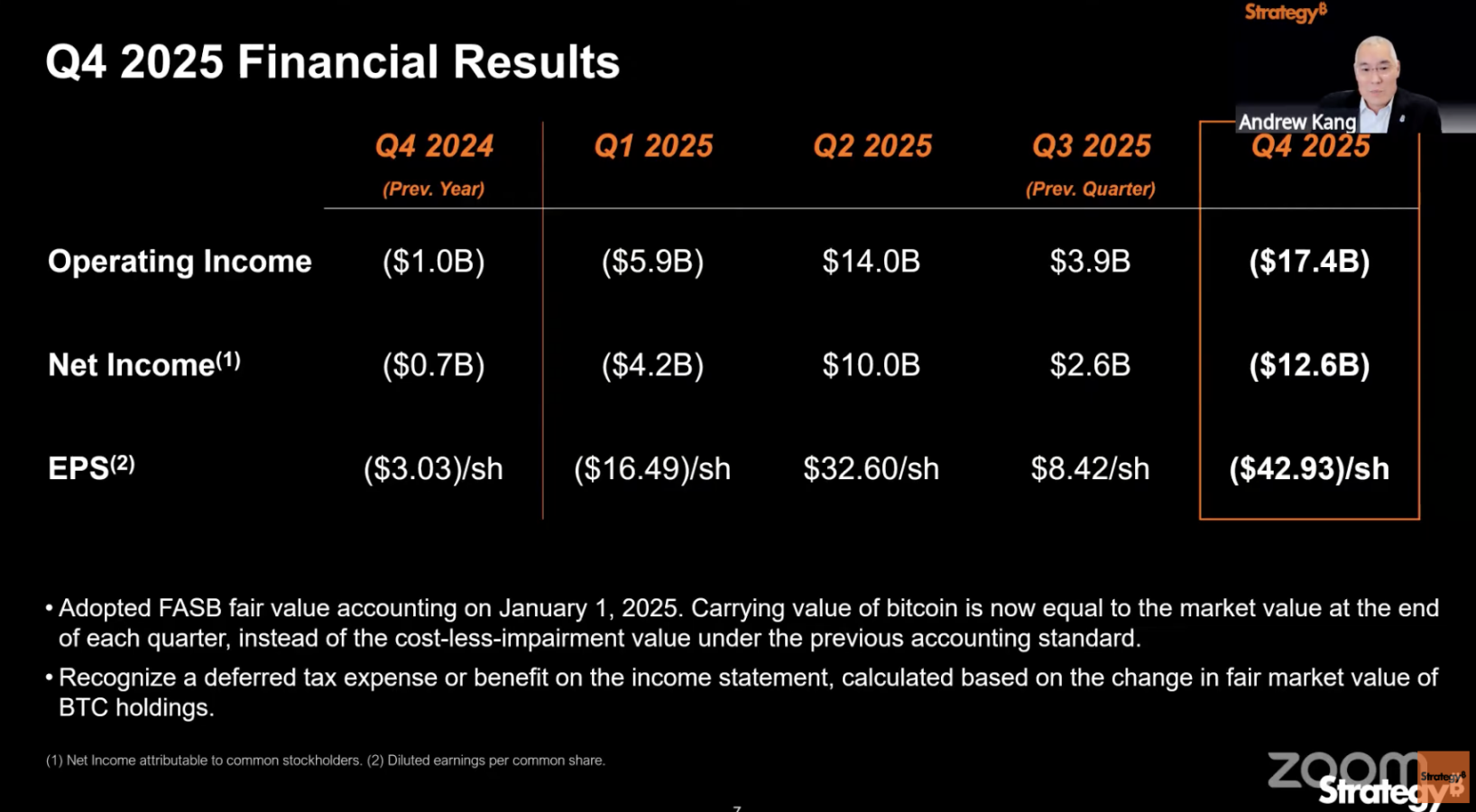
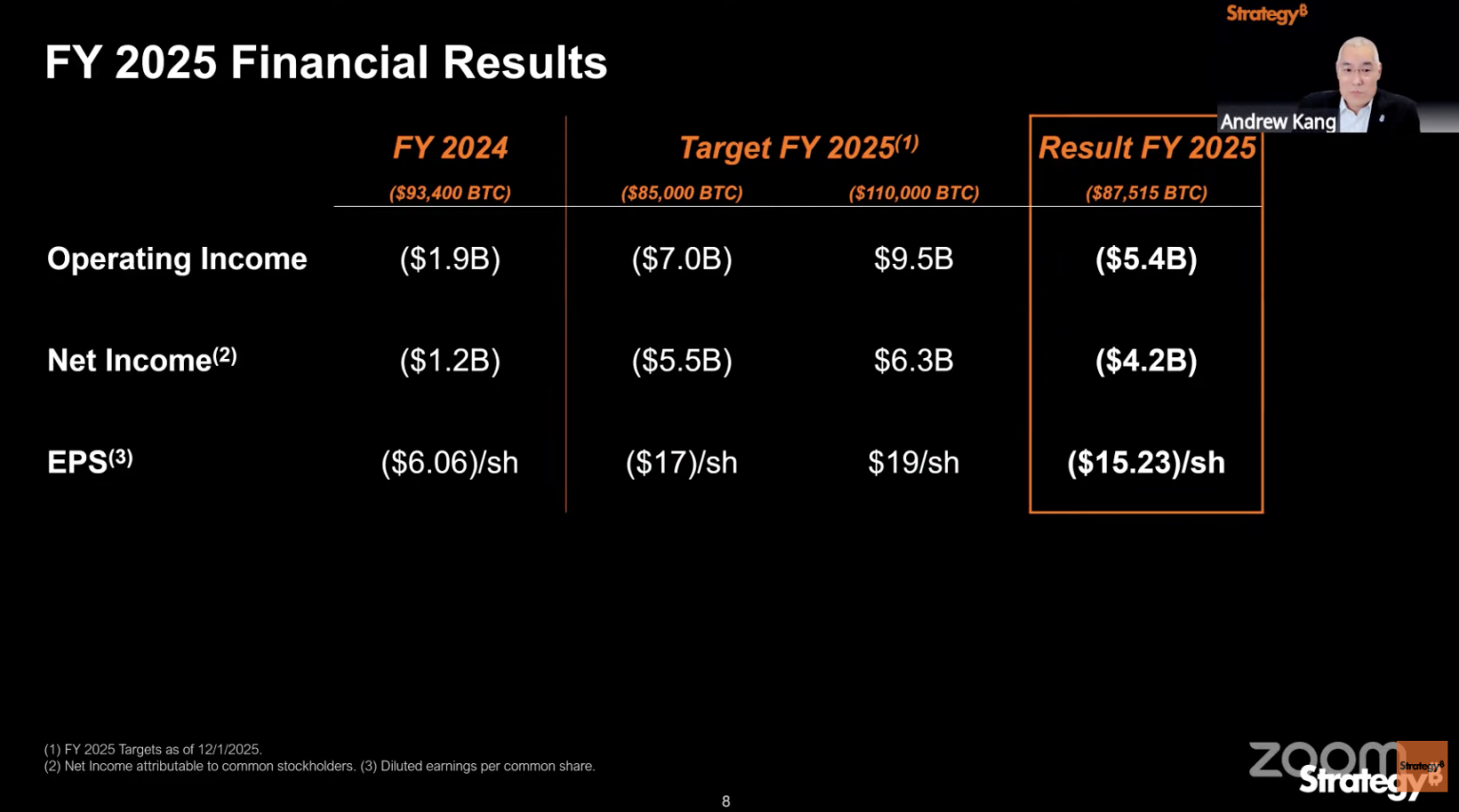
In terms of holding cost, Strategy's total original cost for holding Bitcoin is $54.26 billion, with an average cost per coin of $76,052. With the current price of Bitcoin at approximately $65,000, the company's Bitcoin holdings have an unrealized loss of over $7.8 billion.

Marginalized "Main Business" and Amplified "Leverage"

It is highly ironic that Strategy's traditional main business—enterprise analytics software—has been reduced to a nearly forgotten footnote in the earnings report. The scale and contribution of its business are worlds apart from the size of its Bitcoin strategy.

In Q4 2025, the company's software business maintained positive growth, but the data performance was relatively flat: total revenue was $123 million, up only 1.9% year-over-year; subscription service revenue was $51.8 million, up 62.1% year-over-year; overall gross profit for the quarter was $81.3 million, with a gross margin maintained at a high level of 66.1%.

From the data, it is clear that while the software business has stable profitability and high gross margins, its revenue scale is only in the hundreds of millions. Compared to the company's tens of billions in fundraising scale, tens of billions in Bitcoin holding costs, and over ten billion in quarterly losses, the marginal contribution of this main business is almost negligible.

For today's Strategy, the company's core resources and strategic focus have completely shifted towards Bitcoin. Strategy provides investors with a leveraged Bitcoin exposure through complex financial instruments such as stocks, bonds, and preferred shares. It has itself彻底 become a "shadow of Bitcoin," with its corporate development deeply tied to the price of Bitcoin—prospering together and falling together.

What Happens When Convertible Bonds Mature?

In the latest earnings call, Phong Le stated, "Strategy currently has $6 billion in net debt, and the current leverage ratio is around 13%, which is only half that of investment-grade companies and one-third that of high-yield companies. In an extreme scenario, if the Bitcoin price falls by 90% to $8,000, then our Bitcoin reserves would equal our net debt. At that point, we would be unable to use Bitcoin reserves to repay the convertible bonds and would consider restructuring, issuing additional shares, or issuing more debt."
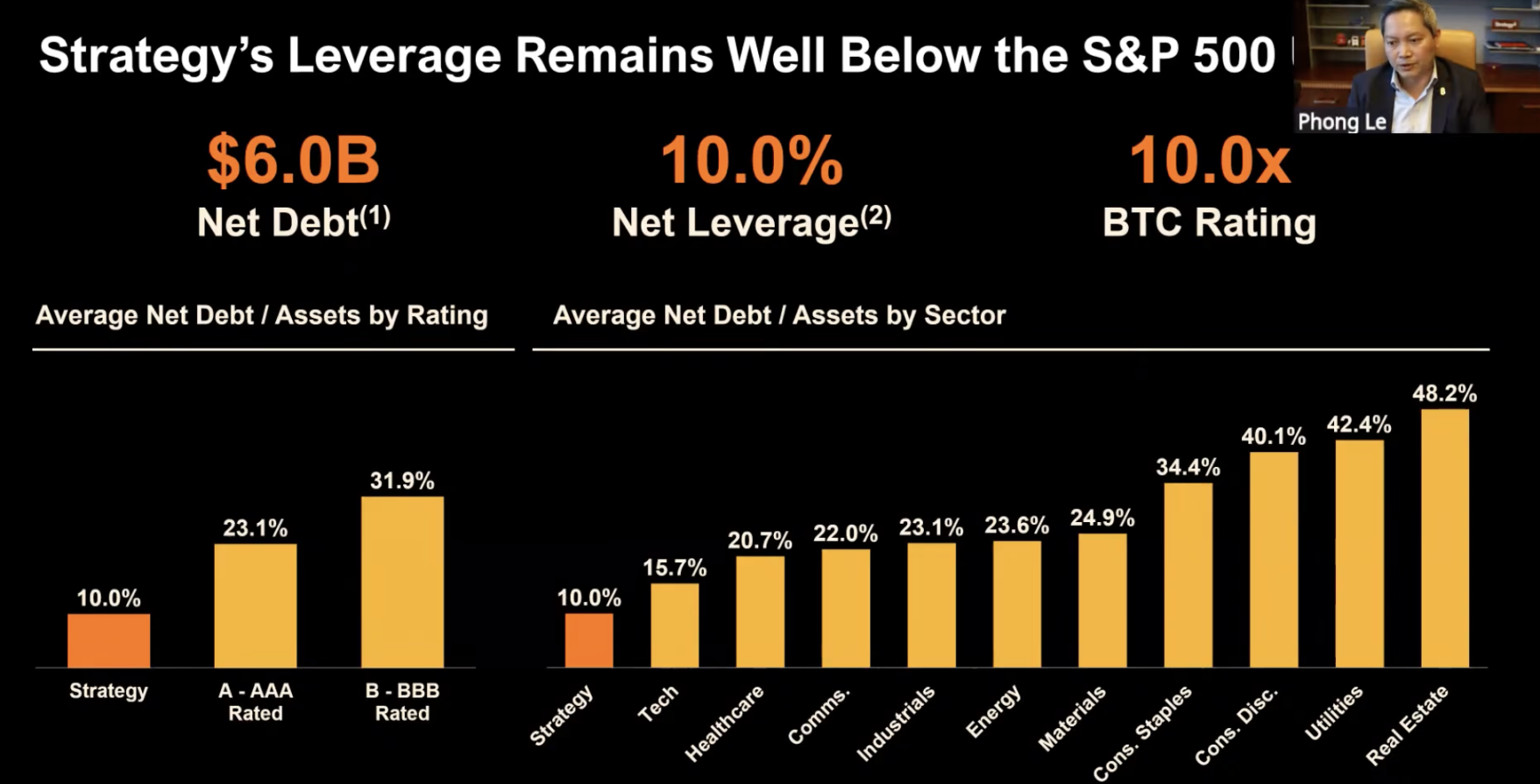
Additionally, Phong Le hopes the company will gradually achieve equityization. If equityization cannot be achieved by then, they will seek other ways to restructure the debt, aiming to sustainably reduce leverage, avoid selling Bitcoin, and continue the Bitcoin accumulation strategy.

When the "Flywheel" Loosens

Strategy's "Bitcoin flywheel" model is built on a very fragile assumption: that the Bitcoin price will spiral upward in the long term, and the capital market will always be willing to provide premium financing for the company. The two form a positive循环, driving the company's stock price and holding规模 to grow simultaneously.

However, when the Bitcoin price falls below its average holding cost ($76,000), the risks and paradoxes Strategy faces are also exposed.

STRC High Dividend Yield: High Return Corresponds to High Risk

The perpetual preferred stock STRC launched by Strategy currently has a dividend yield of 11.25%, and this yield has been continuously上调 since July 2025.
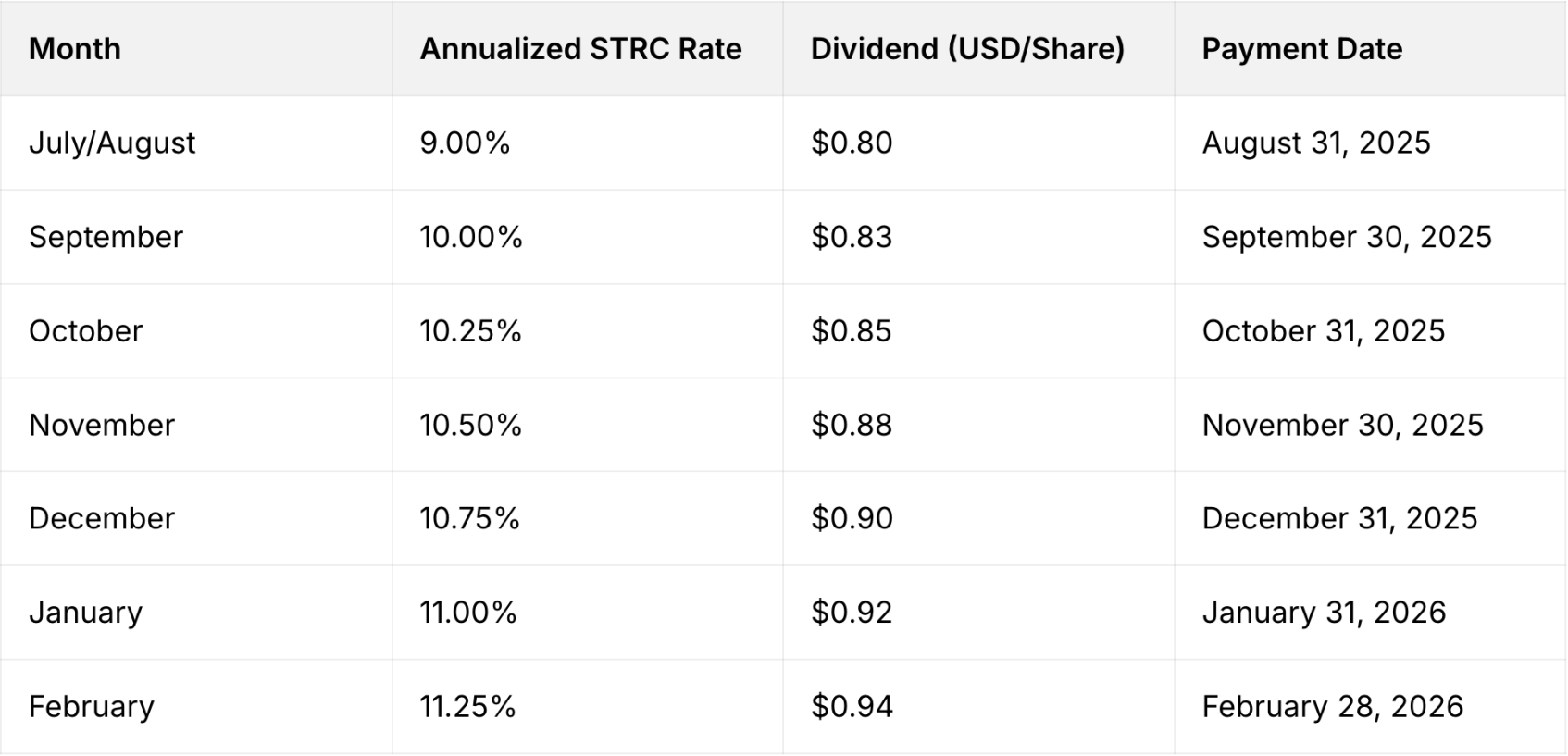
Strategy designed this variable mechanism to keep the STRC price as stable as possible around the $100 face value, reduce volatility, and position it as a "short-term high-yield credit" or a "high-yield savings account" alternative.

In the current low-interest-rate environment, an 11.25% nominal yield is indeed very attractive, especially for investors seeking high fixed income. But the basic logic of the capital market has never changed: high returns必然 come with high risks. The high dividend of STRC is backed by the huge uncertainty deeply tied to Strategy's Bitcoin strategy.

Strategy's core strategy is "Bitcoin leverage + financing expansion." Its solvency highly depends on: the long-term rise of the Bitcoin price, and continuously raising funds by issuing MSTR common stock, other preferred shares, or debt to buy more BTC.

If a prolonged Bitcoin bear market occurs, with mNAV持续低迷 or even at a discount, and equity financing becomes more difficult, the reserves could be quickly depleted. Although the company has established a $2.25 billion USD reserve as a buffer, this is merely buying a 2.5-year insurance policy for this high-stakes gamble.

The current market has already reflected some concerns: the STRC price is below the $100 face value, currently at $93.67.

mNAV Compressed to 1.07, Can the Financing Channel Remain Smooth?

The core motivation for Strategy to无限 issue shares to buy Bitcoin lies in its mNAV indicator, a key metric used to measure its stock valuation relative to its Bitcoin reserves. When mNAV > 1, it means the market gives Strategy a valuation higher than the value of its Bitcoin holdings (i.e., trading at a premium), and investors are willing to pay an additional premium for its "Bitcoin leverage strategy."

Currently, Strategy's mNAV has been compressed to 1.07. Once it falls below 1, the financing channel may be forced to close. At that point, Strategy may lose its ability to support the stock price and add positions,彻底 becoming a prisoner of Bitcoin price fluctuations.

Contrary to what was emphasized in the latest meeting, Strategy CEO Phong Le said in an interview with "What Bitcoin Done" in November 2025 that if the company's mNAV falls below 1 and financing options dry up, selling Bitcoin would be "mathematically" reasonable. But he clarified this would be a last resort, not a policy adjustment.

Negative Feedback Loop?

For Strategy, the most terrifying thing is not the current huge losses, but the potential触发 of a negative feedback loop, which is also the script that all crypto market players最不愿 face:

Bitcoin price falls → Company's net assets shrink → mNAV falls below 1, premium disappears → Unable to raise new funds through financing → Unable to pay high interest and dividends → Forced to sell Bitcoin to raise funds → Increased Bitcoin selling pressure, price falls further → Net assets shrink further......

Can Policy Benefits and Technical Commitments Restore Confidence?

In the earnings call, Michael Saylor did not focus solely on the short-term bearish news of the company's single-quarter loss. Instead, he used the comprehensive shift in U.S. policy and the accelerated adoption by the financial industry as the centerpiece to outline the long-term bullish blueprint for Bitcoin's development. At the same time, he addressed the market's biggest concerns about quantum technology risks and implementation plans to重塑 market confidence in the company's Bitcoin strategy.

Michael Saylor emphasized that Bitcoin's development is currently迎来 unprecedented policy and financial双重红利期. On the policy front, the U.S. government's attitude towards digital assets has completed a fundamental shift from suspicion to recognition. The President and 12 cabinet members have clearly expressed support for Bitcoin, and bipartisan consensus on digital asset regulation and adoption has made the U.S. a leading阵营 in global digital asset development.

On the financial front, Bitcoin's industry adoption has experienced explosive growth: large banks have纷纷 launched full-chain services for Bitcoin trading, credit, and custody; fintech companies continue to加码 Bitcoin布局. The dual entry of public markets and traditional financial institutions has continuously strengthened Bitcoin's financial attributes, with liquidity and recognition持续提升.

In response to the various FUD sentiments弥漫 in the market, Michael Saylor also gave direct responses, particularly focusing on quantum computing, a core technical concern: The commercial-level threat of quantum computing to Bitcoin will take at least 10 more years to materialize, and the Bitcoin community has the ability to achieve global consensus upgrades to meet future technical challenges.

Michael Saylor further stated that Strategy will proactively shoulder industry responsibility by launching a global Bitcoin security initiative. It will unite global resources in cybersecurity and cryptocurrency security to research and launch consensus solutions for quantum computing and emerging security threats, promoting the healthy and stable development of the entire cryptocurrency industry.

Summary

If the market continues to fall, the $17.4 billion quarterly operating loss and $12.4 billion net loss may only be the beginning of Strategy's困境.

The real test lies in whether faith can overcome gravity when market panic spreads, when the "premium" disappears, and when new funds dry up? For investors, the current Strategy may be an option contract with extremely high risk and extremely high odds: if they bet correctly, the Bitcoin price recovers, the flywheel restarts, and investors get returns; if they bet wrong, the negative feedback loop starts, the company falls into crisis, and investors face heavy losses.

The outcome of this high-stakes gamble betting on the company's future is still unknown, but Strategy has already sounded the alarm for the entire cryptocurrency industry—in a狂热 market sentiment,过度偏执的信仰 and不加节制的杠杆 may face the backlash of reality.


Twitter:https://twitter.com/BitpushNewsCN

Bitpush TG Discussion Group:https://t.me/BitPushCommunity

Bitpush TG Subscription: https://t.me/bitpush

Original link:https://www.bitpush.news/articles/7609741

Domande pertinenti

QWhy did Strategy (formerly MicroStrategy) report a net loss of $12.4 billion in Q4 2025, and what accounting change contributed to this?

AStrategy reported a net loss of $12.4 billion in Q4 2025 primarily due to the adoption of a new fair value accounting standard starting January 1, 2025. This standard requires the company to revalue all its Bitcoin holdings at market price at the end of each quarter, and any price decline is directly recorded as an impairment loss on the income statement. The significant drop in Bitcoin's price during the quarter led to this massive paper loss.

QDespite the huge loss, how many Bitcoins did Strategy purchase in January 2026, and what is its total holding as of February 1, 2026?

ADespite the loss, Strategy purchased 41,002 Bitcoins in January 2026. As of February 1, 2026, the company holds a total of 713,502 Bitcoins, which represents approximately 3.4% of the total Bitcoin supply, making it the largest corporate Bitcoin holder globally.

QWhat is the average cost per Bitcoin for Strategy's holdings, and what is the current unrealized loss given the Bitcoin price of ~$65,000?

AThe average cost per Bitcoin for Strategy's holdings is $76,052. With the current Bitcoin price at approximately $65,000, the company is facing an unrealized loss of over $7.8 billion on its Bitcoin portfolio.

QWhat is the mNAV metric, and why is it critical for Strategy's 'Bitcoin flywheel' strategy?

AmNAV (market NAV) is a key metric that measures Strategy's stock market valuation relative to the value of its Bitcoin holdings. An mNAV greater than 1 indicates the market is valuing the company at a premium to its underlying Bitcoin assets, which is crucial for its strategy. This premium allows Strategy to issue new shares at a favorable valuation to raise capital for further Bitcoin purchases, fueling its 'Bitcoin flywheel' of buying more Bitcoin with raised funds. If mNAV falls below 1, this primary funding channel could close, severely hampering its strategy.

QAccording to CEO Michael Saylor in the earnings call, what are the two main pillars of long-term optimism for Bitcoin that he highlighted to counter the negative quarterly results?

ACEO Michael Saylor pointed to unprecedented policy and financial sector adoption as the main pillars for long-term Bitcoin optimism. Policy-wise, he noted a fundamental shift in the U.S. government's stance from skepticism to support, with the President and 12 cabinet members endorsing Bitcoin and bipartisan consensus on digital asset regulation. Financially, he highlighted explosive growth in adoption, with major banks offering full-service Bitcoin trading, credit, and custody, and continued investment from fintech companies, strengthening Bitcoin's financial properties and liquidity.

Letture associate

$500 to Buy OpenAI Stock: Silicon Valley's Most Respectable Liquidity Invitation

Silicon Valley's largest venture capital platform, AngelList, has launched a new fund called USVC, allowing U.S. retail investors to buy into high-profile AI companies like OpenAI, Anthropic, and xAI with a minimum investment of $500—no accredited investor status required. Promoted by AngelList co-founder Naval Ravikant, the fund is framed as an opportunity for ordinary people to access high-growth private tech investments traditionally reserved for VCs. However, critics argue it functions more like an exit vehicle for early insiders. USVC acquires shares not through primary rounds but largely via secondary transactions—purchasing stakes from early investors, VC funds, and employees looking to cash out at peak valuations. With companies like xAI heavily weighted in the portfolio, the fund effectively channels retail money into providing liquidity for insiders who entered at much lower valuations. The fund’s structure raises concerns: shares are illiquid, with no secondary market, and buybacks are limited and discretionary. The actual annual fee reaches 3.61%, far above the advertised 1% management fee. This model parallels the "low float, high fully diluted valuation" strategy seen in crypto, where early investors profit by selling to latecomers at inflated prices. The timing—alongside similar moves by platforms like Robinhood—suggests that Silicon Valley’s sudden interest in retail inclusion may be less about democratizing access and more about securing exits for insiders.

marsbit16 min fa

$500 to Buy OpenAI Stock: Silicon Valley's Most Respectable Liquidity Invitation

marsbit16 min fa

Trading

Spot
Futures

Articoli Popolari

Cosa è BITCOIN

Comprendere HarryPotterObamaSonic10Inu (ERC-20) e la sua posizione nel mondo delle criptovalute Negli ultimi anni, il mercato delle criptovalute ha assistito a un aumento della popolarità delle meme coin, catturando l'interesse non solo dei trader, ma anche di coloro che cercano coinvolgimento comunitario e valore di intrattenimento. Tra questi token unici c'è HarryPotterObamaSonic10Inu (ERC-20), un progetto intrigante che mescola riferimenti culturali nel tessuto delle criptovalute. Questo articolo esplora gli aspetti chiave di HarryPotterObamaSonic10Inu, analizzando i suoi meccanismi, l'etica guidata dalla comunità e il suo coinvolgimento con il panorama crittografico più ampio. Che cos'è HarryPotterObamaSonic10Inu (ERC-20)? Come suggerisce il suo nome, HarryPotterObamaSonic10Inu è una meme coin costruita sulla blockchain di Ethereum, classificata secondo lo standard ERC-20. A differenza delle criptovalute tradizionali che possono enfatizzare l'utilità pratica o il potenziale investimento, questo token prospera grazie al valore di intrattenimento e alla forza della sua comunità. Il progetto mira a creare un ambiente in cui gli utenti coinvolti possono riunirsi, condividere idee e partecipare ad attività ispirate a diversi fenomeni culturali. Una caratteristica notevole di HarryPotterObamaSonic10Inu è la zero tassa sulle transazioni. Questo elemento allettante tende a incoraggiare il trading e il coinvolgimento della comunità, privo di costi aggiuntivi che possono scoraggiare i trader di piccole dimensioni. L'offerta totale della moneta è fissata a un miliardo di token, un numero che segna la sua intenzione di mantenere una circolazione sostanziale all'interno della comunità. Creatore di HarryPotterObamaSonic10Inu (ERC-20) Le origini di HarryPotterObamaSonic10Inu sono avvolte in un certo mistero; i dettagli sul creatore rimangono sconosciuti. Lo sviluppo di questo token non presenta un team identificabile o un piano esplicito, cosa non rara nel settore delle meme coin. Invece, il progetto è emerso organicamente, con il suo progresso fortemente dipendente dall'entusiasmo e dalla partecipazione della sua comunità. Investitori di HarryPotterObamaSonic10Inu (ERC-20) Per quanto riguarda investimenti esterni e finanziamenti, HarryPotterObamaSonic10Inu rimane ambiguo. Il token non elenca alcuna fondazione di investimento conosciuta o un sostegno organizzativo significativo. Invece, la linfa vitale del progetto è la sua comunità di base, che informa la sua crescita e sostenibilità attraverso azioni collettive e coinvolgimento nello spazio crittografico. Come funziona HarryPotterObamaSonic10Inu (ERC-20)? In quanto meme coin, HarryPotterObamaSonic10Inu opera principalmente al di fuori delle strutture tradizionali che governano spesso il valore degli asset. Ci sono diversi aspetti distintivi che definiscono il funzionamento del progetto: Transazioni senza tasse: Senza costi fiscali sulle transazioni, gli utenti possono comprare e vendere liberamente il token senza preoccuparsi di costi nascosti. Coinvolgimento della comunità: Il progetto prospera sull'interazione della comunità, sfruttando le piattaforme social per creare entusiasmo e facilitare il coinvolgimento. Discussioni, condivisione di contenuti e coinvolgimento sono elementi cruciali che aiutano ad espandere la sua portata e a favorire la lealtà tra i sostenitori. Nessuna utilità pratica: Va notato che HarryPotterObamaSonic10Inu non offre un'utilità concreta all'interno dell'ecosistema finanziario. Piuttosto, è classificato come un token principalmente per attività di intrattenimento e comunitarie. Riferimento culturale: Il token incorpora astutamente elementi della cultura pop per attirare interesse, collegandosi a appassionati di meme e seguaci delle criptovalute. HarryPotterObamaSonic10Inu esemplifica come le meme coin operino in modo diverso rispetto ai progetti di criptovalute più tradizionali, entrando nel mercato come costrutti sociali innovativi piuttosto che come asset utilitari. Cronologia di HarryPotterObamaSonic10Inu (ERC-20) La storia di HarryPotterObamaSonic10Inu è segnata da diversi traguardi notevoli: Creazione: Il token è emerso da un meme virale, catturando l'immaginazione di molti appassionati di criptovalute. Le date di creazione specifiche non sono disponibili, sottolineando la sua crescita organica. Inserimento negli scambi: HarryPotterObamaSonic10Inu ha fatto il suo ingresso in vari scambi, consentendo un accesso e un trading più facili da parte della comunità. Iniziative di coinvolgimento della comunità: Attività in corso volte a migliorare l'interazione della comunità, comprese gare, campagne sui social media e generazione di contenuti da parte di fan e sostenitori. Piani di espansione futura: La tabella di marcia del progetto include il lancio di una collezione NFT, merchandising e un sito di eCommerce relativo ai suoi temi culturali, coinvolgendo ulteriormente la comunità e cercando di aggiungere più dimensioni al suo ecosistema. Punti chiave su HarryPotterObamaSonic10Inu (ERC-20) Natura guidata dalla comunità: Il progetto dà priorità al contributo collettivo e alla creatività, garantendo che il coinvolgimento degli utenti sia al centro del suo sviluppo. Classificazione come meme coin: Rappresenta l'epitome delle criptovalute basate sull'intrattenimento, distinguendosi dai veicoli d'investimento tradizionali. Nessuna affiliazione diretta con Bitcoin: Nonostante la somiglianza nel nome del ticker, HarryPotterObamaSonic10Inu è distintivo e non ha alcuna relazione con Bitcoin o altre criptovalute consolidate. Focus sulla collaborazione: HarryPotterObamaSonic10Inu è progettato per creare uno spazio per la collaborazione e la condivisione di storie tra i suoi detentori, fornendo un canale per la creatività e il legame comunitario. Prospettive future: L'ambizione di espandersi oltre il suo presupposto iniziale verso NFT e merchandising delinea un percorso per il progetto per potenzialmente entrare in strade più mainstream all'interno della cultura digitale. Poiché le meme coin continuano a catturare l'immaginazione della comunità crittografica, HarryPotterObamaSonic10Inu (ERC-20) si distingue per i suoi legami culturali e il suo approccio centrato sulla comunità. Anche se potrebbe non adattarsi al modello tipico di un token orientato all'utilità, la sua essenza risiede nella gioia e nella camaraderia coltivate tra i suoi sostenitori, evidenziando la natura in evoluzione delle criptovalute in un'epoca sempre più digitale. Con la continuazione dello sviluppo del progetto, sarà importante osservare come le dinamiche della comunità influenzano la sua traiettoria nel panorama in continuo cambiamento della tecnologia blockchain.

1.2k Totale visualizzazioniPubblicato il 2024.04.01Aggiornato il 2024.12.03

Cosa è BITCOIN

Come comprare BTC

Benvenuto in HTX.com! Abbiamo reso l'acquisto di Bitcoin (BTC) semplice e conveniente. Segui la nostra guida passo passo per intraprendere il tuo viaggio nel mondo delle criptovalute.Step 1: Crea il tuo Account HTXUsa la tua email o numero di telefono per registrarti il tuo account gratuito su HTX. Vivi un'esperienza facile e sblocca tutte le funzionalità,Crea il mio accountStep 2: Vai in Acquista crypto e seleziona il tuo metodo di pagamentoCarta di credito/debito: utilizza la tua Visa o Mastercard per acquistare immediatamente BitcoinBTC.Bilancio: Usa i fondi dal bilancio del tuo account HTX per fare trading senza problemi.Terze parti: abbiamo aggiunto metodi di pagamento molto utilizzati come Google Pay e Apple Pay per maggiore comodità.P2P: Fai trading direttamente con altri utenti HTX.Over-the-Counter (OTC): Offriamo servizi su misura e tassi di cambio competitivi per i trader.Step 3: Conserva Bitcoin (BTC)Dopo aver acquistato Bitcoin (BTC), conserva nel tuo account HTX. In alternativa, puoi inviare tramite trasferimento blockchain o scambiare per altre criptovalute.Step 4: Scambia Bitcoin (BTC)Scambia facilmente Bitcoin (BTC) nel mercato spot di HTX. Accedi al tuo account, seleziona la tua coppia di trading, esegui le tue operazioni e monitora in tempo reale. Offriamo un'esperienza user-friendly sia per chi ha appena iniziato che per i trader più esperti.

3.6k Totale visualizzazioniPubblicato il 2024.12.12Aggiornato il 2025.03.21

Come comprare BTC

Cosa è $BITCOIN

ORO DIGITALE ($BITCOIN): Un'Analisi Completa Introduzione all'ORO DIGITALE ($BITCOIN) L'ORO DIGITALE ($BITCOIN) è un progetto basato su blockchain che opera sulla rete Solana, con l'obiettivo di combinare le caratteristiche dei metalli preziosi tradizionali con l'innovazione delle tecnologie decentralizzate. Sebbene condivida un nome con Bitcoin, spesso definito “oro digitale” a causa della sua percezione come riserva di valore, l'ORO DIGITALE è un token separato progettato per creare un ecosistema unico all'interno del panorama Web3. Il suo obiettivo è posizionarsi come un asset digitale alternativo valido, anche se i dettagli riguardanti le sue applicazioni e funzionalità sono ancora in fase di sviluppo. Cos'è l'ORO DIGITALE ($BITCOIN)? L'ORO DIGITALE ($BITCOIN) è un token di criptovaluta esplicitamente progettato per l'uso sulla blockchain di Solana. A differenza di Bitcoin, che fornisce un ruolo di stoccaggio di valore ampiamente riconosciuto, questo token sembra concentrarsi su applicazioni e caratteristiche più ampie. Aspetti notevoli includono: Infrastruttura Blockchain: Il token è costruito sulla blockchain di Solana, nota per la sua capacità di gestire transazioni ad alta velocità e a basso costo. Dinamiche di Offerta: L'ORO DIGITALE ha un'offerta massima fissata a 100 quadrilioni di token (100P $BITCOIN), sebbene i dettagli riguardanti la sua offerta circolante siano attualmente non divulgati. Utilità: Sebbene le funzionalità precise non siano esplicitamente delineate, ci sono indicazioni che il token potrebbe essere utilizzato per varie applicazioni, potenzialmente coinvolgendo applicazioni decentralizzate (dApp) o strategie di tokenizzazione degli asset. Chi è il Creatore dell'ORO DIGITALE ($BITCOIN)? Attualmente, l'identità dei creatori e del team di sviluppo dietro l'ORO DIGITALE ($BITCOIN) rimane sconosciuta. Questa situazione è tipica tra molti progetti innovativi nel settore blockchain, in particolare quelli allineati con la finanza decentralizzata e i fenomeni delle meme coin. Sebbene tale anonimato possa favorire una cultura guidata dalla comunità, intensifica le preoccupazioni riguardo alla governance e alla responsabilità. Chi sono gli Investitori dell'ORO DIGITALE ($BITCOIN)? Le informazioni disponibili indicano che l'ORO DIGITALE ($BITCOIN) non ha alcun sostenitore istituzionale noto o investimenti di venture capital prominenti. Il progetto sembra operare su un modello peer-to-peer incentrato sul supporto e sull'adozione della comunità piuttosto che su percorsi di finanziamento tradizionali. La sua attività e liquidità si trovano principalmente su exchange decentralizzati (DEX), come PumpSwap, piuttosto che su piattaforme di trading centralizzate consolidate, evidenziando ulteriormente il suo approccio di base. Come Funziona l'ORO DIGITALE ($BITCOIN) Le meccaniche operative dell'ORO DIGITALE ($BITCOIN) possono essere elaborate in base al suo design blockchain e alle caratteristiche della rete: Meccanismo di Consenso: Sfruttando il proof-of-history (PoH) unico di Solana combinato con un modello di proof-of-stake (PoS), il progetto garantisce una validazione efficiente delle transazioni contribuendo all'alta performance della rete. Tokenomics: Sebbene meccanismi deflazionistici specifici non siano stati dettagliati ampiamente, l'ampia offerta massima di token implica che potrebbe soddisfare microtransazioni o casi d'uso di nicchia che devono ancora essere definiti. Interoperabilità: Esiste il potenziale per l'integrazione con l'ecosistema più ampio di Solana, inclusi vari piattaforme di finanza decentralizzata (DeFi). Tuttavia, i dettagli riguardanti integrazioni specifiche rimangono non specificati. Cronologia degli Eventi Chiave Ecco una cronologia che evidenzia traguardi significativi riguardanti l'ORO DIGITALE ($BITCOIN): 2023: Il dispiegamento iniziale del token avviene sulla blockchain di Solana, contrassegnato dal suo indirizzo di contratto. 2024: L'ORO DIGITALE guadagna visibilità poiché diventa disponibile per il trading su exchange decentralizzati come PumpSwap, consentendo agli utenti di scambiarlo contro SOL. 2025: Il progetto assiste a un'attività di trading sporadica e a un potenziale interesse per impegni guidati dalla comunità, sebbene non siano state documentate partnership significative o avanzamenti tecnici fino ad ora. Analisi Critica Punti di Forza Scalabilità: L'infrastruttura sottostante di Solana supporta alti volumi di transazioni, il che potrebbe migliorare l'utilità di $BITCOIN in vari scenari di transazione. Accessibilità: Il potenziale basso prezzo di trading per token potrebbe attrarre investitori al dettaglio, facilitando una partecipazione più ampia grazie a opportunità di proprietà frazionata. Rischi Mancanza di Trasparenza: L'assenza di sostenitori, sviluppatori o di un processo di audit pubblicamente noti potrebbe generare scetticismo riguardo alla sostenibilità e all'affidabilità del progetto. Volatilità del Mercato: L'attività di trading è fortemente dipendente dal comportamento speculativo, il che può comportare una significativa volatilità dei prezzi e incertezze per gli investitori. Conclusione L'ORO DIGITALE ($BITCOIN) emerge come un progetto intrigante ma ambiguo all'interno dell'evolvente ecosistema di Solana. Sebbene tenti di sfruttare la narrativa dell'“oro digitale”, la sua partenza dal ruolo consolidato di Bitcoin come riserva di valore sottolinea la necessità di una chiara differenziazione della sua utilità e struttura di governance. L'accettazione e l'adozione future dipenderanno probabilmente dall'affrontare l'attuale opacità e dalla definizione più esplicita delle sue strategie operative ed economiche. Nota: Questo rapporto comprende informazioni sintetizzate disponibili a ottobre 2023, e potrebbero essersi verificati sviluppi oltre il periodo di ricerca.

99 Totale visualizzazioniPubblicato il 2025.05.13Aggiornato il 2025.05.13

Cosa è $BITCOIN

Discussioni

Benvenuto nella Community HTX. Qui puoi rimanere informato sugli ultimi sviluppi della piattaforma e accedere ad approfondimenti esperti sul mercato. Le opinioni degli utenti sul prezzo di BTC BTC sono presentate come di seguito.

活动图片