Quantum Computing Will Trigger A Bitcoin Supply Shock: Michael Saylor

bitcoinistPubblicato 2025-12-20Pubblicato ultima volta 2025-12-20

Introduzione

Quantum computing will not break Bitcoin but instead harden it, according to Michael Saylor. In response to a future quantum threat, a coordinated global upgrade to quantum-resistant encryption will be enforced. Active Bitcoin holders will migrate their coins to secure new wallets, while lost or inaccessible coins will remain permanently frozen. This process will enhance network security, reduce the effective supply of Bitcoin, and trigger a deflationary event. Saylor argues that the upgrade is inevitable and that the market will ultimately reach consensus, despite Bitcoin’s decentralized nature. The result will be a clearer accounting of lost BTC and a stronger, more secure network.

Quantum computing has become a durable risk narrative for Bitcoin. This week, Galaxy Digital head of research Alex Thorn sat down with Strategy executive chairman Michael Saylor addressing the issue, shortly after Saylor posted his own “Bitcoin Quantum Leap” thesis on X.

“The Bitcoin Quantum Leap: Quantum computing won’t break Bitcoin—it will harden it. The network upgrades, active coins migrate, lost coins stay frozen. Security goes up. Supply comes down. Bitcoin grows stronger,” Saylor wrote on Dec. 16, 2025.

Saylor Doubles Down On Freezing Dormant Bitcoin

In Thorn’s interview, Saylor’s argument is less a cryptography lesson than a coordination claim: when a quantum threat is broadly recognized, the response will not be optional, and Bitcoin will follow the same upgrade logic as the rest of the digital economy.

“There’s going to be a point when the world will form a consensus that there’s a quantum threat. We’re not there now, but you won’t miss it because the United States government will direct all of the defense contractors to upgrade their encryption algorithms to be quantum resistant,” Saylor said.

He described a cascade in which major platforms ship standardized quantum-resistant libraries across consumer devices and core financial systems, with enforced timelines and re-authentication requirements. In that scenario, Saylor suggested, Bitcoin’s transition would be a software upgrade problem, not an existential crisis.

“They will ship an upgrade and they will say [...] please install the new client software and reauthenticate yourself. And you’ve got X days, 90 days, 30 days... And if you don’t, we’re going to freeze your funds. For your own good,” Saylor said.

Saylor repeatedly returned to incentives as the decisive factor. In his view, owners of meaningful balances will not rationally opt out of an upgrade that preserves access to their holdings, and the same logic extends to the broader ecosystem’s ability to reach rough consensus.

“The Bitcoin network just runs on software. There’s going to be a quantum upgrade. It’s going to have quantum resistant encryption libraries,” he said, adding that he would expect those to align with widely adopted standards shipped across operating systems and enterprise infrastructure.

Where his answer becomes more explicitly market-relevant is in the downstream implication: coins that can be migrated will be migrated, and coins that cannot be migrated — because the holders are deceased or keys are irretrievable — would remain stranded. Saylor framed that as a security hardening event that also forces a clearer accounting of lost supply.

“We’re going to re-encrypt all the Bitcoin and all the wallets [...] It’s going to get re-encrypted if the holders of the private keys are alive and if they like money,” he said. “If they’re dead, they’re not going to re-encrypt. And if they’ve lost the keys, they’re not going to re-encrypt.”

Bitcoin Supply Shock Imminent

That is where the “deflationary event” language enters: the upgrade, in his view, would effectively separate recoverable BTC from unrecoverable BTC in a way the market would have to price. “This is going to be a massive upgrade to network security and it’s going to be a massive deflationary event,” Saylor said. “And we’re going to get the answer to the age old question, how much BTC has been lost?”

Saylor also addressed the common objection that decentralization makes coordinated upgrades impractical. He argued the opposite: decentralized networks still converge when sufficiently motivated, and global supply chains and defense ecosystems coordinate under pressure despite being fragmented across thousands of entities.

“You think you’re not going to get consensus? All the smart people with money in the world that thought it was smart to put their money on the crypto network, you think they’re the people too stupid to want to upgrade?” he said.

In his framing, the practical difference versus a bank-driven migration is timing. A centralized institution can enforce a short deadline; Bitcoin, because it is global and permissionless, would likely take longer, on the order of months to years, but would still converge. “We’re probably going to do this over the course of 30 days or 90 days. It’ll probably take two years or one year,” Saylor said.

At press time, BTC traded at $88,000.
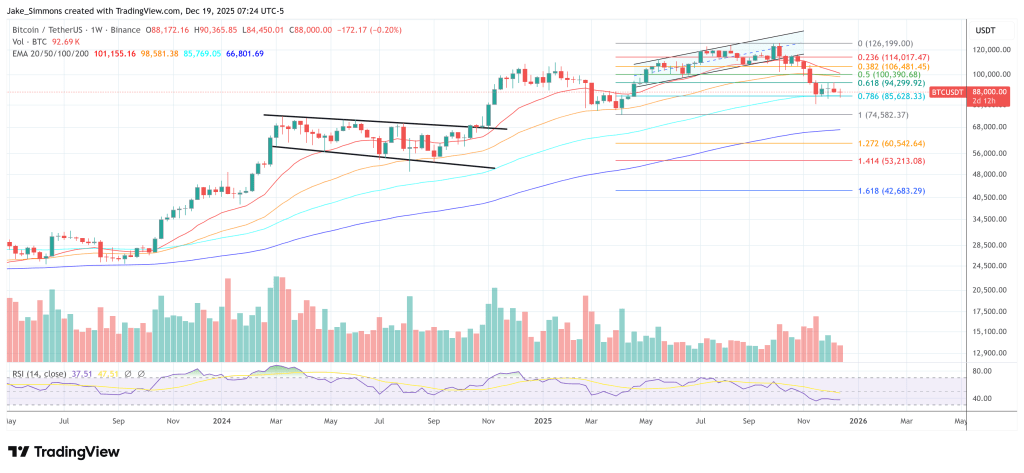
Bitcoin remains between the 0.618 and 0.786 Fib, 1-week chart | Source: BTCUSDT on TradingView.com

Domande pertinenti

QWhat is Michael Saylor's main argument about quantum computing and Bitcoin?

AMichael Saylor argues that quantum computing will not break Bitcoin but will instead harden it. He believes the network will upgrade, active coins to quantum-resistant encryption, while lost coins remain frozen. This process will increase security, reduce supply, and make Bitcoin stronger.

QAccording to Saylor, what will trigger the global consensus to upgrade encryption algorithms?

ASaylor states that the United States government will direct all defense contractors to upgrade their encryption algorithms to be quantum-resistant, which will signal a broad recognition of the quantum threat and trigger a global consensus for upgrades.

QHow does Saylor describe the process of Bitcoin's quantum upgrade?

ASaylor describes it as a software upgrade where quantum-resistant encryption libraries will be shipped. Users will be required to install new client software and reauthenticate within a deadline (e.g., 30-90 days), or their funds will be frozen for security reasons.

QWhy does Saylor believe the quantum upgrade will be a deflationary event for Bitcoin?

AHe explains that the upgrade will separate recoverable BTC (migrated by active users) from unrecoverable BTC (held by deceased or key-losers), effectively reducing the circulating supply and forcing the market to account for lost coins, thus creating a deflationary shock.

QHow does Saylor counter the argument that decentralization makes coordinated upgrades impractical?

ASaylor argues that decentralized networks can still reach consensus when motivated, citing examples like global supply chains and defense ecosystems coordinating under pressure. He believes Bitcoin holders, being smart and financially invested, will rationally choose to upgrade to protect their assets.

Letture associate

Abandon Illusions, Prepare for the Most Grueling Time in the Crypto Market

The article argues that while cryptocurrency adoption will continue to accelerate, market valuations may remain depressed or decline further for a prolonged period. This decoupling between real-world usage and price action is presented not as a flaw, but as a necessary and healthy feature of the market's maturation. The author draws a parallel to the dot-com bubble, where internet user growth exploded even as the Nasdaq crashed. The core thesis is that the market is undergoing a painful but essential recalibration. Many assets were fundamentally overvalued, and the current phase will pressure-test business models, eliminating flawed projects and forcing rational valuations. Cryptocurrency is transitioning from a speculative asset to a core, "boring" infrastructure technology, much like the internet did. This shift creates discomfort. Builders, early investors, and retail token holders may see value captured by traditional companies and VCs that leverage the open infrastructure. The article posits that the biggest beneficiaries might be traditional and hybrid businesses that use crypto to improve efficiency, rather than the underlying protocols themselves. The author's outlook for near-term prices is not optimistic, warning that the process could be a prolonged test of patience. They advocate for a long-term perspective, capital preservation, and a focus on businesses with sound unit economics, while cautioning against over-financialized models and excessive infrastructure building. The conclusion is that a major market bottom, characterized by capitulation, has not yet been reached.

marsbit46 min fa

Abandon Illusions, Prepare for the Most Grueling Time in the Crypto Market

marsbit46 min fa

Trading

Spot
Futures

Discussioni

Benvenuto nella Community HTX. Qui puoi rimanere informato sugli ultimi sviluppi della piattaforma e accedere ad approfondimenti esperti sul mercato. Le opinioni degli utenti sul prezzo di A A sono presentate come di seguito.

活动图片