Quant enters crucial supply zone: Will QNT’s 24% weekly rally falter?

ambcryptoPubblicato 2026-03-21Pubblicato ultima volta 2026-03-21

Introduzione

Quant (QNT) has surged 24.14% in the past week, significantly outperforming Bitcoin, which declined 2.64%. The altcoin is approaching a critical supply zone between $80 and $88, a key resistance area. While QNT has shown strength by rebounding from the long-term demand zone of $55–$60, its weekly chart still reflects a bearish structure, with the RSI below 50 and OBV not trending higher. Key resistance levels to watch are $88, $105, and $135. A daily close above $88 could signal a bullish continuation, while rejection at $80 and a drop below $75 may indicate a bearish reversal. Traders are advised to consider taking profits in the $80–$88 zone or wait for a clear breakout above $88 or breakdown below $75 for directional bias.

At press time, Quant [QNT] rallied 4.91% in 24 hours and was up by 24.14% over the past week. These were impressive numbers for the mid-cap altcoin, especially in comparison to Bitcoin [BTC]. The leading crypto has shed 2.64% over the past week and was oscillating about the $70k level.

In the coming days and weeks, BTC could make another push higher toward $80k. This could provide fuel for altcoins to climb higher, but only a few altcoins have already shown strength.

Quant could be one of them. It has a higher timeframe bearish trend but has reacted positively at the long-term demand zone at $55-$60. In March, QNT rebounded swiftly from $60.92 to $80.72, a 32.5% move in two weeks.

Quant is likely to rally to the Value Area High
Source: QNT/USDT on TradingView

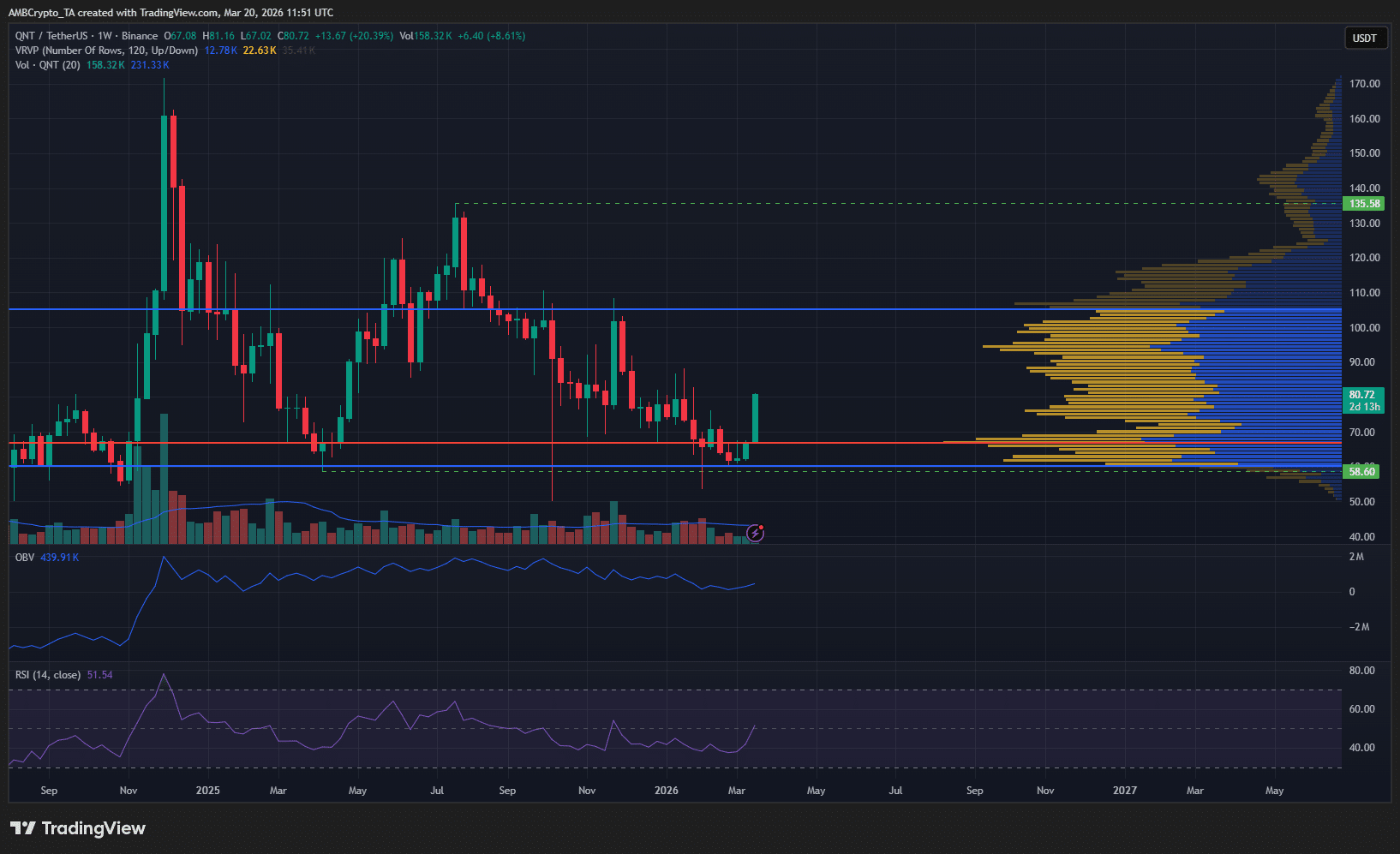
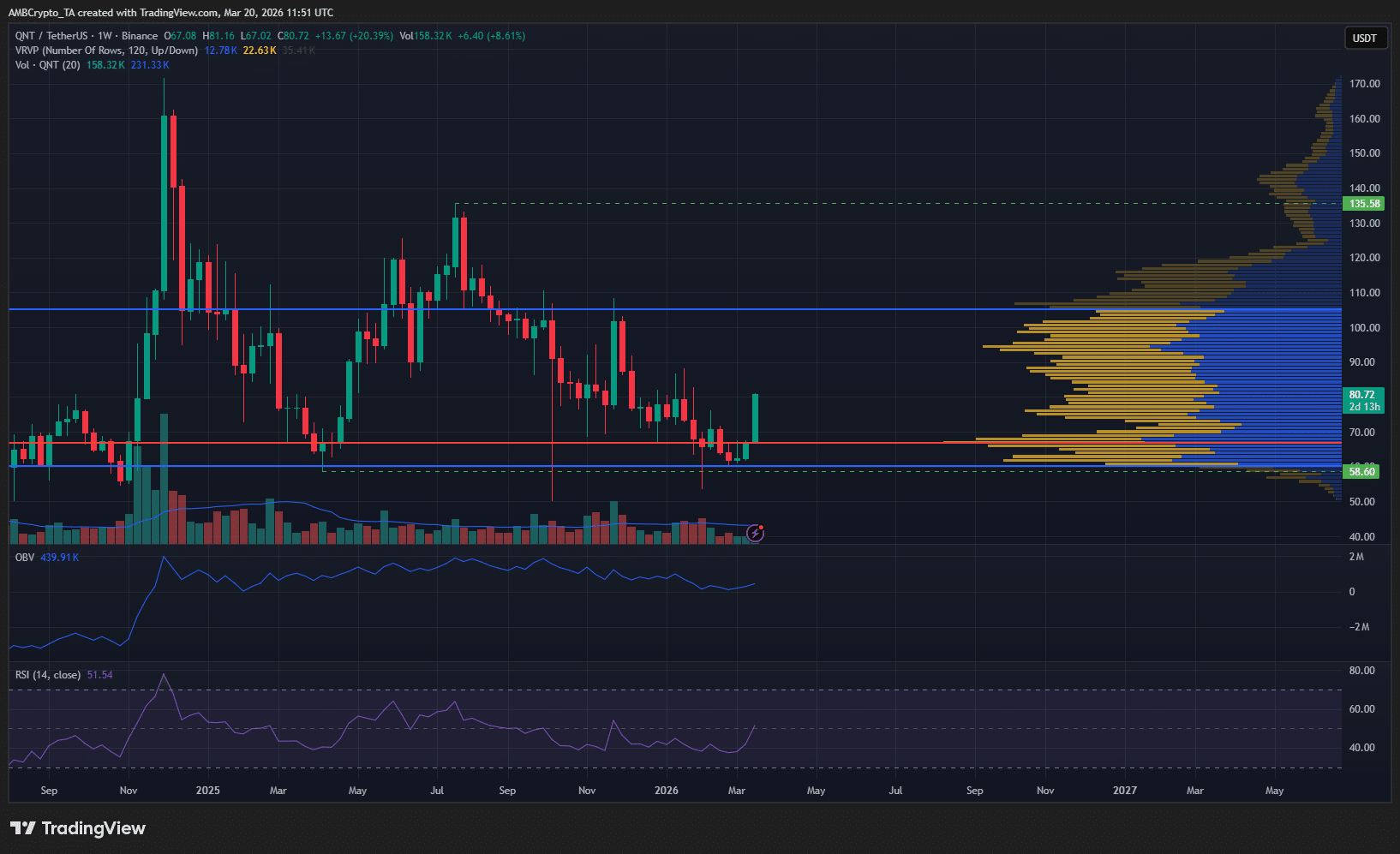
The weekly chart showed a long-term bullish swing structure but a bearish internal structure. Even after the strong gains in March, the local swing high at $88.3 remained unbroken.

The Visible Range’s Value Area was between $60 and $105, with the Point of Control at $67. That means the high-volume node shifted into bullish control, which was encouraging for bulls. However, they still had a long way to go before they could maintain their momentum.

Since April 2025, QNT has been stuck within the $58.60-$135.58 levels. The $88, $105, and $135 levels were the next key resistances to the north for QNT to overcome.

The OBV has not trended higher lately, and the RSI has remained below the neutral 50 level. The structure and technical indicators remained bearishly poised on the weekly timeframe.

QNT is at a make-or-break region
Source: QNT/USDT on TradingView

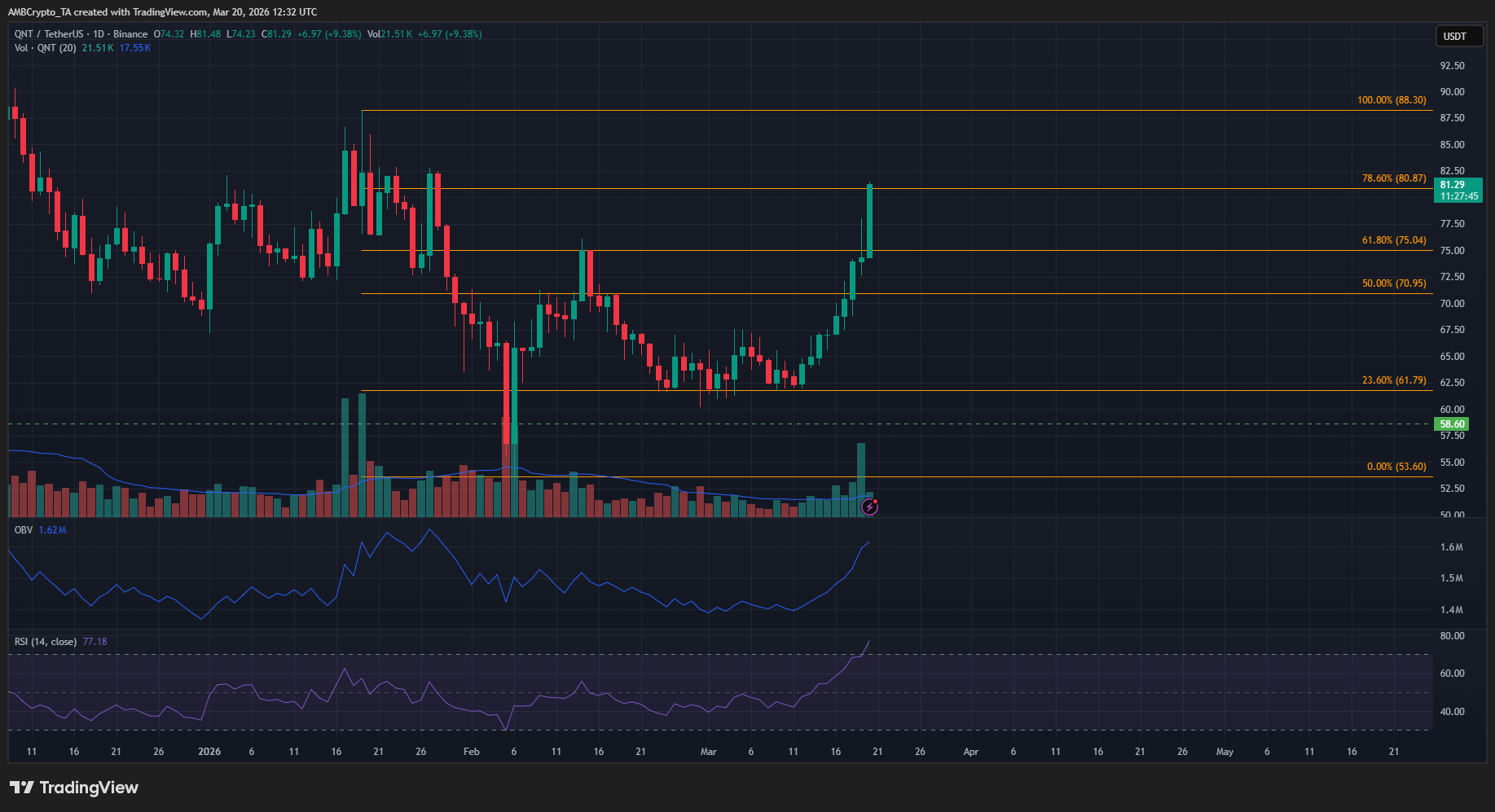
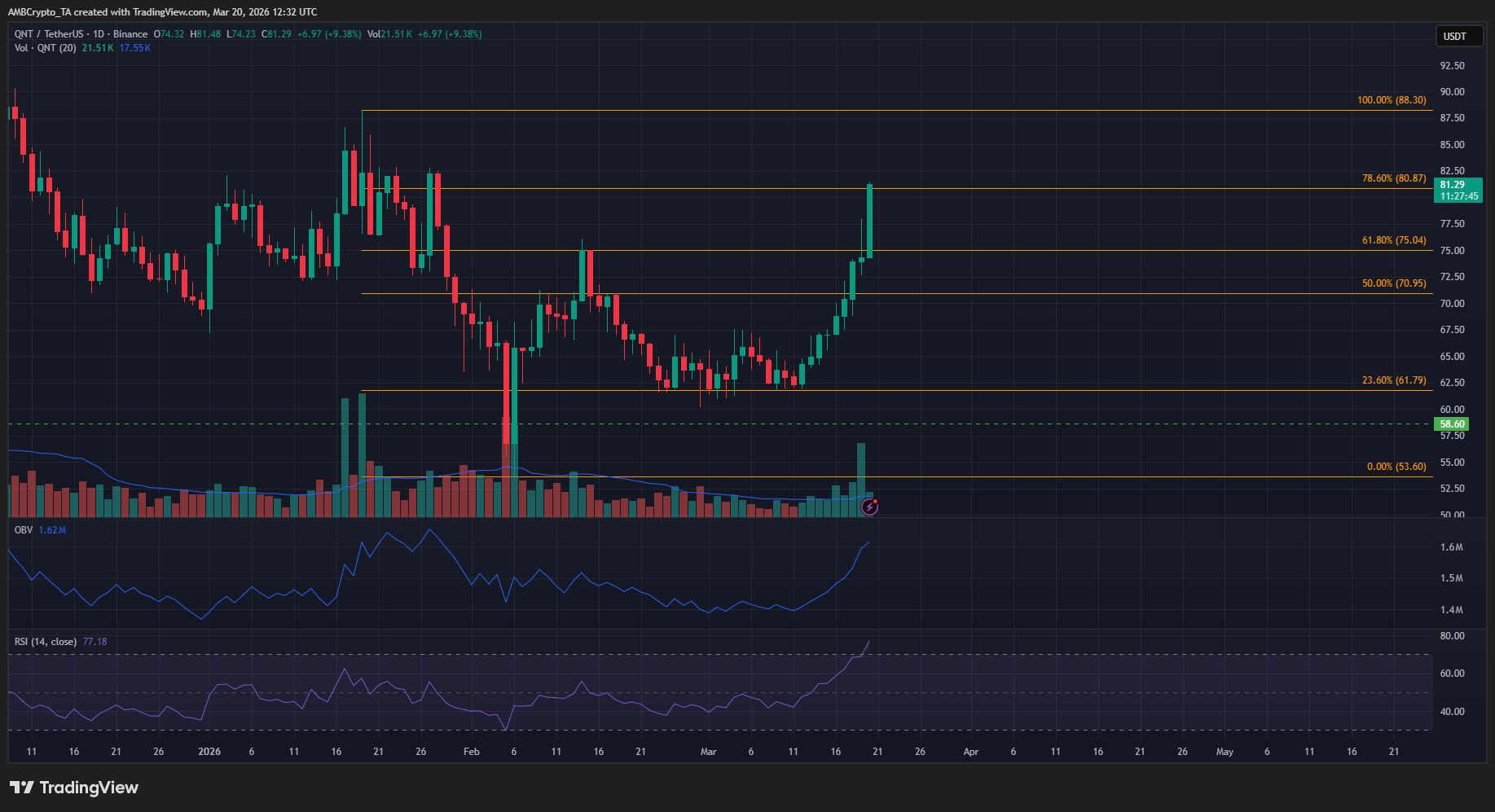
On the 1-day chart, the swing structure was bearish. This drop in January and February was used to plot a set of Fibonacci retracement levels (orange). The $75.04 and $80.87 levels were the levels that demarcated the golden pocket within the retracement.

If the bears were going to take control, they were most likely to do it within this price range. Yet, it has not happened so far.

So swing traders looking to go long should wait, while those looking to sell QNT can do so and book profits. It is unclear where the next leg will go.

A daily session closing above $88 would be a strong sign of a bullish continuation. Meanwhile, rejection from $80 and a subsequent fall below $75 would be indicative of a bearish trend’s renewal.


Final Summary

  • QNT traders already in long positions can look to take profits as the price enters the $80-$88 resistance zone.
  • Swing traders can wait for $75 or $88 to be breached to decide their next directional bias.

Domande pertinenti

QWhat is the current weekly and 24-hour price performance of Quant (QNT) as mentioned in the article?

AAt press time, Quant (QNT) had rallied 4.91% in 24 hours and was up by 24.14% over the past week.

QWhat are the key resistance levels that QNT needs to overcome to the north, according to the weekly chart analysis?

AThe key resistance levels to the north for QNT are $88, $105, and $135.

QWhat is the significance of the Fibonacci retracement's 'golden pocket' levels on the 1-day chart for QNT?

AThe 'golden pocket' levels, $75.04 and $80.87, are the price range where bears are most likely to take control, making it a critical zone for a potential trend reversal.

QWhat would a daily closing price above $88 indicate for QNT's price action?

AA daily session closing above $88 would be a strong sign of a bullish continuation for QNT.

QWhat trading advice is given to swing traders who are currently in long positions on QNT?

ASwing traders already in long positions are advised to look to take profits as the price enters the $80-$88 resistance zone.

Letture associate

OpenAI Post-Training Engineer Weng Jiayi Proposes a New Paradigm Hypothesis for Agentic AI

OpenAI engineer Weng Jiayi's "Heuristic Learning" experiments propose a new paradigm for Agentic AI, suggesting that intelligent agents can improve not just by training neural networks, but also by autonomously writing and refining code based on environmental feedback. In the experiment, a coding agent (powered by Codex) was tasked with developing and maintaining a programmatic strategy for the Atari game Breakout. Starting from a basic prompt, the agent iteratively wrote code, ran the game, analyzed logs and video replays to identify failures, and then modified the code. Through this engineering loop of "code-run-debug-update," it evolved a pure Python heuristic strategy that achieved a perfect score of 864 in Breakout and performed competitively with deep reinforcement learning (RL) algorithms in MuJoCo control tasks like Ant and HalfCheetah. This approach, termed Heuristic Learning (HL), contrasts with Deep RL. In HL, experience is captured in readable, modifiable code, tests, logs, and configurations—a software system—rather than being encoded solely into opaque neural network weights. This offers potential advantages in explainability, auditability for safety-critical applications, easier integration of regression tests to combat catastrophic forgetting, and more efficient sample use in early learning stages, as demonstrated in broader tests on 57 Atari games. However, the blog acknowledges clear limitations. Programmatic strategies struggle with tasks requiring long-horizon planning or complex perception (e.g., Montezuma's Revenge), areas where neural networks excel. The future vision is a hybrid architecture: specialized neural networks for fast perception (System 1), HL systems for rules, safety, and local recovery (also System 1), and LLM agents providing high-level feedback and learning from the HL system's data (System 2). The core proposition is that in the era of capable coding agents, a significant portion of an AI's learned experience could be maintained as an auditable, evolving software system.

marsbit44 min fa

OpenAI Post-Training Engineer Weng Jiayi Proposes a New Paradigm Hypothesis for Agentic AI

marsbit44 min fa

Your Claude Will Dream Tonight, Don't Disturb It

This article explores the recent phenomenon of AI companies increasingly using anthropomorphic language—like "thinking," "memory," "hallucination," and now "dreaming"—to describe machine learning processes. Focusing on Anthropic's newly announced "Dreaming" feature for its Claude Agent platform, the piece explains that this function is essentially an automated, offline batch processing of an agent's operational logs. It analyzes past task sessions to identify patterns, optimize future actions, and consolidate learnings into a persistent memory system, akin to a form of reinforcement learning and self-correction. The article draws parallels to similar features in other AI agent systems like Hermes Agent and OpenClaw, which also implement mechanisms for reviewing historical data, extracting reusable "skills," and strengthening long-term memory. It notes a key difference from human dreaming: these AI "dreams" still consume computational resources and user tokens. Further context is provided by discussing the technical challenges of managing AI "memory" or context, highlighting the computational expense of large context windows and innovations like Subquadratic's new model claiming drastically longer contexts. The core critique argues that this strategic use of human-centric vocabulary does more than market products; it subtly reshapes user perception. By framing algorithms with terms associated with consciousness, companies blur the line between tool and autonomous entity. This linguistic shift can influence user expectations, tolerance for errors, and even perceptions of responsibility when systems fail, potentially diverting scrutiny from the companies and engineers behind the technology. The article concludes by speculating that terms like "daydreaming" for predictive task simulation might be next, continuing this trend of embedding the idea of an "inner life" into computational processes.

marsbit46 min fa

Your Claude Will Dream Tonight, Don't Disturb It

marsbit46 min fa

Trading

Spot
Futures
活动图片