Pyth to launch reserve using buybacks from DAO treasury funds

cointelegraphPubblicato 2025-12-12Pubblicato ultima volta 2025-12-12

Introduzione

The Pyth Network, a blockchain oracle provider, announced it will use one-third of its protocol revenue to buy back PYTH tokens on the open market through its DAO treasury. This strategy aims to establish a network reserve and boost both revenue and token value. The PYTH token has declined over 80% in the past year, despite a brief surge after Pyth partnered with the U.S. government to publish economic data onchain. At the time of writing, PYTH was trading around $0.063, down 1.3% in 24 hours. The move follows a similar proposal from Aave’s DAO in October, though community reactions remain uncertain, citing past criticisms of token buyback schemes in other projects like Mango Markets.

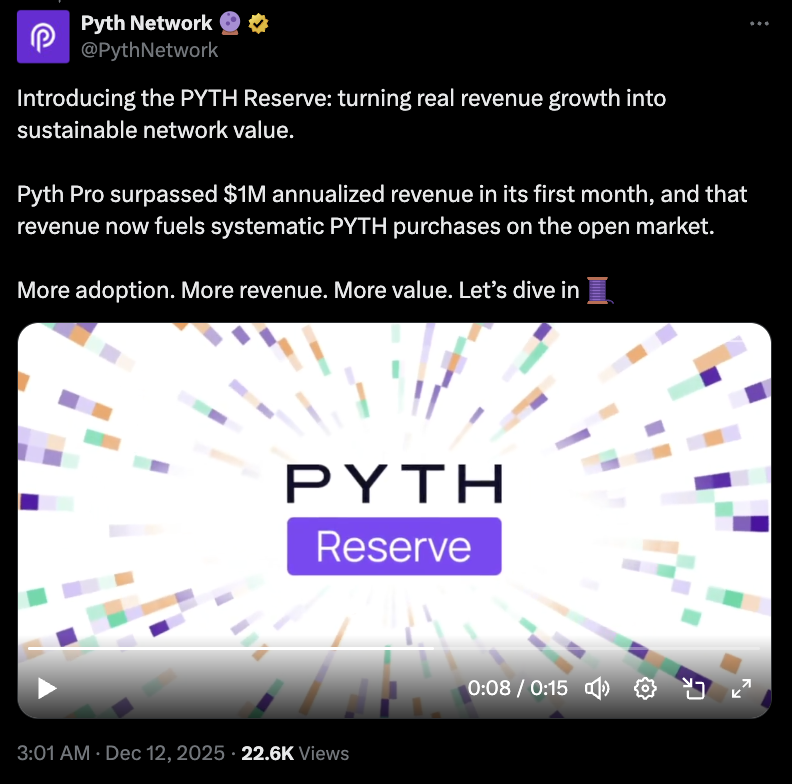
The Pyth Network, a blockchain oracle provider, said it will convert a portion of its revenue into PYTH token purchases as part of a reserve strategy.

In a Friday blog post, Pyth said the tokens it buys on the open market with one-third of the protocol’s revenue through its decentralized autonomous organization (DAO) would constitute the network’s reserve. The network said the strategy was designed to increase revenue and token purchases.

“[I]t’s time to rewrite the market data economy on a global level,” said Pyth.
Source: Pyth

The price of the Pyth Network token (PYTH) has dropped by more than 80% over the past year, despite a brief surge when the platform deepened ties to the US government. The Trump administration announced in August that the company and Chainlink would be responsible for publishing the country’s economic data onchain.

According to data from Nansen, the PYTH price decreased by about 1.3% over the previous 24 hours, reaching about $0.063 at the time of publication.

Related: Grayscale launches Pyth investment fund

Aave DAO proposed a similar buyback initiative in October

The DAO behind the Aave protocol introduced a proposal that would use $50 million of its annual revenue to repurchase its native token, Aave (AAVE). As of Friday, it did not appear that the proposal had been approved.

It’s unclear how Pyth users may respond to the plan. In 2024, when Mango Markets suggested a buyback program to purchase its MNGO tokens, co-founder Daffy Durairaj accused the creators of “untrustworthy behavior and self-dealing.”

Magazine: When privacy and AML laws conflict: Crypto projects’ impossible choice

Letture associate

From Theft to Re-entry: How Was $292 Million "Laundered"?

A sophisticated crypto laundering operation was executed following the $292 million hack of Kelp DAO on April 18. The attack, attributed to the North Korean Lazarus group, began with anonymous infrastructure preparation using Tornado Cash to fund wallets untraceably. The hacker exploited a vulnerability in Kelp’s cross-chain bridge, stealing 116,500 rsETH. To avoid crashing the market, the attacker used Aave and Compound as laundering tools—depositing the stolen rsETH as collateral to borrow $190 million in clean, liquid ETH. This move triggered a bank run on Aave, causing an $8 billion drop in TVL. After consolidating funds, the attacker fragmented them across hundreds of wallets to evade detection. A major breakpoint was THORChain, where over $460 million in volume—30 times its usual activity—was processed in 24 hours, converting ETH into Bitcoin. This shift to Bitcoin’s UTXO model exponentially increased tracing complexity by shattering funds into countless untraceable fragments. The final destination was Tron-based USDT, the primary channel for illicit crypto flows. From there, funds were cashed out via OTC brokers in China and Southeast Asia, using unlicensed underground banks and UnionPay networks outside Western sanctions scope. Ultimately, the laundered money supports North Korea’s weapons programs, which rely heavily on crypto hacking for foreign currency. The incident underscores structural challenges in DeFi: its openness, composability, and lack of central control make such laundering not just possible, but inherently difficult to prevent.

marsbit1 h fa

From Theft to Re-entry: How Was $292 Million "Laundered"?

marsbit1 h fa

Google and Amazon Simultaneously Invest Heavily in a Competitor: The Most Absurd Business Logic of the AI Era Is Becoming Reality

In a span of four days, Amazon announced an additional $25 billion investment, and Google pledged up to $40 billion—both direct competitors pouring over $65 billion into the same AI startup, Anthropic. Rather than a typical venture capital move, this signals the latest escalation in the cloud wars. The core of the deal is not equity but compute pre-orders: Anthropic must spend the majority of these funds on AWS and Google Cloud services and chips, effectively locking in massive future compute consumption. This reflects a shift in cloud market dynamics—enterprises now choose cloud providers based on which hosts the best AI models, not just price or stability. With OpenAI deeply tied to Microsoft, Anthropic’s Claude has become the only viable strategic asset for Google and Amazon to remain competitive. Anthropic’s annualized revenue has surged to $30 billion, and it is expanding into verticals like biotech, positioning itself as a cross-industry AI infrastructure layer. However, this funding comes with constraints: Anthropic’s independence is challenged as it balances two rival investors, its safety-first narrative faces pressure from regulatory scrutiny, and its path to IPO introduces new financial pressures. Globally, this accelerates a "tri-polar" closed-loop structure in AI infrastructure, with Microsoft-OpenAI, Google-Anthropic, and Amazon-Anthropic forming exclusive model-cloud alliances. In contrast, China’s landscape differs—investments like Alibaba and Tencent backing open-source model firm DeepSeek reflect a more decoupled approach, though closed-source models from major cloud providers still dominate. The $65 billion bet is ultimately about securing a seat at the table in an AI-defined future—where missing the model layer means losing the cloud war.

marsbit7 h fa

Google and Amazon Simultaneously Invest Heavily in a Competitor: The Most Absurd Business Logic of the AI Era Is Becoming Reality

marsbit7 h fa

Trading

Spot
Futures

Articoli Popolari

Come comprare DAO

Benvenuto in HTX.com! Abbiamo reso l'acquisto di DAO Maker (DAO) semplice e conveniente. Segui la nostra guida passo passo per intraprendere il tuo viaggio nel mondo delle criptovalute.Step 1: Crea il tuo Account HTXUsa la tua email o numero di telefono per registrarti il tuo account gratuito su HTX. Vivi un'esperienza facile e sblocca tutte le funzionalità,Crea il mio accountStep 2: Vai in Acquista crypto e seleziona il tuo metodo di pagamentoCarta di credito/debito: utilizza la tua Visa o Mastercard per acquistare immediatamente DAO MakerDAO.Bilancio: Usa i fondi dal bilancio del tuo account HTX per fare trading senza problemi.Terze parti: abbiamo aggiunto metodi di pagamento molto utilizzati come Google Pay e Apple Pay per maggiore comodità.P2P: Fai trading direttamente con altri utenti HTX.Over-the-Counter (OTC): Offriamo servizi su misura e tassi di cambio competitivi per i trader.Step 3: Conserva DAO Maker (DAO)Dopo aver acquistato DAO Maker (DAO), conserva nel tuo account HTX. In alternativa, puoi inviare tramite trasferimento blockchain o scambiare per altre criptovalute.Step 4: Scambia DAO Maker (DAO)Scambia facilmente DAO Maker (DAO) nel mercato spot di HTX. Accedi al tuo account, seleziona la tua coppia di trading, esegui le tue operazioni e monitora in tempo reale. Offriamo un'esperienza user-friendly sia per chi ha appena iniziato che per i trader più esperti.

140 Totale visualizzazioniPubblicato il 2024.12.11Aggiornato il 2025.03.21

Come comprare DAO

Discussioni

Benvenuto nella Community HTX. Qui puoi rimanere informato sugli ultimi sviluppi della piattaforma e accedere ad approfondimenti esperti sul mercato. Le opinioni degli utenti sul prezzo di DAO DAO sono presentate come di seguito.

活动图片