Pump.fun Lawsuit Annual Review: Mysterious Informant, Internal Records, and Answers Yet to Be Revealed

深潮Pubblicato 2025-12-23Pubblicato ultima volta 2025-12-23

Introduzione

Summary: In January 2025, investors filed lawsuits against meme coin launchpad Pump.fun and its founders in a New York court, alleging the platform sold unregistered securities after they suffered losses (one plaintiff lost $231, another $242,000). The cases were later consolidated. The lawsuit expanded significantly in July 2025, with plaintiffs accusing Pump.fun, Solana Labs, Solana Foundation, and Jito Labs of operating as a coordinated "racketeering enterprise." Core allegations include selling unregistered securities, operating an illegal gambling operation, enabling wire fraud through misleading "fair launch" claims, facilitating money laundering (including for the Lazarus Group), and a complete lack of investor protections (KYC/AML). A major turning point came when a confidential informant provided plaintiffs with approximately 15,000 internal messages from Pump.fun, Solana, and Jito, allegedly revealing detailed technical coordination and discussions on MEV exploitation for insider advantage. The plaintiffs are preparing a Second Amended Complaint incorporating this evidence, due by January 7, 2026. Amid the legal battle, Pump.fun's weekly trading volume has plummeted over 80% from its January peak. The case raises fundamental questions about decentralization and fairness in the crypto ecosystem.

Written by: June, Deep Tide TechFlow

In January 2025, the meme coin market was at the peak of frenzy. As former U.S. President Donald Trump launched the TRUMP coin, an unprecedented wave of speculation swept through, with the wealth-creating myth of "100x coins" capturing the market's attention.

At the same time, a lawsuit against the Pump.fun platform was quietly initiated.

Fast forward to recent days.

Pump.fun co-founder and COO Alon Cohen has not made a sound on social media for over a month. For someone who is usually active and always online "surfing and catching up on gossip," this silence is particularly noticeable. Data shows that Pump.fun's weekly trading volume has plummeted from a peak of $3.3 billion in January to the current $481 million, a drop of over 80%. Meanwhile, the price of PUMP has fallen to $0.0019, down about 78% from its all-time high.
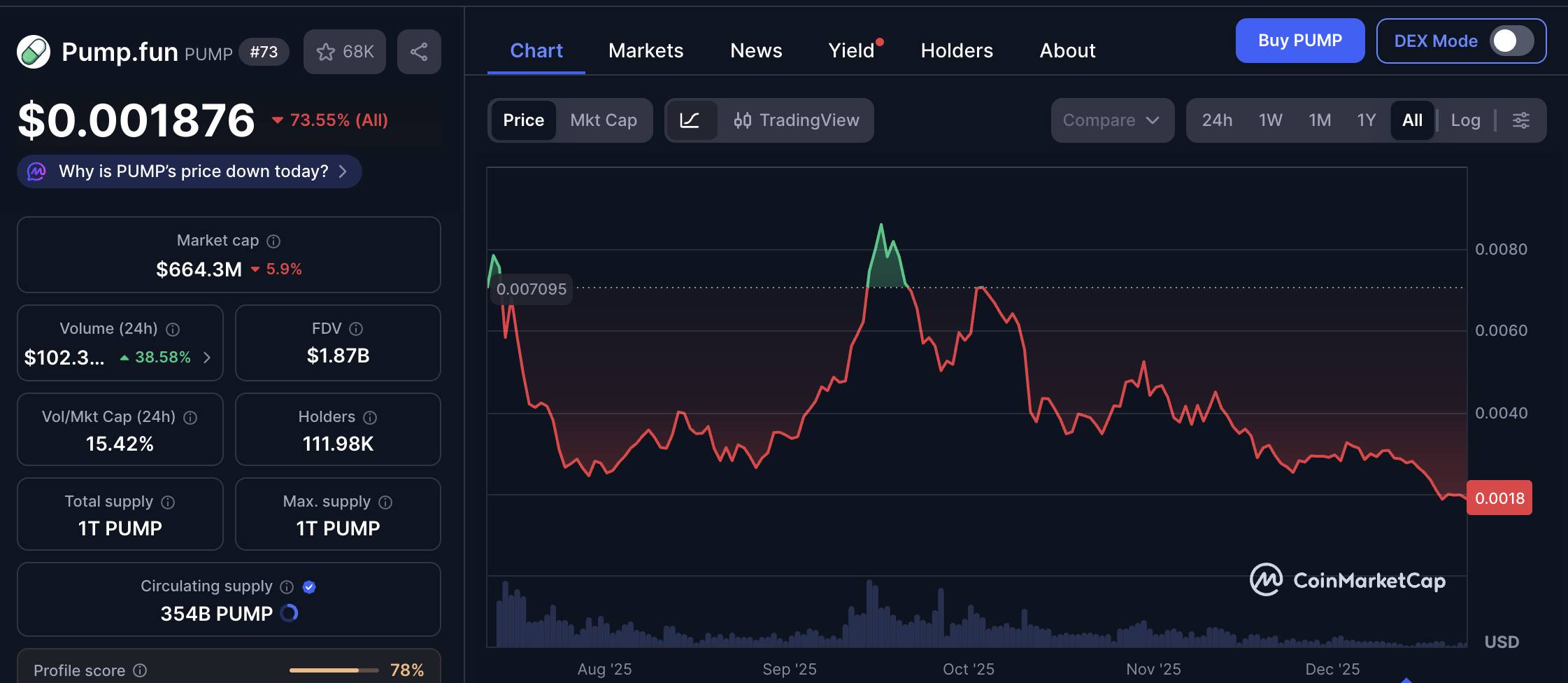
Looking back to July 12 a few months ago, the situation was completely different. Pump.fun's public sale was issued at a uniform price of $0.004 per token, selling out in 12 minutes and raising approximately $600 million, pushing sentiment to a climax.

From the excitement at the beginning of the year to the current chill, the market's attitude has formed a stark contrast.

Amid all these changes, the only thing that hasn't stopped is the buyback plan. The Pump.fun team is still methodically executing its daily buyback plan. As of now, the cumulative buyback amount has reached $216 million, digesting about 15.16% of the circulating supply.

At the same time, the lawsuit that was overlooked during the market frenzy is now quietly expanding.

Everything Started with the Loss on $PNUT

The story begins in January 2025.

On January 16, investor Kendall Carnahan率先 filed a lawsuit in the Southern District of New York (case number: Carnahan v. Baton Corp.), targeting Pump.fun and its three founders. Carnahan's诉求 was clear: he suffered losses after purchasing $PNUT tokens on the platform and accused Pump.fun of selling unregistered securities, violating the U.S. Securities Act of 1933.

According to the court documents, the investor's actual loss amount was only $231.
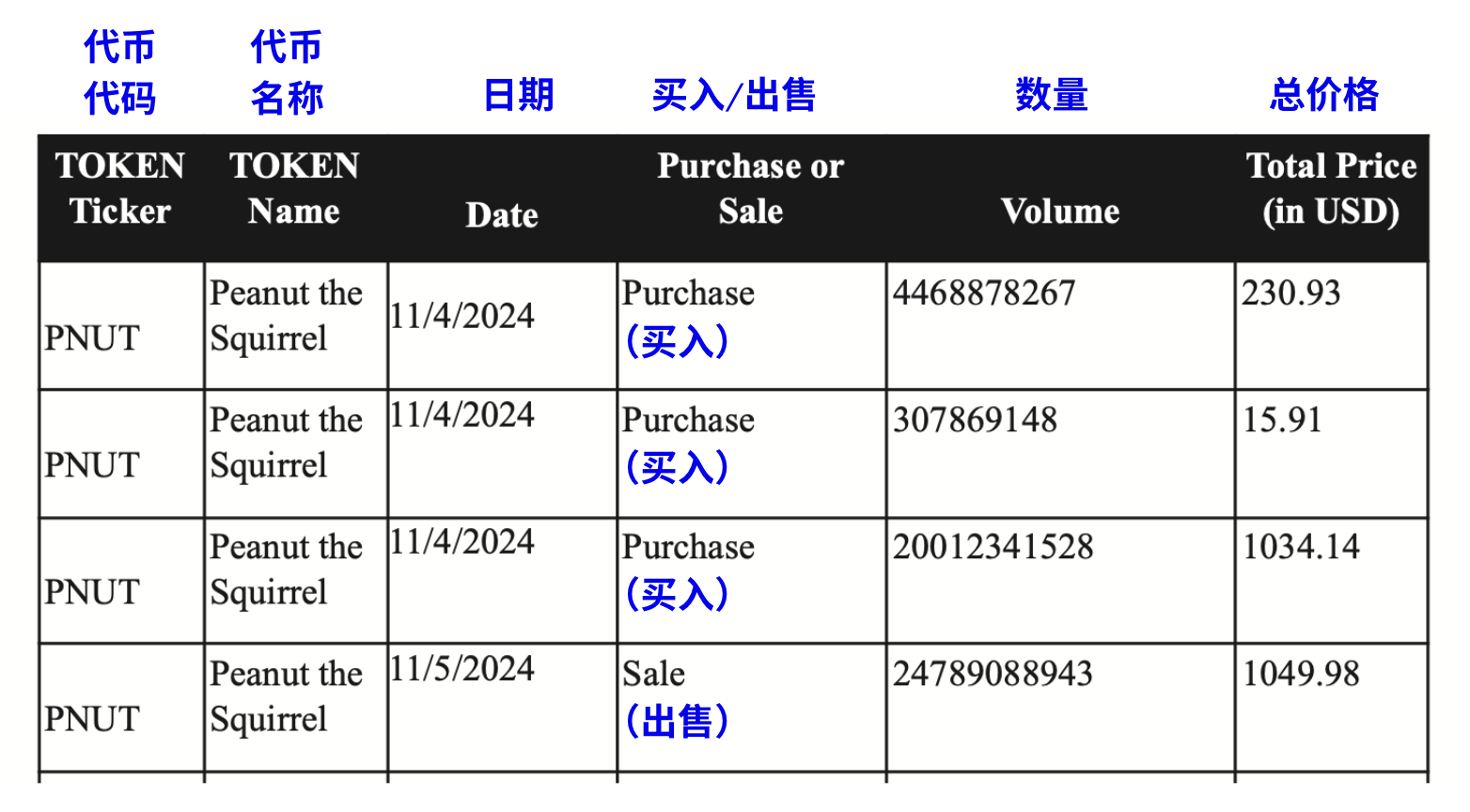
Just two weeks later, on January 30, another investor, Diego Aguilar, filed a similar lawsuit (case number: Aguilar v. Baton Corp.). Unlike Carnahan, Aguilar purchased a wider variety of tokens, including $FRED, $FWOG, $GRIFFAIN, and other meme coins issued on the Pump.fun platform. His lawsuit had a broader scope, representing all investors who purchased unregistered tokens on the platform.

At this point, the two cases were proceeding independently, with the same defendants:

Pump.fun operating company Baton Corporation Ltd and its three founders, Alon Cohen (COO), Dylan Kerler (CTO), and Noah Bernhard Hugo Tweedale (CEO).

Cases Consolidated, Plaintiff with $240K Loss Becomes Lead Plaintiff

The two independent lawsuits quickly caught the court's attention. Judge Colleen McMahon of the Southern District of New York, who was presiding over the case, noticed a problem: the two cases targeted the same defendants, the same platform, and the same alleged violations, so why were they being handled separately?

On June 18, 2025, Judge McMahon directly questioned the plaintiffs' legal team:

Why were there two independent lawsuits addressing the same issue? She asked the lawyers to explain why the two cases should not be consolidated.

The plaintiffs' lawyers initially tried to argue, claiming that two separate cases could be maintained—one specifically for the $PNUT token and another for all tokens on the Pump.fun platform—and suggested appointing two separate lead plaintiffs.

But the judge was clearly not buying it. This "divide and conquer" strategy would not only waste judicial resources but could also lead to conflicting rulings in different cases. The key point was that all plaintiffs faced the same core issue: they all accused Pump.fun of selling unregistered securities and considered themselves victims of the same fraudulent system.

On June 26, Judge McMahon ruled to formally consolidate the two cases. At the same time, the judge, in accordance with the provisions of the Private Securities Litigation Reform Act (PSLRA), formally appointed the plaintiff with the largest losses, Michael Okafor, as the lead plaintiff (according to court records, Okafor lost approximately $242,000 in Pump.fun transactions, far exceeding the losses of other plaintiffs).

Thus, the investors, who had been fighting separately, formed a united front.

Targets Shift to Solana Labs and Jito

Just one month after the cases were consolidated, the plaintiffs dropped a bombshell.

On July 23, 2025, the plaintiffs submitted the "Consolidated Amended Complaint," and the list of defendants expanded dramatically. This time, the矛头 was no longer aimed solely at Pump.fun and its three founders but directly targeted core participants in the entire Solana ecosystem.

The newly added defendants included:

  • Solana Labs, Solana Foundation, and their executives (Solana Defendants): The plaintiffs alleged that Solana was more than just providing blockchain technology. According to the court documents, there was close technical coordination and communication between Pump.fun and Solana Labs, far exceeding an ordinary developer-platform relationship.

  • Jito Labs and its executives (Jito Defendants): The plaintiffs argued that it was Jito's MEV technology that allowed insiders to pay extra fees to ensure their transactions were prioritized, allowing them to buy tokens before ordinary users and achieve risk-free arbitrage.

The plaintiffs' strategy was clear: they试图 to prove that Pump.fun, Solana, and Jito were not operating independently but formed a tight-knit community of interest. Solana provided the blockchain infrastructure, Jito provided the MEV tools, and Pump.fun operated the platform—the three共同构建 a system that appeared decentralized but was actually manipulated.

Core Allegations: More Than Just "Losing Money"

Many might think this is just a group of investors throwing a fit after losing money speculating on coins. But a careful reading of the hundreds of pages of court documents reveals that the plaintiffs' allegations point to a carefully designed fraudulent system.

First Allegation: Sale of Unregistered Securities

This is the legal foundation of the entire case.

The plaintiffs argue that all meme tokens issued on the Pump.fun platform are essentially investment contracts. According to the *Howey Test, these tokens meet the definition of securities. However, the defendants never filed any registration statements with the U.S. Securities and Exchange Commission before publicly selling these tokens to the public, violating Sections 5, 12(a)(1), and 15 of the Securities Act of 1933.

When the platform sold tokens through its "bonding curve" mechanism, it also completely failed to disclose necessary risk information, financial status, or project background to investors—all information that must be provided when issuing securities.

Note: The Howey Test is a legal standard established by the U.S. Supreme Court in the 1946 case SEC v. W.J. Howey Co. to determine whether a specific transaction or plan constitutes an "investment contract." If it meets the criteria of this test, the asset is considered a "security" (Security), must be regulated by the U.S. Securities and Exchange Commission (SEC), and comply with the registration and disclosure requirements of the Securities Act of 1933 and the Securities Exchange Act of 1934.

Second Allegation: Operating an Illegal Gambling Enterprise

The plaintiffs define Pump.fun as a "Meme Coin Casino." They point out that users投入 SOL to buy tokens is essentially "placing a bet," the outcome of which depends primarily on luck and market speculation, not the actual utility of the token. The platform, as the "house," takes a 1% fee from each transaction, just like a casino taking a cut.

Third Allegation: Wire Fraud and False Advertising

Pump.fun表面上宣传 "Fair Launch," "No Presale," "Rug-proof," giving the impression that all participants are on a level playing field. But in reality, this is an outright lie.

The court documents指出 that Pump.fun secretly integrated MEV technology provided by Jito Labs. This means that insiders who knew the "inside story" and were willing to pay extra "tips" could use "Jito bundles" to buy tokens before ordinary users' transactions were executed, then immediately sell for profit after the price rose—this is所谓的 front-running.

Fourth Allegation: Money Laundering and Unlicensed Money Transmission

The plaintiffs accuse Pump.fun of receiving and transferring large amounts of money without obtaining any money transmission licenses. The court documents claim that the platform even assisted the North Korean hacker group Lazarus Group in laundering stolen funds. In a specific case, hackers issued a meme token named "QinShihuang" (秦始皇) on Pump.fun, using the platform's high traffic and liquidity to mix "dirty money" with legitimate trading funds from ordinary retail investors.

Fifth Allegation: Complete Lack of Investor Protection

Unlike traditional financial platforms, Pump.fun has no "Know Your Customer" (KYC) process, anti-money laundering (AML) protocols, or even the most basic age verification.

The plaintiffs' core argument can be summarized in one sentence: This is not a normal investment affected by market fluctuations, but a fraudulent system designed from the outset to make retail investors lose money and insiders profit.

This expansion意味着 the nature of the lawsuit has fundamentally changed. The plaintiffs are no longer satisfied with accusing Pump.fun of acting alone but are describing it as part of a larger "criminal network."

One month later, on August 21, the plaintiffs further submitted the "RICO Case Statement," formally accusing all defendants of共同 constituting a "racketeering enterprise" that, through Pump.fun's表面上 "fair launch platform,"实际上 operated a manipulated "Meme Coin Casino."

The plaintiffs' logic is clear: Pump.fun did not operate independently. Behind it, Solana provided the blockchain infrastructure, and Jito provided the MEV technology tools. The three formed a tight-knit community of interest, collectively defrauding ordinary investors.

But what evidence do the plaintiffs have to support these allegations? The answer was revealed a few months later.

Key Evidence: Mysterious Informant and Chat Records

After September 2025, the nature of the case underwent a fundamental转变.

Because the plaintiffs obtained hard evidence.

A "confidential informant" provided the plaintiffs' legal team with the first batch of internal chat records, numbering about 5,000. These chat records are alleged to come from internal communication channels within Pump.fun, Solana Labs, and Jito Labs, documenting technical coordination and business dealings among the three parties.

The emergence of this evidence was a treasure trove for the plaintiffs. Because all previous allegations—about technical collusion, MEV manipulation, and insider优先交易—were still at the speculative level, lacking direct evidence.

And these internal chat records, it is alleged, can prove the "conspiratorial relationship" among the three parties.

One month later, on October 21, this mysterious informant provided a second batch of files, this time even more staggering: over 10,000 chat records and related documents. These materials are alleged to detail:

  • How Pump.fun coordinated technical integration with Solana Labs

  • How Jito's MEV tools were embedded into Pump.fun's trading system

  • How the three parties discussed "optimizing" the trading process (which the plaintiffs believe is a euphemism for market manipulation)

  • How insiders traded using informational advantages

The plaintiffs' lawyers stated in court documents that these chat records "reveal a精心设计的欺诈网络," proving that the relationship between Pump.fun, Solana, and Jito was far more than just表面上的 "technical partners."

Motion for Second Amended Complaint

Faced with such a massive amount of new evidence, the plaintiffs needed time to organize and analyze it. On December 9, 2025, the court granted the plaintiffs' request to file a "Second Amended Complaint," allowing them to incorporate this new evidence into the lawsuit.

But a problem arose: over 15,000 chat records needed to be逐一 reviewed,筛选, translated (some可能 be in non-English languages), and analyzed for their legal significance—a huge workload.加上 the upcoming Christmas and New Year holidays, the plaintiffs' legal team明显 didn't have enough time.

On December 10, the plaintiffs filed a motion with the court requesting an extension of the deadline for submitting the "Second Amended Complaint."

Just one day later, on December 11, Judge McMahon approved the extension request. The new deadline was set for January 7, 2026. This means that after the New Year, a "Second Amended Complaint" that may contain even more explosive allegations will be presented to the court.

Current Status of the Case

As of now, this lawsuit has been ongoing for nearly a year, but the real battle is just beginning.

On January 7, 2026, the plaintiffs will submit the "Second Amended Complaint" containing all the new evidence, at which point we will see what those 15,000 chat records actually reveal. Meanwhile, the defendant side has been unusually quiet. Pump.fun co-founder Alon Cohen has not spoken on social media for over a month, and executives from Solana and Jito have not made any public response to the lawsuit.

Interestingly, despite the lawsuit's growing scale and influence, the cryptocurrency market doesn't seem to care much. Solana's price has not experienced剧烈波动 due to the lawsuit, and while the $PUMP token's price continues to fall, it's more due to the collapse of the overall meme coin narrative than the impact of the lawsuit itself.

Epilogue

This lawsuit, which began over losses from trading meme coins, has evolved into a class action lawsuit against the entire Solana ecosystem.

The case has also gone beyond the scope of "a few investors维权 over losing money." It touches on the core issues of the cryptocurrency industry: Is decentralization real, or is it an精心包装的幻象? Is a fair launch truly fair?

However, many key questions remain unanswered:

  • Who exactly is that mysterious informant? A former employee? A competitor? Or an undercover agent from a regulatory agency?

  • What exactly is in those 15,000 chat records? Is it conclusive evidence of collusion, or is it normal business communication taken out of context?

  • How will the defendants defend themselves?

In 2026, with the submission of the "Second Amended Complaint" and the advancement of the case审理, we may get some answers.


Crypto di tendenza

Domande pertinenti

QWhat is the core legal basis of the lawsuit against Pump.fun, Solana Labs, and Jito Labs?

AThe core legal basis is the allegation that Pump.fun sold unregistered securities. The plaintiffs argue that all meme tokens issued on the platform constitute investment contracts under the Howey Test, making them securities that were sold to the public without the required registration statements from the SEC, violating the Securities Act of 1933.

QWho was appointed as the lead plaintiff in the consolidated case and why?

AMichael Okafor was appointed as the lead plaintiff. The court appointed him because, according to court records, he suffered the largest financial loss of approximately $242,000 from trading on Pump.fun, which far exceeded the losses of the other plaintiffs.

QWhat new evidence significantly changed the nature of the lawsuit in September 2025?

AA confidential informant provided the plaintiff's legal team with the first batch of approximately 5,000 internal chat logs. These logs, allegedly from internal communication channels of Pump.fun, Solana Labs, and Jito Labs, are said to document technical coordination and business dealings between the three parties, providing potential evidence of collusion.

QWhat are the key allegations beyond the sale of unregistered securities?

AKey additional allegations include operating an illegal gambling enterprise (a 'Meme Coin Casino'), committing wire fraud through false advertising of a 'fair launch', engaging in money laundering and unlicensed money transmission, and a complete lack of investor protection measures like KYC or AML protocols.

QWhat is the current status of the case and what is the next major deadline?

AThe case has been ongoing for nearly a year. The next major deadline is January 7, 2026, when the plaintiffs are scheduled to file their Second Amended Complaint, which will incorporate and present the analysis of over 15,000 internal chat logs obtained from the confidential informant.

Letture associate

The 'Saving U.S. Treasuries' Baton Pass: Bessent Fumbled Last Week, This Week It's Wash's Turn

"Rescuing US Treasuries" Relay: After Bessent's Miss, All Eyes Are on Walsh Last week, US Treasury Secretary Bessent's announcement to at least double long-term Treasury buybacks failed to sustainably lower yields, which quickly rebounded. The market response saw a drop in the dollar alongside surges in gold and Bitcoin, interpreted as a "pressure release valve" for anxiety. The focus now shifts to Fed Chairman Walsh's upcoming Jackson Hole speech. Markets are highly sensitive to his message, seeking clarity on the Fed's policy response to stubborn inflation and worsening fiscal conditions. Analysts warn that a lack of new guidance could disappoint markets and worsen the sell-off in long-dated bonds. Analysts question the scale of Bessent's operations, noting they are too small relative to the overall debt market and do not constitute quantitative easing. A key issue is the Fed's massive holdings of long-term bonds, which distorts the market. With the Fed holding low-yielding short-term bonds that are losing money relative to its policy rate, discussion is growing around a potential Fed-led "Operation Twist." This would involve selling short-term bonds to buy long-term ones, aiming to lower long-end yields without expanding the balance sheet. The upcoming PCE inflation data will set the stage for Walsh's speech. However, the window for action is narrowing amid political pressures. A critical threshold is the 30-year yield at 5%; holding above it could increase stress on the dollar and leveraged sectors. Overall, the article suggests that without coordinated Fed action to anchor inflation expectations, Treasury interventions may ultimately fail, with investors increasingly looking to assets like gold as hedges.

marsbit26 min fa

The 'Saving U.S. Treasuries' Baton Pass: Bessent Fumbled Last Week, This Week It's Wash's Turn

marsbit26 min fa

Hyperliquid's Compliance Journey: From Permissionless to Permissioned via HIP-3

Hyperliquid’s Compliance Path: From Permissionless to Permissioned HIP-3 Hyperliquid currently blocks U.S. access because its permissionless, on-chain infrastructure conflicts with U.S. market structure laws, which restrict futures trading to registered exchanges, clearinghouses, and brokers. Through its Hyperliquid Policy Center (HPC), the project is advocating for regulatory modernization, proposing that regulated entities be allowed to build products on HyperCore (its exchange and clearing layer) while fulfilling their compliance obligations. The platform’s modular stack separates roles like a traditional exchange (DCM), clearinghouse (DCO), and broker (FCM), but reconstructs them on-chain with code. This enables permissionless access, self-custody, and 24/7 global trading, but clashes with U.S. rules requiring KYC, specific margin models, and custodial arrangements. To resolve this, HPC is engaging with U.S. regulators (CFTC, SEC) to seek clarity that deploying on-chain software does not itself trigger licensing, and to establish exemptions allowing non-custodial wallets to route users to regulated derivatives. Recent political signals suggest openness to this approach. On the technical side, Hyperliquid Labs has introduced permissioned HIP-3 deployers on testnet. These allow regulated entities to launch markets, perform KYC, and whitelist compliant users. While these create separate order books, whitelisted market makers can bridge liquidity between them, ensuring deep, shared liquidity across the same L1. Features like payload-based “PA” permissions enable DEX-level account controls (e.g., reduce-only orders), mirroring traditional broker authorities. The strategy is not to open the native, permissionless front-end to U.S. users, but to position Hyperliquid as neutral infrastructure that U.S. regulated firms can use while meeting their legal duties. This paves a compliant path for U.S. investor access while preserving the protocol’s core, permissionless nature.

marsbit50 min fa

Hyperliquid's Compliance Journey: From Permissionless to Permissioned via HIP-3

marsbit50 min fa

Two Funding Rounds in Three Months: The Chinese Version of Palantir is on Fire

Investment Community AI has learned that Beijing Zhongshu Ruizhi Technology Co., Ltd., a domestic industrial-grade causal intelligence and high-reliability decision-making AI company, has recently completed a strategic financing round worth hundreds of millions of RMB. This round saw participation from China Internet Investment Fund, Suzhou Chuangtou National Social Security Fund, Financial Street Capital, ICBC Capital, Kunlun Capital, among others, with existing shareholders also increasing their investment. This follows a Series B funding round in the hundreds of millions completed just three months prior. The rapid succession of two major funding rounds signifies strong market recognition of the company's underlying original technology and scaled commercial implementation. Often referred to as the "Chinese version of Palantir," Zhongshu Ruizhi is entering a new phase of accelerated technological iteration, widespread scenario replication, and scaled performance release, mirroring the explosive growth of China's AI market. Founded in April 2020 by Dr. Han Han, a Tsinghua University Ph.D. and former core drafter of national AI policies, the company is mission-driven to "move AI from the digital world to the physical world." It focuses on the high-reliability, strong-decision industrial AI track and enterprise-grade AI Agent full-stack infrastructure. The team tackles the challenge of applying AI to China's vast and complex industrial and energy systems by developing a new intelligent operating system from scratch. Its core technological breakthrough lies in three proprietary底层 technologies: meta-causal cognitive theory, causal models, and a dynamic ontology engine. These address critical pain points of generative large models in industrial settings—such as AI hallucinations, insufficient reasoning, lack of temporal logic, unverifiable decisions, and multi-source rule conflicts—thereby providing trustworthy, explainable, and executable智能决策 capabilities. Commercially, Zhongshu Ruizhi has achieved scaled deployment, serving over 50 central state-owned enterprises and industrial groups in sectors like power, petroleum, and aerospace, with implementations in more than 800 highly complex production scenarios. The company reported doubled revenue in 2025, demonstrating strong self-sufficiency and a viable business model—a rarity among new-generation AI firms. The latest funds will be allocated towards advancing foundational theoretical research, replicating successful application models to expand market presence (including overseas), and attracting top-tier talent. Lead investor China Internet Investment Fund highlighted that in the current shift from general AI capability contests to deep industrial empowerment, industrial-grade causal intelligence is crucial for building China's modern digital foundation and fostering new quality productive forces. They expressed support for the company's efforts to define decision-making paradigms and trustworthy standards for industrial intelligence, aiming to secure a rule-making voice in the global physical AI arena.

marsbit1 h fa

Two Funding Rounds in Three Months: The Chinese Version of Palantir is on Fire

marsbit1 h fa

The Biggest Political Economy Question in the AI Era: As Robots Become More Capable, How Do Humans Share the Value?

In the AI era, the most pressing political economy question is: as machines become increasingly capable, how can humanity share in the value they create? An article originally critiquing China's tech focus has sparked a deeper debate on this global challenge. Historically, industrial progress improved efficiency but still relied on human labor for wealth creation and distribution. AI is fundamentally different—it is now replacing cognitive and knowledge work. As AI and robots take over more tasks, economic growth may continue while direct human participation in value creation shrinks, creating a core tension between productivity gains and widespread income generation. The issue is not unique to China. While leading tech companies amass enormous wealth, labor's share of income is declining globally. The core problem is a broken link: technological innovation and corporate profits are not translating into sufficient consumer income and demand. Three potential paths forward are outlined: a traditional capitalist model where profits primarily go to capital owners; a state-capitalist approach with public investment in AI; and more innovative models like digital sovereign wealth funds, universal shareholding, or AI-era basic income schemes to directly distribute AI-generated value. The future competitive advantage may lie not just in technological supremacy, but in which society can build a new, inclusive distribution system for the intelligent economy. The ultimate challenge is ensuring that as AI creates value, humans have a means to obtain income and share in the resulting widespread social benefits.

marsbit1 h fa

The Biggest Political Economy Question in the AI Era: As Robots Become More Capable, How Do Humans Share the Value?

marsbit1 h fa

Trading

Spot

Articoli Popolari

Come comprare PUMP

Benvenuto in HTX.com! Abbiamo reso l'acquisto di Pump.fun (PUMP) semplice e conveniente. Segui la nostra guida passo passo per intraprendere il tuo viaggio nel mondo delle criptovalute.Step 1: Crea il tuo Account HTXUsa la tua email o numero di telefono per registrarti il tuo account gratuito su HTX. Vivi un'esperienza facile e sblocca tutte le funzionalità,Crea il mio accountStep 2: Vai in Acquista crypto e seleziona il tuo metodo di pagamentoCarta di credito/debito: utilizza la tua Visa o Mastercard per acquistare immediatamente Pump.funPUMP.Bilancio: Usa i fondi dal bilancio del tuo account HTX per fare trading senza problemi.Terze parti: abbiamo aggiunto metodi di pagamento molto utilizzati come Google Pay e Apple Pay per maggiore comodità.P2P: Fai trading direttamente con altri utenti HTX.Over-the-Counter (OTC): Offriamo servizi su misura e tassi di cambio competitivi per i trader.Step 3: Conserva Pump.fun (PUMP)Dopo aver acquistato Pump.fun (PUMP), conserva nel tuo account HTX. In alternativa, puoi inviare tramite trasferimento blockchain o scambiare per altre criptovalute.Step 4: Scambia Pump.fun (PUMP)Scambia facilmente Pump.fun (PUMP) nel mercato spot di HTX. Accedi al tuo account, seleziona la tua coppia di trading, esegui le tue operazioni e monitora in tempo reale. Offriamo un'esperienza user-friendly sia per chi ha appena iniziato che per i trader più esperti.

478 Totale visualizzazioniPubblicato il 2024.12.12Aggiornato il 2026.07.09

Come comprare PUMP

Discussioni

Benvenuto nella Community HTX. Qui puoi rimanere informato sugli ultimi sviluppi della piattaforma e accedere ad approfondimenti esperti sul mercato. Le opinioni degli utenti sul prezzo di PUMP PUMP sono presentate come di seguito.

活动图片