Pump.fun Launches Direct Investment, Spending $3 Million to Buy 12 New Memes

marsbitPubblicato 2026-01-20Pubblicato ultima volta 2026-01-20

Introduzione

Pump.fun, a leading Meme token launch platform, has announced the creation of its investment arm, Pump Fund. The fund will launch its first initiative, the Build in Public (BiP) hackathon, this month. With a total allocation of $3 million, it plans to invest $250,000 into each of 12 new tokens launched on its platform, valuing each project at $10 million. Beyond funding, selected projects will receive mentorship from Pump.fun’s founders and additional resources. This marks Pump.fun’s first direct financial endorsement of specific Meme tokens, signaling strong support for promising new projects. The platform, known for its substantial revenue—reportedly over $954.8 million historically—aims to reinvest in the ecosystem beyond token buybacks. The BiP hackathon encourages founders to publicly build products after launching a token on Pump.fun. Key requirements include retaining at least 10% of the token supply and maintaining active communication with supporters via social media and live streams. Project selection will prioritize organic user growth, genuine market appeal, and long-term sustainability over hype. Applications opened on January 19 and will run for 30 days. The first winning projects will be announced on February 18, though the program will continue indefinitely. For those tracking potential opportunities, new tokens on Pump.fun—especially those tagged with Pump Fund or BiP—are worth monitoring closely in the coming weeks.

Original | Odaily Planet Daily (@OdailyChina)

Author | Azuma (@azuma_eth)
On the morning of January 20, Pump.fun officially announced the launch of its investment division, Pump Fund. Pump Fund will initiate its first project, the Build in Public (BiP) hackathon, this month, investing $3 million in 12 new tokens issued through the platform, with $250,000 allocated to each token, corresponding to a valuation of $10 million. In addition to financial support, Pump.fun will also provide professional guidance from its founders and other substantial resources.

As the project with the strongest revenue-generating capability in the entire Meme sector, this is the first time Pump.fun has openly expressed its support for specific Meme tokens through official channels with real money (the attitude may be more important than the funding scale). Therefore, the selected tokens are highly likely to become the seed candidates in the Meme sector in the coming period.

Pump.fun's Revenue-Generating Capability

Pump.fun's staggering revenue capability is no secret. Data compiled by analyst Adam (@Adam_Tehc) on Dune shows that Pump.fun's historical total revenue has reached $954.8 million. Although daily revenue has significantly declined as the Meme hype cooled, it still amounts to hundreds of thousands of dollars per day.
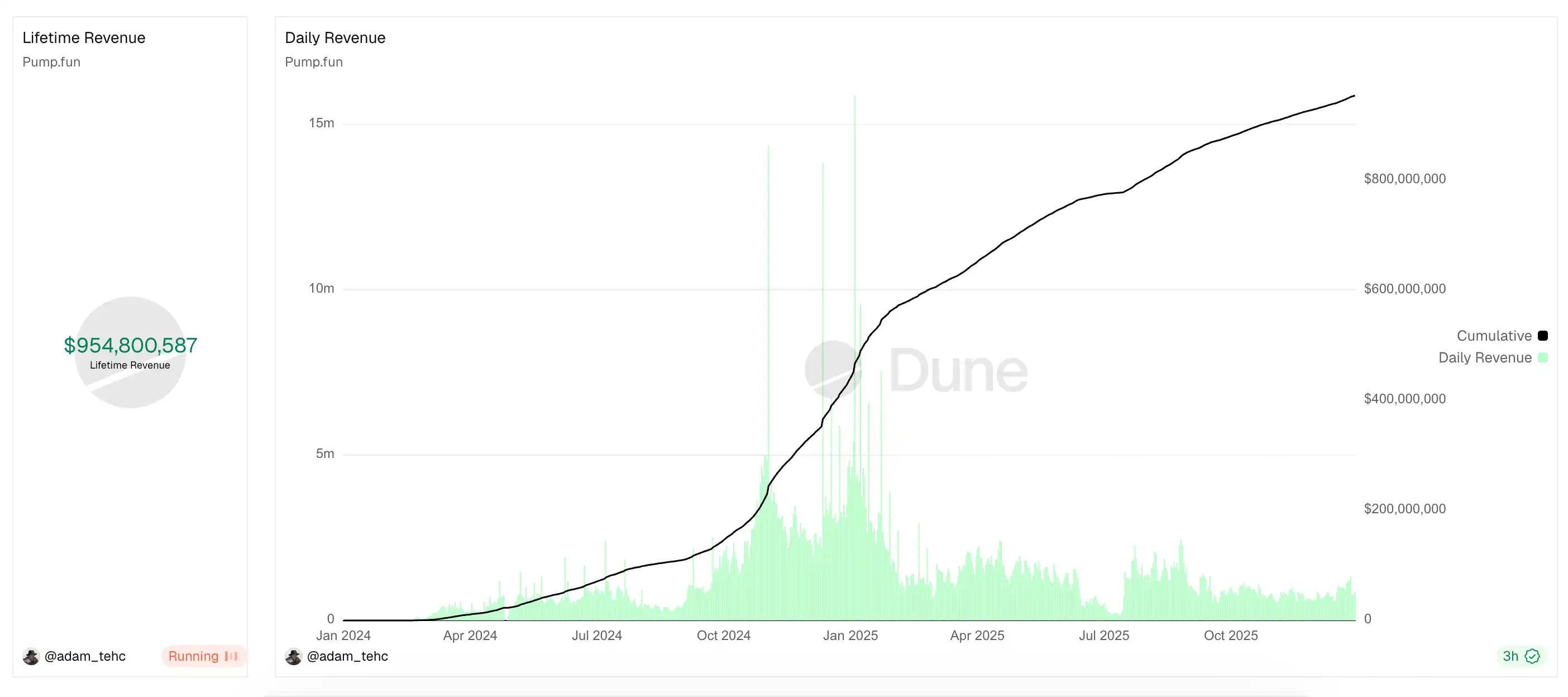
Holding massive real funds, Pump.fun is exploring other paths for ecosystem feedback beyond PUMP token buybacks. Pump Fund and its affiliated BiP hackathon are Pump.fun's latest attempts.

BiP Hackathon Details

According to the description on the BiP hackathon's dedicated page, the project aims to support founders who issue tokens on Pump.fun and publicly build products. Unlike traditional hackathons where participants rely on VCs or judges for evaluation to compete for prizes, the BiP hackathon intends to introduce token performance as a variable, allowing the market to determine whether a project is worth advancing and enabling users to become the earliest investors.

When discussing this key difference, Pump.fun founder Alon stated in an X post: "Before Pump.fun, my co-founder and I tried many different ideas. Consumer finance, DeFi, SocialFi, NFTs—but all failed. One of the biggest problems we encountered was that we found it extremely difficult to get our products in front of users. Trying to reach the right user base was an incredibly tedious task..."

Specifically, the BiP hackathon requires:

  • Participants must issue a token on Pump.fun and then publicly build a product;
  • Participants must also hold at least 10% of the token supply to align interests;
  • Finally, the event strongly encourages founders to speak publicly on social media like X or livestream on Pump.fun to maintain effective communication with the community.

As for the types of participating projects, Pump.fun imposes no restrictions; they are not even limited to cryptocurrency-related products. Projects from different market stages and various verticals can participate.

Regarding how the 12 winning projects will ultimately be selected, Pump.fun did not provide specific rules but pointed out two main principles: First, organic user growth and genuine appeal are preferred over connections and flashy promotions; second, in addition to the appeal of the product itself/social media, the long-term sustainability of the project will also be evaluated.

Key Timelines to Note

According to the BiP hackathon's schedule, applications opened on January 19. Participants are required to launch their tokens at the time of application and begin public building (including livestreaming development progress, regularly sharing updates, and maintaining community interaction). The application window will be open for 30 days. On February 18, Pump.fun will announce the first batch of winning projects and provide funding (at least one will be announced). Considering that some projects may need more time to gain market attention and demonstrate appeal, the program will continue to run long-term.

So the timeline is clear: if you want to spot potential opportunities among this batch of Meme tokens, you need to start paying attention to newly issued tokens on Pump.fun from now on, especially those with the Pump Fund or BiP labels. Although the first batch of winning tokens won't be announced until 30 days later, tokens likely to be selected by Pump.fun will inevitably show competitiveness before then.

Overall, while Pump.fun's event may not drive a collective sentiment recovery in the Meme market, it can at least contribute some new tokens with clearer evaluation dimensions.


Domande pertinenti

QWhat is the purpose of Pump Fund's first project, the Build in Public (BiP) hackathon?

AThe BiP hackathon aims to support founders who launch tokens on Pump.fun and publicly build products. It will invest $3 million in 12 new tokens, with $250,000 per token at a $10 million valuation, and provide professional guidance and resources.

QHow much total revenue has Pump.fun generated historically according to data analyst Adam?

APump.fun's historical total revenue has reached $954.8 million.

QWhat are the key requirements for participants in the BiP hackathon?

AParticipants must issue a token on Pump.fun, publicly build a product, hold at least 10% of the token supply to align interests, and are strongly encouraged to communicate publicly on social media like X or via live streams on Pump.fun.

QWhen will Pump.fun announce the first batch of winning projects for the BiP hackathon?

APump.fun will announce the first batch of winning projects on February 18, after the 30-day application window that started on January 19.

QWhat principles will Pump.fun use to select the 12 winning projects in the BiP hackathon?

ASelection will prioritize organic growth and genuine user attraction over relationships and flashy marketing, and will evaluate projects based on long-term sustainability alongside product and social media appeal.

Letture associate

What Happens to Ethereum Developer Tools After the Grants Run Out?

On February 27th, the Ethereum Foundation (EF) announced Project Odin, a structured sustainability support program designed for a select group of strategic, previously grant-funded teams. Unlike a standard grant, Odin offers a long-term advisory mechanism focused on helping these teams establish credible, sustainable paths within a two-year framework, thereby reducing long-term dependence on single funding sources. The program addresses a critical post-grant challenge: how essential public goods, especially major developer tools, can achieve financial sustainability beyond initial funding. While grants from EF and programs like Gitcoin or RetroPGF remain vital for startups and research, they often fall short for mature, widely-used infrastructure. Tools like compilers, languages, and network stacks are deeply embedded but struggle with monetization, trapped between being too foundational to lose and too public to generate natural revenue. Project Odin provides teams with a dedicated Strategic Advisor to guide them through a three-phase process: 1) analyzing current funding and realistic options, 2) validating potential paths with stakeholders, and 3) executing plans, which may include crafting support contracts, service agreements, or other recurring revenue models. The first pilot participant is Vyper, a critical smart contract language for the EVM, highlighting the need for sustainable models for core infrastructure. The initiative reframes the public goods conversation from "who should be funded" to "how do already-proven teams avoid perpetual funding crises?" It encourages ecosystem participants—protocols and projects that depend on these tools—to view sustainable support not just as charity, but as essential risk management for their own operational supply chains.

marsbit15 min fa

What Happens to Ethereum Developer Tools After the Grants Run Out?

marsbit15 min fa

MARA Reports Q1 Revenue Below Expectations, Net Loss of $1.3 Billion, Stock Plunges After Hours

Bitcoin mining firm MARA Holdings reported disappointing Q1 2024 results, causing its stock to erase all daily gains and fall 3.44% in after-hours trading. Revenue dropped 18% year-over-year to $174.6 million, missing Wall Street estimates of $192.7 million. The company posted a net loss of $1.3 billion, a significant increase from a $533.4 million loss a year ago, primarily driven by unrealized losses on its holdings of 38,689 Bitcoin, which depreciated in value during the quarter. MARA also sold over 15,100 BTC in late March to repurchase debt at a discount. The broader mining environment remains challenging due to a 35% decline in Bitcoin's price from its all-time high and a nearly 30% increase in mining difficulty over the past year. MARA's market cap ranking among U.S. miners has slipped to seventh. Critically, the company announced a strategic pivot away from Bitcoin mining expansion. It stated it has no plans to purchase new mining equipment and is fully transitioning toward AI data centers. Its strategy involves retrofitting existing mining sites for AI and high-performance computing (HPC) and leveraging its recent $1.5 billion acquisition of Long Ridge Energy & Power, a gas-fired power plant and data center. This infrastructure could eventually support 600 MW of AI compute capacity, allowing MARA to redeploy up to 90% of its non-custodial mining power for AI and IT workloads.

marsbit15 min fa

MARA Reports Q1 Revenue Below Expectations, Net Loss of $1.3 Billion, Stock Plunges After Hours

marsbit15 min fa

The AI Investment Landscape Is Being Reshaped: Beyond the 'Magnificent Seven', What Opportunities Lie in the Semiconductor Supply Chain?

AI Investment Map is Reshaping: Opportunities Beyond the 'Magnificent Seven' Since ChatGPT ignited the AI wave, investment initially focused on the "Magnificent Seven" tech giants dominating cloud infrastructure. However, the rise of DeepSeek and debates on AI capital expenditure effectiveness are shifting this dynamic. Investors now recognize opportunities deeper in the supply chain—the companies providing the essential "picks and shovels." Early concerns about an AI investment "arms race" and potential low returns were partly alleviated by strong Q1 earnings from cloud providers, validating robust compute demand. This has highlighted a more certain investment thesis: regardless of which AI applications ultimately win, massive capital expenditure will first fuel demand for semiconductors and related components. This "pick-and-shovel" logic has driven semiconductor ETFs to record highs. Key beneficiaries include: * **Memory Chipmakers (e.g., SK Hynix, Samsung, Micron)**: High Bandwidth Memory (HBM) is a critical bottleneck for AI training. * **Photonics Companies**: Crucial for high-speed data transfer within AI data centers. * **The Broader "AI-11" Semiconductor Ecosystem**: This encompasses foundries & lithography (TSMC, ASML), logic & custom chips (AMD, Broadcom, Intel, Marvell), and enterprise storage (SanDisk, Western Digital). Every dollar of AI infrastructure spending flows through this chain. While the "Magnificent Seven" remain dominant in market size, their earnings growth premium over the rest of the S&P 500 ("S&P 493") is narrowing. Market attention and marginal investment are shifting towards the expanding semiconductor supply chain. The investment narrative is evolving from "betting on the ultimate AI winner" to "investing in the certainty of the infrastructure build-out." Understanding this shift from the demand side to the supply side is key to identifying future AI investment opportunities.

marsbit44 min fa

The AI Investment Landscape Is Being Reshaped: Beyond the 'Magnificent Seven', What Opportunities Lie in the Semiconductor Supply Chain?

marsbit44 min fa

Trading

Spot
Futures
活动图片